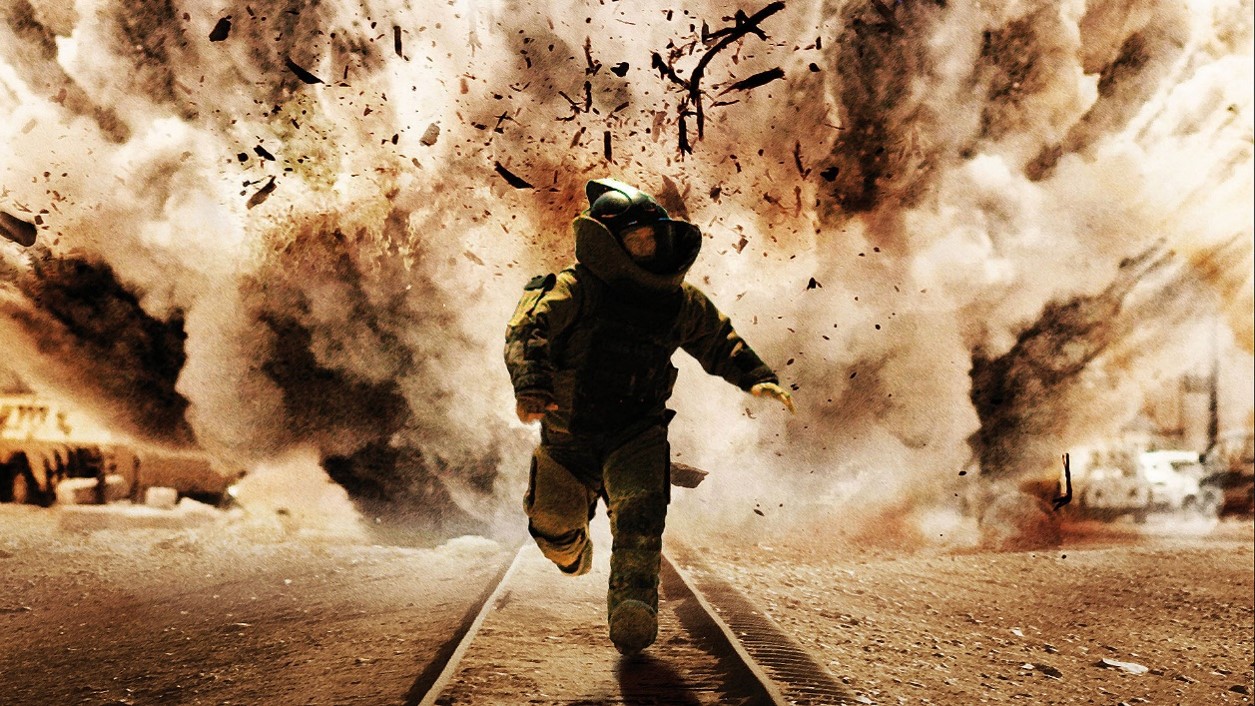
This is going to hurt.
This week I want to kick off a new series of posts focusing on movie and TV depictions of explosive ordnance disposal (EOD), otherwise known as bomb disposal. That’s right: for once, I’m going to talk about things I’m actually qualified to speak on, rather than the semi-lucid ramblings you usually get.
We’ll start, predictably enough, with The Hurt Locker. Winner of six Oscars, and with a 96% rating from critics and 84% from audiences on Rotten Tomatoes, the 2008 Kathryn Bigelow film has been described as:
- “The most literally exciting film you will see this year.” Ian Nathan in Empire.
- “Without a doubt one of the best war pictures I have ever seen, and I have seen most of them.” Ed Koch in The Atlantic.
- And this one, which we’ll definitely circle back to: “An unflinching look at the personal cost of being really good at a really tough job,” (emphasis mine), by Wendy Ide in the Times UK.
Against this tide of adulation, there is a small but vocal backlash against the film for its inaccuracies, such as James Clark’s “Here’s Why ‘The Hurt Locker’ Is The Worst War Movie Of All Time” and Kate Hoit’s “The Hurt Locker Doesn’t Get This Vet’s Vote”.
As you might have guessed from some of my previous comments, I’m going to come down more on the latter end of the spectrum. However, for all its faults, the film has many good points too.
To give the bottom line up-front, the film fails in its attempt (as I see it) to portray a flawed hero. In fact, Jeremy Renner’s character is not a maverick, lovable rogue who breaks the rules in order to get results. He’s an incompetent psychopath who breaks the rules and endangers himself and his team while failing badly at his job.
But let’s dive in and do this character assassination, and please let me know if you think I’m being fair or not. As always, thanks for reading, and please subscribe if you haven’t already. I’m always open to new topic requests, just let me know in the comments or by email.
If you enjoy this blog and want to support it, please consider a donation. Keeping this blog going doesn’t cost much, but it isn’t free either, so any help would be very much appreciated👍
As I re-watched this film recently as research for this post (honestly, the lengths I go to for you, dear reader), I was live-drafting a “what’s good” and “what’s crap” list. Because I want to focus today’s article on the film’s failed portrayal of explosive ordnance disposal (EOD), I ended up not using most of that list. However, I think it will serve as a nice little follow-on story next week, so watch this space.
The main character is an utterly awful person…
Jeremy Renner plays Staff Sergeant William James, who arrives in theatre to replace the previous team leader who died during an EOD operation (more on that below). James is a maverick. We instantly know he’s a maverick because he listens to heavy metal music while setting up his billet and, what’s more, he moves the barriers away from the windows to let more light in. Here’s a guy, the film is trying to tell us, who cares not a whit for the stultifying conventions of barracks life.
In fact, he’s an asshole. He’s offhand to the point of rude to his right-hand man Sgt Sandborn (Anthony Mackie), and he barely acknowledges the very recent tragic loss of Sandborn’s colleague, his predecessor. He’s a newbie in this theatre and already acts like he knows everything.

The only person James shows any humanity to is the locally-employed shopkeeper’s assistant “Beckham.” This is probably done to show his “human” side, in contrast to his normal behaviour:

Not content with being an asshole to his team, James also acts like a tool toward the locals. Winning “hearts and minds”, he is not. Why, for example, does he feel the need to press a gun to some poor taxi driver’s head and shoot out the guy’s window? It can’t be because he’s breaking the cordon, since James clearly doesn’t care in the slightest about the cordon, judging by his behaviour on other operations.

More damningly, he subjects his team and other friendly troops to unnecessary danger by taking ridiculous risks himself. The film does acknowledge this, but I think it’s shown in a more benign way than it really is. If you’ll allow me to put my head where the director’s is, and simultaneously bring in an old analogy from Team America: the film tries to portray Staff Sgt James as a dick, but he’s really an asshole:
Some of this terrible behaviour could be forgiven if he was a good operator who got things done and generally made life safer for the rest of the troops. Staff Sgt James is none of these things. I used to train troops going overseas in counter-IED tactics and principles. One of the most important lessons (and I even had a slide with this heading) was “Don’t be a dickhead.” Being a dickhead is a sure-fire way to annoy the local population and have them target you or your buddies. Staff Sgt James is terrible at counter-IED, but he’s also very bad at IED disposal (IEDD), i.e. targeting the device itself, as we’ll discuss next.
…and he’s also a terrible EOD operator…
This is the film’s biggest failing in my opinion. Although it’s never made quite explicit, the subtext from The Hurt Locker is that James is a good EOD operator. Sure, he might be a bit of a maverick, but he gets the job done, dammit! We see this in his interaction with the idiot Colonel Reed at the UN building:

Even if the film doesn’t explicitly say it, some of the fawning commentary (see above) shows that this is what people take from the film.
As usual, I’m going to be the bad guy who bursts your bubble. Staff Sgt William James is quite bad at doing EOD/IEDD. Let me explain.
He exposes himself and his team to danger unnecessarily
As we discussed already, James doesn’t care about his own or his team’s safety. The most important part of the EOD philosophy is the protection of life. This includes the operator’s life. In any military context, and EOD is no different, soldiers are not supposed to take unnecessary risks. After all, it takes months to train an EOD operator, which represents a significant investment. It’s not in Uncle Sam’s interest that one of his highly-trained EOD specialists dies for the sake of one operation, let alone his teammates too.

How should he do it differently? Here’s a list for him to get started:
- Use the robot. It’s more effective than you are in most situations (spoiler alert: most situations involve shooting the IED with a special anti-IED weapon). It’s also more replaceable, and less likely to be targeted by the enemy. Finally, it means you don’t get tired and end up making terrible decisions (more on this below).
- Don’t “finger-fuck” the IED. Forgive my language, but sometimes the military vernacular cuts right to the point. When you mess about with an IED, pulling and dragging on it, you make yourself very vulnerable. Remember our targetable actions from last week? Well, these especially apply to EOD operators. Every time that you prodded, kicked, pulled, moved, or licked a device, you gave the bomber a great idea for how to target you the next time. The entire scene with the multiple devices is a case study in how not to EOD:
We know well that the enemy were watching, both in that scene and in the one with the car bomb (which also included some horrendous manual actions, including kicking the car boot open). They even took videos of his actions:

- Wait for security (and use them). James, we know you don’t like waiting. But you can’t go ahead with your task until the area around you is secure and cordoned off. It’s the infantry’s job to have your back, so use them. And it should go without saying, but please don’t go haring off into the pitch black night of Baghdad’s back alleys with no security, then split up your team, then act surprised when one of them gets shot.
If James took the advice above, he and his teams would be much safer and Uncle Sam’s investment would be more secure. He would also have more time to plan, but that’s something else he can’t really get his head around.
He doesn’t plan anything
EOD sounds like a cool job and, to be perfectly honest, it’s pretty cool at times. But, like all cool jobs, it’s got its fair share of boring bits. Here are some of the sexy and unsexy aspects of EOD:

Planning your approaches on a whiteboard is definitely unsexy, but it’s crucial. As with all military operations, nothing happens without a plan. Now, planning doesn’t always happen behind a desk. It can happen in the turret of a tank, or a muddy ditch while taking fire. But we don’t generally make plans while wearing a bomb suit. It weighs about 35 kg1, with another 10 kg2 for the helmet, not to mention the equipment you’re carrying. Your physical and mental faculties quickly degrade in a bomb suit, no matter how fit you are. Especially in forty-degree3 heat. Instead, we make our plans at the truck (or Humvee, in their case).
Every time we go “downrange” in an EOD suit, we have a simple, step-by-step plan of what we’re going to do. We might even write out the steps on a waterproof notebook and tape it to our suit. Seriously: your mental faculties degrade rapidly in that thing. The mortal sin of EOD is so-called “hot planning”, i.e. changing your plan while downrange in the EOD suit. This is robustly drilled out of us in training, for the sad but important fact that hot planning got many EOD operators killed in the past. If we ever see something unexpected, we go back to the truck and make a new plan, with our team. We don’t drag on wires4 to find out where they lead:

The other advantage of planning is that is gives us a comprehensive view of the threat facing us. An amateur might go straight for the device which has been called in, but a professional EOD operator knows that their first priority is to ensure that they and their team are operating from a safe and secure location. That means relying on the aforementioned infantry for security (James doesn’t like waiting), but it also means having an awareness of the people and the items around you which could be hiding another IED. In the scene with the bomb factory in the school, James (as usual) rushes in before the security get there, and doesn’t even do a basic search of the immediate surroundings for IEDs. More importantly, he doesn’t stop to think about the situation: who are the enemy, and how might they target James and his team? The first step of any EOD response is the threat assessment, and doing this would have highlighted the obvious risk of staying where they were. Staff Sgt William James is directly responsible for the death of the medical office Lt Col Cambridge, but this is yet another failing he doesn’t have to answer for in the film.

He doesn’t have any forensic awareness
James has a box of mementoes in his room, bits of IEDs that “nearly killed” him. This includes the switch from the car bomb at the UN building and the battery from the multi-shell mega-IED. Recall from our EOD hierarchy above that preserving forensic evidence is a key part of the philosophy. Gathering evidence (bits of IEDs) allows Weapons Intelligence Teams (WIT) to build up a profile of bombers and help identify who they are and apprehend them. Gathering, photographing, and cataloguing forensic evidence is definitely one of the unsexy aspects of EOD, but, like most of the unsexy parts, it’s quite important.
The bomb factory in the school is a smorgasbord of forensic evidence, but he just leaves it after finding the dead child with the IED inside them. He tears the car apart to find a switch (before even removing the detonators from the shells in the trunk, which is quite frankly insane), but only so that he can admire it while enjoying his post-approach cigarette. I’m going to show the gif of him getting punched again, because it makes me happy:

…although the bar isn’t set very high
While the bulk of my ire is directed at the character of William James, we can’t wrap up without mentioning Staff Sgt Thompson, the operator who gets killed in the opening scene. He’s clearly a much better person than James, as he doesn’t go out of his way to get his team killed. And we do see a little bit of planning before he goes downrange (not as much as you would do in real life, but let’s leave some room for artistic licence here).
He still makes a few big mistakes, though, and these are what get him killed. Firstly, the wheel falling off the counter-charge wagon is a setback, but it’s definitely not a reason to abandon the robot approach and go forward in the suit.

Secondly, and without going down too much of a rabbit hole of EOD techniques, there are much more effective ways that he could have dealt with that IED, with the robot, and without the need for the little wagon. Thirdly, there was no consideration given to the threat to him from a nearby triggerman, despite the enemy having ample means, motive, and opportunity to kill him that way. It comes back (as always) to planning: a simple set of “actions on” for his team, along the lines of: “If you see someone take out a phone, shoot them,” would potentially have saved his life. Thompson is no William James, but it would be wrong to think he represents what “good” looks like either.
Conclusion: What’s the point of The Hurt Locker?
Who am I to say this is a terrible film, with all the accolades it’s received? The Hurt Locker not irredeemable: in fact, it’s got many good points, and gets a lot of things right, EOD aside. The film’s aim is to show how some people respond to dangerous situations by wanting more and more. In this, it succeeds, but it lacks a message or, I guess, a coherent moral. Sgt James is so clearly a terrible person and a bad soldier and leader, but suffers no punishment for his actions. In fact, he gets to carry on doing the same job again for another year, with seemingly no questions asked about the trail of friendly dead and injured he left in his wake.
“War is a drug”. The spoiler is in this quote from the opening scene. The Hurt Locker tells a story of a deeply damaged and antisocial individual who is a liability to himself and others, while doing an important job very badly. As a depiction of war it’s not bad, with many realistic elements (along with many unrealistic ones: I’ll do a full teardown next week). As a depiction of what “good” EOD looks like, it’s about as effective as this:

But the depiction of Staff Sgt James as an adrenaline junkie, while entertaining, is a little bit hollow. The implied message seems to be (at least in my reading, please feel free to disagree): “You need to be a bit of a twisted individual to do this job properly.” In fact, the opposite is true. Armies don’t want their men and women to be antisocial psychopaths. An army is a very social organisation, and relies on social bonds to operate effectively. A soldier who has normal fears for their own life, and cares about their comrades’ lives, but can subordinate those fears to the drills and procedures of training: that’s who you want doing the job of fighting. And in this important respect, The Hurt Locker falls short. As an atmospheric immersion into a warzone, it’s pretty good. As a study of the men who prosecute that war, it’s pretty bad.
I hope you enjoyed my hatchet-job balanced review of The Hurt Locker. Please let me know what you think in the comments—especially if you disagree with anything I’ve said above! Next week I’m going to do a less structured but more comprehensive dump of everything that the movie gets right and what it gets wrong (and which wasn’t covered here). If you want to make sure you never miss a post, please subscribe in the box below. And if you want to share this with someone who might be interested, you can use the buttons below. Until next week!
Featured Image: The Hurt Locker, Summit Entertainment (2009)
- About 75 lbs in freedom units. ↩︎
- 22 lbs. ↩︎
- A hundred degrees in old money. ↩︎
- I’m pretty sure the red cable is supposed to be electrical wire, but it sure as hell looks like detonating (det) cord. Det cord would make a lot more sense in building an IED like that. However, we see James take a detonator out of each shell, and the thick red cable runs to the firing point on the wall where we see the exposed wires, so I’m pretty sure it’s wire. ↩︎


Leave a Reply