The limitations of biology and physics.
| << Firearm fails: Pushing the envelope of pistol performance (Part 1: Historical and tactical confusion.) | Will the real Jack Reacher please stand up? >> |
As promised, this week is a follow-up to last week’s post on how Hollywood gets pistols wrong. They’re treated like mini-rifles, with similar target effects, and used in the same scenarios. Whereas I focused on tactical employment last week, this week I want to go down the rabbit hole of precision and accuracy in pistols.
I briefly touched on this before with my Expendables post, but I want to go into more detail here (and there was far more wrong with that scene than the pistol shooting).
Thanks, as always, for reading! If you like what you see, please subscribe. Comments below are always appreciated, and you can email me or comment for any topic requests.
If you enjoy this blog and want to support it, please consider a donation. Keeping this blog going doesn’t cost much, but it isn’t free either, so any help would be very much appreciated👍
Pistols have always been a close-range weapon
Last week we briefly looked at the evolution of pistols from the flintlock era as a close- or zero-range weapon, roughly on par with a sword in terms of effectiveness. In some contexts, pistols even had lower lethality. When Irish gentlemen of the late 18th century felt compelled to defend their honour with a duel of pistols, they were partaking in a safer activity than their forebears who relied on swords. Sharpe’s Revenge almost gets this right:

Unfortunately, they can’t resist giving the hero the trick shot where he deliberately wings his opponent. This wouldn’t really happen1, because a pistol gives nowhere near enough precision. Sharpe isn’t alone; here are more improbable flintlock pistol shots from film:

Improvements in pistol technology led to only incremental improvements in precision. The most notorious real-life example of this is the gunfight at the O.K. Corral in Tombstone, Arizona, in 1881. Four lawmen faced four outlaws from a distance of six feet (2 m). The eight men fired about thirty shots in thirty seconds, mostly from revolvers. There were nine hits, including one from a shotgun. This gives the pistols an accuracy of just over 25% from 2 metres:

Still, this doesn’t stop Hollywood from giving Western revolvers some sniper levels of accuracy:

The Magnificent Seven has more than enough examples by itself (and a dodgy dynamite Deus Ex Machina which I’ll come back to another day):

The Gunslinger’s shoot-out in The Dark Tower is another example chock-full of sniper shots. He even out-snipes a sniper through the sniper scope. Sigh. My first assumption was that Idris Elba’s character has some sort of magic, this being a Stephen King story. But I looked it up and, apparently, while he is supposed to be highly trained, there’s no mention of magical abilities. Moreover, the guns and bullets would need to also be magic to achieve the feats shown here:

For one more contemporary example of the inaccuracy of pistols, let’s look at a gun battle between eight FBI agents and two criminals in a Miami suburb in 1986. The shootout ended with both suspects dead, along with two agents. Five more agents were wounded. The perpetrators were armed with a rifle and a shotgun, whereas all bar one of the agents were using pistols. The battle happened at close range, between 5 and 20 metres:

Still in denial, Hollywood screenwriters continue to show improbable trick shots, usually by the heroes:

And, finally, there’s this absolutely spectacular contribution from Steven Seagal:

Yes, you saw that correctly. He shot the flare out of the dude’s hand, then shot the shot-off segment of flare in mid-air before it hit the gasoline puddle. Why? Presumably to show off his magic pistol, because I can see no other logical reason.
Last week we mentioned two levels of unrealism at play with these film and TV depictions. The first is the improbability of our anyone (even our beloved heroes) being such consistently top-tier shots. The second is when they pull off shots that not even a perfect shooter could do. In other words, they break the limitations imposed by physics. Let’s look at each of these in turn.
Hollywood heroes pull off some unrealistic shots…
It’s hard to hit a target with a handgun. If you’ve never tried it before, take my word for it. All else being equal (and it’s not, see next section), a pistol is harder to aim than a rifle:

The first two factors—more points of contact and a longer sight picture—make the shooter more precise and more accurate2. The third factor, the barrel length, makes the weapon more precise.
The best pistol shooters in the world (or, at least, the best Olympic shooters, as per the International Sport Shooting Federation) compete to hit five 13 cm (~5″) targets from 25 m distance in four seconds, with a score of four hits considered good, and two or three hits middling (here’s an example from the 2023 ISSF World Championships in Baku). Olympic sport shooting is not the only shooting discipline out there, but it is easily measured and so we can compare the feats of our Hollywood heroes to the best shooters in the real world:


I must confess (and it’s becoming something of a trend whenever I analyse movie pistol shots) to being a bit disappointed at some of the results above. I expected all of the shots, and the Magnificent Seven ones in particular, to be way outside the bounds of possibility. That’s the scientific method, however: negative results must still be published!
However, I didn’t account for movement of either the target or the shooter, and this is important: we’ll come back to this.
In any case, while we might argue that individual shots or groups of shots are on par with ISSF Olympic champion levels, we stretch disbelief too much when all of our heroes’ shots are this good. If they really were better than Olympic shooters, then one wonders why they didn’t become Olympic champion shooters instead of cowboys, secret agents or hitmen, all of which must be tougher jobs with pretty poor conditions and limited benefits (with the exception of secret agents, they probably have a decent public sector pension—but I digress).
With miraculous pistol accuracy ubiquitous in film and TV, it’s nice to see filmmakers actually pay heed to any degree of realism. One example I like is at the end of In Bruges:

It’s literally a long shot, and both characters think so. Okay, Colin Farrell is being a bit too blasé about it (maybe he could try jumping from side to side, or even lying down to present a smaller target), but he knows enough about pistols to know that he’s pretty safe. Ralph Fiennes takes his time, aims carefully (I estimate the distance is about 20 to 30 m), and gets lucky, which you can see from his expression post-shot. Lucky (or unlucky for Farrell) breaks do come, but you can’t show us a dozen “lucky” shots in quick succession and expect us not to throw things at the screen.
A bigger sin is where filmmakers show us shots that go beyond the extremes of human ability, and actually break the physics of ballistics: this is what we’ll discuss next.
…which sometimes verge on the impossible
Okay, so we have an idea of the upper limit of what a human being is capable of doing with a pistol. I want to emphasise that this is very much an upper limit. If you put me on a 25 m range, I’d be lucky to hit one or two man-sized targets in five. Admittedly, I’m not a pistol marksman, but nor did I ever fail the test.
Now, in the interests of balance, I need to concede that there are some out there who hold to higher standards. Prepared Gun Owners rubbishes the idea of an acceptable level of “combat accuracy” (i.e. a lower standard just to get the job done). They prescribe no more than a 4″ group3 at 25 yards. If that’s the bar, well, fair play to you. All I can say is I’m delighted those guys didn’t set the test for my pistol qualification.
To put it another way, four inches at 25 yards is an angular width of 16 minutes (a minute is 1/60 of a degree. In marksmanship, this is referred to simply as 16 MOA (“minutes of angle” or “minutes of arc”). See diagram below4:

By the same logic, the top Olympic ISSF shooters hit a 5″ target consistently at 25 m in rapid fire, which is equivalent to 20 MOA.
What if our shooters were perfect? If we removed all human error and unsteadiness in holding a pistol, then what kind of precision could we get from a pistol?
Well, another source (The Hunting Gear Guy) has done the analysis and reckons that 4 MOA (1″ at 25 yards) is the “mechanical accuracy” for a custom bullseye pistol, with most consumer pistols being 6 to 15 MOA.
My own back-of-the-envelope method involves comparing barrel lengths, since this determines bullet precision (albeit not necessarily in a linear way, but that’s the assumption I’m making here). A rifle barrel is about 4-5 times longer than a pistol barrel, and rifle precision can reach 1 MOA, according to Gun Digest: “If a rifle could produce a 1-inch group of shots at [100 yards], aka a 1-MOA group, it was considered an accurate gun.” This means that 4-5 MOA would be an accurate pistol, which ties in with the higher end of the Hunting Gear Guy’s estimate.
Let’s say a pistol’s mechanical precision is 6 MOA. In other words, if you placed it in a vice, this is the spread you’d get on your rounds. With that in mind, let’s examine how some of the scenes above compare with this idealised, best-case situation:


Movement affects precision too, although this is rarely acknowledged
When I looked at some of the pistol feats above, I was a bit taken aback by how plausible they were. But, as I mentioned there, I hadn’t accounted for movement. And this makes a huge difference. There are two types to consider: the movement of the shooter and movement of the target.
The latter is unavoidable (you can’t politely ask the enemy to stand still while you take aim), so we train for this (although it’s not tested for the standard pistol practice). There are two ways to hit a moving target, and the direction of movement is crucial:

For the other type, the movement of the shooter, this is generally avoided: you exclusively practice firing while in a stationary position, which lets you support your weapon and aim down the sights. When you move, you move quickly, and you keep your finger off the trigger. Your buddies are firing while you’re moving.
Okay, but let’s say you have to shoot on the move, as many Hollywood heroes feel the need to do. What effect does movement have on your precision?
I lack firm data to back this up: the following is based on my own experience and intuition. So please take it with a grain of salt, and feel free to add your own two cents in the comments. Having said that, here’s how I would quantify the added difficulty of movement:
- Target is moving: 2 to 3 times more difficult to hit
- Shooter is moving: 10 times (yes, really) more difficult to hit
- Shooter is on a moving platform but is stationary themselves: 3-5 times more difficult to hit
These multipliers are, well, multiplicative, so if you’re moving yourself and firing at a moving target, I would say it’s 20 to 30 times more difficult to make the equivalent shot. And, for the sake of absurdity, if you’re moving while on a moving platform5, shooting at a moving target, you’re going to be 60 to 150 times less precise. Or accurate. At that stage, the difference doesn’t really matter!
In conclusion: report cards and realistic levels of precision
Putting all of the above together, we can come up with a “report card” for the various scenes depicted here. These are only a few snippets, of course, and fairly random ones at that. I can always revisit this for more scenes/movies in the future, if you think it worthwhile (let me know below!). Remember, a smaller MOA means a less believable shot:
| Movie (scene) | Description | Shot details and estimated MOA | Realism grading |
|---|---|---|---|
| Sharpe’s Revenge | Flintlock pistol duel with Wigram. Sharpe deliberately misses, hitting Wigram in the arse | 10 metres, 0.5” target therefore 5” at 100 m therefore 5 MOA | Completely unbelievable. This would be almost physically impossible with a modern pistol |
| The Patriot | Long-range sniper pistol shot by British Cavalry officer from horseback at the retreating Yankee forces | 100 m, 10” target therefore 10 MOA, with moving platform and moving target | Completely unbelievable. This would be nearly impossible with a modern pistol, and both target and shooter are moving |
| Les Miserables | Pistol shot at charging cavalry. Arm used to steady to weapon | 10 m, 5” target therefore 50” at 100 m therefore 50 MOA, moving target | A bit of a stretch, but I’ll allow it |
| A Fistful of Dollars | Clint Eastwood quickdraw to shoot weapon out of main baddie’s hands and kill four other baddies, then shoots rope holding up prisoner | Quickdraw: 10 m, 1” target (rifle in hands) therefore 10” at 100 m therefore 10 MOA. Very rapid fire. Rope break: 5 m, 0.25” target therefore 5” at 100 m therefore 5 MOA | Combination of pro shooter precision and rapid fire makes this unbelievable. Rope break shot stretches the limits of pistol physics, and is unaimed |
| The Magnificent Seven | Several scenes, including shooting a baddie holding a girl hostage, hero shooting at baddies from horseback | Hostage: 15 m, 3” target therefore 20” at 100 m therefore 20 MOA Horseback: 100 m, 10” target therefore 10 MOA with moving platform | Hostage shot is a slight stretch. Horseback shot would be pretty hard to believe even if stationary |
| Hostiles | Shooting at a retreating baddie after firefight | 50 m, 10” target therefore 20” at 100 m therefore 20 MOA with movement, but it mostly away from shooter (small horizontal component) | Believable for skilled shooter |
| The Dark Tower | Shooting at two baddies with two different pistols, baddies are in two different directions, while shooter is jumping through the air. Subsequently hits a sniper through the rifle scope | Air shot: 30 m, 10” target therefore 33” at 100 m therefore 33 MOA, while shooter moving Sniper kill: 50 m, 1” target therefore 2” at 100 m therefore 2 MOA | Magic is the only explanation |
| John Wick Chapter 2 | Shooting two approaching baddies while wrestling a third | 10 m, 5” target (head shots) therefore 50” at 100 m therefore 50 MOA at moving targets, but movement is mostly head-on | Believable for skilled shooter |
| Mission: Impossible—Fallout | Quickdraw on four baddies before they kill a cop | 5 m, 10” targets therefore 200” at 100 m therefore 200 MOA with rapid fire and quickdraw | Believable |
| Hitman | Killing two armoured agents in hotel corridor | 10 m, 10” targets therefore 100” at 100 m therefore 100 MOA with rapid fire | Believable |
| Spectre | Bond shoots down a helicopter with a pistol, from a boat | ~300 m, 20” target therefore 6.7” at 100 m therefore ~7 MOA with moving target and platform | Unbelievable. At the limits of pistol physics, and movement makes this shot impossible |
| Die Another Day | Bond shoots down a chandelier with a pistol from a car, so that it falls on the baddie and kills him | 80 m, 0.5” target therefore 0.6” at 100 m therefore 0.6 MOA from a moving platform | Magic is the only explanation |
| Fire Down Below | Seagal shoots a flare out of a baddie’s hand, then shoots it again in mid-air | 35 m, 1” target therefore 3” at 100 m therefore 3 MOA. For shot 1 the target is stationary, for shot 2 it is moving unpredictably | Magic is the only explanation |
We can also take away a more realistic table of what an average and pro shooter might achieve at various ranges with a pistol (this is very speculative, to take it with a mountain of salt):

The probability estimates are based on compounding, e.g. the probability of a hit with one shot at ten metres is the same as the probability of a hit with two shots at five metres, and so on. Remember that 10 MOA (the column in the right) is about the physical limit of pistol precision.
To wrap this up, and tie it in with last week’s post, here’s a summary of what we learned:
- Pistols are not just miniature rifles. They are very different weapons with very different characteristics (notably with much lower accuracy) and occupy their own niches in the military “toolkit”.
- Despite this difference, screenwriters like to treat pistols like mini-rifles, giving their heroes battlefield levels of “bang” in a small package which they can hide away for plot or looking cool purposes.
- Because of this, they show characters (especially police) on screen brandishing pistols in all sorts of unrealistic and dangerous ways.
- Pistols are effective at close ranges, but their accuracy drops off very quickly with distance. This was ever the case, as we can see from historical examples.
- Still, Hollywood chooses to focus on highly unlikely shots in their action sequences. Sometimes these shots exceed the levels of Olympic shooters, and sometimes they even exceed the physical capabilities of a pistol.
- Lots of shots happen on the move, and this is another level of (dramatically) increased difficulty which screenwriters don’t account for.
Thanks for reading! If you like what you see, please share and subscribe, and let me know what you’d like to see more of.
- And didn’t, in the original novel: Sharpe’s poor aim causes the arse-hit. Much more plausible. ↩︎
- Yes, there’s a difference. Accuracy is about getting close to the intended target, precision is about getting multiple rounds to land consistently close to one another. There’s a good explainer here. You can be precise without being accurate, and vice versa. The very same principle applies to numbers: if I estimate my holiday spend to be €578.98, and the final figure is €810.40, then I’ve made a precise but not at all accurate estimate. If, on the other hand, I say it’s “about €800”, then I’ve made an accurate but not precise estimate. In this context (and in many), accuracy is more important than precision. In shooting, both are important, but bad accuracy can be more easily addressed by zeroing the weapon or changing the point of aim. ↩︎
- A “group” or “grouping” is a marksmanship term meaning the size of the notional circle into which the bullet holes on your target will fit. ↩︎
- If my mixing of metric and imperial like this bothers you, then I’m sorry: I empathise, but let this be your harsh welcome into the world of firearm discourse. Besides, for our rough purposes, a yard is the same as a metre. We’re estimating distances from single frames, for heaven’s sake. ↩︎
- Let’s say you’re running along the top of a train, shooting at someone speeding in a car next to the train. Don’t tell me this has never been attempted in movies. ↩︎
Featured image: Film poster for Hangman
The Internet Movie Firearms Database was an invaluable resource in putting this post together, I highly recommend it.

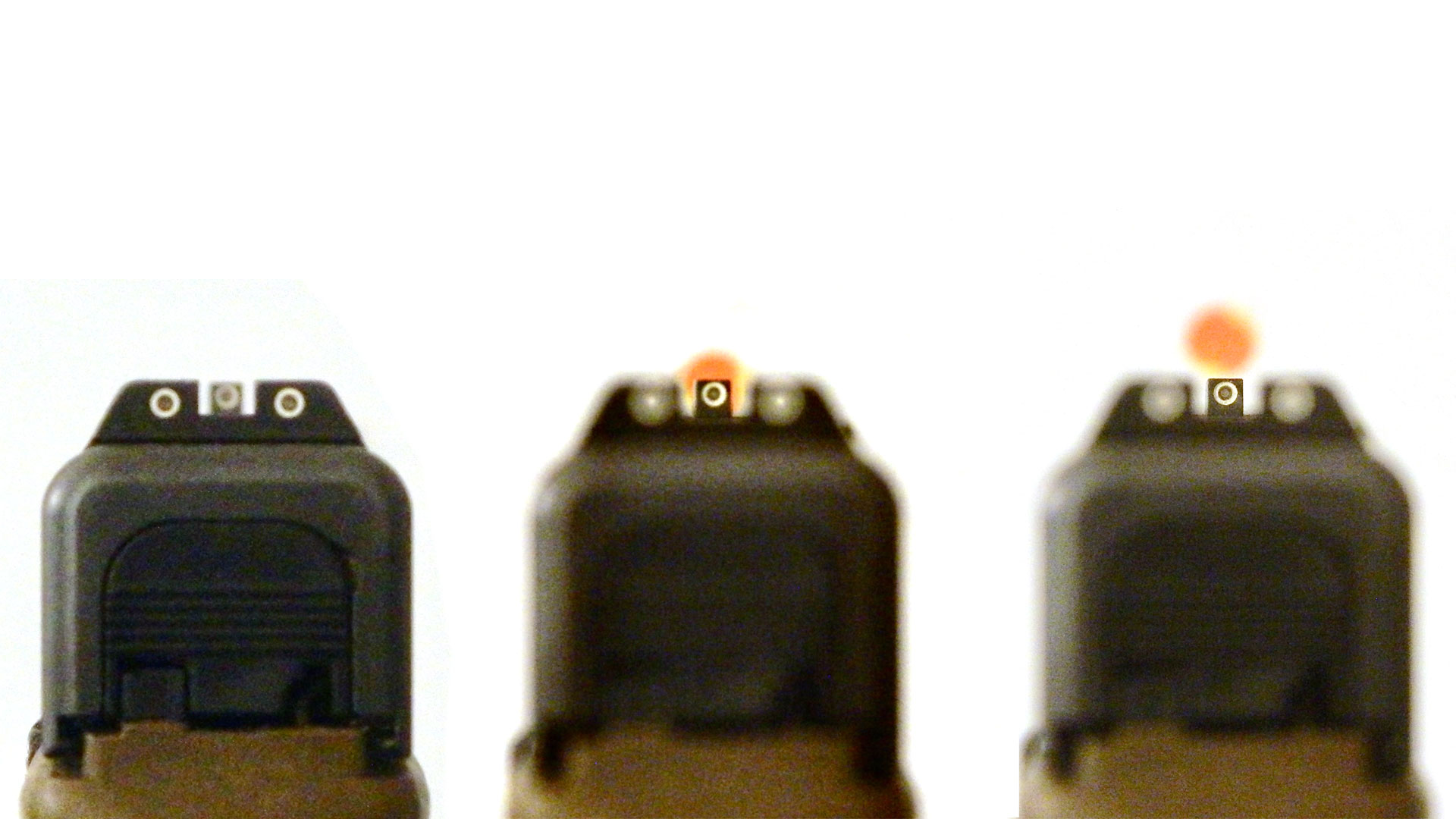
_Fig_4-17.png)
Leave a Reply to The military lone wolf in Hollywood storytelling – Military Realism ReportCancel reply