The good, the bad, and the pedantic
Hello again to all my loyal subscribers and new movie realism enthusiasts. I hope you enjoyed last week’s EOD exposé of The Hurt Locker, because you’re in for more of the same this week. Last week I wanted to focus on the EOD aspects of the film, but today I’m going to take a more generalised and unstructured critical approach, listing everything which (in my opinion) the movie got right as well as everything it did not.
I’m not the first person do to a realism teardown (BBC, The Atlantic (paywall), ScreenRant 1 and 2) of The Hurt Locker, but what I hope is one of the more comprehensive ones, based on both my general military experience as well as specific EOD experience.
To give you the bottom line up-front, it’s very much a mixed bag of realism. But I want to stress that I’m flexing my pedantic muscles to the max here. Compared to something like The Expendables, this is quite realistic, even in the unrealistic bits. You might call me out for being unfair by holding The Hurt Locker (THL) to a higher standard than most other films on my blog, but most films I write about don’t claim to be all that realistic. THL does, and so we need to evaluate it against that bar.
In other words, to bring back my realism vs. magic see-saw, we see that THL sits a little bit on the drama side…

…whereas, and here’s the problem1, many people think it sits more on the realism side. Including the film’s creators. I’m going to try to acknowledge the nuance of unrealism by breaking this post down by the good points, the bad points, and those pedantic little points which I really shouldn’t call out, but I will, because I’m me.
Thanks, as always, for reading! Please subscribe using the button below if you never want to miss a post. Feel free to email me if there’s something you want me to write about.
If you enjoy this blog and want to support it, please consider a donation. Keeping this blog going doesn’t cost much, but it isn’t free either, so any help would be very much appreciated👍
The good
The atmospheric elements are spot-on…
Watching The Hurt Locker, you really feel like you’re there. The rubbish is particularly on-point. One thing you notice immediately with a failed or post-conflict state is the breakdown in basic infrastructure, of which rubbish collection is one of the more visible (and olfactory) aspects. It’s a small thing, but oddly rare in war films—contrast this with the opening scene of American Sniper, with nary a plastic bottle to be seen.


Another element of atmosphere which I appreciate is the deafening noise inside an armoured car. This is something any veteran can speak to. The two things you need in any armoured vehicle are a helmet, because you will be thrown around the place, and an internal radio so that the crew can speak to each other.
Finally, I have to mention the scenes where Jeremy Renner is in a bomb suit. Yes, what he’s doing is utterly insane, but the director does an excellent job of putting us inside the suit’s helmet with him, hearing his laboured breathing and almost feeling the sluggish effort it takes to make even the smallest movements in the suit:
…and they did their homework on many aspects of military (even EOD) life
It’s no surprise that they got the feeling of the suit right, because the film is on point about lots of small details of military life.
The jargon the actors use is mostly spot-on, e.g. “Let’s bip this IED2,” which means “blow in place”, or detonate without making any attempt at a less forceful explosion3. They even show good radio voice procedure which, if you’re a regular reader, you’ll know is a particularly sad bugbear of mine.
Here’s another good one:

Ignore what he does afterward to the car (which is certifiable behaviour), and ignore the fact that one bullet lights up the petrol tank (very unlikely), but focus instead on the fact that, for once in Hollywood, a fire and/or bullet does not automatically set off a bomb. This is realistic and all too rare—I’ll take the small win.
Soldiers deployed overseas don’t usually learn much about the local culture, but they usually pick up a few words. And if deployed in an Arabic-speaking country, then two of those words will almost certainly be “imshi” and “yalla”. The first means “go away,” and the second means “hurry up/let’s go”. Put together, it’s a pidgin way of urgently telling someone to go away. And we hear the troops saying this to locals during evacuations. Where might they have picked up these few words? On “mingy street”, of course, the designated area just inside the camp perimeter where local traders can hawk their wares. The Hurt Locker also has a Mingy Street, which is not something you often see in war films. This ties in to a deeper point, which is that lots of military life involves hanging around in camps (which in another reason the “adrenaline junky” persona of James makes absolutely no sense). Good food, entertainment (sanctioned or illicit), and things like Mingy Street are just as central (and usually more pervasive) to a soldier’s experience as are “operations”. And all the time, soldiers will be counting down the days until they rotate home: another small but important detail which The Hurt Locker incorporates:

One last detail to go into the “good” camp is physics. The Hurt Locker understands physics in a way that most war films don’t. Two examples illustrate this for me. The first is when the team carry out a controlled demolition (and Sandborn debates killing James as the latter goes back to retrieve his gloves4—an action for which he’d get my sympathy). After James comes back and they hit the button, we see a flash and hear a bang a split second later. Okay, there should be a longer gap between flash and bang, but this is progress: very few war films which I’ve seen show the time lag caused by speed of sound Vs. speed of light5. So, major kudos to Bigelow and team on this one. The other scene in this vein is the sniper scene. We see a definite time lag between characters pulling the trigger and seeing the “fall of shot” through their scopes. (nothing else about this scene is realistic though—see below). Physics: The Hurt Locker gets you.

The bad
Now we get to the things The Hurt Locker gets wrong, which is a longer list. I’ll try not to overlap too much with last week’s post, which dealt specifically with why Staff Sgt James is a terrible EOD operator. In a film about EOD, there will be some overlaps, but I’ll only mention those things which we skimmed over or didn’t deal with at all last week.
The rest of the EOD fails
In both the car bomb scene and the opening number we see security forces hastily evacuating civilians (willingly or reluctantly) from the danger area. So far, so good. What’s not good is how the EOD teams launch straight into their job before the civilians have been evacuated:

Also, you would think they could find another way to bring the UN workers out rather than going right past the car. All of this is part of the very poor or complete lack of planning which we discussed last week: it’s not sexy, but it’s an integral part of the operation.
In the scene with multiple IEDs, Staff Sgt James deploys a smoke grenade en-route to the IED, for literally no other reason that I can see other than vexing his team.

I guess there would be a crumb of logic if he used the smokescreen while at the IED, to prevent the enemy seeing what he’s doing (it’s my beloved “targetable actions” riff again), particularly in his case, since he’s doing such crazy and easily targetable stuff. But of course it would be easier to not do such crazy stuff, indeed, even to use the lovely robot which Uncle Sam has so generously provided him with.
Finally, later in that same scene, there’s the bizarre moment where the bomber runs out, presumably to initiate the IED and kill James, only for the EOD tech to hold up the detonator to him. “Look,” his smug face is saying through the visor, “I defeated your bomb.” Why not shoot the bomber? He was about to shoot a blameless taxi driver only moments before for the crime of breaking their extremely porous cordon. Now you see the guy who planted this bomb to kill US forces, including yourself. But you let him go to fight another day? I suppose it is in character if we take last week’s explanation of how James is an awful EOD operator.

The scene where they become snipers
Oh dear. There’s a lot wrong here. Let’s start with this ridiculous image of Sandborn dual-wielding a rifle and pistol, like he’s Sylvester Stallone:

It only goes downhill from here. After learning that the Brits are on the “same team”, they come under fire from enemy snipers and James and Sandborn save the day in a come-to-Jesus buddy-buddy scene which shows how they can work together. The British special forces really don’t come out of this scene looking well (MURICA!). Firstly, to have no spare tyre, then to let themselves be mistaken for the enemy by some jumpy Yanks, then to die in quick succession, only for the plucky American non-sniper EOD team to save their remaining asses. And this is a crucial point: Sandborn and James are not snipers.

Here they are, nevertheless, operating a Barret .50 cal sniper rifle and taking down a few baddies at long range. They are momentarily foiled in their plans to save the day because the fresh magazine has blood on it. Apparently blood stops rounds from feeding properly, which is news to me and, I suspect, any armourer who’s ever worked with a rifle. The full scene is below:
Another howler in the scene above is that Sandborn, even when he has no ammo in his rifle, just stays in the same place. We know the enemy can see him there, because they killed the actual sniper only minutes before. Even non-snipers such as this pair should know that you don’t stay in the same place. It’s a basic soldiering skill. I remember vividly being a cadet behind a ditch-line, popping down to change magazines and popping up in the same place, and being torn asunder robustly admonished by the instructor who, quite rightly, thought I was too lazy to crawl/shuffle the five metres to another firing position. It’s inconceivable that James and Sandborn didn’t have similar experiences in training, but not only are they not changing position, they’re not even getting down in cover while reloading.
The complete lack of command and control
The three EOD buddies central to The Hurt Locker are part of “Bravo Company”, as we see in all of the countdown titles. This can mean one of two things:
- The team are attached to B Company of some other larger (probably infantry) unit (a battalion is the next level up from a company) and support the company in EOD clearance operations.
- The team are part of B Company of an EOD battalion which supports the Brigade or Divisional operations.
The problem with Option 1 is that it implies that there’s also an EOD team with A, C, and any other companies in this battalion, which seems like a lot of EOD teams. Besides this, we never see any other members of B Company, including the Captain or Major in charge who would be the one giving James his orders at every IED operation. As well as this, there would be camaraderie and interactions between the three-man EOD team and the rest of the company: the footsoldiers, the NCOs, and the platoon officers. There’s no way that Staff Sgt James’ rogue ways would go unnoticed or uncorrected by the unit who rely so heavily on a good EOD team for their own safety.
The problem with Option 2 is that we never see any other members of the EOD unit. This option would imply even more interaction with other NCOs and officers, because the team would be surrounded in-camp by their “own” people: other EOD techs and teams. Even when out on operations, they would not always be alone. The unit high-ups would show up to keep an eye on things and would be ready to step in to advise or even take over on the more complex tasks. In The Hurt Locker, Staff Sgt James seems to be his own boss, which is probably one of the most unrealistic aspects of the film.
In fact, the only senior officer we see in a command role is the sadist and moron Colonel Reed. This chap is an unfortunately realistic depiction of some (though by no means all) senior officers in the military. A promotion system which favours seniority over merit and conformity over imagination means that you do end up at times with hopelessly incapable people at, or near, the top.

Nevertheless, the command and control question remains open. What unit is this colonel in charge of? Is is the same one that B Company is a part of? It’s plausible that a colonel (especially a bad one) wouldn’t know his own attached troops, especially given that James has only just rotated in. But it’s not at all plausible that this is the only interaction with “higher HQ” which the team has throughout this time.
This lack of command and control manifests itself in the most bizarre scene in the film, when James leads Eldrich and Sandborn on a wild goose chase, into the night, through the streets of Baghdad, to catch the bombers. Rather than wait for the security detail to show up and catch the baddies (security should be already there), James thinks this is an implied task for his team. He doesn’t explain to the team (or the viewers) why: 1) The baddies would still be hanging around watching, after all the time it would have taken the EOD team to get there; 2) How three US soldiers on their own are going to find said baddies in unfamiliar streets in the dark; 3) What they’re going to do when they find the baddies (and how they will even know they’ve found them), and 4) Why splitting up is an even better idea. This is the culmination of some terrible decision-making throughout the film, and it works out about the best way it possibly could have.
Now that we’ve dealt with the bad aspects of this film, let’s finish with my favourite part: the little minutiae which really don’t matter but which I’ll nevertheless pick apart.
The pedantic
These are the things which are wrong, but we honestly cannot hold against the filmmakers. This is a work of fiction, after all, and some dramatic licence is needed. Let’s do a bit of a rapid fire:
- Kill zone. “25 metres [from the IED]. You’re in the kill zone now.” No-one would ever say that on the radio to an operator. For starters, this varies with the size of the IED (although that’s not a bad estimate for a 155mm artillery shell). More importantly, though, it’s irrelevant information. The EOD operator’s job is to go in, carry out their plan, and get out. Nowhere is considered “safe” until you’re back at the control point.
- Blast effect. We’ve covered this before: you have to be damn close to an artillery shell to suffer terminal blast effects. Staff Sgt Thompson is at least 10 or 15 metres from the IED when the shooter is spotted, and he runs another (at least) 15-20 metres before the blast. The blast pressure at that distance won’t kill him. A large fragment might, however, so let’s assume this is what happens. On a related point: why doesn’t the bomber trigger it earlier?
- All these tanks. Eldrich makes a sarcastic comment about “all these tanks” as the team deploy on their first tasking. Soldiers whingeing about army stupidity = very realistic. Soldiers not knowing the difference between tanks and armoured cars = very unrealistic. Using the generic term “tank” for any armoured or tracked vehicle is something every civilian does6 and no soldier does.

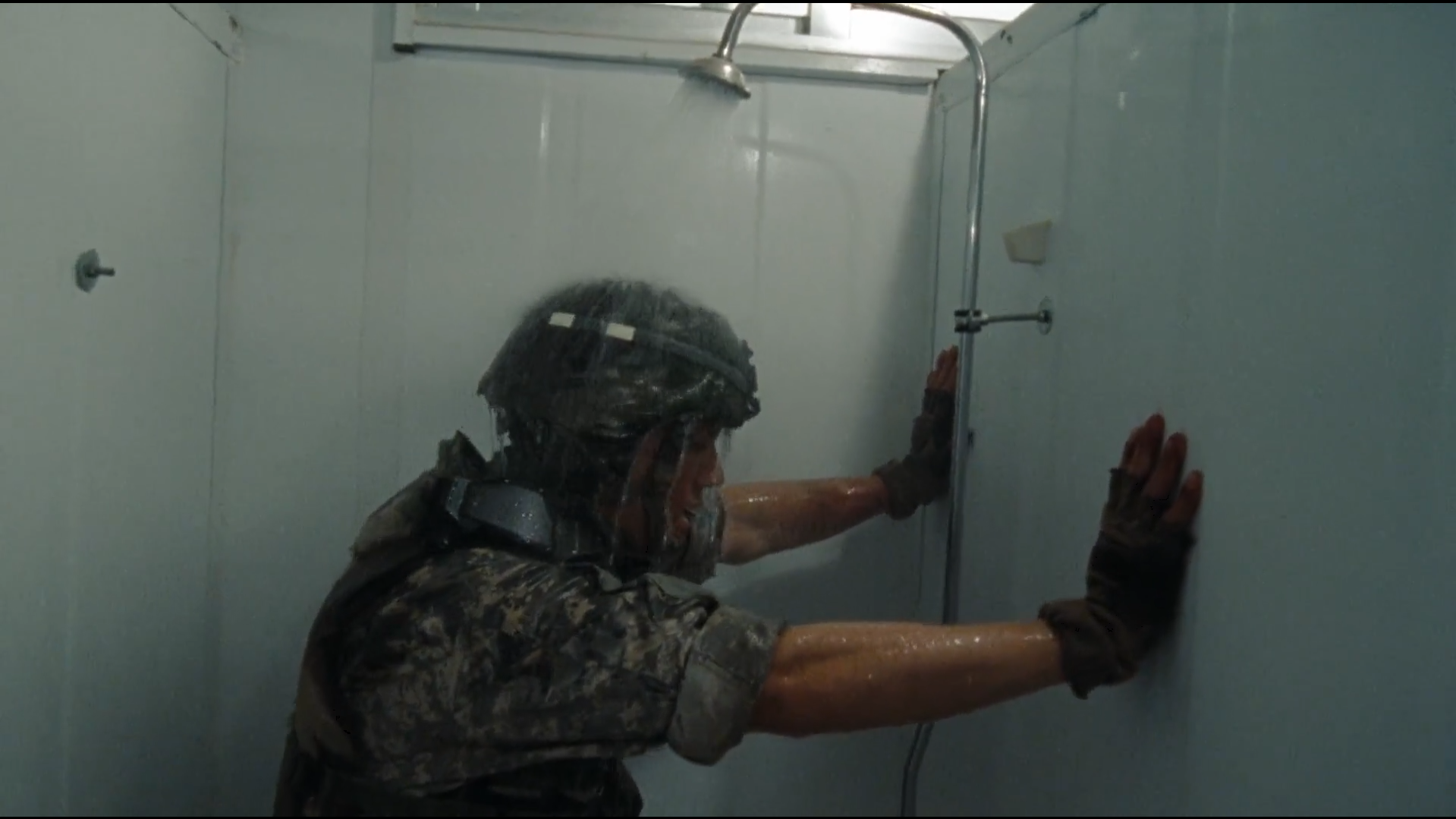
- The long shower. Honestly, this was one of the most unrealistic scenes for me! Anyone who’s served in an army camp overseas (especially in a desert climate) knows that water is a precious resource. 30-second showers might be the norm. 15-second showers happen when water is scarce, and maybe 1-minute showers when things are good. This shit would never fly:

Conclusion
This week’s post was a bit of a hodgepodge of leftover thoughts and ideas from last week, so thanks for bearing with me. I wanted to share some of the things which The Hurt Locker got right, but in doing so, I had to share the stuff they got wrong, and this post ended up being more dumping on the film, which is a bit unfair.
There’s a saying in EOD: “This isn’t a spectator sport.” It’s usually muttered with an eye-roll by some instructors as they stand in the rain watching some poor student work through their threat assessment on a smudged whiteboard, waiting for the answer to pop out at them (which it never does). In trying to make a compelling film about an EOD team, The Hurt Locker has had to butcher any semblance of realism relating to that topic. Which is a shame, because the film gets lots of other things right.
In researching and writing these two articles on the film, it’s climbed in my estimation little by little. I posited last week that THL lacks a coherent message, or a moral. On reflection, I think I can give it a message, even if it’s not the one that Bigelow and Boal intended. Once again, let’s look at: “War is a drug,” the tell-all at the start of the film. A psychiatric compulsion to re-experience trauma is something which is prevalent in many traumatic walks of life. I would argue that the EOD job is a particularly poor way to get this adrenaline fix, because 1) If you’re doing it properly, it can actually be quite dull and procedural and 2) If you’re doing it wrong, you’ll be quickly found out or would never have been selected in the first place.
This is still true, but consider this: It’s 2004, the height of the war, and the US Army is finding it increasingly difficult to resource their counterinsurgency operations. EOD operators are in particular demand, given the growth in IED use by the insurgency. Is this organisation going to pass over a willing volunteer for duty? Are they going to stop him from going overseas a second time, even if there are serious doubts about his abilities? Are the Army medical teams going to hold him back because he reads as completely unsuitable for the job? In the face of such shortages, it’s plausible that someone like William James slips through the net. Furthermore, with very stretched EOD units, maybe there’s not enough time for his superiors to monitor what he’s doing on the ground. The only senior officers who witness what’s happening are either morons (Colonel Reed), or soon blown up (Lt Col Cambridge). The Army makes do with the totally unsuitable operators it has, such as Staff Sgt James, and ends up doing a bad job at fighting the IED threat, loses far more soldiers than it needs to, and ultimately loses the war.
The above is a depressing message, but it’s actually the only one that fits with the actions we see on the screen, and it’s the only one that fits with the historical facts in Iraq. Again, I don’t think this is the message which the film’s creators intended (especially back in 2008, when things looked to be improving, but before they got much, much worse).
Featured Image: The Hurt Locker, Summit Entertainment (2009)
- Let’s be honest. In the grand scheme of human affairs, this is not a problem. ↩︎
- In the opening scene, by the ill-fated Staff Sgt Thompson. ↩︎
- To speak very broadly, and of course there are exceptions, in EOD you often try to balance the quick solution, e.g. “bip” which will remove the threat but sometimes at unacceptable levels of destruction, with the less forceful methods that might take much longer, but have less risk of causing damage. In both cases, protecting life is the paramount aim. In the opening scene, Staff Sgt Thompson is trying to get the job done quickly while protecting life (although he could have been more careful—obviously). In the other scenes, Staff Sgt James makes no such effort. ↩︎
- As an aside, we never go back to a demolition once the detonator has been wired up and connected, let alone after one of the charges has been initiated. This does, however, tie in with James’ reckless/idiotic character, so the filmmakers aren’t wrong here. ↩︎
- If you’d like a refresher, this is basically the same effect which causes a lag between lightning and thunder. Thunder and lightning only happen simultaneously when you’re right under the storm. In the same way, an explosion flash and bang only happen simultaneously when you’re on top of the explosion—which hopefully you’re not. The light reaches us practically instantaneously, whereas the sound travels at about 350 metres per second, so three seconds per km or maybe four-and-a-bit seconds per mile. For a big demolition like we see in this scene, you would want to be about a kilometre away if possible (and it’s definitely possible). ↩︎
- Including my wife, whom I of course correct on every occasion. She’s a saint. ↩︎


Leave a Reply to EOD critiques: The Hurt Locker – Military Realism ReportCancel reply