What Hollywood gets wrong about military radio communications.
🎧 Available in audio
This week, I want to alert you to an alarming fact, of which you may not even be aware: Hollywood scriptwriters clearly have not undergone training in radio voice procedure. I know this is difficult to hear, but I’ll provide incontrovertible evidence today of this disturbing fact.
In all seriousness, pedantic though this may be (even by my standards), I think it reveals a deeper misunderstanding in Hollywood as to how military units and sub-units communicate and, more fundamentally, how command and control works (or doesn’t).
Thanks, as always, for reading! If you like what you see, please subscribe. Comments below are always appreciated, and you can email me or comment for any topic requests.
If you enjoy this blog and want to support it, please consider a contribution. Keeping this blog going doesn’t cost much, but it isn’t free either, so any help would be very much appreciated👍
“Over and out”: The tip of the iceberg
I hate to be the one to break it to you1, but you’ve been lied to for your whole movie-watching life. The most widely used radio phrase in films is made-up and meaningless. I’m talking, of course, about the words “over and out”, as seen in some examples below:

TV Tropes mention this and describe it as an example of the “Coconut Effect“, wherein something wrong becomes an established protocol in film and TV to the extent that the real thing would be rejected by audiences. This may be true, although I’m inclined to chalk the popularity of “over and out” down to simple ignorance on the part of writers, because there are plenty of war movies out there which don’t make this mistake.
I want to go beyond mere voice procedure, sexy though that topic is, into a more fundamental misunderstanding by filmmakers of how radios fit into military operations.

Hollywood writers misconstrue radios as just a way of carrying out dialogue with a character who’s off-screen. This is wrong, as I will explain below. But the misconception also sheds light on some real-world military-technological challenges.
Oh, and why is “over and out” wrong? Well, each one is a “pro-word”, i.e. a short word that substitutes for something else:
- Over = I have finished speaking and I expect a response from you
- Out = I have finished speaking and I do not expect a response from you
By process of logical addition:
- Over and out = I have finished speaking and I expect a response from you and I have finished speaking and I do not expect a response from you
Thus indicating either someone who has changed their mind in the last split second or who is undergoing a split personality episode. Or, I suppose, a sloppy screenwriter.
Radio communications are not a conversation
“Over and out” can go beyond mere sloppiness as seen above and become a trite verbal seasoning, such as this Bond example:

If “over and out” by itself is meaningless, then its usage as part of a back and forth is even more so, robbing it of even its singular assumed finality. The filmmakers have used “over and out” here as a verbal prop to add to the visual cues that tell us these characters are separated in space and are talking on a radio. But their dialogue, while seeming to pass the sniff test in terms of advancing the story, is not a realistic depiction of how radios are used. Radio communication in the military is quite distinct from conversations:

Radio comms are not conversations, and yet Hollywood usually treats them this way. Radio comms are about managing the execution of pre-existing plans, and they are a critical support activity carried out by someone partly or wholly dedicated to this task. In other words, the commander is not the person on the radio. And the reason for this is simple: most of any radio message is routine chatter.
Before we delve into these reasons, let’s describe what we’re talking about. A military radio system operates on push-to-talk. Only one person, or “station”, can speak at a time, which has three important implications:
- Messages need to be as short as possible
- People need to follow a clear set of rules when transmitting
- The net must be kept to a practicable size
A very simplified and indicative radio net is shown below:

The diagram above could be a company net, with platoon-sized manoeuvre elements, or a battalion net with companies, etc. At each level of command, there is a single net where manoeuvre, support, and headquarter elements can coordinate. This also means that most commanders will be on two nets at once: the “up” net to their superior, and the “down” net with their own sub-units.
Radio comms manage the already-agreed plan
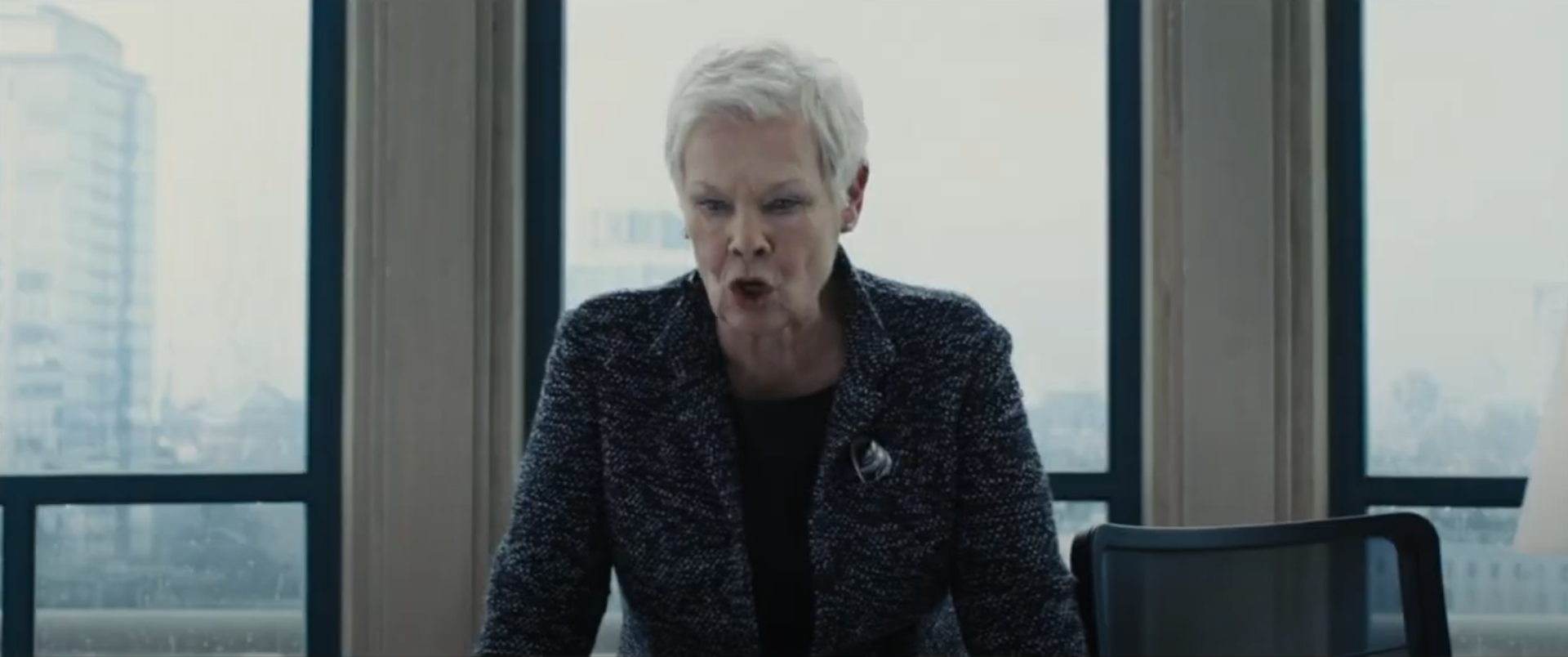
A recurring problem in these examples is that the filmmakers use radio communications as a way of advancing the plot through the characters making plans on the fly, over the air. The “take the bloody shot” scene from Skyfall is a case in point:

Judi Dench’s M is 2500 km away but still making split-second life-or-death decisions for Naomie Harris’s Moneypenny to execute. Predictably, this does not go well. Contrast with Bradley Cooper in the opening scene of American Sniper, when he’s agonising over the kid in his sights who might be a suicide bomber: “You got eyes on this? Can you confirm?” he asks his commander. “Negative,” comes the reply. “You know the ROEs” (rules of engagement).

In the Bond example, there is clearly no plan, and the two operatives are trying to devise one on the fly (and on the train and on the motorbike) with a distant HQ who don’t even have eyes-on. In American Sniper, the operative is told to follow his ROEs, i.e. “stick with the plan”, even though the commander is nearby.
The Hurt Locker is another offender. Jeremy Renner’s EOD operator character is a “wild man”2 who earns a punch from his teammate for turning off his radio in the middle of an approach. Although this deserves a punch, the writers miss the point here and throughout the film. An EOD approach, especially when done by a human, and especially3 when that human is wearing a bomb suit in the Iraqi heat, is not something which is done off the cuff.

Even when an EOD operation does involve making approaches in a bomb suit, the time spent “down range” is dwarfed by the time spent in the truck, at a whiteboard, talking with the team about the threat and the device and the many possible contingencies. If you are making an approach and you encounter something new, like the daisy-chain of IEDs in the movie poster above, you do not come up with a plan on the spot, radio or no radio. You walk back to the safe zone where the rest of the team is, you take off your helmet (at least), and you come up with a new plan. The “hot planning” depicted in the film is frowned upon, for good reason: it has gotten many EOD techs killed.
This is generally true, not just for bomb disposal. Military units don’t, by and large, make their plans or change their plans over the radio. Security is one obvious reason for this, but an even more important one is that it’s quite difficult. Delivering a set of orders to a dozen callsigns as they move is a deeply frustrating experience, even for simple operations4. The radio is used to support the plan’s execution, not to make the plan. Filmmakers like to show their heroes making decisions on the cuff, because it raises the stakes and increases the payoff when things go well. However, this brings up another aspect of unrealism, discussed in the next section.
Commanders don’t spend their time on the radio
Movies like to focus the bulk of the dialogue on their main characters, which is understandable. They also like their main characters to hold somewhat important ranks5. This translates into a lot of radio chatter between the main character and other important characters over the radio. Full Metal Jacket gives us an example of this, when the squad are pinned down by a sniper and have just taken a casualty:

The voice procedure is a bit sloppy and redundant, and contains the hateful “over and out”, but otherwise this isn’t a bad scene. Cowboy spends more time giving fire control orders and situation updates to his squad than he does on the radio to his acting commander, which is realistic. Also, the radioman is clearly looking after the routine comms, and only comes over when Murphy wants to speak directly to Cowboy. Cowboy tells the radioman to “stay close”, which is wise. He could do more and get him to fill out a contact report or casualty evacuation report in the background, to let him focus on directing the firefight, but more on that below.
The Siege of Jadotville gives us a scene which is bit less credible. Jamie Dornan and Michael McElhatton have a regular phone conversation (i.e. not push-to-talk) over what is clearly a radio set which should not have this functionality. Perhaps there’s a technical way to achieve this, but I am not aware of it—please let me know in the comments if I’m wrong!

What bothers me more about this scene is the fact that we jump several layers of command (each of which would have its own comms net) to get from the besieged company at Jadotville to the General at Force HQ6. The two men have an unstructured chat and might as well be arguing over a pint at the bar. There’s no scribe at either end taking down times and details of messages in the unit journal, as would happen in reality, especially for a high-stakes radio exchange like this.
Commanders spend a lot less time on the radio than depicted on-screen, because they are usually busier planning and directing the battle. At all levels, they have deputies to manage the bulk of their radio comms. At platoon level, the Lieutenant will have a radio operative who will call in the reports. At formation level, the general officer will have an entire operations room and team of radio operatives.
Of course soldiers will, at times, need to explain a situation or request support from their commander: neither film above is wrong in this respect. This, however, is done through a standardised reporting process and is not a head-to-head between commanders, which is where both examples fall down slightly, with Siege of Jadotville being the more dramatic (i.e. less realistic) example.
The majority of any radio message is routine back-and-forth using pro-words
The reason why commanders, especially higher-ranking ones, don’t spend their time yammering away on the radio is that it’s an inefficient use of their time. Just like how a CEO doesn’t write every email or a government minister doesn’t sign every paycheck, most communications are delegated to someone on the staff, who can quickly call in the commander or their deputy should the need arise.
Even with dedicated radio staff, there is still a need to keep communications concise, to avoid clogging up the net. Remember, when one station is transmitting, no-one else can talk. The Full Metal Jacket exchange above takes place between a squad and a platoon leader, but the other squads in the platoon can’t effectively communicate with each other or with platoon HQ while the Cowboy/Murphy exchange is happening. Although it’s a fairly concise exchange, and would serve its purpose in real life, it’s unlikely that both men would be able to speak and hear each other so clearly. Let’s take a look at this exchange cleaned up with better voice procedure to compensate for the inevitable confusion of battle:

The above does not include the almost inevitable repetitions required, but the standardised format makes this easier. Instead of “I didn’t get any of that, say again your last,” we would have something like: “10, say again Charlie, over,” to which Cowboy would simply reply with: “11, Charlie: 500m North of checkpoint four, over.”
The more realistic exchange takes longer, but leaves less room for confusion by both parties. It also leaves many more spaces for other callsigns to interject if needed. At the same time, they can hear that there’s a contact report going on, which is a pretty big deal, so know to stay off the net unless something is a higher priority.
The banal fact is that most radio comms are radio checks or routine location updates. These can be mind-numbingly tedious, e.g.:
- “Hello 0, this is 30, passing V4 now, over.” [no response]
- “Hello 0, hello 0, this is 30, radio check, radio check, over.” [still no response]
- “Hello 0, this is 30, nothing heard, out to you. Hello 20, this is 30, radio check, radio check, over.”
- “Hello 30, this is 20, say again, over.”
- “Hello 20, this is 30, radio check, over.”
- “20, you’re strength 3, over.”
- “30, you’re strength 5. Can you please relay a message to 0? Over.”
- “20, wilco, send your message, over.”
- “30, passing V4 now, over.”
- “20, roger, out to you, hello 0, hello 0, this is 20, message, over.”
- “0, send over.”
- “20, relaying message from 30 passing V4, over.”
- “0, acknowledged, out.”
By the time the operations room update callsign 30’s location, they are halfway to V5 and almost ready to start the process again.
During an operation with many moving parts, the unit will probably have pre-arranged code words to signify the start of a particular phase or the crossing of a particular report line (a checkpoint on a map), e.g. “Irene” at the start of Black Hawk Down:

A codeword would have improved the exchange above in The Spy Who Loved Me, assuming they had a pre-agreed code-word to represent “Bond has just left my tender embrace” (let’s say “EAGLE”):

There’s no need for the baddie on skis to tell the seductress that he’s waiting, since this was presumably part of the plan. This would also work for storytelling purposes, since we, the audience, would clearly see that something sneaky is afoot.
Conclusion: Is life imitating art? Technology is flattening the hierarchy
Technology has been flattening military hierarchies for many years. The famous picture below which shows the White House situation room during the Osama Bin Laden assassination operation is a case study in the kind of top-heavy communications which I’ve been declaiming in this post:

I presume and hope that the setup above was just an elaborate piece of theatre, because I can’t begin to fathom how a direct link between a tactical commander on the ground in Pakistan and the Commander in Chief is a useful command and control situation. It’s almost as silly as “take the bloody shot” from Skyfall.
Or maybe there was no direct control, but they all got a kick out of watching a live feed of Bin Laden die. It wouldn’t be my cup of tea, but I won’t judge, given the trauma he caused them and their nation ten years before.
Regardless of the reasoning behind this setup, it is emblematic of how technology has disrupted many of the established military norms, and not necessarily for the better. I have never come across a commander or operations officer, myself included, who didn’t want more information, at a more granular level, and quicker from their patrols. And I’ve never met a patrol commander, myself included, who didn’t resent the imposition of somebody breathing down their neck from an air-conditioned office tens of kilometres away asking for constant updates while a situation is evolving on the ground.
The underlying issue I see with all of the examples above, and many more besides, is that they conflate military radio comms with 1:1 phone conversations. The reason it’s all a bit ambiguous is that technology has allowed this to creep into real life as well. Military comms infrastructure has been slow to embrace the mobile phone. There are good reasons for this (security, signal coverage) as well as bad (inertia, the fear of making life easier for soldiers). But there are qualitative differences between 1:1 phone calls, or even conference calls, and push-to-talk radio networks with many active stations.
As military communications technologies evolve, perhaps the underlying structures and hierarchies will too, and many of the criticisms discussed here will seem quaint and outdated. But please stop saying “over and out”.
- That’s a lie. I’m a pedant and I love it. ↩︎
- My problems with The Hurt Locker are extensive and probably warrant a post of their own someday. Let me know if you want to see this. ↩︎
- Not a footnote, but “especially” cubed. ↩︎
- It can be done, and is an important skillset within mobile operations. However, it is awkward, messy, and heavily reliant on standard radio order formats, as discussed later in this post. ↩︎
- One famous example of this trend is Saving Private Ryan, where Tom Hanks’s character, a captain, leads a team of only eight. ↩︎
- The character of General McEntee is a fictional one. As others such as MajorSamm have pointed out, his character appears to be a composite of the ONUC Force Commander Lt Gen Sean MacEoin and 35th Infantry Battalion commander Lt Col O. MacNeill. This is probably justified for storytelling purposes, but the “phone call” scene still seems out of place to me. ↩︎


Leave a Reply