Distance, speed, and time get hopelessly mangled in space opera and science fiction.
| << “Over and out”, over and over again | Firearm fails: Pushing the envelope of pistol performance (Part 1: Historical and tactical confusion.) >> |
I’m hoping you’ll forgive me for a slight change of tack this week. Instead of looking at contemporary war films, I decided to subject you to a rant about flagrant abuse of distance, speed, and time in science fiction / space opera1. Don’t worry, there is still a military point buried in this post. Do let me know what you think of the new subject area, and thanks, as always, for reading this blog! If you like what you see, please subscribe. Comments below are always appreciated, and you can email me or comment for any topic requests.
If you enjoy this blog and want to support it, please consider a contribution. Keeping this blog going doesn’t cost much, but it isn’t free either, so any help would be very much appreciated👍
The Andromeda Galaxy is not a setting you can use
I recently tried to watch the Netflix film Atlas, which stars Jennifer Lopez and is set in a world suffering from the after-effects of a robot rebellion against humanity. There were some good visuals at the outset and a real sense of menace from the main antagonists, but a plot decision early on made me switch off, and it’s unlikely I will return to it. The offending decision? To set the baddies’ hideout on a planet in the Andromeda Galaxy.

Never mind where in the Andromeda Galaxy they are—that is a whole other level of sloppiness which we won’t deal with here2. The focus today is on the distance to the location.
With very few exceptions (discussed in more detail below), other galaxies are a thoroughly inappropriate setting for wars, adventures, quests, or anything vaguely relating to human lifetimes or timescales. When I hear an author or a filmmaker talk about “The Andromeda Galaxy”, I immediately switch off, because it tells me that they haven’t even tried to make the setting believable. I am willing to suspend my disbelief in the service of fiction, but a story about baddies on rockets fleeing to the Andromeda Galaxy makes about as much sense as a character in Toy Story escaping to Mars on a toy rocket.

I’ll explain below why it’s terrible, but here are some more examples from film, TV, video games, and books. Not all of these are guilty of unthinkingly using the setting, as I’ll explain in more detail later:
- Gene Roddenberry’s Andromeda
- Mass Effect: Andromeda
- Various Marvel Cinematic Universe films/episodes/whatever they are called
- Star Trek: Odyssey
- Alistair Reynolds’s House of Suns
- Iain M. Banks’s The Algebraist
Cosmic distances are hard to comprehend, so here’s a primer
Writing good science fiction is hard, because space is so very big[citation needed. Maybe ask Carl Sagan?].

Anything involving other planets and star systems uses some sort of “hyperspace” (Star Wars) or “warp speed” (Star Trek) fudge to make the plot work, or else puts the human passengers into suspended animation to “fast forward” the tedious interstellar medium (e.g. Passengers). If we used current propulsion technologies, then it would take far too long to get anywhere remotely interesting, as we see on the comparison below:

The Parker Solar Probe is the fastest (real) spacecraft ever launched, and would take nearly 4 billion years to reach the Andromeda Galaxy. But let’s be fair and assume standard science fiction faster-than-light travel. It still takes us over three centuries to get there, and this is at the Star Trek canon’s fastest possible speed. Thank God, incidentally, for the Star Trek canon, since few science fiction franchises provide detailed information such as ship speeds. From what I can tell, the fastest Star Wars speeds are only slightly faster than the maximum Star Trek speeds, so we’re still on the order of centuries to get to Andromeda. What all this means is that if the baddie in Atlas was 1) resourceful, 2) stupid, and 3) patient enough to get to the Andromeda Galaxy, then the best course of action would be to leave him there. Going after him is not worth the wait. Especially when things go wrong and you need to phone home, since radio communications travel at only the speed of light:

The size of the cosmos is humbling, with plenty of real estate to work with
The tragic thing about throwing out references to “the Andromeda Galaxy” is that it’s completely unnecessary. Space is big, as we noted above, and the Milky Way galaxy is more than big enough for any conceivable adventure you might want to write. There’s a reason all the successful science fiction franchises limit3 the action to a single galaxy, either our own, or one “far, far away”.
The universe is much bigger than any single galaxy, but a single galaxy is the broadest extent of possible home for any space-faring civilisation. To get another idea of its size, watch what happens when we scale down our reference distances from earlier:

If you’re thinking about using a different galaxy as a setting, or of bringing an “intergalactic” elegant to your story, then stop and think again. If you’re still thinking about it, then think again some more. Are there are exceptions? Perhaps: see below.
Intergalactic settings in SF are best used judiciously
If you are going to use the Andromeda galaxy, or other galaxy besides the Milky Way, then you should use these vast and almost incomprehensible distances to drive a unique story. For example, Alistair Reynolds’s House of Suns involves travel to the Andromeda Galaxy, albeit via a wormhole, which is an SF kludge to get around long distances. But the exotic distance and otherness of the new setting drives the plot forward. Likewise, Iain M. Banks’s The Algebraist implies travel by an alien species from our galaxy to Andromeda. However, these creatures live for tens of millions of years, and the journey is still considered long, lonely, and semi-mythical even for them. This brings up a more general point, which is that distance, speed, and time ought to be (and can be) aids to the plot, rather than impediments. It helps if we remember “Dad’s Silly Triangle” from Physics 101:

Science fiction requires us to suspend our disbelief just enough
Nobody comes to an SF story looking for perfect realism. We, as viewers or readers, are perfectly happy to suspend a certain amount of disbelief. In this respect, SF is no different from fantasy. We do, however, need to see an internal consistency within the story. Magic is fine, even magic dressed up in sciencey words such as “tachyon drives” or “midichlorians”, provided the rules are somewhat clear and the plot follows these rules. Look at what a mess the Game of Thrones showrunners made of the last season, due among other things to armies and fleets that could teleport across space and dragons with arbitrarily powerful fire-breath, as in the gif below.4

With SF, it’s perfectly okay, and often better for the story, if there is some mechanism for traveling faster than light. After all, nobody wants to see characters spend decades or centuries shuttling between the points of action. Even “Warp Factor 9.99” is okay, provided it’s used consistently. The plot should be based around the distance/speed/time constraints in the fictional world, rather than, as is too often the case, travel happening at “The Speed of Plot“.
I would suggest that the very same is true for space opera, and I opened this article saying that it applied to both. I find the distinction between the two genres a bit unhelpful and inconsistent. It’s inconsistent because so many works fall into both camps, and also get muddied with the additional “hard” vs. “soft” SF, or even “sci-fi” vs. “SF”. I don’t think it’s helpful because it implies that certain genres get off the hook for certain elements, e.g. a space opera doesn’t need to have logical worldbuilding consistency, or an SF story doesn’t need to have strong character arcs.
There’s further reading and more information on the distinction between the two genres here and here, but please let me know what you think: am I being too dismissive of the differences between the genres?
For example, the Star Wars franchise is often considered to be a space opera: one of the most successful in entertainment history. However, there are clearly technological elements, and an attempted scientific explanation for “The Force”5, all of which are elements of SF. Regardless of genre, or even magical elements, there was an internal consistency to the original trilogy which enabled the epic setting to add drama to the human struggles of the main characters.
The sequel trilogy breaks this consistency in many ways, the most egregious being the laser weapon that can travel through hyperspace and destroy any planet in the galaxy. The original Star Wars galaxy worked: it seemed like a big place, where a big empire rules and rebels resist and old sages hide on backwater planets and it takes time to get around6. In the sequels, all sense of scale is lost and the galaxy feels like a sandbox.

I’ll do a more in-depth (and way more pedantic) critique some other time of the Star Wars sequel trilogy.
This sloppiness with distance, speed, and time bleeds into other aspects of the story
I promised at the top of this post that there was a military link, and I haven’t forgotten.
As the squad of space marines and mad scientist (J Lo) travel to (sigh) the Andromeda Galaxy, there occurs a farcical briefing minutes before the assault commences. J Lo’s Atlas storms in with a bunch of briefing materials and tries to re-write the Rangers’ plan of attack and undermine their commander. Ostensibly she is there for “intel”, although she is jolly late in the game if that’s the case. She hands out notes on the terrain and weather conditions at the target, and it’s implied that none of the squad/battalion7 have seen this absolutely critical information before, including a map of the location they are about to drop into. Telling the troops where they are about to land goes well beyond J Lo’s “intel” brief; this is part of the “execution” of the mission (see below).
This setup is absurdly disorganised. It only starts to make sense if we assume that the colonel is deliberately undermining J Lo’s character by pushing her “intel briefing” to the last possible moment before they actually deploy. If this is the case, then he’s a very foolish officer, and this still doesn’t explain his unit’s complete lack of preparation, reconnaissance, and contingency planning.

Remember, this is supposedly an operation to apprehend the greatest terrorist known to humanity. It’s as if Seal Team Six came up with the plan to kill Bin Laden while on the chopper en-route to Abbottabad. With a newly-joined team member who kinds thinks she is the leader because she hung out with Bin Laden at school.
How should this scene look? Well, orders are a formal process that happens before any military operations. They take place in a safe and secure environment (inasmuch as possible), and the commander (not the commander and his scientific advisor) will go through every aspect of the plan, including the route in. So the orders will not happen on the spaceship, since that is very much an active phase of the plan. It’s also where, in my experience, things are most likely to go wrong. So you spend quite a long time in orders talking about the route in, and what to do if something goes wrong on this route in (e.g. you are attacked by a swarm of AI drones).
Orders follow a formal sequence, which makes sure that commanders and planners don’t leave out crucial parts of the plan:

I could spend a lot longer—a whole article, in fact—pulling apart this film on its military merits, but I wanted to focus on the absurdity of the Andromeda Galaxy. Atlas is not the only offender, but it’s the latest, and hence drew my ire.
Let me know if the SF military critique is something you would like to see in the future, and if there are any films in particular which should get the treatment.
But until then, or at least next time, that’s all from me. Thanks, as always, for reading! I am keen to see what you think in the comments below. Don’t forget to like (if you liked it) and subscribe (if you want to see more).
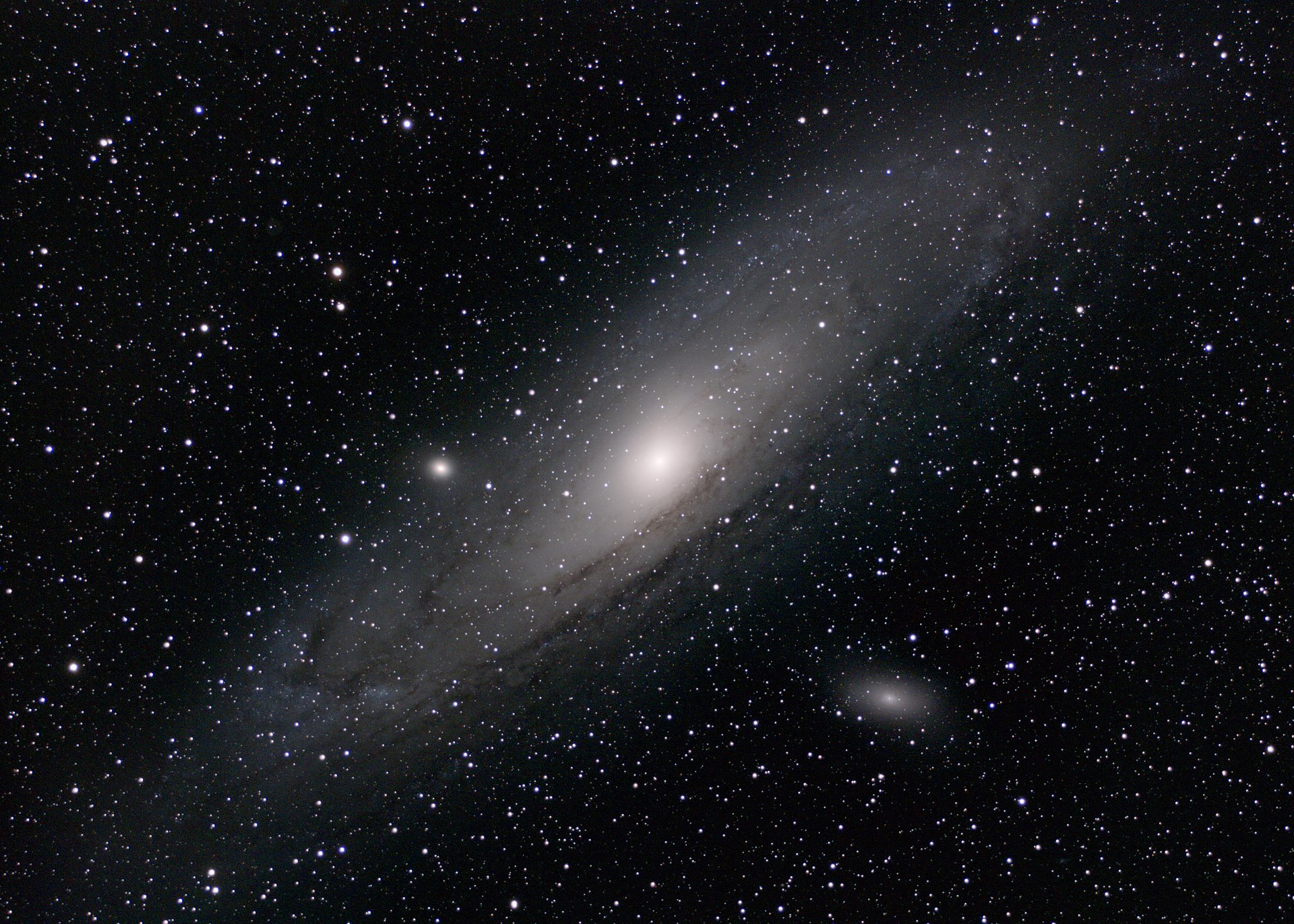
Featured image: Andromeda Galaxy. By Torben Hansen – File:M31 09-01-2011.jpg here, CC BY 2.0, accessed on Wikimedia Commons
- I’m not sure how helpful this distinction is, but, very roughly, SF is usually considered the more realistic of the two. I’ll go into more detail further in this post to explain why I think it’s unhelpful. ↩︎
- Suffice to say that the Andromeda Galaxy is about as big as our Milky Way galaxy, and contains about a trillion stars, and about the same number of planets. So a location reference of “GR-39 / Andromeda Galaxy” is not quite getting you onto the target. That four-digit alphanumeric designator will give you about 68,000 possible combinations for planets, which will cover about 0.000007% of them. ↩︎
- Even writing this word feels wrong: how can you call it “limiting” when you have a canvas of over 100 billion stars, the same number of planets, and distances that take years or centuries to traverse? ↩︎
- Brett Devereaux has some brilliant analyses of GoT here, here, and here, as well as Amazon’s The Rings of Power here and here… honestly, if you haven’t seen his blog yet, you’re in for a treat. ↩︎
- Albeit this was retconned into the prequels which were released 20 years after the original trilogy. ↩︎
- Yes, granted, there’s the infamous time dilation of Luke’s Jedi training in The Empire Strikes Back. ↩︎
- The unit is supposedly the “4th Rangers Battalion” of the ICN. A battalion would imply between 300 and 1000 soldiers, although we only see 25 in the briefing room. You could perhaps assume that these are the company and platoon commanders and battalion HQ staff, but the film seems to code them as “grunts” rather than as officers. Perhaps I’m being too pedantic here, because it’s plausible that a mecha-battalion numbers only in the dozens. ↩︎


Leave a Reply