
Dust as an explosive hazard
Hello again to all. This week I was inspired to write about dust explosions after one of you shared a BBC article with me on the explosive potential of custard powder. I thought I’d talk a bit more about this industrial hazard but also put it in the context of explosions more generally, since these terms are often used quite loosely. Since I’m a pedant, I like to categorise everything, and therefore I was keen to put dust explosions in their own little box (metaphorically speaking: as we’ll see, putting a dust explosion in a box would be a very bad idea).
Firstly, we’ll look at all the different types of explosion you will hopefully not come across. Then we’ll go into more detail on chemical explosions, and that will lead us on to dust explosions as a subset of chemical explosions. We’ll see how the same performance considerations which apply to things like propellants also crop up in unexpected and unwanted situations like a factory.
If you enjoy this article, or this blog, please like and share it on your social networks. Please subscribe if you haven’t already, using the handy link below to never miss a new article. And please weigh in on the comments section below if you feel like it. Enjoy!
If you enjoy this blog and want to support it, please consider a donation. Keeping this blog going doesn’t cost much, but it isn’t free either, so any help would be very much appreciated👍
Explosions come in three varieties
An explosion is a violent expansion in volume. In other words, something which used to occupy a small amount of space now takes up a much larger amount of space, and the change happened suddenly:

We humans on Earth associate explosions with “bangs” because the aforementioned rapid expansion in volume causes a shockwave in the air which, in turn, reaches our eardrums as a loud report1. There are three ways that explosions can occur, and they take place at different scales, all of which are far below our ability to perceive.
Physical explosions happen at the material scale
A physical explosion is what happens when something bursts open or breaks apart suddenly. These can range from:

All the way to:
The action happens at the microscopic scale: the bonds between atoms or the larger-scale grain structures of the material. These are the interfaces which break apart under the internal pressure. As with any explosion, the sudden expansion of released air causes a shockwave, and this is what makes the bang.

Some more examples of physical explosions are boilers bursting, champagne corks popping, and tyres blowing out. We don’t need to dwell in too much detail on these, so let’s move to the complete other end of the scale.
Nuclear explosions happen at the sub-atomic scale
If we zoom in past the material bonds, past the chemical bonds between atoms, and deep into the nucleus of the atom, then we might have the fleeting opportunity to see a nuclear reaction which, in turn, could cause a nuclear explosion:

I won’t go into too much detail here either, since I wrote a post recently about nuclear weapons. But it’s worth mentioning that nuclear explosions also encompass far more destructive events such as supernovas.
Let’s zoom back out a little bit, not quite as much as before, and find that middle ground where chemicals play.
Chemical explosions happen at the molecular scale
Chemical explosions involve a chemical reaction: the name is a hint. Most explosions that we naturally think about fall into this category, and when we mention “explosives”, we’re always talking about things that lead to chemical explosions.

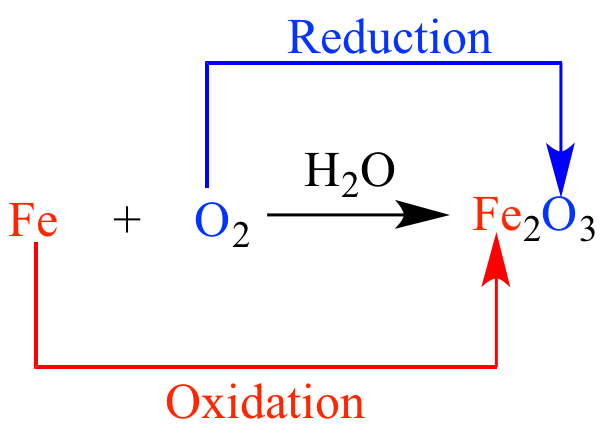
Chemical explosions are a subset of oxidation/reduction (“redox“) reactions, in which one party to the chemical reaction gives electrons to the other:

You will be familiar with redox reactions, of course, since what we colloquially know as “fire” is a type of redox reaction. When “fires” happen very quickly, we call them explosions, and that’s what we’ll discuss next.
Staying at the same microscopic distance scale, let’s crank the time scale and step into the gaps between the seconds of our normal perception.
A chemical explosion is like a fire, but much faster
A chemical explosion is a sped-up burning (or redox) process. To understand how this works, it would be great if we could slow down our perception of time. The problem with our current monkey-brains is that all explosions look and feel very similar, even though there’s a world of difference between what happens in a gun barrel and what happens in a hand grenade. There are two “speeds” of explosion: deflagration and detonation. The first spreads slower than the speed of sound, and the second is faster. Before we look at either of these, however, let’s cover the slow kind of oxidation-reduction reaction.
Oxidation can happen slowly
As I mentioned above, this is the most familiar type of oxidation:

The carbon in the candle is reacting with the oxygen in the air and oxidising to carbon dioxide while releasing heat at the same time. The candle burns over the course of hours, but redox reaction can happen even more slowly. Steel rusting is an example of oxidation, where the iron in the metal gets converted to iron oxide (this is the reaction which is shown in the image above from UCLA) over the course of months or years:
I mention fires and rust just to illustrate the point that time scales are crucial when we look at redox reactions. To reprise a graphic I used on a previous post discussing Hollywood’s obsession with flaming gun barrels:

If we want to now experience the much faster deflagration, we need to crank up our mental clock speed to slow the outside world by a factor of a thousand.
Deflagration is very quick oxidation
If every millisecond feels like a second, the “bang” of a gunshot is broken up into several distinct phases, which we could observe if we shrank and teleported ourselves inside the cartridge case:

The speed of the deflagration reaction heavily depends on the ambient pressure. If you watch videos of loose propellant being lit, it can seem remarkably slow to burn, but this is because it’s at atmospheric pressure. Inside the cartridge case and the gun barrel, the confinement causes a positive feedback loop which accelerates the burn rate:

We don’t have to make the impossible (and suicidal) trip inside a rifle round to experience fast deflagration. Black powder, when lit, reacts quickly with a characteristic “fizz” or “whump” sound2.
In summary, deflagration happens at the millisecond timescale. But there’s another level left for us to explore. Detonation, which we’ll discuss next, is much faster than deflagration.
Detonation is extremely quick oxidation
When a substance detonates, we need to slow down time even more, by a factor of a million, to get a good idea of what’s happening. Detonation is a type of reaction associated with high explosives. Just to remind you:

The difference between detonation and deflagration is:
| Parameter | Deflagration | Detonation |
|---|---|---|
| Speed of reaction | 1-100s metres per second | Kilometres3 per second |
| How reaction spreads | Heat transfer (below the speed of sound in the material) | Shock wave (faster than the speed of sound in the material) |
| Where the reaction happens | On the surface of the material | Throughout the material |
| Time for reaction to complete | ~0.1 second | ~0.1 milliseconds |
| Fuel and oxidiser locations | In the same mixture, but on separate molecules | Part of the same molecule (usually) |
| What is sounds like | A low “thud” | A sharp “bang” |
| Amount of energy released | Depends on the amount of energetic | Also depends on the amount of energetic, but is released much faster |
| Applications | Moving bullets down a barrel, propelling rockets | Breaking things into very small pieces and making the pieces fly away very fast |
A key requirement for both deflagrations and detonations is a fuel and an oxidiser. Explosives (both high and low) are ways of combining these two crucial elements in such a way that:
- The redox reaction doesn’t happen until we’re good and ready…
- …but when we’re ready, oh boy does it happen
A final thought: explosion types are not mutually exclusive. A chemical explosion will obviously result in the violent physical explosion of any container it occurs in (such as an artillery shell). A nuclear explosion (at least on Earth) is dependent on chemical explosions to create the right conditions for a nuclear reaction. We split them up because we are sad people who like to categorise everything, but there’s plenty of overlap.
Now that the chemistry lesson for the day is over, let’s dive properly into dust explosions and see what they’re all about.
Dust explosions are similar to some very powerful munitions
Dust explosions are a serious industrial hazard. The example mentioned in the BBC article happened in a Bird’s Custard factory in Banbury, in 1981. Nine workers were injured in the explosion, and the ensuing firefight caused rivers of custard to pour from the building. Some more serious and recent incidents have killed upwards of 100 workers (at an automotive plant in China in 2014) and 14 workers (at a sugar refinery in USA in 2008).
Dust explosions happen because certain industrial processes create similar conditions to the deflagration reaction we discussed above. Remember that all redox reactions need a fuel and an oxidiser. The fuel is the dust itself, so long as this is a combustible material. This can be a foodstuff (flour, sugar powder, and of course custard powder), another organic material such as sawdust, metallic powders such as aluminium4, or other powders such as coal dust. The oxidiser in this reaction is the abundant oxygen in the air all around us.
The familiar fire triangle is extended to a fire pentagon when thinking about the hazard from dust explosions: confinement and dispersion are the two additional factors needed:

If you’re wondering why things like flour and sawdust are so susceptible to an explosion, it’s worth considering the effects of surface area. When flour is compacted together in a bag in your kitchen, it has a pretty small surface area relative to its mass. If you were to start throwing clumps of it around the kitchen5, however, you would greatly increase the surface area of the flour. Let’s see why with a simplified example:

When a greater share of surface area is exposed, as in the example of the small cubes above, then there’s more area for the chemical reaction between the fuel (the cube) and the oxidiser (the air around it) to occur. In the example above, there is ten times more surface area. In reality, individual particles of dust are much smaller than a centimetre, so you can assume that the surface area per unit of mass is thousands of times greater, and therefore the reaction is thousands of times faster. Add in the effect of confinement and, as we saw in the pressure feedback loop above, the reaction can propagate much quicker:
The very same principle behind dust explosion accidents is what weapons designers rely on for fuel-air explosives (FAEs):

Whereas in an FAE the source of ignition is part of the design, in a dust explosion the source of ignition can be a naked flame or else friction, static, or electrical sparks from industrial equipment. Just like with FAEs, however, the “free” oxygen in the air around the fuel/dust can greatly add to the explosive effect of the reaction.
The speed of a dust explosion reaction is generally below the speed of sound, i.e. it is subsonic, and therefore counts as a deflagration, although dust detonations are also possible, where the reaction speed becomes supersonic. These are not seen in industrial processes, however, and are “confined” to coal mining only, as a theoretical possibility.
Dust explosions are destructive, sometimes tragically so, and are an everyday hazard in many industrial processes. They illustrate the awesome power of “fire” (i.e. redox reactions), and show why we should not take this force of nature for granted.
Conclusion: A lot can happen in a short space of time
We use the term “explosion” in everyday life to loosely describe things that go bang or make a bright flash. Because we perceive events happening on the scale of seconds, we miss so much of the subtlety and differences between different types of explosive phenomenon.
If we could see things happening by the microsecond, we would see how shockwaves propagating through high explosives create powerful detonations which can tear the strongest materials into tiny pieces. The rest of the world would appear still during this brief moment.
If we could see things happening by the millisecond, we could marvel at the deflagration that ensures a steady release of energy from gunpowder to propel a bullet down the barrel. Most dust explosions would appear to react at an even more leisurely pace still.
Still slower again are our everyday interactions with redox reactions such as a candle flame or a rusting piece of steel. All of these reactions achieve the same thing, which is the oxidation of a fuel and the reduction of an oxidiser, with some energy released as part of the bargain. The only difference is the rate at which energy is converted. Let’s hope that most of our interactions are on the slower end of the spectrum. Knowing the hazards associated with dust explosions, and avoiding them, will help keep us on the straight and narrow.
That’s all for this week, folks. I hope you enjoyed this rabbit hole of explosive chemistry (if you did, I can go deeper; if you didn’t, I have more video game shooter articles up my sleeve). Thanks for reading and, as always, please share this on your socials to spread the word of the hazards of dust explosions. If you haven’t done so already, please subscribe using the link below. Finally, please weigh in on the comments section with your reactions and suggestions. Thanks, and I’ll see you all next week.
Featured Image: Generated by Chat-GPT6, Android app v.1.2024.282
- If you’re an alien reading this in a vacuum, then forgive my anthropocentric viewpoint. ↩︎
- These, of course, are the technical terms. ↩︎
- Miles. ↩︎
- “Aluminum,” if you hail from the part of the world that loves freedom. Don’t tell my European friends, but I actually prefer the American spelling. ↩︎
- I don’t advise trying this at home. The explosive risk is probably the least of your worries if you do. ↩︎
- Prompt 1: “Can you generate an image of a Bird’s Custard tin with an incendiary fuse coming out of the top to make it look like a bomb”
Prompt 2: “Please remove the words “incendiary fuse” from the tin. Also get rid of the fuse but leave the grenade elements. Get rid of the bird in the background. Make the image long and wide, suitable for a website banner.” The original image is below. ↩︎



Leave a Reply to Magical instant bullets – Military Realism ReportCancel reply