Weapons of mass distraction: Part 4.
Hello again, and Happy Thanksgiving to all my US readers. Welcome to this fourth and final instalment of my weapons of mass destruction (WMD) series, where we’ve been looking at the realities of chemical, biological, radiological, and, finally, nuclear warfare. We’ve also examined what Hollywood gets right and wrong about these terrifying weapons, which together form the quad known as “CBRN” in defence circles:


If you’ve been following this series, you’ll know that I’ve been casting a lot of doubt on the Hollywood depictions of the destructiveness of these weapons, hence the “weapons of mass distraction” subtitle above. I’m happy terrified to report that nuclear weapons (NW) are a different kettle of fish. Their fearsome reputation is entirely deserved, and we’ll discuss how NW achieve such destruction by tearing apart material at a more fundamental level than normal explosives do, and producing several different types of deadly effect.
We’ll also discuss how these weapons are difficult to make, requiring the concerted effort and expertise of a powerful state. This probably puts them beyond the ability of most terrorist groups, which is one of the areas where Hollywood does go outside the bounds of realism when it comes to NW. Finally, we’ll discuss the term “weapons of mass destruction” and where it came from, and see how NW, much more so than radiological, biological, or chemical weapons, deserve to be thought of this way.
Thanks, as always, for reading! If you like what you see, please like and share on social media with anyone who might be interested. If you haven’t done so already, please subscribe to the blog using the link below so that you never miss an article. Finally, please share your thoughts on this article and the whole WMD series in the comments below. I hope you enjoy.
If you enjoy this blog and want to support it, please consider a donation. Keeping this blog going doesn’t cost much, but it isn’t free either, so any help would be very much appreciated👍
Nuclear weapons are singularly destructive machines
A nuclear explosion releases energy from deep within the material…
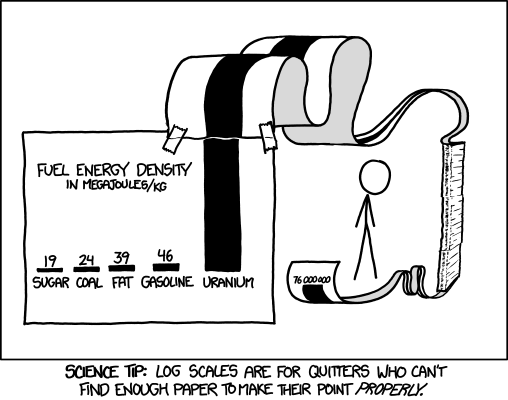
We touched on this last week when talking about radiological weapons (i.e. dirty bombs), but it bears repeating. A nuclear explosion is a very different beast to a “chemical” (i.e. a high explosive) explosion1, happens many thousands of times faster, and is millions of times more powerful:

By harnessing the energy in the nuclear bonds rather than the chemical bonds, a single piece of nuclear fuel can produce millions of times more energy per unit of mass than conventional explosives. Of course, the energy in these nuclear bonds can be harnessed for good as well as for ill, via a nuclear reactor:
Peaceful nuclear power is a whole other discussion point, however, with its own Hollywood fails which we might get into sometime, but not today.
…with lots of energy released in many different ways…
The energy released from the nuclear bonds mentioned above gets expressed in several different forms:

What the graph above is showing is the several distinct events which happen as part of a nuclear explosion.
- The very first thing that hits you is a burst of gamma rays travelling at the speed of light. You won’t see or feel anything. Gamma rays, as we saw last week, travel right through your body: it takes thick, dense materials (e.g. lead shielding) to stop them. Because they travel straight through, many of the gamma rays do little or no damage. Unfortunately, in a nuclear explosion, the level of gamma radiation may be high enough to cause radiation sickness, which could cause nasty symptoms within days or even hours. The good news is that you won’t have to worry about this. The bad news is that your life is about to get much worse.
- Shortly after the gamma ray burst is a burst of electromagnetic radiation4: the infamous electromagnetic pulse, or EMP. This has no impact whatsoever on you5, but may damage unshielded electronics you’re using.
- The third thing to hit you is the neutron radiation. This is a much nastier form of ionising radiation, and one that’s rarely seen outside of nuclear physics. It’s travelling roughly a hundred times slower than the gamma radiation, but each unit of energy does about ten times more damage to your body as it passes through. You’re probably dead from this type of radiation in the longer term, but you’ll soon have more pressing problems. Neutron radiation has another nasty result, which is that it makes other materials radioactive, leading to long-term effects such as fallout (see below).
- The next thing to get you is the thermal radiation. This is just like the heat from the sun (infrared light) but as if you were standing much closer to it. Depending on how close you are, this might incinerate you.
- Finally, if the wall of heat didn’t get you, the blast may well. This is a wall of air being pushed forcefully outward, tearing away everything in its path. It’s just like a normal explosive blast, but at a much larger scale. The blast consists of a large positive (i.e. outward) pressure wave followed by a smaller negative (inward) rebound. The negative pulse, although less intense, can do more damage than the initial pulse because 1) it lasts longer and 2) structures have already been weakened and are now being pushed the other way, like bending a piece of metal back and forth until it breaks. The video below shows the blast wave effect, positive and negative, on trees:
The infamous “nuking the fridge” scene from Indiana Jones and the Kingdom of the Crystal Skull does show the thermal pulse before the blast (although it would happen much quicker, in fractions of a second). In all other respects, of course, this scene is ridiculous6:
…killing people by blast, fire, radiation, and fallout
A nuclear explosion would undoubtedly be a devastating event. But how devastating? There are many variables, of course, but a chapter (available online) in a 1986 book The Medical Implications of Nuclear War gives an estimate of deaths and casualties in the US if the Soviet Union were to attack them with 100 nuclear weapons, each with a yield (destructive effect) of 1 megaton. It’s worth bearing in mind that such an attack scenario is on the low end of what either superpower is capable of:

There are factors of weather, topography, and building types that can change the destructive effect of a nuclear explosion. For example, the bomb that was dropped on Nagasaki by the US during the Second World War was more powerful than the one which was used to attack Hiroshima days previously, but the steep hills of Nagasaki, the fact that the bomb was dropped off-target, and the fact that a firestorm didn’t break out, all resulted in fewer casualties in the latter attack. The total number of casualties, all rough estimates7 from The Bulletin of the Atomic Scientists and Newsweek, were:
| Attack | Deaths from heat, blast , and fire (immediate) | Deaths from radiation or injuries (within days/months) | Death attributed to radiation (within years/decades) |
|---|---|---|---|
| Hiroshima | 80,000 | 50,000 | 1,000 to 70,000 |
| Nagasaki | 40,000 | 30,000 | 1,000 to ? |
You can see how uncertain the estimate of increased cancers is. The same uncertainly applies to the figure for total casualties (from increased cancer rates) from all nuclear atmospheric testing since 1945. This figure is estimated at anywhere from “tens of thousands” to over 200,000.
Fallout is not the largest contributor to casualties from a nuclear explosion: blast and heat are, with immediate radiation effects also being significant. Films and TV shows tend to focus more on the threat from fallout, however8, with one classic example being Dr. Strangelove:
The explosions in the clip above come from real-life nuclear test footage and depict nuclear and thermonuclear explosions, not the “salted” Cobalt-60 weapons which make up the doomsday machine in the film. The idea behind such a device (or series of devices) is to use the radiation produced by the thermonuclear explosion to turn some normally harmless Cobalt-59 into9 Cobalt-60, which gets vaporised and scattered by the blast. This would contaminate10 a large area (in Dr. Strangelove, the whole world, since the Russians make enough bombs) for a century after the blast. Fortunately, this type of “salted” weapon is only theoretical, and it’s unclear whether such a device would even work: the only time cobalt was used in a nuclear test (in 1957, by the British, and not for the purposes of creating large-scale contamination), it was regarded as a failure.
Since nuclear weapons are (thankfully) no longer tested these days, nuclear superpowers need to rely on test data from the days of unrestricted, devil-may-care blasting. This means they’re (again, thankfully) unlikely to build or use an untested “salted” bomb: a very small mercy in the context of nuclear weapon destructiveness. Nuclear powers will rely on their tried-and-tested designs because nuclear weapons are fiendishly difficult to make, as we’ll discuss next.
Fortunately, nuclear weapons are difficult to make
Getting the right material is hard…
The first barrier to making nuclear weapons is getting the right “fissile” material11. This is hard. For example, in August 1945, the US had one bomb’s worth of enriched uranium, and they used it all in “Little Boy”, the weapon they used against Hiroshima. Plutonium is an alternative weapon material (and it’s what they used for the Nagasaki device, “Fat Man”), but it makes for a more technically challenging weapon (see next section). Besides, creating plutonium is a whole other technical challenge too. So it usually starts with uranium, and there are two challenges here:
- Finding natural uranium. Uranium exists in mineral deposits in the ground12, although these deposits are not uniformly distributed. Kazakhstan, Australia, Namibia, and Canada are some of the world’s largest producers. If you’re looking to make a bomb and you don’t have reserves under your own soil, you can either buy it from a friendly country (which might pose problems if they know what you want to use it for) or extract it from seawater, although this technology is not yet proven at scale.
- Enriching the uranium to weapons-grade material is the next step. Naturally-occuring uranium is about 99% U-238, a non-fissile version of the natural. Enriching can bring the proportion of fissile U-235 from 1% up to the 90% needed to work in a bomb. This is a complex process, however, involving lots of gas centrifuges connected in series, and is difficult: just ask Iran.

It’s important to make a distinction here and reinforce what we discussed last week regarding radiological “dirty bombs.” Radioactive sources are not especially hard to come by (e.g. hospitals generally have them), but “radioactive” is very different from “fissionable.” There was a decade or so of panic after the collapse of the Soviet Union, where intelligence agencies worried that “abandoned” nuclear weapons material in places like Ukraine and Belarus would find its way into terrorists’ hands. There were several instances of sting operations where fissile material was bought on the black market, which would obviously raise alarm bells. In each case, though, it later turned out that the buyers were journalists or intelligence agents doing a sting operation and there was no actual terrorist involved.
The Sum of All Fears, a 2002 adaptation of a Tom Clancy novel, expressed these post-Cold War concerns. A neo-Nazi faction13, led by an East German nuclear weapons scientist, obtain an Israeli nuclear bomb which was lost in the Golan Heights during the Yom Kippur War. The terrorists initiate the bomb at the Super Bowl stadium in Baltimore, causing mass casualties:
As you’d expect from Tom Clancy, the novel has some more realistic detail about the technical performance of the weapon (which the terrorists fail to understand before killing the scientist), and its explosion is a “fizzle” (of which more detail in the next section).
Finding an old warhead is probably the most realistic way that terrorists could “improvise” a nuclear weapon, because of the difficulties obtaining material which we’ve outlined above. Even assuming they got the material, however, turning it into a deployable weapon would be another huge leap of engineering. Even repurposing an old intact bomb would pose huge challenges for a terrorist group unless they had significant resources and expertise. We’ll discuss the technical challenges of nuclear weapons in the next section.
…and the engineering is extremely complicated…
Once you obtain the fissile material for a nuclear weapon, your problems have only just begun. The material you have will dictate the type of weapon you can build. In theory, it’s simple: assemble a “critical mass” of uranium or plutonium, and a nuclear chain reaction will happen, releasing devastating amounts of energy. The challenge is that the energy released by a critical mass of fissile material (i.e. the explosion) pushes the material apart, so it stops being a critical mass:

When only a small portion of the nuclear material undergoes fission this is called a “fizzle”, as mentioned in the previous section. A fizzle means a reduced yield (i.e. less destruction). We need to put this in perspective, though: it could still have devastating results. The bomb dropped on Hiroshima (although not considered a fizzle) resulted in “only” 1.4% of the uranium undergoing nuclear fission—the rest was scattered in the explosion. It still killed over 100,000 people. To minimise the effects of fizzle, two different designs are used, depending on the fissile material:

The gun-type design is easier to build (although it would be a mistake to call anything nuclear-related “easy”). As I mentioned above, during WW2 the US only enriched enough uranium for one bomb. They didn’t even test it, because they were so sure that it would work. The implosion type is more difficult to build, and the Americans did test this one (the so-called “Gadget” used in the Trinity Test, as depicted in Oppenheimer). For an implosion device, a whole host of things need to go right at precisely the correct time for it to work:

Even detonating the high explosives, normally an easy thing to do, needs to be meticulously synchronised14 in an implosion device or else the explosive shockwave will be asymmetrical and will lead to a non-nuclear explosion.
The complexity of nuclear devices isn’t always reflected in Hollywood. Season Six of 24 takes the idea of a “suitcase nuke” to extreme levels with a device the size of a large pipe bomb :

A more realistic mini-nuke (and not suitcase size) is shown in The Fourth Protocol. In the clip below, the two Russian agents assemble the gun-type device from disguised parts:
Hollywood aside, the threat from nuclear terrorism, although real, is unlikely, according to nuclear experts. As early as 1953 the White House had issued a memorandum (reproduced in this book) to all US law enforcement agencies listing some of the ‘tell-tale’ characteristics of a nuclear weapon as used by terrorists or enemy agents, including:
- Extremely heavy objects, heavier than lead (i.e. fissionable material)
- Steel cylinders ranging in diameter from five to twelve inches, open or closed at each end (for gun barrel-type weapons)
- High explosives shaped into a segment of a sphere (for implosion-type weapons)
There were rumours in the 1990s that the feared Aum Shinrikyo cult, who we’ve encountered before in the context of chemical and biological weapons, were secretly developing a nuclear weapon in the Australian outback, but these rumours have been debunked.
Conclusion: Nuclear weapons are the weapons of most destruction
We previously discussed how chemical and radiological (and, to a lesser extent, biological) weapons get a more dramatic treatment on-screen than is warranted based on the real threat they pose. The same cannot be said about nuclear weapons: the threat on screen reflects the threat in real life (albeit with a bit of dramatic licence given to nuclear terrorists, but we’ll forgive that), and nukes are truly deserving of the WMD label. As to whether the other “CBR” elements deserve this moniker, this is much less clear. So where did this come from, and why do we lump CBRN or NBC into one bucket along with WMDs?
The first use of the term “weapons of mass destruction” has nothing to do with N, B, C, or even R type weapons. The Archbishop of Canterbury used the phrase to describe his horror at the bombing of Guernica during the Spanish Civil War:
Who can think at this present time without a sickening of the heart of the appalling slaughter, the suffering, the manifold misery brought by war to Spain and to China? Who can think without horror of what another widespread war would mean, waged as it would be with all the new weapons of mass destruction?
—Archbishop Lang, 1937

Strategic15 bombing was a new horror which emerged in the 1930s, but it saw a horrific expansion during WW2. Aside from the atomic bomb attacks on Hiroshima and Nagasaki, mentioned above, there were raids with conventional or incendiary16 bombs which killed tens of thousands of civilians at a time (or in the case of Tokyo on 9-10 March 1945, over 100,000, which was more than either atomic bomb). The emergence of nuclear, and later, thermonuclear17 weapons upped the ante considerably in terms of “mass destruction”. Throughout the Cold War, WMDs were synonymous with nuclear weapons. The first use of the term in relation to chemical weapons came in 1989 by the US as it was preparing the ground for its first invasion of Iraq. The rest, of course, is recent history: as we’ve seen over the last few weeks of this series, the threat from CBR weapons was built up during the 1990s and 2000s (whether in good faith or not). So it’s worth bearing the political context in mind when we think about CBRN weapons and WMDs.
The original meaning of “WMD” still stands, however, despite the semantic shift to include CW, BW, and RW. Interestingly, some legal frameworks (notably the US criminal code, and by extension the FBI’s definition) include conventional explosives under the WMD umbrella. The 2013 Boston Marathon bomber was convicted in 2015 under this “weapons of mass destruction” definition and sentenced to death.
I’m going to leave the last word to nuclear scientist Gert G. Harigel, in a 2001 article he wrote for the Nuclear Age Peace Foundation. This quote sums up the main through line of this series, which is that we should look at each element of CBRN in a different way:
The term “Weapons of Mass Destruction” (WMD), used to encompass nuclear, biological, and chemical weapons, is misleading, politically dangerous, and cannot be justified on grounds of military efficiency… Whereas protection with various degrees of efficiency is possible against chemical and biological weapons, however inconvenient it might be for military forces on the battlefield and for civilians at home, it is not feasible at all against nuclear weapons. Chemical weapons have shown to be largely ineffective in warfare, biological weapons have never been deployed on any significant scale. Both types should be better designated as weapons of terror against civilians and weapons of intimidation for soldiers.
—Gert G. Harigel, 2001
Thanks for reading, I hope you enjoyed this (slightly longer than usual) conclusion to our four-parter on weapons of mass destruction. If you haven’t read them yet, and enjoyed this, please check out parts 1 (chemical), 2 (biological), and 3 (radiological), which are also online. Please like and share this article on your socials, and subscribe using the link below if you haven’t already. Finally, please comment below if you have any points to add to the discussion above. Next week we’ll take a bit of a retrospective to mark the six-month point of this blog, so I’ll see you then!
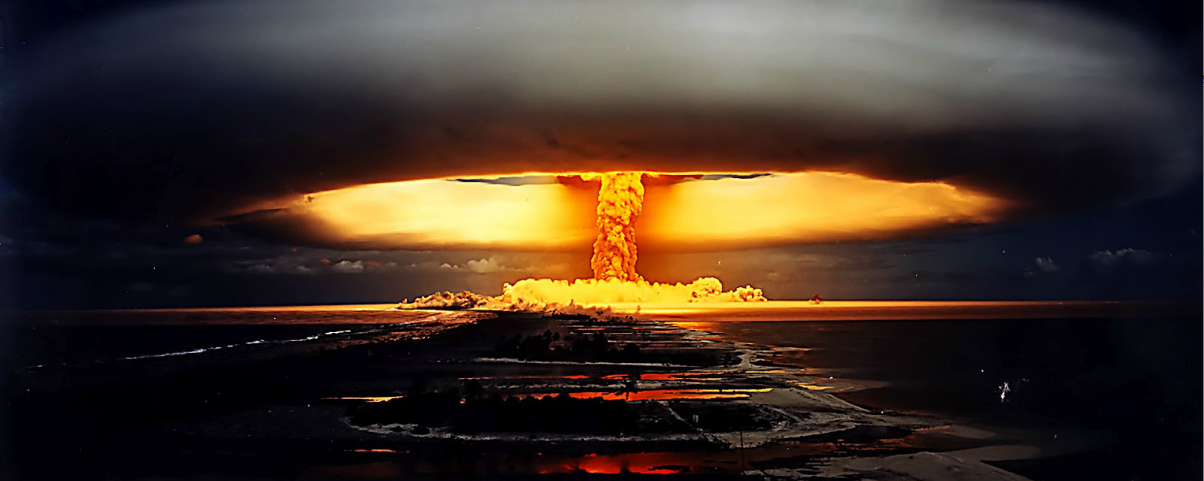
Featured Image: CTBTO, Licorne test 1970, French Polynesia. Available on Flickr.
- Although, as an aside, it takes a lot of very precise high explosives to initiate a nuclear explosion, by shaping a detonation wave into a collapsing implosion which compresses the nuclear fissile material into a critical mass and causes the nuclear explosion. ↩︎
- Nuclear weapons are so powerful that scientists and engineers came up with an entirely new way of measuring their effects. 27 kt means 27 kilotons, or the same blast effect as 27,000 tonnes of TNT. Remember the 500 tonne stack of TNT we saw a few weeks ago in our lightsabers post? That’s a lot of explosive, and made a very impressive bang. But this bang was “only” 0.5 kilotons TNT equivalent, a tiddler in nuclear weapon terms. They go all the way up into the megaton (millions of tonnes of TNT) range. ↩︎
- Logarithmic: each equal step along the graph is ten times more. If you plotted these effects on a “normal” linear scale, you’d only really see the blast effect between 1 and 10 seconds, everything else would be a scrunched-up spike around zero. ↩︎
- Strictly speaking, gamma radiation is part of the electromagnetic radiation spectrum, along with x-rays, visible light, etc., but the definition excludes these other effects. ↩︎
- Unless you’re a cyborg, android, replicant, or other such transhuman. ↩︎
- There’s plenty to criticise, and I’ll refer you to a real live nuclear weapons expert to break down this scene and many others. One thing he doesn’t mention, which always bothers me, is how Indy somehow manages to avoid being turned into pink goo when the fridge 1) gets kicked out at thousands of miles per hour and 2) lands on the hard dirt of the desert. Even if the fridge is made of a magical adamantium material, the human inside is not, and is subjected to the same accelerations. ↩︎
- Sources vary, and it is impossible to get exact figures. Due to the scale of the destruction, it was not easy for the authorities to compile accurate records. It’s worth quoting in full Col. Stafford Warren, the Chief Medical Officer of the Manhattan Project (testifying to Congress in 1946. and quoted here):
“One very great source of confusion was the fact that the Japanese themselves had no information, no precise data. They did not know what the population of either city was beforehand. They had very little way of telling how many people had survived or had returned to the city.
I am embarrassed by the fact that even though I led a medical party which was supposed to get figures on the mortality, and so on, that we could not come back with any definitive figures that I would be able to say were more than a guess.
The only actual fact that we could get at the end of the second month of study, at the beginning of October, was that at Nagasaki they had recorded the burning and cremation of 40,000 bodies. It is my belief that there must have been 20,000 or 30,000 more in the ruins, buried or consumed by the fire.
The data in Hiroshima was likewise inadequate and I see no way of putting a precise figure on the mortality or how a precise figure can ever be put on the total casualties.” ↩︎ - I was discussing this with a friend, and he made the very valid point that this is because we humans have an understandable tendency to prioritise our own safety and good health. If we are unfortunate victims of a nuclear attack and are (as is likely) incinerated in an instant, well then our capacity to worry has also been incinerated. However, if we survive, then we’ll quite rightly worry about the radiation threat from fallout, and not give as much thought to the poor souls who have been vaporised. ↩︎
- If you recall from last week’s footnote on the topic, putting a number after an element indicates what isotope it is. Cobalt-59 is the ordinary non-radioactive version of the metal, and it would surround the weapon. When the weapon detonates, the many neutrons emitted would travel through the cobalt and many would be “captured” by the Cobalt-59, turning it into Cobalt-60 (because it has one more neutron in its atom), which emits gamma radiation. ↩︎
- Cobalt-60 has a half life of about five years, which makes it ideal for fallout (insofar as something so horrendous can be “ideal”). A shorter half life would generate more dangerous radiation, but it would dissipate quicker. A longer half life, the opposite. For Cobalt-60, the initial fallout contamination would give you a lethal dose in 30 minutes. After five years, the radiation is half as powerful and a lethal dose would take one hour (that’s what a half-life means). After about 50 years (ten half-lives), the dose would be low enough that you could spend up to four days walking around without immediate effects (although you’d be increasing your risk of cancer). After 100 years, the dose would be considered within the bounds of normal background radiation, albeit on the high side. After 130 years, the dose would be negligible. The above from the Wikipedia entry. ↩︎
- “Fissile” material just means material whose atoms can “fission” or split in two. Fissile radioactive are different properties of a material. For example, natural uranium (U-238) from the ground is more radioactive than “weapons-grade” uranium which has been enriched to mostly U-235. U-238 won’t fission, but it will poison you. U-235 (and weapons-grade plutonium) is slower to poison you, but God help you if you accidentally make a critical mass of it. U-238 is also called “depleted uranium”, and there’s a whole other post I could write about that. ↩︎
- It undergoes natural radioactive decay and is one of the reasons why geothermal energy works. ↩︎
- The novel had the main antagonists being a radical group of Palestinians, but they were left out of the film screenplay to make it more appealing to an international audience. ↩︎
- To the extent that normal bridgewire electric detonators are no use whatsoever, since they have an uncertainty measured in milliseconds, which is an eternity in a nuclear weapon context. ↩︎
- A euphemistic militarism to describe bombing cities indiscriminately. ↩︎
- Fire-starting ↩︎
- I didn’t have time to get into thermonuclear weapons (also known as hydrogen bombs, H-bombs, or fusion bombs) in this article, but I might return to this subject at a later time. ↩︎


Leave a Reply