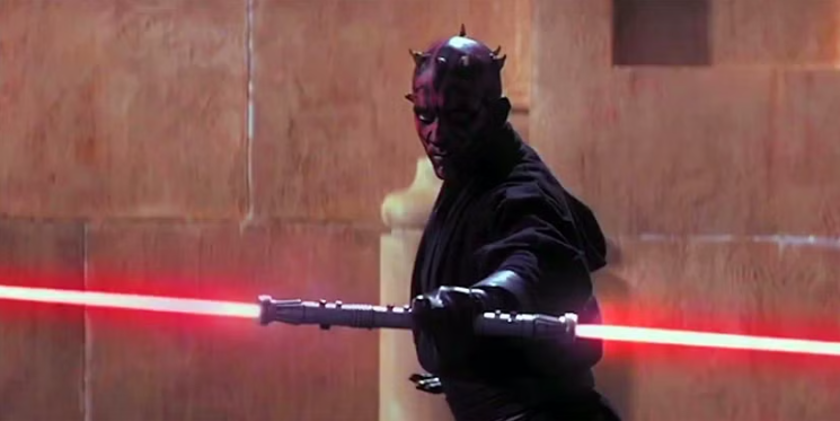
The limitations of melee weapons.
Hello again! This week we are returning to the theme of science fiction weapons (check out Part 1 and Part 2, both on lasers), but taking a close look at one specific example: the lightsaber1 from Star Wars. From its first appearance…

…to its overuse in later instalments of the series…

…the lightsaber is a defining aspect of the franchise and of the Jedi (and Sith, or “dark” Jedi) Knights. It’s even used to great effect by pirates, despite Cartman’s objections in South Park:
The lightsaber is a sword with a “retractable”/disappearing blade which is made from a bright, hot, substance which can cut through almost anything. We’re going to look firstly at the technical aspects of the technology: does it make sense? Then we’ll look at how it’s used in Star Wars, and determine whether it is actually a useful weapon.
As always, thanks for reading! Please do comment below if you think I’ve missed anything or if you just you vehemently disagree (you can also comment if you agree with me). Please subscribe using the button below so that you’ll never miss a post, and please like and share this post with other science fiction aficionados.
If you enjoy this blog and want to support it, please consider a donation. Keeping this blog going doesn’t cost much, but it isn’t free either, so any help would be very much appreciated👍
Technical teardown: science fiction or magic?
I would love to believe in the plausibility of lightsabers, since they are undoubtedly one of the coolest science fiction weapons out there: they cut through anything2, they deflect blaster fire, and they make a cool sound as the blade swings. Unfortunately they don’t make a lot of sense from a technical point of view.
I’m borrowing heavily from this Nautilus article on the science of Star Wars weaponry: would highly recommend reading it. In short, lightsabers are either light-based or plasma-based weapons. Each option has some evidence in favour, and some against:

On the balance of evidence, I would lean toward plasma (especially given that Star Wars blasters are also deemed to be plasma weapons), but this raises additional questions.
The most important, for me, is that lightsabers never seem to run out of energy, despite outputting enormous amounts of power. We’re told that a kyber crystal3 sits at the heart of each lightsaber. Some sources claim that the crystal powers the weapon, others that the crystal is a focusing mechanism for a different power source within the hilt, e.g. the “Diatium power cell” shown in the diagram below:

We also know that lightsabers last a long time: generations. Let’s do some back-of-the-envelope calculations (which you can feel free to skim over and read the headlines, if calculations are not your thing):

So 24 kW, or the power of a large home heating system, might not seem very impressive. But remember that a house’s boiler is fed by a constant stream of electricity or fossil fuels (how can I forget, says you, when you get a bill every month for it). The lightsaber is a self-contained system. Let’s do another calculation (yay?) to see how much energy we need:

We’re getting there! Now we just need to find some materials that give us an energy density of 20 million MJ per kilo, and we can start building us some lightsabers. What are our options?

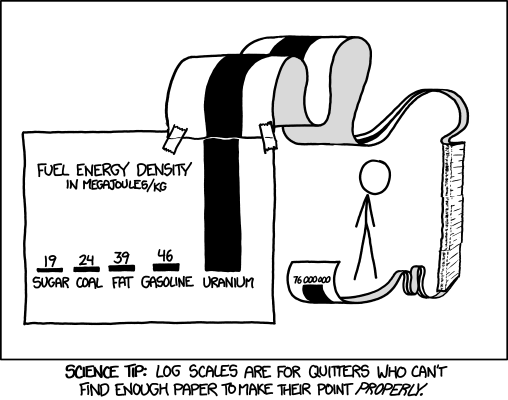
Ah, we don’t have very many great options. We need something that has 20 million MJ/kg and 95 million MJ/litre, and the graph tops out at 150 and 40, respectively. So we’re more than a little bit off the chart. Luckily, we do have a nuclear option: the nuclear option. As xkcd taught us, we just need to make a big enough graph and then we can see the potential of nuclear fuel:
This will work! Uranium gives us 76 million MJ/kg, and we need 20, so we’ll get nearly four generations of use out of one lightsaber if we assume it’s undergoing a similar type of nuclear reaction in extreme miniature inside the lightsaber.
There’s one problem with this, of course (there are many problems, but I’m being generous). Carrying around a miniature nuclear reactor on your belt is an even bigger temptation to disaster than inadvertently activating it (as we’ll discuss below). One must assume that damaging the lightsaber hilt (such as in a lightsaber duel) would destroy whatever containment the power source is using and would trigger a rapid energy release. What would happen if all that energy was unleashed in one go? Twenty million megajoules also happens to be the energy stored in 500 tonnes of TNT (a high explosive). Luckily for us, this is exactly the amount of TNT that was detonated in Operation Sailor Hat, an experiment designed to simulate the effects of a nuclear explosion (after the world more or less agreed that doing actual nuclear explosions for these tests was a bad idea):

And here’s what the ensuing explosion looks like:
All of this suggests a better use for these Diatium power cells: just use them as a nuclear superweapon instead of powering a fancy sword. Because, as we’ll discuss next, a lightsaber is not a useful fighting weapon.
Tactical considerations: this isn’t the weapon you’re looking for
Let’s dispense with the notion that the lightsaber is a useful weapon. It is not. It is more of a liability to the wielder and of limited utility against the enemy.
Lightsabers would be an extreme liability for their users…
Let’s examine the effects of a lightsaber on the poor Jedi who needs to wield it (even discounting the mini-nuke risk we discussed above). Firstly, the way it’s held on a belt when inactive poses a massive risk which always makes me cringe. A single button activates the weapon, so the user is only ever a careless brush away from severing their leg or gonads with an unexpected beam of plasma.

Carrying a lightsaber like this is akin to keeping a fully automatic Uzi in your pocket with ammunition loaded and cocked, no safety catch, and the trigger guard removed. And I’m not saying that people don’t do that, but they suffer the consequences: accidental or negligent gunshots happen tragically often due to unsecured ways of storing the weapon. But for the Jedi, a highly trained military force, this level of risk should be unacceptable. And don’t even get me started on the increased level of risk posed in dual-wielding lightsabers or carrying a double-ended one:

When ignited (activated? Unsheathed?), the lightsaber makes a loud and distinctive sound and shines brightly to all potential targets. “Look, everyone,” it says. “A Jedi is here. Right over here, in fact.” A beam of plasma at 10,000 degrees Celsius is a giant beacon summoning all the attention toward the poor Jedi. At the same time, the sudden flash of light will blind said Jedi to everything else around them:

The heat is another problem, one even worse than the visual impairment. A metre-long column of plasma at 10,000 degrees will be very uncomfortable for the wielder, especially when they habitually go without any kind of personal protective equipment. This would be an even bigger problem in lightsaber duels. To quote Nautilus:
Expecting some free-floating plasma to clash with some other free-floating plasma is like … expecting soup to clash with other soup
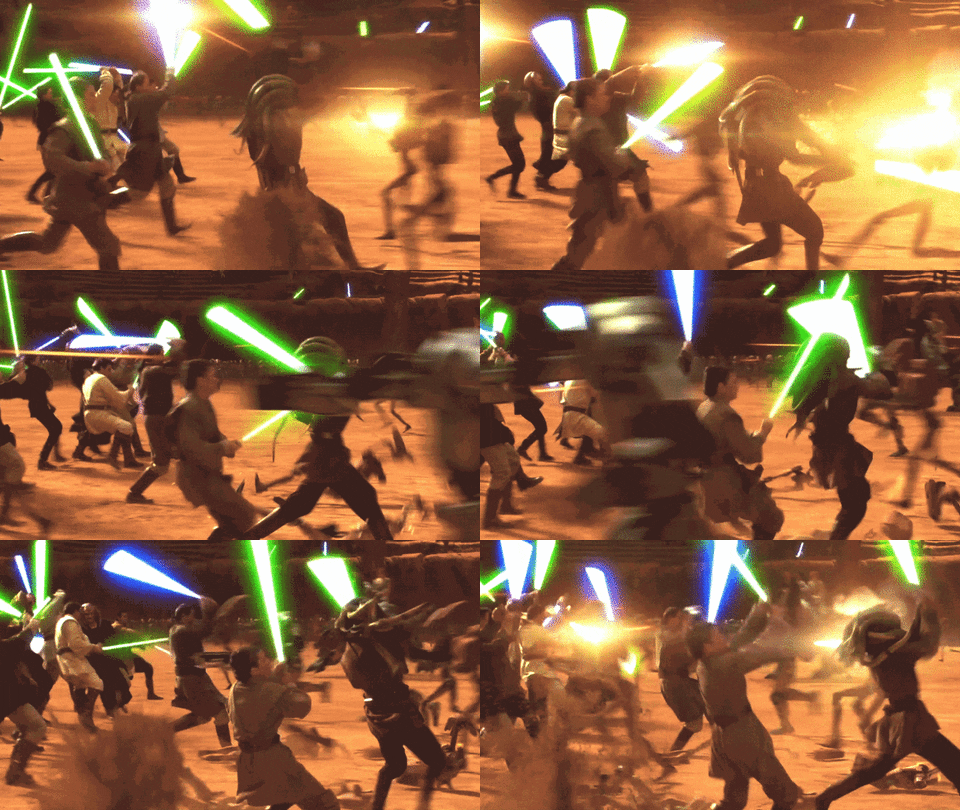
In lightsaber duels, instead of the sparks and static noises we get when two blades meet, we should instead expect showers of plasma which will fall indiscriminately on each combatant, burning holes in them.
As a weapon, therefore, a lightsaber would pose serious dangers to the user. Surely, though, this can be justified by the effect it has on the enemy?
…and would have limited effects on the enemy
Unfortunately not. Lightsabers are very fancy swords, but they are still swords: if you don’t want to be sliced apart by one, then don’t be within two or three metres of a Jedi. It really is as simple as that4. Okay, so they can deflect blaster bolts back at the firer:

This is only plausible when the enemy are up close and personal, in which case (as we see) it’s as easy to just hack them to bits. We discussed previously how blasters are much worse than firearms because they travel so slowly and are highly visible: I’d love to see Jedi trying to deflect a hail of bullets in the same way. I suppose the reason they can do this is their Force abilities, but this is purely a defensive measure: it’s a bit like Neo’s bullet-dodging abilities in The Matrix. Below are just a few ways that you can defeat a Jedi with a lightsaber:
- Rapid fire blaster bolts aimed at different parts of the Jedi: the lightsaber can move quickly, but it can’t be in two places at the same time. Aim for the bottom of the legs and the head at the same time.
- Exploding projectiles: Use a proximity fuze so that the sneaky Jedi can’t destroy the warhead with the lightsaber
- Flamethrowers
- Lasers: Jedi might be fast, but they’re not speed-of-light fast
If the Jedi need to have a cool melee weapon to show off their strength and agility, then some sort of bladed staff would be just as (in)effective, and without many of the significant downsides of lightsabers.
Star Wars isn’t the only science fiction franchise preoccupied with hand-to-hand combat. Dune features extensive hand-to-hand combat between elite space knights. The rationale for this is the personal shield units which soldiers normally wear and which protect them from fast-moving projectiles, but are useless against slower threats such as swords and knives5. Then there’s Warhammer 40k, which abounds with “power” swords, hammers, maces, and other melee weapons which are augmented with an energy field:

Conclusion: A status symbol
Lightsabers undoubtedly have a “wow” factor as weapons. I’m not sure I’d fully agree with Obi-Wan when he called them “an elegant weapon, for a more civilised age.” I’m not sure what’s elegant about a mini nuke spitting out hot plasma which may well blind and burn the user while slicing holes into anyone unfortunate enough to getting within swinging range.
Not only are they inelegant, though, but the technical challenges in getting them to work would be substantially greater than shown in the films. From powering it to not burning or blinding yourself, the lightsaber is more of a threat to the user than it is to most opponents. Why does it exist, so, in our long-ago, far away galaxy? There are two big reasons:
The first, as always with these movie critiques, is that screen storytellers have very good reasons for including lightsabers: they’re very cool. From their appearance, to their sound, to their merciless effect on every material aside from “lightsaber”, they are a defining feature of the Star Wars canon. They mark who the good guys and the main bad guys are, and they give us some excellent one-on-one duels which you simply wouldn’t get with ranged weapons. So I’m glad I like in a world which can dream up a lightsaber, while being equally glad I live in a world where they are practically impossible.
The second, more coherent and canonical reason to defend the use of lightsabers is as a status symbol. Jedi Knights are galaxy-roaming warrior-monks whose goal (outside of the events of the films) is to keep the peace. Violence is supposed to be a last resort for a Jedi Knight. In this context, it makes sense that their primary weapon is a little bit useless. It’s not envisaged to be used overmuch. If a Jedi is lightsabering his or her way through a situation, something has gone terribly wrong.
In this sense, the lightsaber is like a pistol or a ceremonial sword in a modern-day military. I’ve written before how a pistol (at least in the military) is less useful as a weapon and more useful as a signifier of rank or purpose, e.g. that the bearer is an officer. The lightsaber is the Jedi Knight’s status signifier: anyone dangling one off their belt is a serious person, with serious powers and (more importantly) the might of the Jedi Order and the Old Republic behind them. It won’t do to cross them.
But what do you think? Is a lightsaber really as useless as I’ve made it out to be? Is it something more than a Jedi’s status symbol? Would you choose to carry a lightsaber, if you had the choice? Let me know what you think in the comments below! If you enjoyed this, please subscribe to never miss an update. Please also share this article with like-minded folks: I really appreciate your help in spreading the word! Thanks for reading, have a great weekend, and I’ll talk to you again next week.
Featured Image: Star Wars: Episode 1 – The Phantom Menace, 20th Century Fox (1999)
- My text editor insists this is not a word, but offers “lightsabre”, “lightsabers”, and “lightsabres” as acceptable alternatives. Go figure. ↩︎
- Except other lightsaber. ↩︎
- Not Khyber, as autocorrect tries to tell me. You’d have to assume the filmmakers were inspired by the real-life example of the armour-penetrating Khyber knife, or Pesh-kabz, of Afghanistan fame. ↩︎
- There was a great PC game years ago called Jedi Knight 2: Jedi Outcast, where you could throw your lightsaber like a boomerang, greatly expanding the range of attack possible. To my knowledge, however, this type of attack only happens once in the films, in Return of the Jedi, but it’s a straight thrown and pickup, not a boomerang. ↩︎
- As a technology, this is pretty baffling. It’s presumably a design choice, but why would you limit the shields to a certain speed of attack? Why not block swords and knives? ↩︎




Leave a Reply