Introduction
Explosive Ordnance Disposal, or EOD, is a specialised military (and sometimes civilian) capability which is all about making dangerous explosive threats safe. It also occasionally crops up in TV and films, usually as a way to add tension to a climactic scene, but occasionally as the story itself (e.g. The Hurt Locker, which I have devoted a whole section to below).
It’s one of those niche military skillsets that somehow our hero is always fluent in, regardless of whether he is an international secret agent or a municipal police detective. Regardless of who’s doing the bomb disposal, the actions themselves are portrayed as tense. The stakes are high because the consequences for failure are total:

This is the part where I’m supposed to say that EOD is actually pretty humdrum. In time-honoured fashion with this blog, I ought to rain on your childish belief in the inherent coolness of a job. I ought to tell you that the cool parts are grossly exaggerated and the lame admin bits take up most of one’s time.
I ought to, but I won’t, because it isn’t true. EOD actually is cool. It’s genuinely, unequivocally, unapologetically cool. I never felt as accomplished as I did in the EOD truck, with blue lights on and police escorts front and rear, speeding through the city to get to the scene of the task. EOD incidents draw crowds, and every eye is on you as the police bring you through the cordon. What’s more, everything you do is in the public eye, so it’s a high-stakes bit of improv theatre performed to an extremely fickle audience.
No matter how rigidly you’ve followed procedures and relied on your education and training, no matter how many precautions you’ve taken and safety measures you’ve put in place, there’s nothing like the adrenaline of pressing the button and waiting that fraction of a second (which feels like an age) to hear the bang—the right kind of bang, the bang that marks one infinitesimal but oh-so satisfying victory in the great war against explosive threats.
Awesome and all as EOD is, Hollywood still manages to take quite a few liberties. Sometimes this is forgivable for the sake of drama, sometimes it’s just incoherent or farcical. There are also aspects of EOD which (in my biased opinion) are just as gripping as the big explosions but are usually overlooked.
I put this page together to collect some of my weekly articles on EOD and weave it into an overall explainer for you. I’ve gone through a few Hollywood examples along the way so you can see what works and what doesn’t. I’ll start with a less Hollywood-y but very common EOD scenario: the buried bomb from WW2. Then I’ll talk about improvised explosive devices, focusing mainly on car bombs and bombs in cars (there’s a difference!) because that’s where a good chunk of Hollywood’s attention goes. Then I’ll talk about what it’s like to wear the bomb suit before covering manual neutralisation techniques, a.k.a. snipping red and/or blue wires (another Hollywood staple). I’ll finish on a case study of The Hurt Locker, since it’s arguably the archetypal EOD movie.
If you haven’t subscribed to the blog already, please do so here and never miss a post:
Because this is a collection of previous posts, I don’t have upfront sections on “here’s what EOD is” and “here are the different types of EOD,” or “here are the principles of EOD.” For starters, this would entail a lot of extra work on my part, so I’m sorry. Secondly, I worry that it could drag us down a dull rabbit hole of obscure military terminology, when we really want to just jump right in and talk about things blowing up. Thirdly, I certainly don’t want to give the impression that this is an online EOD lesson. It’s not. If you want to learn this (awesome) trade, then find a recruiting office near you.
Conventional Munitions Disposal a.k.a. “Make that old bomb go bang.”
My friend, who lives in Germany, has had to endure several bouts of evacuation over the years when unexploded WW2 bombs were found during construction. Germans take such things as a matter of course, but my friend is an expat and was definitely not used to this type of disruption where she came from. Thinking it was another example of German officiousness, she asked me (and I’m paraphrasing slightly):
“Why do they take such extreme precautions? I mean, it’s been in the ground for eighty years and hasn’t gone off yet. It’s hardly going to go off now… Is it?”
If you’ve ever wondered the same thing, then read on to find out why EOD is such complex work. In essence, the risk comes from uncertainty. Bombs are surprisingly intricate machines, and, with so many lying dormant for so long underground, there are many bad things that can happen. EOD teams have many ways of dealing with unexploded bombs1, but the most important part of any EOD operation is getting everyone out of harm’s way, and this is where the disruption comes in.
Caution comes from uncertainty
If you’re not sure about something you should take extra precautions. This is especially true in EOD, for obvious reasons. Doing EOD with historic munitions always means dealing in uncertainty. Bombs, even WW2 era ones, are more than just big containers of explosives. They are sophisticated machines with many moving parts. Like all machines, there can be uncertainties in manufacturing and reliability which get compounded by decades spent underground.

Getting bombs to explode is surprisingly complicated
Bombs, like all munitions, are engineered to stay safe and inert (with minimal maintenance) for months or years in storage, and then detonate violently when dropped on a target:

The trick to achieving this is to cleverly manipulate the explosive train. Recall in our Expendables article that an explosive train is how you get from a small initial impulse to a large and violent detonation:


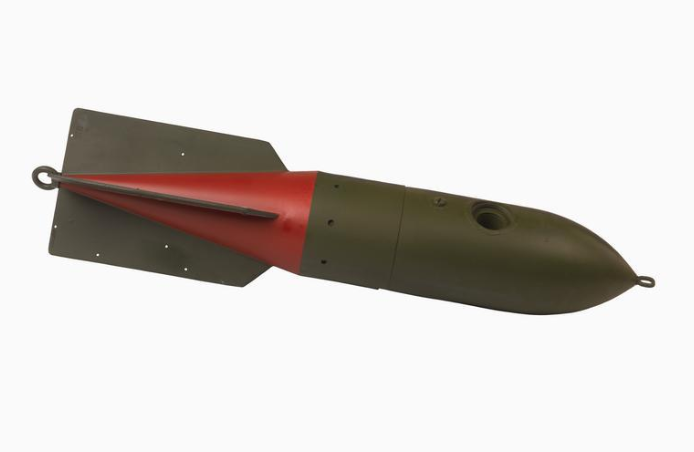
As you can see above, most of the complicated parts of the explosive train are in a part of a bomb called the fuze. The rest of the bomb is simply additional bang, with some fins for aerodynamic stabilisation and a lifting lug or two. The bomb shows is a German “Sprengbombe Dickwandig 50”, which means “thick-walled explosive bomb”. The “50” refers to its weight in kilograms2, and the series ran up to SD-1700, which, as you might guess, was a much bigger 1.7-tonne monster. Of course there are aerodynamic and weight and structural design challenges with making bigger bombs, but the fuzing—the complicated part—can be identical, so all you’re adding is marginal “bang”.
To keep bombs safe in storage (and in fires, plane crashes, bullet impacts etc.), the fuze uses mechanical and electrical components to keep the explosive train “out of line”, so that the accidental initiation of a sensitive primary explosive detonator does not set off the rest of the train and the whole bomb. An elaborate sequence of events needs to happen in the right order for the bomb to detonate. A typical example might be:

A bomb will not reliably detonate by simply dropping it from a great height. Note my use of the word “reliably”. It might, so don’t go dropping bombs out of planes on top of people just because I said it was okay (dropping anything heavy onto people from planes is not okay; bombs more so). A lot will depend on the type of explosive used3, but it’s certainly not a reliable way to get the bomb to go boom.
But as you know, we put fuzes on bombs for this very purpose. So why do they fail?
Mass production means many failures
To put it simply, when we make lots of something, then we will see every type of uncommon but possible failure. This is related to Murphy’s Law (“If there is a wrong way to do something, then someone will do it”) as well as the much less fun statistical Law of Large Numbers.
This is made more difficult when one design principle (such as safety, a.k.a. “will it explode unexpectedly?”) works in a contradictory way to another (e.g. reliability, a.k.a. “will it explode on the target?”). A feature which boosts the effect of one principle will detract from the other:

A very simple example of this would be a removable fuze, like we saw above for the German SD-50. You store the fuze and the bombs in separate storehouses4 so that if the fuzes explode accidentally due to having all that scary primary explosive inside, then the bombs will still be fine and you’ll be saved a much bigger and more catastrophic explosion. And, of course, you screw the fuzes into the bombs before the flight. But you can guarantee that someone, somewhere, will forget to put on the fuze, or will not screw it in far enough, or do any one of dozens of things which will prevent the bomb from exploding when it hits the target. So you’ve made it safer, but marginally less reliable5.
Leaving aside human error, there are all kinds of unlikely but possible mistakes that can arise during manufacturing. As with everything that’s manufactured, cost is a major factor, as shown above.
During World War Two, the Allies dropped over a million tonnes of bombs on Germany, and Germany dropped 40,000 tonnes on the UK during the Blitz. Taking a very rough average bomb size estimate of 100 kg, that works out at ten million and 400,000 bombs, respectively. That’s a lot of bombs. The estimated failure rate of these bombs was 10%, for all the reasons we discussed above. Most of these failures would have been found and dealt with at the time by EOD teams, but many were not. A half-tonne bomb falling from the sky can make a big hole, even if it doesn’t detonate. So it’s not a huge surprise that many of these failures were forgotten about in the chaos and confusion of blitz, destruction, and subsequent reconstruction. This is why these bombs keep surfacing, often literally, during construction works in German and British cities. Adam Higginbotham (of Midnight in Chernobyl fame) wrote an excellent article for the Smithsonian Magazine explaining the technical and human side of UXOs in Germany. It contains an excellent graphic showing how a mechanical-chemical fuze with an anti-tamper device works, and also how the same fuze failed to initiate the bomb when it penetrated the soil and came to rest nose-up:

Lest we think that this is a uniquely WW2 phenomenon, Belgian farmers still unearth 150 tonnes of WW1 UXOs from their fields every year. Modern weapons such as cluster munitions can have even higher failure rates, with an estimated 25% of the four million submunitions6 dropped on Lebanon during the 2006 war remaining as UXOs after the conflict.
Now that we’ve seen why bombs land without exploding, let’s consider the effect of the subsequent time spent buried underground.
Decades underground does strange things to a bomb
Here are two pictures of a German SC500 bomb. The first is from a recent EOD operation, and the second is a contemporary photo:

What are the differences? Perhaps it’s more apt to ask what the similarities are, since there are so few, at least on the face of it. But the EOD team dealing with it has to figure out its identity as a vital first step to dealing with it. They do this be measuring its length and diameter, overall shape (despite the mud and corrosion), and any markings (which are unlikely when the bomb is in that condition). They will also consult old records of air raids to see what types of bombs were used where and when. There’s also quite a lot of cooperation these days between German and UK authorities on the technical specifications of their own WW2 bombs and fuzes, since these keep coming up in the others’ cities.
Identifying the bomb is important because the EOD team needs to know:
- What is the main explosive? This is important because it has the potential to do the most damage to people and property.
- What other explosives are present as part of the explosive train? This is important because time and harsh environments can do funny things to explosives and make them unpredictable.
- How does the fuze work? This is important because it tells the EOD team what to do and what not to do. E.g. for an impact-initiated fuze, don’t kick it7.
Time and environmental factors affect these three things. In some cases, accidental detonation is less likely, e.g. if rust seizes up a clockwork fuze so that the firing pin can’t physically strike the primary explosive. In other cases, an accident is more likely, e.g. a safety pin corrodes and allows a detonator to come into line with a booster. The problem for EOD teams is that they don’t know what condition the fuze and the explosives are in. You saw the pictures above: these things will be caked in rust and dirt. X-rays might help a little, but only if the bomb is sitting in a favourable position to take an x-ray image (for instance, this would be very difficult or impossible in the case of the SC500 above). WW2-era bombs have been known to detonate if handled roughly, often with tragic results. For example, a digger struck a buried bomb in Germany in 2014, detonating it and killing the operator. Hitting a bomb with a digger would normally not cause it to initiate, but some combination of the state of the fuze and the environmental degradation meant that it was much more sensitive.
In summary, then, there are a few questions which EOD will most likely be unable to answer:
| Question | Can we answer it? |
|---|---|
| What is it? | Almost certainly |
| How is the fuze supposed to work? | Probably |
| Why didn’t it work? | Unlikely |
| What state is it in now? Is it safe to move? | Unlikely |
Once a bomb is (literally) unearthed, the (literal) alarm bells ring and a police and EOD job kicks off to answer these questions. That’s what we’ll talk about in the next section.
Getting a bomb out of a built up area is unsurprisingly complicated
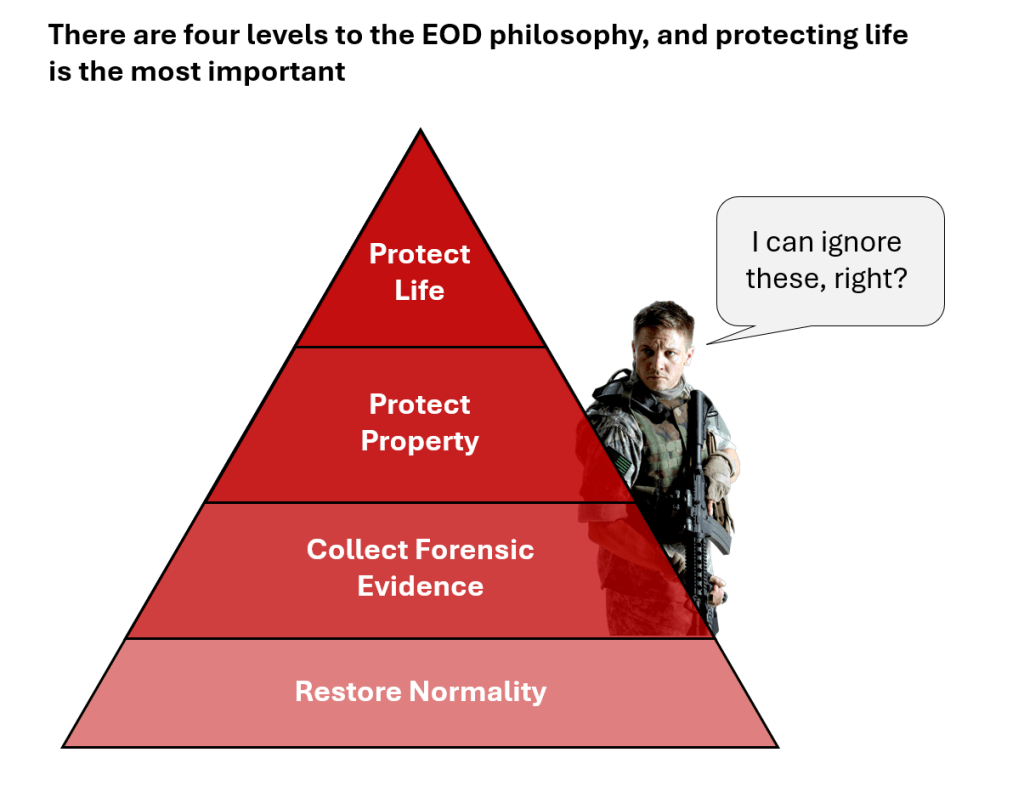
When police discover a bomb, they will call a specialist EOD team. These might consist of military specialists, as in most of the UK, for example, or they could be civilian, as in Germany. The EOD team’s priorities will be protecting life, protecting property, and restoring normality, usually in that order8.
A long, small bang is preferable to a short, big bang…
A bomb, fundamentally, is a store of chemical energy. It’s designed to release that energy all at once on a target. When an EOD team finds an unexploded bomb, they want to release the energy somewhere else besides the target, which means taking the bomb somewhere remote and detonating it there. If they can’t do that, usually because the bomb is deemed unsafe to move, then they might try the next best thing and try to release the energy slowly, either by burning it out or by doing a controlled “low order” explosion, which is a non-technical term for anything less than a full detonation. Here’s an examples of what I mean:
See how half of the shell body came away intact, rather than breaking into small fragments? This means that the explosion was a lot less powerful and took a lot longer than a normal one. By contrast, take a look at how an artillery round is supposed to detonate:
These are different munitions, but still I hope you can appreciate the difference between the first “low order” explosion and the full “high order” one where the energy was released hundreds of times more quickly and with tiny, fast, and lethal fragments.
The obvious preference of everyone involved is to do the least destructive thing, but you always prepare for the worst to happen and, for that reason, you get people out of harm’s way. The only people who stay in harm’s way are the EOD team themselves. While they will obviously do everything in their power to carry out actions safely, the inherent uncertainty of the machines they’re dealing with mean that it can be deadly: at least 11 bomb technicians were killed in Germany since 2000.
…but you need to prepare for the worst
Once a bomb9 is discovered, the first thing that happens is a cordon and evacuation. The police cordon off an area a certain radius from the bomb and evacuate everyone within. The cordon can be as small as 100 m or as large as 1.5 km (see below). Obviously the bigger your cordon, and the more built-up the area, the more people you need to evacuated, and therefore the longer this stage will take.
While the evacuation is happening the EOD team can build some “protective works” around the bomb. These can consist of hundreds and hundreds of sandbags or dozens or much larger “Hesco” baskets, but in either case, the aim is to contain the blast and fragmentation effects of an explosion. You can see the aftermath of such protective works (including remnants of Hesco walls) in the photograph below taken after the detonation of a WW2 German bomb found in Kingston, near London, in 2019:


Nothing ever happens in EOD until the cordon and evacuation is complete. The size of the bomb, as well as the drills and procedures of the EOD team, will determine how wide the cordon is and therefore how many people need to be evacuated. A handful of recent examples from Germany and the UK illustrate this:
| Year | Location (link) | Size of bomb | Numbers evacuated | Cordon radius |
|---|---|---|---|---|
| 2016 | Augsburg (link) | 1,800 kg | 54,000 | 1,500 m |
| 2017 | Frankfurt (link) | 1,800 kg | 60,000 | 1,500 m |
| 2017 | Birmingham (link) | 250 kg | At least 80 (overnight) and major routes closed | 500 m |
| 2023 | Düsseldorf (link) | 1,000 kg | 13,000 | 500 m |
| 2024 | Plymouth (link) | 500 kg | 10,000 | 300 m |
As with everything public safety-related, police and EOD need to make a local assessment and balance the risk from the bomb against the risk caused by disrupting people for hours or days at a time. The cordon ensures that, whatever the EOD teams do, they can do it safe in the knowledge that their actions are extremely unlikely to kill or injure other people should things go wrong. This is why cordon and evacuation is the most important part of EOD.
Conclusion: The most disruptive aspect of EOD is also the most important
There’s a well-known story in EOD circles about the importance of cordon and evacuation. I couldn’t find open-source verification for this, so I’ll leave out the specific details10.
During an infamous terrorist bombing in a city centre in recent years, the well practiced EOD team were able to deploy their robot to the suspect device before it exploded. They were about to take disruptive action which probably would have rendered it safe, but needed a cordon in place. Unfortunately a member of the press chose that moment to break the cordon and try to get a good picture of the robot doing its job. The police saw him and alerted the EOD team, who paused their operation while the police went back into harm’s way to forcibly remove the photographer. While hustling him away, the timer ran down and the IED detonated, injuring many and destroying large amounts of property.
The moral of the story is that evacuations are the only way to ensure you achieve the first and foremost pillar of EOD, which is the protection of life. Despite all the technical training and fancy equipment which EOD teams have, the most important part of our job is done by the beat cops. It starts before the team gets there and ends after they leave. And if it isn’t done right, then nothing else we do matters.
And that’s why my expat friend, on moving to Germany, had to learn that her new life now includes WW2-era bomb evacuations. Rare though they might be, they are very disruptive, but a necessity for the EOD technicians who travel the other way, against the tide of escaping locals. These brave men and women face the uncertain threat of a deadly machine which was assembled long ago in a factory far away, then dropped from thousands of feet and buried by decades of concrete and soil. And they do it over and over again, in towns and cities across the country, and will be doing it for years to come.
Dealing with conventional munitions is difficult enough, but the task becomes much more difficult when we (or rather, when the baddies) start to make improvised explosive devices (IEDs), or homemade bombs. Let’s talk about those next.
Improvised Explosive Device Disposal a.k.a. “Don’t let that car explode.”
Let me be very clear: I am not going to tell you how to blow up a car. So if that’s what you were looking for, please look elsewhere. Unfortunately there are plenty of internet resources for this, with generative AI adding its own two cents and helping/not helping (depending on your perspective). If you’re dumb enough to try to make explosives based on what a chatbot tells you, then you’re beyond my ability to help.
I will, however, tell you how not to blow up a car or, more specifically, why many of the car explosion methods we see in film and TV are unrealistic or impractical. Yes, as always, I’m going to ruin some of your favourite films and TV programmes.

Because there’s a bit of meat to this topic, I’m going to split it over two sections. First we’re going to look at how TV terrorists make their jobs needlessly difficult. Then we’re going to look at the reality of car assassinations using explosives, and talk about how intended targets really ought to behave (vs. how they do in films).
Perpetrator behaviour
Overview and nomenclature
I’ll structure this section into two smaller parts. In the first, I’ll talk about how TV terrorists use far too much explosive in their car hits. In the second, I’ll talk about (and rate) the various ways baddies trigger cars to blow up in films.
Before I start, though, let me clear up some nomenclature. I’m deliberately not using the term “car bomb” to describe an assassination using explosives in a car. In my understanding, a car bomb is a vehicle-borne improvised explosive device (VBIED11), i.e. a car (or van, or truck) packed with lots of explosives, designed to destroy large numbers of people and/or lots of property. Some sources (e.g. Wikipedia) use “car bomb” for both types, but I think it’s helpful to keep them as very separate concepts in your mind. I’ll go into more detail below, but just wanted to get that out of the way. Here’s an example of what I mean:

As a rather obvious aside, that scene from Lethal Weapon 3 makes the former bomb disposal operator in me cringe… there are no words to describe how bad this is.
Secondly, and conversely, I’m using the term “terrorist” in a looser manner than normal style would dictate. Many vehicular assassinations are carried out by criminals rather than terrorists, even more so in media than in real life. This is probably due to my own military bias, where we see terrorists as a more sophisticated and dangerous enemy than “mere” criminals, and tailor our tactics accordingly. Of course, this is not always the case, especially when it comes to bombs in or on cars. So please forgive the loose terminology.
Blast size: Too much of a good thing means problems for bombers
When a TV baddie wants to kill someone, they don’t take half measures. They pack way more than the required amount of explosives into the car, then they add a bit more for safety, then they double it:

You might assume from examples like this that they don’t just want to kill the driver, but most of the people on the street as well, and maybe a few folk the next town over.
Why is this a problem? Well, there are two things at play here. There’s terrorists over-egging the pudding for dramatic effect, and then there’s Hollywood’s explosion inflation ratio, where small charges make big, fiery blasts (which I’ve covered before). But if we focus on the terrorist, then we should ask why they would want to put more “bang” there than is needed to kill? You might argue that they want to send a message, or to be sure of getting the job done, and these are fair enough. But they have three big reasons to keep it small:
- Explosives are hard to come by, so you won’t want to waste them in overkill. Bear in mind that you don’t just need enough “bang dough” to kill the one target who is the focus of this movie, you need enough to kill all of your targets, plus all the practice efforts required to perfect the device and rehearse the attack12.
- More explosive means a bigger device, which is harder to conceal and takes longer to emplace13, raising the risk level for the bomber.
- Killing bystanders is usually not the aim of an assassination, and only tends to alienate the criminal/terrorist organisation, depriving them of much-needed local support.
Despite TV terrorists’ over-ambition, of course, we still see characters surviving what should be lethal explosions (e.g. Casino below), but that’s just the Hollywood hero armour we’ve come to expect.
Initiation methods: Realistic ways to make it go bang
The car ignition method brings challenges
It’s one of the most recognisable death scenes in film: a character gets into their car, puts the key in the ignition, twists it, then has a sudden premonition of doom (maybe we get a close-up of their shocked face) before the shot cuts to the car exterior and we see it blow up spectacularly in a ball of flames. It’s iconic, it’s dramatic, it’s terrifying, and it’s not how I (or probably any terrorist nowadays) would choose to kill the driver of a car.
Before we get into the whys and wherefores, let’s consider a few examples of this “vanilla” initiation method from film and TV:

Before we dive into some criticism, let’s take a moment to appreciate the old-school special effects in Casino: you can see where they replaced Robert De Niro with a dummy just before the explosion/fireball.
Okay, using the car’s ignition to set off the bomb: let’s be positive and start with the pros—why would a terrorist use this method?
- Firstly, every IED needs a power source to initiate the detonator, and every car has a battery, so there is a lovely and deadly symbiosis here.
- Secondly, turning the ignition is something which you know the target will do. They have to do it to start the car. Therefore it’s something you can target = a “targetable action”. Remember this phrase, we’ll come back to it next week.
- Thirdly, and most importantly, by using the car’s ignition, we’re relying on the target to set off the bomb. In military parlance, this makes it a “victim-operated” IED. This means that the bomber, after planting the device, can scarper and be out of physical and legal harm’s way when the device actually initiates.
Unfortunately, that’s it for the pros of using car ignition initiation. What are the cons?
- Firstly, and this is honestly the biggest one for me: you need access to the inside of the car14 to plant the bomb. You need to find ignition wires, hook up your detonator to these (while praying you haven’t connected to a live wire accidentally—see the next point), then conceal your actual bomb somewhere close by, then hide the bomb, the wires, and all evidence of your tampering. If you already have the car keys, then there may be better ways to kill your target. You could mess with the brake lines or the steering, or even just hide in the backseat and strangle them once they get in15.
- The second reason not to rely on car ignition is safety. You, as the bomber, need to emplace the device while breaking into the target’s car, which is probably in their driveway or a car park. At any moment you might be found out, so you’re under pressure. You’re also working in a cramped space. All of this is to say that the potential for connecting the wrong wire is there. Unless you’ve practiced beforehand on the same make and model, or tested the wire first with a multimeter, you will have a brown-trouser moment when you first hook up that detonator, hoping you got the right wire. Not a good idea. Self-safety is an issue with all victim-operated IEDs, but especially in this case.
- Thirdly, and for the same reasons as above, using the car’s ignition will be less reliable than using your own pre-prepared power source in a pre-prepared and pre-tested device.
- Fourthly, with a pre-prepared device, the time taken to emplace it will be much shorter. You can just attach it underneath the driver’s side door with magnets and be on your way (this is the preferred approach for modern terrorists). This is much easier and less stressful than messing around with wires in the engine compartment or driver’s footwell.
- Fifthly, and finally, there are other, potentially better targetable actions that you can use, especially if you have the keys of the car. You could target the lifting of the door handle, for example, or the weight of sitting on the car seat. Although it’s played for laughs, the scene in Wise Guys where Danny De Vito, as the “junior man”, is starting the boss’s car, gets this right:
A final quibble with this method is that some scenes show the victim trying to start the car, and the engine turning over a few times before the bomb detonates (e.g. The Pelican Brief) If the link to the car battery is what does it, then the very first instance of turning the key will have the desired effect (albeit being a bit less dramatic).
Remote control is a riskier proposition for the perp
A sophisticated criminal or terrorist might add some spice to their car assassinations with remote control detonation, as in the film examples below:

Remote control gives a strong sense of the terrorist being in control, like a spider at the centre of a web, pulling all the strings. In technical terms, blowing up a car via remote control is a special example of a command IED. The advantage of command IEDs is the level of control they give the bomber: they choose exactly when the device initiates. The disadvantage is that the terrorist needs to be nearby, so it’s riskier than a victim-operated device. This scene from Scarface shows the advantage and disadvantage of command IEDs:
There are two minor issues I’ll take with the above clip: firstly, the lump of plastic explosive under the car just seems to be smushed onto the underside, whereas the receiver unit is attached with magnets. There is no way you would trust the stickiness of plastic explosive (which, in any case, isn’t particularly sticky) to not fall off as soon as the car hit bump. Secondly, the baddies are a bit too close to the target car for their own safety and for making a clean getaway afterwards.
In general, though, this type of initiation can be plausible, but only if you account for the extra work and risk to the terrorist. For example, in The Dark Knight, the judge seems to be killed by a command device controlled by someone who can see when she looks up (that’s how it looks to me, but I’m keen to hear other hypotheses). This means that the Joker, or someone from his organisation (?) is sitting in a bush or another car nearby, waiting for the judge to get in, open the envelope, and look up. Why? Just for cool points? We know that the Joker is all about this, but we, the audience, are the only people who get to appreciate this coolness! The only person who is in the car and who reads the piece of paper gets immediately atomised.
Command detonation is car assassinations isn’t unheard of, but it takes a sophisticated criminal or terrorist enterprise and lots of coordination. The bomber needs to be there, or somewhere close nearby. So you’d better have a good reason for doing it that way (like they did in Scarface, for example).
Before I wrap this section, a special mention must go to The Transporter 2. Not since The Expendables have I seen such a silly scene (thanks again Jason Statham). The sheer idiocy of this scene might merit its own blow-by-blow takedown sometime. Watch this space.
Timed devices warrant a (brief) mention
Before finishing, we’d better say a little bit about the third way that terrorists can initiate an IED, which is probably the simplest method: the passage of time. Timed IEDs are very common (insofar as IEDs themselves are common). They can be much simpler than the victim-operated or command IEDs described above, and are the usual way of setting off VBIEDs, i.e. large car bombs (remember the distinction I drew above between a car bomb and a bomb in a car). However, one place we don’t often see timed IEDs is targeting somebody in a car. There’s a simple reason for this: the success of a timed IED lies in knowing exactly where your target will be at a given time, and it’s very hard to predict where somebody’s car will be at an exact time, since people move and cars move.
On the other hand, if your target is a building (these don’t move), or a military base (these don’t move quickly), or civilians out shopping (they move, but you don’t care which people you kill, provided you kill some), then a terrorist might use a timed IED.
With that caveat, and just for completeness, let’s see two examples where a timed IED might have been used to target somebody in a car:

For Michael Collins, the first thing we need to say is that this never happened. The IRA16 of the 1920s did not use bombs in cars (or car bombs, for that matter) in a way that the IRA(s)17 of the 1970s-90s very much did. However, for our purposes, let’s take the film at face value and try to figure out how they have managed to carry out this assassination. We know they have at least one man on the inside of Dublin Castle, but it stretches credulity to think that Ned Broy (Stephen Rea’s character) managed to plant it and would willingly choose to be so close when it exploded. In any case, what triggers the bomb? It can’t be the ignition, because the car was started before the target got in. It explodes before the car moves, but after the targets sit in and visibly move the car with their weight. It couldn’t have been a command IED, which only leaves a timed device. This is also implausible, because it would assume that the bombers knew exactly when the target was due to get into the car. I’ve included it under “timed” more so to argue the point, and maybe to illustrate why this isn’t a great fictional addition to an otherwise great film.
In The Godfather, we see Fabrizio running away just after planting the bomb which was supposed to target Michael, but kills his wife Appolonia instead, since she decided at the last minute to move the car. This could be a victim-operated IED, designed to initiate when the car moves. It could also be a timed device, however, and I suspect this is more likely, but with the same caveat: how did Fabrizio know that Michael was going to be in the car at that exact time? I suppose you could argue that he didn’t, and that’s reflected in the fact that poor innocent Appolonia gets killed instead. This is a very real issue with all IEDs, but timed ones in particular: they are indiscriminate. As an aside, I think that this explosion is done very well. It seems to emanate from the back of the car and is a very large blast, which would make sense if the bomb was in one of the suitcases which Fabrizio loaded immediately prior. The shockwave is quick and deadly and very obvious: there’s none of the slow-mo jumping away from explosions which we often see on screen.
Conclusion: Perpetrators
As usual with these posts, I’ve ended up somewhere different to what I expected when I started. I thought it was going to be primarily about the car ignition method of setting off a bomb, but my research18 revealed the amount of on-screen car assassinations that used different triggering methods. Moreover, I have never in my career heard about an IED which was wired into a car’s ignition, but found two real-life examples while researching this post: one from 2007, and the other from 1978, a mob killing. So, although I stand by my critique of it as a method, it’s clearly included for a historical reason in some films.
What I did find, however, was that regardless of the initiation method chosen, films use a car explosion as a shorthand for nefarious ability. Blowing up cars with little visible effort or preparatory work is the preserve of a certain level of baddie. A good example of this is Law Abiding Citizen:

Gerald Butler’s vigilante character is an ex-CIA killer, which (in Hollywood logic) means he has the know-how and resources to turn anything in a bomb, including (among other things) the cars in the clip above. Not only can he initiate the cars from his prison cell19, but he also manages to lock the doors so that people can’t get out as cars around them explode.
If I can sum up Hollywood’s understanding of terrorists, it’s as a sort levelling-up character in a role-playing game. Once a character becomes badass enough, killing people via car IEDs is just something that comes naturally:

In fact, blowing up cars is never easy, can go wrong in so many ways for the terrorist, and is a lot messier and less flashy than the films usually show.
This week we focused heavily on the terrorist, the criminal, the bomber, the perpetrator—the person behind the attack, whatever he’s20 called. We discussed the various options open to a terrorist who wants to carry out car assassinations, and why many of the on-screen depictions are unrealistic. In most cases, this boils down to a simple fact: blowing up a car is (thankfully) a complicated thing to do, and films don’t put enough thought into how and why a terrorist will go to such an extent of trouble to get their target, aside from the cool visuals.
Next week we’re going to stay on the topic of car explosions, or UVIEDs, to give them their technical term. We’re going to look at the grisly reality of car assassinations and then compare this reality to how Hollywood targets seem to act (spoiler: not very believably). While film baddies get an easy ride, making their bombs with no difficulty, film targets do little or nothing to make life difficult for the terrorist.
Target behaviour
This week is the promised follow-up to last week’s discussion on exploding cars in film and TV, and how screenwriters don’t really understand how terrorists and criminals go about achieving this grim feat of engineering and chemistry. Last week we looked at the tactics that a bomber might use, including the size of the bomb and how to initiate it. We looked at the three main categories of IED: victim-operated, command, and timed, and saw that the first one was the most practical for a would-be terrorist.
This week we’ll focus more on target behaviour, i.e. those unfortunates in film and TV who get blown up (or narrowly dodge same). We will set the scene for this with a discussion of the real tactics used by terrorists and some unfortunate real-life examples of car assassinations.
So, with that in mind, let me give you a word of warning. We’re going to discuss some pretty nasty killings and show some pictures of cars which were blown up with people inside them. I’m not going to be gratuitous for the sake of it, but it is a grisly topic and so a certain amount is unavoidable. You can sit this one out, no shame, and I won’t include it in the final exam.
And just to remind you again from last week, I’m deliberately not using the term “car bomb”, since this (in my experience) is used to denote a car full of explosives which is designed to kill a large number of people and/or destroy property. Instead, we’ll use the unwieldy “a bomb in a car”, or the jargon-y “UVIED”21, or the even more unwieldy “in-car assassination using explosives”.
The reality of UVIEDs is grim
So, I said at the top that I wasn’t going to tell you how to blow up a car. And I still won’t, because I have no desire to end up on a watchlist22. I will discuss, in non-technical terms, some of the characteristics of real vehicle assassinations.
The abbreviation used for a “bomb in a car” is UVIED (under vehicle improvised explosive device23), which is quite telling in itself. Historically, these IEDs are placed underneath a car, usually underneath the driver’s seat. They can be rigged to initiate when the car moves, or else with a remote-control mechanism. They have to be big enough to kill the target, but small enough to fit under the car and not be too conspicuous. In the now-familiar taxonomy from last week, they are “victim-operated” IEDs24.
They are used by criminals and terrorist groups the world over, with some differences in methodology from group to group and era to era. This isn’t too surprising: the “talent pool” of IED builders will never be massive25, so the same designs will be used again and again by the same group. Broadly speaking, some common tactics and techniques are:

Let’s take a grisly but necessary look at some of the examples above:
Airey Neave was a British Army officer who had been decorated for his exploits during WW2, including an escape from the notorious Colditz Castle POW camp. In his later life he became a Member of Parliament in the Conservative Party, and later rose to become a prominent advocate for the Unionist cause in Northern Ireland. He was targeted by the INLA26 with an IED underneath his car which was triggered by a tilt-switch (a common trigger for UVIEDs). As Neave’s car ascended an incline coming out of the Palace of Westminster, the device detonated. Neave lost both of his legs in the blast and died a short time later in hospital.

Maksym Shapoval was a Lieutenant Colonel in the Ukrainian military who played an active role in resisting the Russian invasion of the Donbas region. He was killed by a bomb planted in or under his car in Kyiv, with Russian agents presumed to be behind the murder. One bystander was injured in the attack whose aftermath you can see in the clip below:
There are some notable points about the attacks above which differentiates them from the movies. Firstly, the cars are not completely atomised, as they often are in films. The damage is very serious, but it’s localised to the area where the target (usually the driver) is located. Secondly, the victims often suffer a bloody, painful death where they lose their legs in the blast and then bleed out. We don’t usually see this in films. Thirdly, the devices are usually placed underneath the car, and don’t rely on the car’s ignition. Fourthly, and thankfully, they are rare. Although no consolation to the victims themselves, we can at least take some satisfaction in the fact that this isn’t as common as Hollywood makes it out to be.
It’s worth mentioning one film which I came across which does have a very realistic bomb-in-car scene, in that the actual victim is someone other than the intended target:
And, as a complete contrast, here’s the obligatory (for this blog) ridiculous James Bond clip. This time it’s from For Your Eyes Only, and the Q Branch of MI6 have decided that rigging Bond’s own car with explosives linked to a very movement-sensitive switch is a good idea:

What’s even less realistic than how readily that car blows up is how easily the window glass breaks. Unlike the examples in the next section, though, these poor mooks have no reason to suspect that the car will blow up27. Realistic behaviour on the part of Hollywood victims is hard to find.
Nobody checks their cars…
Hollywood characters are not ignorant of the threats facing them but seem to have a learned helplessness regarding doing anything about it. This is a shame, because UVIEDs (especially if they have the amount of bang shown in films) are easy to spot, if you look for them. The terrorist will be nervous and under time pressure when they emplace the IED, so it’s going to be hard to conceal it very well. A little bit of searching around the car would go a long way.

Of course, the difference is that you need to check your car every day, whereas the terrorist only needs to emplace the IED once. Still, for this reason, people who are likely to be targeted by criminals or terrorists (e.g. security forces during an insurgency) are often trained to check their car for UVIEDs before touching it. This can involve using long angled mirrors to see every point under the car, or can be as simple as an “eight-point check”:

Here’s some friendly Canadian forces doing an under-vehicle search at a checkpoint:
That’s not to say that these checks are foolproof (see examples in previous section), but they significantly improve your chances. However, we never really see Hollywood characters check underneath their cars before getting in.
Checking your car for IEDs serves two purposes. Firstly, and obviously, it alerts you to a threat to your life. Secondly, and more subtly, it alerts a would-be terrorist to the fact that you’re a vigilant person who will find an IED if they try to place one.
By carrying out checks, the potential victim can turn a “targetable action” into a non-targetable action. For example, if I leave my house every morning and, without stopping to check, pull the driver’s door handle to open the door, that’s a targetable action. A terrorist can place an IED under the car door which is triggered by either the door handle or the opening of the door. My action of opening the door is a targetable action. However, if I leave the house, pull out a torch and pocket mirror, and check under the car door before touching the handle, then there’s no longer a targetable action. I will see any IED before touching the door, and then obviously will not touch the door. Okay, the terrorist could hide the IED much better, but that takes more effort to make and more time to emplace, and I might still see it. In all likelihood, they will just find another person to target (or maybe another way to target me, but at least it won’t be in my car).
This doesn’t just apply to car doors, of course, but to every part of the car that the terrorist could potentially target. It also applies to the checks soldiers do for IEDs after dismounting from their vehicles. There’s a saying in counter-IED: you’re not doing checks to stop the IED which is there, but for the IED which could be there next time.
But—and this is where it really gets mind-boggling—we often see see Hollywood characters neglect their checks even when they think there’s a high likelihood of a bomb.
…even when they suspect a bomb
When a character in film or TV faces the threat of an exploding car, they still don’t bother to check for bombs underneath before getting in. In last week’s post we linked to the scene from Wise Guys where Danny De Vito is tasked with starting his boss’s car. It’s played for laughs, like this one from The Simpsons where Homer becomes a bodyguard for Mayor Quimby who receives a death threat from Fat Tony and the Springfield Mob:

It’s not always played for laughs, though. In The Sum of All Fears, the baddie Nazi suspects that he might be a target, so he gets his bodyguard to start the car for him:
I’m in two minds about this one. On the one hand, it nearly illustrates the idea of a “targetable action”. The bodyguard starts the Nazi baddy’s car for him because he’s paranoid (and quite rightly so). However, we can assume that the bombers know about his trick, and also know how he likes to light up before driving off. So the targetable action is pressing the cigarette lighter.
Why I still roll my eyes a bit here is because neither man does a physical check of the car to look for an IED or even signs the car has been tampered with. Whatever the difficulty in wiring up to a car’s ignition (which we spoke about last week), putting a switch underneath the cigarette lighter would be harder again, especially without leaving an obvious wire coming out and going to the bomb. The filmmakers are trying to be too smart here, because they know that we expect to see a car get atomised in a fireball. They give us what we want, but only after tricking us.
We see this again in The Irishman. Although it’s only in Jo Hoffa’s imagination that the car blows up, we still get that thrill as the audience:
But if we focus on her behaviour in the scene, despite how obviously worried she is, she still takes the exact same risk as in the previous clip. The only concession is that she makes sure to look sad and nervous while turning the key.
This is like running headlong toward a brick wall while grimacing at the pain you’re about to experience. Why not try to find a route around the wall? But maybe that’s just a part of human nature. Perhaps we don’t want to find the way around the wall.
Conclusion: Behavioural changes work, but require a will
To come full circle, I think characters in film and TV have an exaggerated learned helplessness which is not very realistic. At the same time, though, they are reflecting something which is a very real problem for militaries and security services around the world: people’s reluctance to see themselves as victims or targets, and therefore their reluctance to take basic steps to protect themselves.
Soldiers in conflict zones need to be trained and drilled and supervised and drilled again to make sure that they carry out basic counter-IED tasks. Even though their lives might be on the line, the threat doesn’t seem as real as the threat getting shot does. Or perhaps because the range of potential injuries is so much worse from an IED, soldiers simply choose not to imagine that outcome, and therefore take fewer precautionary measures.
I was once told28 about a US Army staff officer during the early days of the 2003 Iraq War gloating about how “dumb” the insurgents were. “The last seventeen IED attacks on our convoys where we took casualties, their tactics have been the same. They don’t change it up at all.” The point being, of course, that if the enemy are using basic tactics successfully against you, then you’re the “dumb” ones, not them.
Just because Hollywood reflects the worst traits of learned helplessness, doesn’t mean we should all follow suit. Of course the chances that anybody reading this will ever be threatened by an IED in their car is (thankfully) very slim, but it might still be good to learn what not to do from film and TV characters. So let me wrap up this week’s post with a quick “dos and don’ts” PSA.
Should you ever find yourself threatened by mobsters, criminals, or terrorists who have a track record of using in-car assassinations with explosives:
| Do | Don’t |
|---|---|
| Find a secure place to park your car, e.g. a locked garage | Be shy or coy about the fact that you’re checking the car. Remember, you’re doing it so they won’t target you in the future |
| Install an obvious CCTV camera (even one of the dummy ones) | Close your eyes and wince while turning the key: this won’t help |
| Do a quick 8-point check on your car before touching it if it’s been left out in the open | Forget about the other things they can target besides the ignition: doors, the boot/trunk, car seats |
| Better still: use a hand-held mirror and pen light (or phone camera and torch) to help with the above checks | Be afraid to call the police if you see anything unusual |
| Try to deal with any IED yourself, ever |
Now that we’ve established how you should respond to a bomb in your car, let’s turn our attentions to the poor old EOD operator who needs to come along and actually deal with it.
Wearing the bomb suit a.k.a. “Get me out of this thing before I throw up.”
In this section I’m going to answer a question I got a lot when I was still in service: what is it like to wear a bomb suit? This is also known as an EOD suit, a blast suit, or (if you’re my wife), a “bunny suit” or “gimp suit” (depending on how charitable/freaky she was feeling).
Bomb suits are something that everyone associates with explosive ordnance disposal (EOD), along with robots and “controlled explosions.” The lone operator walking toward a suspect device while wearing this heavy armour is one of the enduring images of the trade:


I’ll start out by describing the suits themselves: what they’re used for, and what they’re definitely not for. Then I’ll talk about the physical reality of having to wear one. I’ll wrap up by laying out what this means for the practice of EOD. In other words, how the limitations of the EOD suit constrain the actions of the EOD team.
What the EOD suit is… and what it’s not
A bomb suit is an all-over piece of modern armour which is designed to protect the wearer from the effects of explosions. Specifically, they protect against:
- Primary blast injury, i.e. the blast wave itself. This is a high-pressure pulse of air which can burst eardrums and slosh internal organs into jelly. The suit incorporates foams and gels which absorb some of this blast energy.
- Secondary blast injury, i.e. fragments from the bomb and things that are picked up and thrown by the blast wave. Fragmentation is the most dangerous aspect of any explosive blast. EOD suits protect against this with kevlar and hard armour materials covering most of the body.
- Tertiary blast injury, i.e. being picked up and thrown against something hard by the blast wave. The EOD suit protects against this by cushioning the spine.
The bomb suit weighs 35 kg and the helmet is another 10 kg. Some of the most popular versions come from Med-Eng. Their two latest models show some of the common features: a blast jacket with high collar, a helmet with full visor, an armoured chest-plate, blast trousers, and a “nappy” which you can’t see but which gives extra protection to the groin. The over-boots are always worn by models but never (in my experience) by operators.


You might wonder why, in both models above, the hands are unarmoured. This is because dexterity is crucial in EOD. You absolutely must have the full and unencumbered use of your fingers.
The only time that we wore gloves was to avoid contaminating forensic evidence, in which case they were blue latex ones which provided no protection to one’s hands.
You will note the general lack of gloves in the pictures below:

Can an EOD suit protect against every threat? No, of course not. If you’re working on a large improvised explosive device (IED) when it initiates, then you’re probably pink mist. But if it’s a small IED, like a pipe bomb, then the suit will likely protect everything except your hands (see above).
It also provides protection when you’re walking to and from the IED. Blast pressures scale off sharply with distance (to the extent that I doubt the death scene of the operator in The Hurt Locker was realistic, but I’m being pedantic).

This limitation aside, you might still assume from the above that a bomb suit provides far more protection than the usual combination of body armour, helmet, and (possibly) ballistic glasses or visor which soldiers usually wear to protect themselves. That might lead you to wonder why all (or at least more) soldiers don’t wear heavy protective gear like this into combat.
The first and less important reason is that bomb suits are not actually designed for ballistic protection in the same way that helmets and body armour are. The heavy, tough material which dissipates a blast wave is not necessarily the best protection against a hard impact from a rigid bullet.
Bomb suits are designed to withstand impact from fragmentation, sure, but this is balanced with the blast protection requirement. Besides, the fragments used to test bomb suits are not the same as bullets:

The second and more important reason that large protective suits aren’t on general issue is that they destroy your ability to run, crawl, take cover, aim, shoot, run again… basically, all the things that a soldier needs to be able to do.
There are many scenes in The Hurt Locker which make me roll my eyes, but this one is up there. Where the hell does he pull a pistol from? And what does he think he’s going to achieve with it?

I found an interesting discussion paper from the Sacramento bomb squad (.pdf link) which discussed the tactical problem of firing weapons while suited up. Pistols were actually half-okay (I would be a bit sceptical, but then again these guys are cops, so firing a pistol is much more important for them than it would be for someone military like me). Long guns were a no-go, unsurprisingly.
It turns out that wearing a bomb suit seriously hinders your ability to move. Let’s talk about that a bit more in the next section.
How the bomb suit feels to wear
Normally, when I get dressed, I do it myself. I’m lucky enough to have my own faculties but not lucky enough to have a valet or manservant to do this tedious task for me. Putting on a bomb suit, however, was the one time that I could stand still while someone else dressed me.
That was the only good thing about the suit. And even that wasn’t great. The EOD suit turns you from a reasonable thinking human being into a blithering idiot. All it takes is about thirty minutes of searching in the undergrowth for an IED.

EOD suits are so heavy and clumsy that your range of motion and agility are severely limited. You waddle around like a bad robot, shuffling on your feet to look different directions because it’s easier than turning your head. Getting up and down from lying to kneeling to standing (which you do a lot of) takes immense energy.
Your spatial awareness takes some adjusting in the EOD suit. As you might imagine, the job tries to give you a strong aversion to kicking or elbowing IEDs, even by accident. That’s easier said than done when you weigh 50% more, with a similar increase in physical volume. You learn to take your time, to always look twice before stepping anywhere, and to rely on slow, plodding movements.
This duel between the English King and French Dauphin in Netflix’s 2019 The King made me think about wearing an EOD suit. Not that I ever had to fight someone while wearing it, but the clunky, clumsy movements and the quick exhaustion brought back memories of my time in bomb disposal.
You’re supposed to spend no longer than 30-45 minutes in the suit at a time (shorter still if it’s warm). In practice, I’ve seen it pushed to an hour at times. You might also make several approaches during the same operation, returning to your truck and team in between to de-suit, drink water, and update the team on the plan.
The lazy operator (and I always had this weakness) will be tempted to cram more activity into each approach and therefore minimise the total amount of time spent in a suit. Because if there’s anything worse than putting on the heavy suit for your first approach, it’s putting on a heavier, dirtier, rain- and sweat-sodden suit for your fourth. This is a temptation which must be resisted, however, because longer approaches make for mistakes, and EOD is one of those trades which does not reward mistakes:

You can add “EOD operator” to the list above, although you might not last long enough to be fired (except in a literal sense).
But wait, you say. What about these famous air-cooling systems which are included in EOD suits? Surely, they make wearing it a pleasant experience?
Not quite. Any setting short of the maximum provides no relief, and this max setting itself comes at the cost of a jet engine roaring in your helmet, drowning out what little you could hear beforehand. You don’t need to worry about losing your hearing for too long, however, because the batteries (brand new before you put on the suit) inevitably run out halfway through your approach. When they do, your heat stress (which was only bubbling under the surface) bursts forth and threatens to take you down.
Still, you use it because it’s a damn sight better than the alternative, which is no airflow at all. You use it until it breaks down and then you limp back to your control point, strip down, and curse the system and the engineers who designed it, before carefully replacing every single one of the dozen or so batteries needed to make it work again (however briefly).
The EOD suit, in short, is a massive pain in every respect. But you wear it, because the rules say you have to it might just save your life someday.
Conclusion: What this means for EOD tactics
As I wrote previously, there are some seriously unsexy aspects of EOD to go along with the hero moments:

Planning is a crucial (albeit unsexy) aspect of EOD. An EOD suit, on the other hand, is not at all conducive to proper planning. You would find it hard to plan a piss-up in a brewery in an EOD suit29, let alone plan to defeat a complex and unpredictable explosive device placed by persons unknown with the aim of killing, maiming, and destroying people, property, and you.
What this means for EOD tactics is that the team makes the plan first, debates it, tests it, and practices it without the distraction and burden of an EOD suit. Only when the operator is happy with the plan and knows it inside out does he or she allow the team to dress them in a bomb suit.
I’ve written previously about how Hollywood gets radio communications wrong. Radios aren’t for making plans, they’re for executing plans which were already made, discussed, and rehearsed long beforehand.
With EOD suits, this tendency is amplified. I rarely used a radio for my manual approaches30. There was normally a pretty simple pre-arranged signal with the team to signify “abandon the approach and return to the control point.” There’s not much else that the team might want to communicate to you, since the correct response to nearly ever scenario will be to return to the truck, remove the suit, and determine the next step of the plan. Lord knows, you’re not going to make a good choice while you’re downrange, staring at an IED and wearing 45 kg of armour.
EOD suits are amazing inventions which have saved many an operator’s life and limb. They do have a trade-off, though, like any piece of technology. Cars make you fat, computers break your back, phones rewire your brain… and bomb suits make you dumb.

No matter how dumb an EOD suit makes you, however, you’re not likely to start cutting red wires (or blue ones, for that matter). Let’s turn our attentions back to Hollywood and this particular obsession they have when it comes to EOD.
Manual Techniques a.k.a. “Don’t cut the red wire.”
In this section we’re looking at “manual neutralisation” techniques31 (MNT), which is a fancy way of describing operators cutting wires and disarming bombs by hand. It is one of the most specialised and advanced EOD skills and is reserved for the most extreme scenarios. Not that you’d know this from watching films and TV, however, where it is de rigeur. Any action hero worth their salt needs to disarm a bomb or two at some stage in their franchise career. Never mind that they’re not even basic EOD trained, let alone MNT operators.
We’ll look at this dichotomy between Hollywood’s idea of manual bomb disposal and the (somewhat less exciting) reality. Then we’ll wrap up by examining some of the common clichés we see on screen when it comes to manual techniques and EOD in general.
Hollywood loves EOD manual techniques…
It’s a classic Hollywood climactic shot: our hero stands before an improvised bomb32, wire cutters in hand, staring down the mysterious mess of coloured wires set up by the nefarious baddie. No matter what’s happened in the story up until now, it all comes down to this moment: will our hero(ine) choose the correct wire to cut, or will they (and possibly many more people) meet a speedy end?


TV Tropes lists 37 instances of the cliché in movies, and another 91 in TV shows. There’s a “top ten” countdown of these scenes by WatchMojo.com:
Why are these scenes so popular?
- Character development. They’re a chance to show our main character being cool under pressure. This might be a redemption for some earlier skill or character failure in the film.
- Teamwork and trust. Often this is a chance for the hero to rely on the expertise of others, usually fed through a radio as they work on the IED. Do they trust the person on the other end? Does this person have the right information?
- Raising the stakes for the heroes. Success or failure comes down to a split-second decision. The audience gets a bated breath moment as the camera zooms in on the wire, followed by relief when the bomb is disarmed. This tension is higher still when the “which wire” decision is based on luck (extremely unrealistic, as we’ll see in the next section). Even when it’s based on skill, however, there’s always an element of uncertainty, and that’s what makes these scenes unrealistic.
…but the real EOD community does not
These scenes are unrealistic for three big reasons:
Reason 1: Humans don’t do this
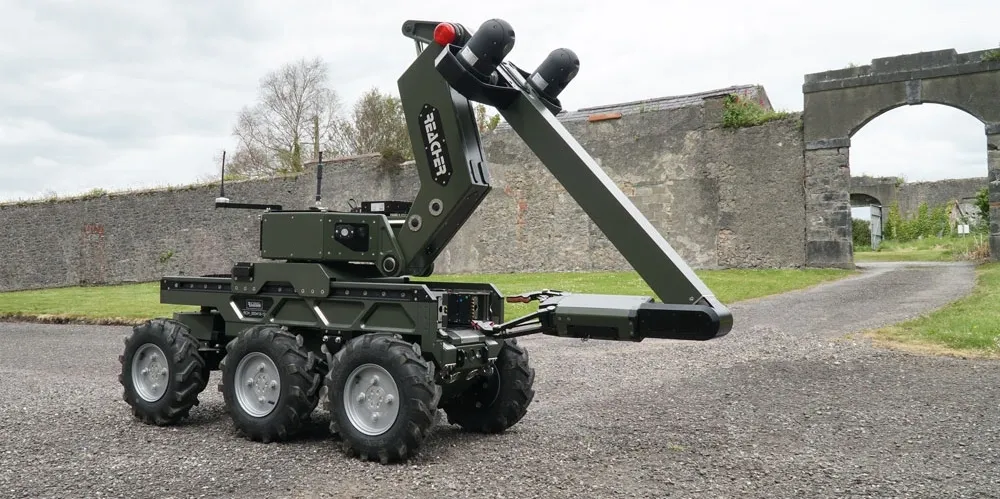
As I’ve said here before, real EOD teams use robots34 to make the first approach to an IED and to attack it. A robot can be replaced much more easily than a trained EOD operator. A significant number of the “red wire / blue wire” scenes could (and therefore should) be handled remotely. Just make sure you don’t get a self-aware robot like in The Simpsons:
As another reminder, protecting life is the most important part of the EOD philosophy, and that includes the life of the operator35:

The EOD community has learned the hard way that putting lots of operators in harm’s way means some get killed, and that’s not a good thing. Now, that’s not to say that EOD operators are shrinking violets who always throw the robot at a problem so they can stay safe and warm in the truck. They just have a very strict set of rules about when they can and can’t put themselves and their team in harm’s way. They spend a lot of time and energy practicing all kinds of manual approaches, so are more than ready to step up if needs be. There are places where a robot can’t go and times when more than just property is at stake. These high-risk situations can justify an operator suiting up (or not—see below) and making the lonely approach themselves.
Reason 2: Disruption is better than “finger-fucking”
We covered this one before in our Hurt Locker post as well, but there we were talking more about “targetable actions” as a reason for why pulling and prodding at a bomb is a bad idea. There’s a simpler reason, however: it’s usually much easier, safer, and quicker to “disrupt” the IED. This is EOD terminology for shooting the device with a shotgun-like weapon. Here’s the basic idea, with a primer on how electrical (and therefore most IED) circuits work:

You can pick up the pieces and figure out how it works later on, when you’re not counting down the clock to being blown to smithereens. Don’t do what James Bond does here:

Reason 3: Never cut anything unless you know both ends
Don’t do anything unless you’re sure what the outcome will be. This is probably good advice for many situations, but especially for bomb disposal. In the Rush Hour clip above Johnson uses a nursery rhyme to help her remember which colour wire to cut (we’ll talk about colours below). In Juggernaut, the hero cuts the red wire, even though he’s told to cut the blue one, because he doesn’t trust the information. There are many examples where the main character is at best going off a hunch and, at worst, simply guessing.
Needless to say, an EOD operator will never do this. You need to have a full understanding of the device before taking any action. If it’s a simple device (and the vast, vast majority of them are), then this will be a simple enough task.
Here’s an example from Walker, Texas Ranger. Chuck Norris casually removes the power from the circuit and then takes the detonator out of the lump of plastic explosive:
It’s still not advisable to be manually disarming bombs (see “finger-fucking”, above), even if you’re Chuck Norris, but at least he can clearly see the parts of the circuit and knows what wire goes where. He knows what he’s doing, and it’s simple, once you know how.
Of course, there is one massive stinking caveat here. Sometimes the bomber is smarter than the operator (or the operator has a bad day), and the operator gets the device wrong. To be fair, this probably partially explains why movie bombs have so many wires (but not fully, as we’ll see below): they have made deliberately complex devices which are hard for an EOD operator to make safe. Lest you think that this is a great way to wreak havoc, it’s worth noting that complexity does not necessarily equal effectiveness.
John Birges build one of the biggest and certainly the most complex IED which the FBI ever had to deal with, and planted it in a casino in Nevada in 1980 as part of a bid to extort $3 million. It worked, insofar as the feds couldn’t disarm the bomb: it exploded in the attempt, causing $18 million of damage, but thankfully killing nobody (due to the evacuation, of which more below). It failed miserably in the bigger picture, though: Birges didn’t get his $3 million, but did get life in prison after being caught.


The Provisional IRA started building booby-trapped IEDs like this during the Troubles. One such example was the “Castlerobin” device, which killed a British EOD operator. It was designed with a hidden compartment which had an anti-lift and anti-tilt mechanism, i.e. if the IED was moved, it would initiate. The response to devices like this is simple: disrupt them (see above) from a distance and then pick up the pieces. Smart bombers and tragically fallen comrades is the reason why EOD teams have adopted robots and disruption as their go-to tactics, rather than snipping red and blue wires. Speaking of red and blue wires, this next bit is really going to blow your mind.
Don’t trust what you see on screen
It bears little resemblance to reality, as the three examples below will illustrate. There are more holes I could pick, but these were the most fun.
Fantasy 1: The colours of a wire are significant
In electric circuits, wires are single or multiple wrapped cores of copper, surrounded by a plastic coating. The copper carries the electricity, and the coating insulates the wire to make sure the electricity doesn’t go off in some silly direction. The colour of the plastic coating has no bearing whatsoever on what the wire does.

This is important because bombs in moves are usually improvised explosive devices. The bomber can use whatever colour he or she likes for the wires making up the circuit. In fact, they will probably use whatever wires they can find inside a spare appliance36. It doesn’t need to look pretty, it’s going to blow up.
True, there are some conventions when it comes to wire colours. If you’ve ever wired a plug, for example, you’ll know the colour convention for live, neutral, and earth conductors (at least in Europe):

But these are industry conventions agreed by committee and used by hundreds of thousands of people. Even so, I suspect few electricians would go snipping wires based on colour alone without first checking and isolating the power. For IEDs, there’s (thankfully) no international trade body and no agreed conventions on wire colours.
Fantasy 2: You can see the countdown
Picture a movie bomb counting down, and you are almost certainly picturing a digital clock face, almost certainly red, something like this:

The big red digital countdown is great for us audiences, but it’s also very useful for our heroes: they know exactly how long they have left. Needless to say, clocks like this are not a common feature of timed IEDs37 in the real world, since they serve no purpose for the bomber and would just be an added bit of unnecessary electronic circuitry.
Often, however, a clock is used as the actual triggering mechanism: when the hands reach a certain spot, or a beeper starts, then this closes the firing switch. In these cases, the clock will look like an actual clock:

If a digital clock is used, it might not be counting down, but might be set to alarm at a certain time, in which case it might not be immediately apparent to the EOD operator how long is left. Another common timing mechanism skips using a clock altogether and just uses an integrated circuit, in which case you definitely are not going to know how long is left:

Fantasy 3: The wires are ready for you to cut
When the goodie reaches the bomb, chances are it’s innards will be laid bare, ready for the surgeon’s knife:

This is very convenient for our heroes (or it would be, had they any clue about how electric circuits work). Unfortunately, real IEDs would not be so easy. Most bombers use a nifty trick called a container. You put things inside it, especially delicate things that might fall apart or get snagged, like trailing wires. This concept seems to be almost entirely absent from Hollywood. Aside from giving the heroes easy access to the IED’s circuitry, it also hugely raises the odds of the device failing because of a wire coming loose accidentally.
If you want to see examples of what I’m talking about, browse the IED gallery in CAT-UXO, a website dedicated to raising awareness of unexploded ordnance threats. You’ll see some examples of easy-to-attack wires, but the more sophisticated IEDs will have boxes or tubes or plastic bottles or tupperware containers where the innards of the IED’s circuitry are kept secure and together. The most challenging part of manual neutralization is getting into the container (which might itself be booby-trapped, like in this MacGyver clip or the real-life Harvey’s Resort Hotel IED mentioned above). This is no mean feat, and is what contributes to this being such a niche skillset, as we’ll discuss in the conclusion.
Conclusion: Manual techniques are niche and not the answer to every bomb
Manual neutralisation techniques for IEDs are the preserve of the most highly-trained and skilled EOD operators38. MNT operators need to carry out keyhole surgery on intricate devices, often while they’re dealing with a panicked hostage or an additional hazard such as chemical agent hazards. They are the folks who are called when there’s a grave and immediate threat to life.
These situations do arise. One infamous one was when the FARC militia in Colombia placed a gruesome “necklace” IED around the neck of Elvia Cortéz, a woman who had been outspoken against the group. The device detonated as an EOD operator was trying to disarm it, killing both of them and wounding several police.

A similarly gruesome case involved the death of Brian Wells in Pennsylvania in 2003. This murder was the subject of a documentary mini-series Evil Genius. The victim of the necklace IED died minutes before the Erie Police Department EOD team arrived on scene, and there’s probably little they could have done for him had they arrived sooner. The team were on scene within 20 minutes of being called, which is a remarkable response time for a team which covers 14 counties and has four members.
What should we take away from this? Most EOD problems don’t require people cutting wires. For those that do, it’s unlikely that the specialists will be close at hand.
In the absence of a highly-trained MNT operator, what’s a decent action hero to do? A good start (and I’ve harped on about this before) is to evacuate the area and put in a cordon. This might not apply in all the above situations, but it definitely does in some, like when John McClane and Zeus mess around with a bomb while people play in the park right next to them. Get those folks away! Then you can do your little riddles. Better again, run away yourself too and let the bomb damage the fountain.
I promised I’d get to this. Let’s take what we’ve learned so far and apply it to The Hurt Locker, which is a realistic and well-researched depiction of the EOD life.

Case Study: The Hurt Locker
Winner of six Oscars, and with a 96% rating from critics and 84% from audiences on Rotten Tomatoes, the 2008 Kathryn Bigelow film has been described as:
- “The most literally exciting film you will see this year.” Ian Nathan in Empire.
- “Without a doubt one of the best war pictures I have ever seen, and I have seen most of them.” Ed Koch in The Atlantic.
- And this one, which we’ll definitely circle back to: “An unflinching look at the personal cost of being really good at a really tough job,” (emphasis mine), by Wendy Ide in the Times UK.
Against this tide of adulation, there is a small but vocal backlash against the film for its inaccuracies, such as James Clark’s “Here’s Why ‘The Hurt Locker’ Is The Worst War Movie Of All Time” and Kate Hoit’s “The Hurt Locker Doesn’t Get This Vet’s Vote”.
As you might have guessed from some of my previous comments, I’m going to come down more on the latter end of the spectrum. However, for all its faults, the film has many good points too.
To give the bottom line up-front, the film fails in its attempt (as I see it) to portray a flawed hero. In fact, Jeremy Renner’s character is not a maverick, lovable rogue who breaks the rules in order to get results. He’s an incompetent psychopath who breaks the rules and endangers himself and his team while failing badly at his job.
When I re-watched this film as research for the original post, I came up with an entire article’s worth of non EOD related problems with this film, and you can find that here.
The main character is an utterly awful person…
Jeremy Renner plays Staff Sergeant William James, who arrives in theatre to replace the previous team leader who died during an EOD operation (more on that below). James is a maverick. We instantly know he’s a maverick because he listens to heavy metal music while setting up his billet and, what’s more, he moves the barriers away from the windows to let more light in. Here’s a guy, the film is trying to tell us, who cares not a whit for the stultifying conventions of barracks life.
In fact, he’s an asshole. He’s offhand to the point of rude to his right-hand man Sgt Sandborn (Anthony Mackie), and he barely acknowledges the very recent tragic loss of Sandborn’s colleague, his predecessor. He’s a newbie in this theatre and already acts like he knows everything.

The only person James shows any humanity to is the locally-employed shopkeeper’s assistant “Beckham.” This is probably done to show his “human” side, in contrast to his normal behaviour:

Not content with being an asshole to his team, James also acts like a tool toward the locals. Winning “hearts and minds”, he is not. Why, for example, does he feel the need to press a gun to some poor taxi driver’s head and shoot out the guy’s window? It can’t be because he’s breaking the cordon, since James clearly doesn’t care in the slightest about the cordon, judging by his behaviour on other operations.

More damningly, he subjects his team and other friendly troops to unnecessary danger by taking ridiculous risks himself. The film does acknowledge this, but I think it’s shown in a more benign way than it really is. If you’ll allow me to put my head where the director’s is, and simultaneously bring in an old analogy from Team America: the film tries to portray Staff Sgt James as a dick, but he’s really an asshole:
Some of this terrible behaviour could be forgiven if he was a good operator who got things done and generally made life safer for the rest of the troops. Staff Sgt James is none of these things. I used to train troops going overseas in counter-IED tactics and principles. One of the most important lessons (and I even had a slide with this heading) was “Don’t be a dickhead.” Being a dickhead is a sure-fire way to annoy the local population and have them target you or your buddies. Staff Sgt James is terrible at counter-IED, but he’s also very bad at IED disposal (IEDD), i.e. targeting the device itself, as we’ll discuss next.
…and he’s also a terrible EOD operator…
This is the film’s biggest failing in my opinion. Although it’s never made quite explicit, the subtext from The Hurt Locker is that James is a good EOD operator. Sure, he might be a bit of a maverick, but he gets the job done, dammit! We see this in his interaction with the idiot Colonel Reed at the UN building:

Even if the film doesn’t explicitly say it, some of the fawning commentary (see above) shows that this is what people take from the film.
As usual, I’m going to be the bad guy who bursts your bubble. Staff Sgt William James is quite bad at doing EOD/IEDD. Let me explain.
He exposes himself and his team to danger unnecessarily
As we discussed already, James doesn’t care about his own or his team’s safety. The most important part of the EOD philosophy is the protection of life. This includes the operator’s life. In any military context, and EOD is no different, soldiers are not supposed to take unnecessary risks. After all, it takes months to train an EOD operator, which represents a significant investment. It’s not in Uncle Sam’s interest that one of his highly-trained EOD specialists dies for the sake of one operation, let alone his teammates too.

How should he do it differently? Here’s a list for him to get started:
- Use the robot. It’s more effective than you are in most situations (spoiler alert: most situations involve shooting the IED with a special anti-IED weapon). It’s also more replaceable, and less likely to be targeted by the enemy. Finally, it means you don’t get tired and end up making terrible decisions (more on this below).
- Don’t “finger-fuck” the IED. Forgive my language, but sometimes the military vernacular cuts right to the point. When you mess about with an IED, pulling and dragging on it, you make yourself very vulnerable. Remember our targetable actions from last week? Well, these especially apply to EOD operators. Every time that you prodded, kicked, pulled, moved, or licked a device, you gave the bomber a great idea for how to target you the next time. The entire scene with the multiple devices is a case study in how not to EOD:
We know well that the enemy were watching, both in that scene and in the one with the car bomb (which also included some horrendous manual actions, including kicking the car boot open). They even took videos of his actions:

- Wait for security (and use them). James, we know you don’t like waiting. But you can’t go ahead with your task until the area around you is secure and cordoned off. It’s the infantry’s job to have your back, so use them. And it should go without saying, but please don’t go haring off into the pitch black night of Baghdad’s back alleys with no security, then split up your team, then act surprised when one of them gets shot.
If James took the advice above, he and his teams would be much safer and Uncle Sam’s investment would be more secure. He would also have more time to plan, but that’s something else he can’t really get his head around.
He doesn’t plan anything
EOD sounds like a cool job and, to be perfectly honest, it’s pretty cool at times. But, like all cool jobs, it’s got its fair share of boring bits. Here are some of the sexy and unsexy aspects of EOD:

Planning your approaches on a whiteboard is definitely unsexy, but it’s crucial. As with all military operations, nothing happens without a plan. Now, planning doesn’t always happen behind a desk. It can happen in the turret of a tank, or a muddy ditch while taking fire. But we don’t generally make plans while wearing a bomb suit. It weighs about 35 kg39, with another 10 kg40 for the helmet, not to mention the equipment you’re carrying. Your physical and mental faculties quickly degrade in a bomb suit, no matter how fit you are. Especially in forty-degree41 heat. Instead, we make our plans at the truck (or Humvee, in their case).
Every time we go “downrange” in an EOD suit, we have a simple, step-by-step plan of what we’re going to do. We might even write out the steps on a waterproof notebook and tape it to our suit. Seriously: your mental faculties degrade rapidly in that thing. The mortal sin of EOD is so-called “hot planning”, i.e. changing your plan while downrange in the EOD suit. This is robustly drilled out of us in training, for the sad but important fact that hot planning got many EOD operators killed in the past. If we ever see something unexpected, we go back to the truck and make a new plan, with our team. We don’t drag on wires42 to find out where they lead:

The other advantage of planning is that is gives us a comprehensive view of the threat facing us. An amateur might go straight for the device which has been called in, but a professional EOD operator knows that their first priority is to ensure that they and their team are operating from a safe and secure location. That means relying on the aforementioned infantry for security (James doesn’t like waiting), but it also means having an awareness of the people and the items around you which could be hiding another IED. In the scene with the bomb factory in the school, James (as usual) rushes in before the security get there, and doesn’t even do a basic search of the immediate surroundings for IEDs. More importantly, he doesn’t stop to think about the situation: who are the enemy, and how might they target James and his team? The first step of any EOD response is the threat assessment, and doing this would have highlighted the obvious risk of staying where they were. Staff Sgt William James is directly responsible for the death of the medical office Lt Col Cambridge, but this is yet another failing he doesn’t have to answer for in the film.

He doesn’t have any forensic awareness
James has a box of mementoes in his room, bits of IEDs that “nearly killed” him. This includes the switch from the car bomb at the UN building and the battery from the multi-shell mega-IED. Recall from our EOD hierarchy above that preserving forensic evidence is a key part of the philosophy. Gathering evidence (bits of IEDs) allows Weapons Intelligence Teams (WIT) to build up a profile of bombers and help identify who they are and apprehend them. Gathering, photographing, and cataloguing forensic evidence is definitely one of the unsexy aspects of EOD, but, like most of the unsexy parts, it’s quite important.
The bomb factory in the school is a smorgasbord of forensic evidence, but he just leaves it after finding the dead child with the IED inside them. He tears the car apart to find a switch (before even removing the detonators from the shells in the trunk, which is quite frankly insane), but only so that he can admire it while enjoying his post-approach cigarette. I’m going to show the gif of him getting punched again, because it makes me happy:

…although the bar isn’t set very high
While the bulk of my ire is directed at the character of William James, we can’t wrap up without mentioning Staff Sgt Thompson, the operator who gets killed in the opening scene. He’s clearly a much better person than James, as he doesn’t go out of his way to get his team killed. And we do see a little bit of planning before he goes downrange (not as much as you would do in real life, but let’s leave some room for artistic licence here).
He still makes a few big mistakes, though, and these are what get him killed. Firstly, the wheel falling off the counter-charge wagon is a setback, but it’s definitely not a reason to abandon the robot approach and go forward in the suit.

Secondly, and without going down too much of a rabbit hole of EOD techniques, there are much more effective ways that he could have dealt with that IED, with the robot, and without the need for the little wagon. Thirdly, there was no consideration given to the threat to him from a nearby triggerman, despite the enemy having ample means, motive, and opportunity to kill him that way. It comes back (as always) to planning: a simple set of “actions on” for his team, along the lines of: “If you see someone take out a phone, shoot them,” would potentially have saved his life. Thompson is no William James, but it would be wrong to think he represents what “good” looks like either.
Conclusion: What’s the point of The Hurt Locker?
Who am I to say this is a terrible film, with all the accolades it’s received? The Hurt Locker not irredeemable: in fact, it’s got many good points, and gets a lot of things right, EOD aside. The film’s aim is to show how some people respond to dangerous situations by wanting more and more. In this, it succeeds, but it lacks a message or, I guess, a coherent moral. Sgt James is so clearly a terrible person and a bad soldier and leader, but suffers no punishment for his actions. In fact, he gets to carry on doing the same job again for another year, with seemingly no questions asked about the trail of friendly dead and injured he left in his wake.
“War is a drug”. The spoiler is in this quote from the opening scene. The Hurt Locker tells a story of a deeply damaged and antisocial individual who is a liability to himself and others, while doing an important job very badly. As a depiction of war it’s not bad, with many realistic elements (along with many unrealistic ones: I’ll do a full teardown next week). As a depiction of what “good” EOD looks like, it’s about as effective as this:

But the depiction of Staff Sgt James as an adrenaline junkie, while entertaining, is a little bit hollow. The implied message seems to be (at least in my reading, please feel free to disagree): “You need to be a bit of a twisted individual to do this job properly.” In fact, the opposite is true. Armies don’t want their men and women to be antisocial psychopaths. An army is a very social organisation, and relies on social bonds to operate effectively. A soldier who has normal fears for their own life, and cares about their comrades’ lives, but can subordinate those fears to the drills and procedures of training: that’s who you want doing the job of fighting. And in this important respect, The Hurt Locker falls short. As an atmospheric immersion into a warzone, it’s pretty good. As a study of the men who prosecute that war, it’s pretty bad.
Conclusion: The reality of EOD
A common point of discord between Hollywood and real life versions of EOD is the behaviour of the people involved. In film and TV you want swashbuckling risk-takers to stride in, act on instinct, and save the day with seconds to spare. In real life you want someone who takes the time to figure out what’s going on and takes only small and calculated risks.
Bombs are dangerous, and you can’t protect yourself from their effects by jumping away in slow motion. You can protect yourself (and others) by:
- Putting some distance between yourself and the bomb
- Using robots to do the dirty and dangerous work
- Thinking about the entire situation rather than just the device
- Making your plans when you’re in a protected space with your team
- Not doing anything you’re not sure about
- Wearing the damn EOD suit
As usual, we can give Hollywood a certain level of “pass” because they want to focus on the nail-biting drama. But also as usual, I’d like to issue a challenge to screenwriters to learn a bit more about the fascinating (and genuinely cool) world of bombs and bomb disposal. You could use this knowledge to make stories which are not only exciting but which are truer to life. You would stand out from the crowd and get a special devotion from the EOD community. Although we are small, we are very pedantic. And we have a lot of time to watch your movies while we wait around for more bombs to be found.
If you want to watch something that’s less Hollywood, more realistic, and still quite entertaining, then check out this trio of documentaries:
Cover picture: Reacher EOD robot (Reamda), via EOD Robots | Secure life group
- Terminology/jargon diversion for those who are interested. What I’m talking about in this article is a subset of what we call “conventional munitions disposal” (CMD), which is in turn a subset of explosive ordnance disposal (EOD). The other main branch of EOD is improvised explosive device disposal (IEDD), which I’ve written about before (especially here and here) and which encompasses everything from small pipe bombs to sophisticated car bombs. The bombs I’m talking about today are technically called “air-dropped bombs”. Any unexploded item of ammunition is often referred to as “unexploded ordnance” (UXO) or “explosive remnants of war” (ERW).
Other types of UXO you might encounter in CMD include artillery projectiles, grenades, tank ammunition, mortars, rockets, and even guided weapons. ↩︎ - The weight of the bomb itself, not the weight of explosive inside it. These bombs had a charge-to-weight ratio of 30-40%. ↩︎
- Explosives are graded according to their sensitivity, which is their susceptibility to initiation from external shocks such as impact, friction, heat, etc. Some explosives are very insensitive (especially in newer munitions, where they are specifically designed as such), but even “classic” explosives like TNT are relatively insensitive, at least when compared to primary explosives or organic peroxide explosives like TATP. ↩︎
- There’s a whole science and practice around what kind of ammunition you can store with others and, as a result, what kind of safety distances you need between each storehouse. This is interesting for us because of recent goings-on in Russia, and I’m planning a whole article about this. ↩︎
- Of course this is a very basic example taking a very unlikely case. Most armourers or ammunition technicians will know how to screw in a fuze. Most flight crew will check. But the possibly of human error is there, however slight, and that’s the whole philosophy behind Murphy’s Law. With enough examples, it will happen. ↩︎
- “Submunitions” are the technical term for the many small bomblets which are dispersed from a single “carrier munition”. The complete system is known as a “cluster munition” or “cluster bomb.” ↩︎
- It’s generally a good idea to avoid kicking any fuzes. ↩︎
- As we discussed in the Hurt Locker post, the EOD Philosophy also includes “collect forensic evidence”, but this is less important in CMD and especially so in the case of legacy WW2 UXOs. ↩︎
- Or any UXO, or even any IED. ↩︎
- You may know which attack I’m talking about. If you can find open-source verification then please let me know and I’ll update. Otherwise let’s keep it anonymous. ↩︎
- I apologise in advance for the heavy use of abbreviations in this page. ↩︎
- Oh, you’re going to pass on practice devices and rehearsals? Well then, good luck. Let’s see how that goes for you. ↩︎
- This seems like a normal word to me, but my diligent copyeditor has suggested “place” instead. Maybe I’m too used to the military jargon, but “emplace” has a narrower, more specific meaning to me, which is more appropriate when we’re talking about IEDs. Forgive the jargon. ↩︎
- Or potentially the engine compartment, but since this needs to be opened from the driver’s side, it amounts to the same thing. ↩︎
- Granted, neither of these approaches is ideal from a reliability point of view, and bring their own problems. But they are a lot simpler than an IED. ↩︎
- Irish Republican Army. ↩︎
- Provisional IRA, Real IRA. These groups were notorious for their terrorist attacks using VBIEDs and UVIEDs during the Troubles. I’ll write about real car-based IEDs in the next section. ↩︎
- This is a very generous term for watching clips of action movies. ↩︎
- And we may well ask how, now that we’ve discussed different methods of initiation. It can’t be by a timed device, because he doesn’t know to the second when the targets will leave the building. Nor is it victim-operated, because not every car moves before blowing up. Command would be the most plausible option, if he snuck out of the cell to blow up the cars, but the fact that the scene cuts to him inside his cell goes against this (or else the director is deliberately and unfairly misleading us). Within the logic of the film, I think the most plausible option is a victim-operated device, but one with a short timer on it post-triggering. ↩︎
- I think the gendered language is justified here, but I’m open to correction if anyone can find me an example (real or fictional) of female bombers. ↩︎
- Which stands for under-vehicle improvised explosive device. ↩︎
- I also don’t want to contribute to IED proliferation. I’m sound like that. ↩︎
- Okay, technically there is a difference, in that an “under-vehicle” IED is a subset of “bomb in car” category. There have been some cases of people killed in cars by bombs that were not underneath the car, but the generalisation holds for the vast majority of cases, so we’ll stick to it here. ↩︎
- Just in case you were under a rock until now, “IED” = “improvised explosive device” = “bomb”. ↩︎
- Not only because of the advanced skills, equipment, and supplies needed, but also because it’s a very dangerous job. ↩︎
- Irish National Liberation Army, a socialist republican splinter group from the Irish Republican Army (IRA), formed in the early 1970s. ↩︎
- Because, as I said, it’s an utterly ridiculous idea. ↩︎
- Massive caveat here, in that the story was told by a British Army source. British military personnel love nothing more than an excuse to bash the Yanks, especially in an area where they (the Brits) are world leaders, such as counter-IED. ↩︎
- An arresting image. Note to self: look into this sometime. ↩︎
- There’s normally a pretty strict control over all radio-controlled devices near IEDs and the weapons used to counter IEDs. ↩︎
- Or “advanced manual techniques” in some quarters. ↩︎
- In the jargon: Improvised Explosive Device (IED). ↩︎
- Sigh. ↩︎
- Some more jargon for you: Remotely-Operated Vehicle (ROV) or Remote-Control Vehicle (RCV). ↩︎
- Especially so if the operator is a multi-talented action hero like John McClane or James Bond who has high immunity to bullets: they are an asset you want to preserve. ↩︎
- Some people will try to use different colours for the “positive” and “negative” halves of the circuit, like the red and black illustrative colouring I put on the wires in my circuit diagram above. But this is also optional. The mock IEDs that EOD teams train with often use segments of twisted wire pair between the different components. This is 1) because twisted wire pair comes in a long reel which is easy to cut up, and EOD teams have these reels for doing remote detonations; and 2) because it can often make sense to separate components of an IED by some distance, and a twisted wire pair is the easiest way to wire this up. This doesn’t apply to the kinds of IEDs we see on screen, though. ↩︎
- Remember from our Exploding Cars post that there are also command and victim-operated IEDs. You rarely see nail-biting defusing scenes with a command IED, although the Walker, Texas Ranger clip above seems to be of a radio-controlled (i.e. command) IED. Victim operated IEDs don’t get much of a look-in either, although you could argue that a booby-trapped bomb where butting the wrong wire makes it explode is, in fact, victim-operated. Which is true enough, but this is usually secondary to the big ticking clock, so time is the primary initiating mechanism. ↩︎
- A cohort which never included me, by the way. ↩︎
- About 75 lbs in freedom units. ↩︎
- 22 lbs. ↩︎
- A hundred degrees in old money. ↩︎
- I’m pretty sure the red cable is supposed to be electrical wire, but it sure as hell looks like detonating (det) cord. Det cord would make a lot more sense in building an IED like that. However, we see James take a detonator out of each shell, and the thick red cable runs to the firing point on the wall where we see the exposed wires, so I’m pretty sure it’s wire. ↩︎