How the military organisation “flaps” to get things done.
Welcome back to all my regular readers, and a fresh welcome if you’re new to the blog. This week we’re going to take a look at the “flap”, its related behaviour “flapping”, and the importance of same to both military culture and actual military operations. I felt the need to write a bit more on this topic after describing the phenomenon in my “what’s life in the military really like” book review a few weeks ago1. It’s such a central part of the military experience that it deserves a bit more attention. At the same time, it doesn’t get quite the respect it deserves from military folk themselves. All the while, of course, most film and TV depictions of military operations leave out this essential aspect.
Before we get started, you may well be wondering what the hell I’m talking about. What is a flap, or a flapper?

Flapping is what birds do, especially the clumsier-looking ones: lots of noise and effort, often resulting in very little beneficial effect.

There are essential elements to a flap, which we’ll describe below. We’ll also go into the reasons behind the flap, and whether there’s a better way for militaries to expend their efforts. As always, we’ll turn our gaze to Hollywood and see whether they make a good attempt at representing this part of military life.
Thanks, as always, for reading! I always welcome comments below if you agree, but especially if you disagree or think I left something out. If you haven’t done so already, please subscribe so that you never miss a post, and like and share this post and any others you’ve enjoyed with like-minded people.
If you enjoy this blog and want to support it, please consider a donation. Keeping this blog going doesn’t cost much, but it isn’t free either, so any help would be very much appreciated👍
Flapping is central to military experience
Flap (verb): To act in a confused and agitated manner which is not called for in the circumstances. Flapping (verb, present participle).
Flap (noun): A state of confusion
Flapper (noun): A person given to flapping or getting in a flap
Being a flapper is not something you want to be called. Coming from your subordinates, it means you lack that essential sang-froid of an effective leader. You do not inspire confidence, rather, derision. Coming from superiors (which is less likely), it implies that you cannot handle the responsibilities of your role. Unfortunately, there are very few, if any, military leaders who will not have this applied to them at some stage or other. It takes an extraordinarily cool customer to avoid the pitfalls of flapping. As such, it’s not as devastating a judgement as some others in the military2. We’ve all done it, and we’ve all been accused of it.
The word itself is a British-ism, but the concept should be familiar to all military personnel. The Americans have the wonderful word “clusterfuck”, which doesn’t quite mean the same thing, but has some overlap. All clusterfucks probably involved a major flap at some stage, but not all flaps are clusterfucks.
There are four essential elements of a flap
- Confusion. Where are we going? What’s the plan? What happens when we get there? No one seems to know the full picture, especially the NCOs and officers. The inevitable answer to any question such as “Why are you doing X?” is “Because Y told me to.”, where “Y” is someone in authority one level above the speaker. Even when people are aware of the overall plan and destination (not a given), there’s a myriad of sub-tasks and ancillary work which is unclear and seems utterly pointless to the outside observer.
- Contradiction.
- “What are you doing here lads?” “We’re picking up rations for No. 4 platoon. Sgt Jones sent us.” “First I’ve heard of it. I’ve no rations for 4 platoon or any platoon. You may go back to Sgt Jones and tell him to take it up with the Cook Sergeant.” “Yes corporal.”
- No-one knows exactly what’s needed, but everyone knows it’s urgent (this is a flap, after all). It’s always better to be seen doing something in the midst of a flap, even if it’s the wrong thing, rather that doing nothing. Nothing annoys a flapper more than seeing subordinates who are not also flapping.
- Frustration. Nobody wanted this flap. Everyone wanted this to be a relaxed morning. But now that the conditions of flap have been foisted upon us (by those useless higher ups in the chain), I need my troops to match my level of flapping. Unfortunately, this means I need to park my “nice boss” persona for a while. The fact that they cannot read my mind and anticipate my every move is a huge failing on their part!
- Inefficient use of time. Although there is a buzz of activity, not much is actually happening. Due to the aforementioned confusion and contradiction, lots of things happen twice or three times only to not matter overmuch, while other important things (such as rest) don’t happen at all. The classic example of this is the “hurry up and wait” scenario described below.
The above elements are all part of normal everyday military life, of course. Only the “true flap” has all of these elements combining together into a mess of feathers:

Flapping is an outcome of military hierarchies
Armies3 are pretty unique organisations. Few other collections of people frequently need to move large numbers of people to new places at short notice. We (in the army) often compare ourselves, usually unfairly, to other large organisations. There’s a whole class of memes which build on this idea—two examples are below (some day I should put up a whole page of military memes I’ve curated over the years from WhatsApp).

“Only in the army would you see X.” “Where else but the army would you see Y?.” Etc. It’s entertaining, and helps us laugh our way through the constant states of flap, but it’s not particularly fair. I’ve experienced civvy street as well as army life, and I’ve seen behaviour there that would instantly be classed as “flapping” were I still in the military. Civilians don’t have a word for it because it’s a normal state of affairs in many organisations.
The difference, however, comes back to this fact that most civilian organisations don’t need to do what armies do. They don’t have the same hierarchical structures and they don’t do things which are as complex. For example, a “hurry up and wait” scenario is the all but inevitable outcome of having a hierarchical organisation. Take the simple example of a battalion (maybe 300 to 500 soldiers) getting ready to travel a short distance the following morning:
| The… | …says… | …and thinks: |
|---|---|---|
| Battalion commander (Lt Col) | “The battalion will depart at 0800hrs” | The general needs by battalion there by ten, it’s a 1hr 15min journey, so this gives me a buffer in case of breakdowns |
| Deputy commander (2IC) (Major) | “The convoy will form on the square at 0745hrs, ready to depart” | This gives me 15 mins to crack skulls if people are late before the boss gets here |
| Company commander (Major/Captain) | “Company X will be inspected at 0715hrs for a 0730hrs departure.” | It will take 5-10 mins to get my vehicles and men4 lined up and ready for the 2IC’s inspection, but I’d better leave some buffer time in case something is wrong |
| Platoon commander (Lieutenant) | “Platoon X will be ready at 0700hrs.” | I need at least 15 mins to check and fix anything before the company commander |
| Platoon sergeant | “Section commanders, have your men and vehicles ready at 0645hrs.” | He needs more than 15 mins: I’ll check everything first. I know what these lads are like and I can light a fire under them if they’re slow |
| Section commander (Corporal) | “Bloggs, Smith, Murphy, O’Reilly, Davis, and ’38 Walsh, mount vehicles at 0630hrs. Moran and ’55 Walsh, you both are drivers, have the cars services at 0620hrs ready for 0630hrs departure.” | I’ll make sure to be there by 0630hrs myself to check the cars are ready, but the lads can get a start on it |
| Moran (Private) | “Yes Corporal.” | Fuck sake, I’d better be at the car for 0610hrs to do the service. This is some flap. |
| Stores staff (Company Quartermaster Sergeants, and other stores NCO5s) | “Stores will be open at 0600hrs for drivers to draw weapons, 0615hrs for everyone else.” | We’ll be flat out issuing weapons all morning. Better get an early breakfast. |
| Cooks | “Breakfast is from 0530hrs.” | This means a 0430hrs start for me. No pints tonight. |
The net result is that most of the drivers and soldiers arrive at least an hour and a half before the convoy actually needs to depart. And the above scenario assumes that orders have already been given the evening before: adding time for each level to brief their troops would elongate the preparations hugely (and, for this reason, would most likely take place the evening beforehand). There’s nothing unrealistic about the scenario above (except maybe the cooks foregoing pints). Some of the layers might reduce their buffers to ten or even five minutes, but equally they might opt for longer. After all, the authority figure at each level is “only” asking for an extra 15 minutes: hardly unreasonable.
There may be better ways to get things done, but I’ve yet to see them
If the battalion commander in the previous example knew that his troops were getting up at or before 0600hrs, he would probably be very annoyed. After all, he’d much rather have well-rested troops for when he gets to his 1000hrs rendezvous6. But he’ll be damned if he’s going to forego his 45 minutes of buffer time. Likewise, each subordinate commander down the line will hold tightly to their own buffers, lest they face the harrowing question “Why aren’t your troops ready?”
One option, like we mentioned above, is to shorten the buffer times at each level of the chain. If each commander requested only five minutes, instead of the 15 that most did, then they would save over an hour of valuable sleep. However, this isn’t very likely. Five minutes goes past in the blink of an eye when you’re in a flap, so the slightest delay from stragglers will have your boss breathing down your neck and demanding to know why you have infringed upon their timing, because now they have fewer than five minutes to get your mess sorted out.
Another option is to have fewer steps in the chain. This is where good Senior NCOs come into their own (well, this, any in many, many other situations). The sergeant major and the company sergeants might decide to flatten things slightly by organising things directly with the platoon sergeants, cutting out the company and platoon commanders. The officers will probably be happy with this process, since it gives them more time to get their own plans ready (or to have a more leisurely breakfast). It also gives them a certain amount of deniability when the convoy is late (but only a certain amount, and only if they’re lacking in moral fibre). This can bring efficiencies, but it only removes one or two layers from the chain.
The ideal system would involve some sort of omniscient deputy commander or sergeant major who had a real-time status update from every soldier, vehicle, and weapon in the battalion, perhaps on some sort of neural link implanted directly into their brain. Said sergeant major could keep a handful (five should be fine) of bulldog NCOs at their side and dispatch them to chivvy the stragglers. This way everyone could be given a reasonable time to be ready by: say, 0745hrs for a 0800hrs departure, and the battalion wouldn’t need a chain of progressively earlier parades to get everyone there on time. This, of course, would subvert the chain of command, and therefore will be very slow to get implemented, even when we get the technology.
Flapping is not well represented in film and TV
Now that we’ve established what a flap is, why it comes about, and why it’s not likely to go anywhere soon, we can examine some film and TV examples to see if anyone represents the flap properly.
Flapping detracts from the action Hollywood wants to focus on…
We don’t always see evidence of flapping in military depictions on screen. For example, the heroes of The Hurt Locker never seem to experience the friction of waiting for everyone to gather before moving out (although this is partly explained by the main character’s horrendous tendency to start working before the security, cordon, and other backup elements are in place).
This is probably due to three reasons:
- Narrative. War movies have a limited amount of screen time to tell their story, develop their characters, and showcase their special effects with cool action scenes. It probably isn’t the best use of time to show the main characters going confusedly from place to place, trying to figure out what’s going on. Nobody laments the fact that Full Metal Jacket cuts straight from Parris Island to Da Nang, leaving out the days or weeks of transportation, waiting, training, waiting some more, transferring between ships over and over again, flitting between multiple transit camps, and ultimately flapping.
- Knowledge. Screenwriters usually don’t know what life in the military is like. If they do their research, they are likely to focus on the sharp and sexy end of military life, not the prosaic. Until you’ve been a part of it, you don’t really understand or appreciate how much effort it takes to do something as simple as getting Brad Pitt’s troop of four Sherman tanks in Fury to move from A to B (plus, if they had spent some time thinking about this movement, they would have probably thought about the risk from better-armoured German tanks and perhaps included some infantry cover or some other form of protection).
- Scale. Many films focus on small squads of specialists instead of large bodies of men. This makes it easier to show these teams moving and operating plausibly with including boringly long “preparing to move” montages. It also, of course, lets us focus on and invest in a handful of named characters while also having at least some of these characters be regular soldiers. Saving Private Ryan is probably the best-known example of this, but some others are Lone Survivor, Enemy at the Gates, and American Sniper.
…but can be a powerful addition to a story, when done right
Despite the limitations of the form, we do sometimes see flapping represented on screen. In the earliest episodes of Band of Brothers, David Schwimmer’s character Lt Sobel is in command of Easy Company as it trains for Operation Overlord. He is (among other things) your archetypal flapper, getting worked up around more senior officers and taking his unease out on his own men—classic flapping behaviour, although no doubt the Yanks have a different term for it:
Contrast his behaviour with the cool unflappability of Dick Winters, who is in command of Easy Company by the time of the actual operation. The preparation for the airborne landings has many elements of a flap: confusion, delays, “hurry up and wait,” but Winters, for his part, is not adding to the flap.
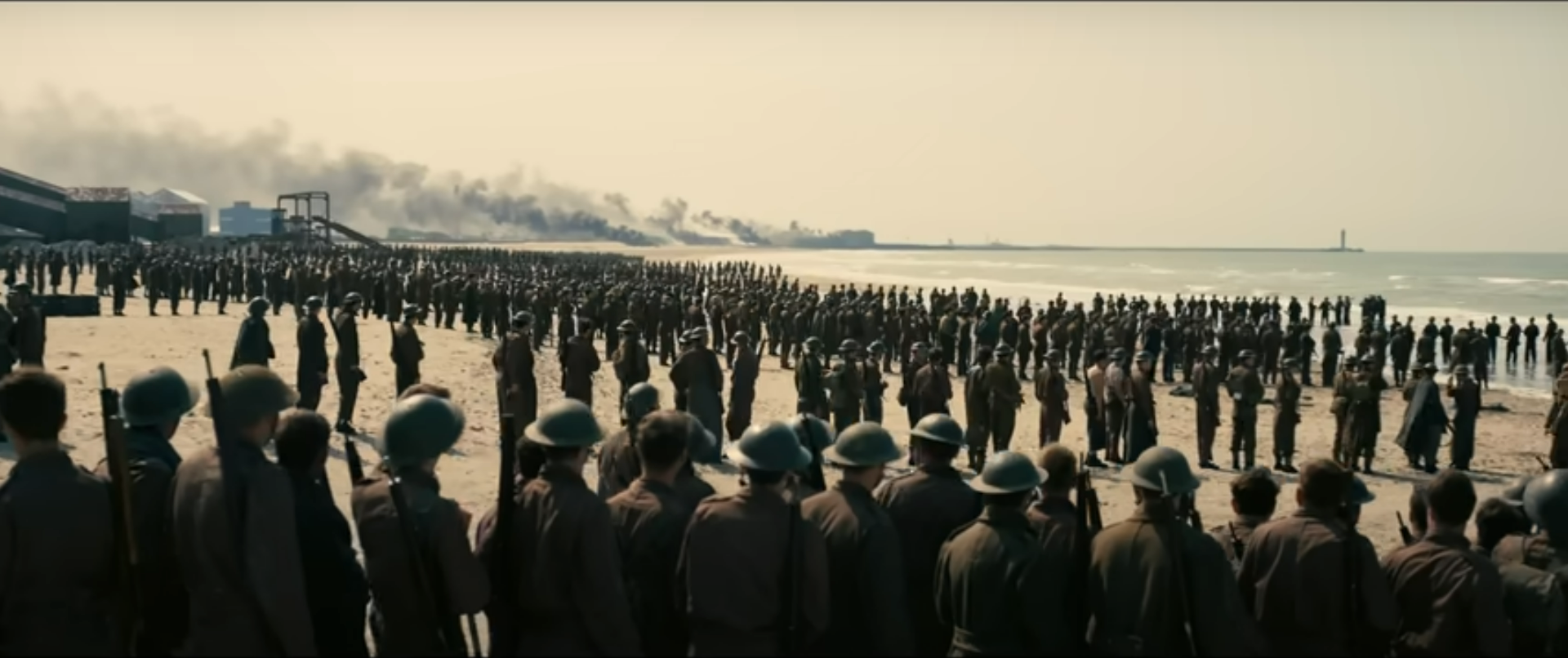
Dunkirk is another WW2 example, where the central conflict in the film is the logistical difficulty in getting so many men off the beach and back safely to Blighty.

Jarhead also gives us a great insight into the experience of hurrying up to wait and wait for the action to start. In the meantime, routine camp duties and the pitfalls therein are the central conflict for the soldier.
Finally, there’s Blackadder Goes Forth. This series has many instances of darkly comic military incompetence, but the shooting of “Speckled Jim” gives us a nearly perfect example of a “flap” in action7:
The general is raring to advance, but communications are difficult (albeit deliberately so, on Blackadder’s part). The most infuriating sight for the general is seeing Blackadder and Baldrick relaxing and eating lunch in the dugout, i.e. not in a flap, as he is. And the focus of his ire is not on the “50,000 men getting killed a week,” it’s on the shooting of a single pigeon.
Conclusion: why you should care
Or: How I Learned To Stop Worrying And Love The Flap
Flapping is an essential, integral, and inescapable part of military life. Anything that involves the simultaneous movement of tens or hundreds of people and dozens or more vehicles will be complex. Add to this the military requirement to prepare for every eventuality, and it’s a wonder anyone ever leaves camp in the first place.
Everything is very simple in war, but the simplest thing is difficult. These difficulties accumulate and produce a friction which no man can imagine exactly who has not seen war.
The most difficult part of military operations is in the logistics, rather than the tactics. It’s more about getting to where you need to be, and less about what happens when you get there. Films usually focus on the latter, often for good reasons: the things that happen there are usually a lot more interesting than the events leading up to it. Although the battle itself might seem like the decisive moment, however, most battles are won or lost beforehand, in the preparatory phase.
Or, to put it another way, to even have a chance at success, an operation needs to leave the camp on time. For all that we roll our eyes at “flapping”, every military person knows this. We all love to deride the “flapper” who is making our life more difficult, but most of us are the very same when it’s our team on the hook. When push comes to shove, we are all capable of sending feathers flying everywhere:

What do you think? Is my judgement sound, or am I merely trying to excuse my own previous flapping behaviour? Tell me what you think in the comments below! If you liked this article, please subscribe using the link below so that you never miss and article. Please also share this content with anyone whom you think might enjoy it: I’m always trying to expand my reach and get new readers to inspire me to write about new topics. Thanks, as always, for reading, and I’ll be back next week.
Featured Image: Dunkirk, Warner Bros. Pictures (2017)
- Specifically, in Men at Arms by Evelyn Waugh (Book 1 of the Sword of Honour trilogy) and August 1914 by Aleksandr Solzhenitsyn. ↩︎
- Such as the devastating “mé féiner” (Irish) or “Jack” (British), which is applied to a selfish person. In the military, where the bonds of comradeship are essential, this is a devastating judgement which many never recover from. ↩︎
- I’m deliberately narrowing my focus here a little bit, because my own background and experience is in the army, rather than air force or navy (hasn’t stopped me before, you might well say). I’m sure that air and sea domains have their own special and unique types of flap and flappers: do let me know in the comments. ↩︎
- And women, of course, I’m using the generic “men” and he/him for simplicity here. ↩︎
- Non-commissioned officers. ↩︎
- Of course, given that the “hurry up and wait” phenomenon extends up the chain indefinitely, there’s every chance that his troops will just be waiting even longer once they get to their destination, so this is probably not the critical factor it might seem. ↩︎
- Genuinely no pun intended. Oh God, I feel terrible. ↩︎


Leave a Reply