Weapons of mass distraction: Part 3.
Happy Thursday everyone, whether you are a regular or a newcomer. We’re onto week three of four of our weapons of mass destruction (WMD) series, having already looked at chemical weapons and biological weapons. This week it’s the turn of the relative newcomer, radiological weapons, also known as “dirty bombs” (absolutely not to be confused with a dirty protest, which arguably was a type of biological warfare). As a reminder, here’s the “CBRN” fearsome foursome:

Elder (military) lemons like myself remember when “CBRN” was the simpler “NBC”, i.e. nuclear, biological, and chemical. What, then, is “radiological” warfare, how does it differ from nuclear warfare, and why was it considered so worthy of inclusion that the military industrial complex forsake a cherished three-letter abbreviation in favour of a more cumbersome four-letter one? Furthermore, how has Hollywood responded to this new threat? Do the film and media depictions of radiological warfare reflect its true level of threat? Read on to find out!
As always, I’d like to remind you to subscribe to the blog if you haven’t already—simply enter your email in the box below, and you’ll never miss a post. Please also share this article on any and all social media, and feel free to add your two cents via the comments section below, which I really appreciate. Thanks for reading, and I hope you enjoy this week’s offering.
If you enjoy this blog and want to support it, please consider a donation. Keeping this blog going doesn’t cost much, but it isn’t free either, so any help would be very much appreciated👍
The radiological threat is the new(ish) kid on the block…
It was around twenty years ago, in the post-September 11th new security paradigm, that “radiological” was added to the pantheon of scary WMDs. The world was waking up to the sheer breadth and depth of possible threats as would-be terrorists were trying everything from liquid bombs to explosive underpants. The dirty bomb, or “radiological dispersion device”, was a new horizon for earnest security experts, over-zealous intelligence agencies, and Hollywood screenwriters alike.
A radiological dispersion device (RDD) is a device which spreads radioactive contaminants over as wide an area as possible, with the aim of inflicting harm through radiation poisoning. It does not cause a nuclear explosion. There is quite a significant difference. Graham Allison, a nuclear terrorism expert, has described the difference as: “If a nuclear explosion is like lightning, a dirty bomb is like a lightning bug.” Here’s what he meant:

Another enabler of RDDs, which also fed into the post-9/11 environment, was the breakup of the USSR a decade previously and the subsequent loss of nuclear materials from previously well-guarded facilities. This was not just theoretical: Chechen rebels had planned and threatened to use RDDs in the mid 1990s as part of their war against Russia. The idea behind an RDD is quite simple:

You don’t need a superpower collapse to get your hands on radioactive material, however. Hospitals have nuclear sources for radiotherapy and imaging, and the security of these sources can sometimes fall short of ideal. The most infamous example of this happened in 1987 in Goiânia, Brazil, when two thieves stole a radiotherapy source containing Caesium-1371 from an abandoned hospital. They dismantled the protective shielding and discovered a glowing blue powder which they started extracting from the source container. The dismantled container and radioactive powder was passed among the neighbours until some displayed signs of radioactive poisoning. Four people died and almost 250 were found in hospital to have radioactive contamination. The cleanup operation involved levelling 85 homes and businesses and even removing soil.
Of course the Goiânia accident was not due to terrorism, rather to plain old criminal opportunism and tragic ignorance. If it had been a terrorist attack, however, the device used would not have been classified as an RDD or dirty bomb, since there was no explosive element. Instead, it would have been called a “RED”: Radiation Explosive Device. The difference between an RED and an RDD is the absence of a “boom”: rather than spreading radioactive material over a wide area, the idea is to silently and stealthily expose people over time.

The most notorious example of RED terrorism (albeit state-sponsored) comes, once again, from our friends in Russia’s security services. In 2006 Alexander Litvinenko, a former Russian security services agent and prominent critic of Vladimir Putin, was admitted to hospital with what would turn out to be severe radiation poisoning. He died three weeks later and Polonium-210 was found to be the substance which killed him. Litvinenko met fellow Russian security men in a hotel bar in London, and this is where the poisoning (or, to be precise, the RED2 attack) took place.

The closest that the USA came to seeing an RDD attack was with José Padilla, an Al-Qaeda member who allegedly spent time in Pakistan researching RDDs and was arrested on arrival at Chicago in 2002. He was detained as an enemy combatant, so never faced trial, which was probably for the best as far as the authorities were concerned, since the evidence seems to have been very thin.
Although radiological warfare has only recently arrived on our threat horizon, Hollywood has made a determined effort to catch up and serve it back to us.
…and this is reflected in the Hollywood offerings
The early 2000s saw, as we mentioned above, a focus from law enforcement on the threat from RDDs. This (US) Public Service Broadcasting documentary from 2003 has it all: post-9/11 alarmism, ominous voiceovers, and a surprisingly balanced analysis of the risks:
Hollywood3 wasn’t long getting in on the act. Dirty War, a BBC/HBO production in 2004, tells the story of an Al-Qaeda RDD initiating in Central London. Cue hordes of panicked civilians being held back by scary security forces in gas-tight suits and respirators:

Right at Your Door (Roadside Attractions, 2006) is next on the bandwagon. They love the idea of WMDs so much that they can’t even pick one to go with: what starts as a “dirty bomb” is also somehow a chemical attack and ends up as a virus, i.e. a biological weapon4. The film industry loses interest after this point; they are much more interested in nuclear weapons, for obvious reasons which we’ll nevertheless get into next week.
TV takes up the mantle in a big way from here on. In chronological order, we have:
- Numb3rs Season 1 Episode 13, the appropriately named “Dirty Bomb“, from 2005. This contains a textbook example of the trope of nerds writing random mathematical gibberish on a blackboard to reach a bizarrely precise answer to what would be an incredibly complex calculation5:
- Dirty Bomb Diaries, 2007
- 24 Season (Day) 8, 2010
- Castle “Countdown” episode 2011, clip here
- Flashpoint “Keep the Peace” episode, 2012
- Madam Secretary “Right of the Boom” episode 2016
After this, even TV seemed to lose interest in dirty bombs, presumably because by 2016 all was right with the world and we hadn’t yet entered the bad timeline. Or perhaps it’s because filmmakers eventually realised that dirty bombs are, you know, kinda lame.
Dirty bombs are not as scary as they sound
I know what you’re probably thinking: radiation is terrifying and there’s no way you’re going to let me tell you it’s not. Okay. Fair enough. I agree: radiation is scary. Alpha particles will bounce off your skin harmlessly enough, but if they get inside your body they will act like battering rams on your soft internal tissues. Beta particles will give you bad burns on any exposed skin. Gamma rays, meanwhile, will shoot right through you like tiny little bullets, chopping your DNA into chaotic little pieces. Your only protection from gamma radiation is metal or concrete shielding, and lots of it:

Radiation is scary, but it isn’t black magic. Let’s reprise and modify the detailed analysis we did previously for explosives:
| How big an effect do you want your dirty bomb to have? | How much radioactive material do you need to achieve this? |
|---|---|
| Small effect | Small amount of radioactive material |
| Medium effect | Medium amount of radioactive material |
| Large effect | Large amount of radioactive material (but you’ll still end up wasting most of it) |
Unless a terrorist got their hands on a truly staggering amount of radioactive material, they would be unlikely to do permanent damage to very many people. Never ones to slouch when it comes to novel threats, Israel conducted testing between 2010 and 2014 in the Negev Desert and concluded that RDDs posed no substantial danger.
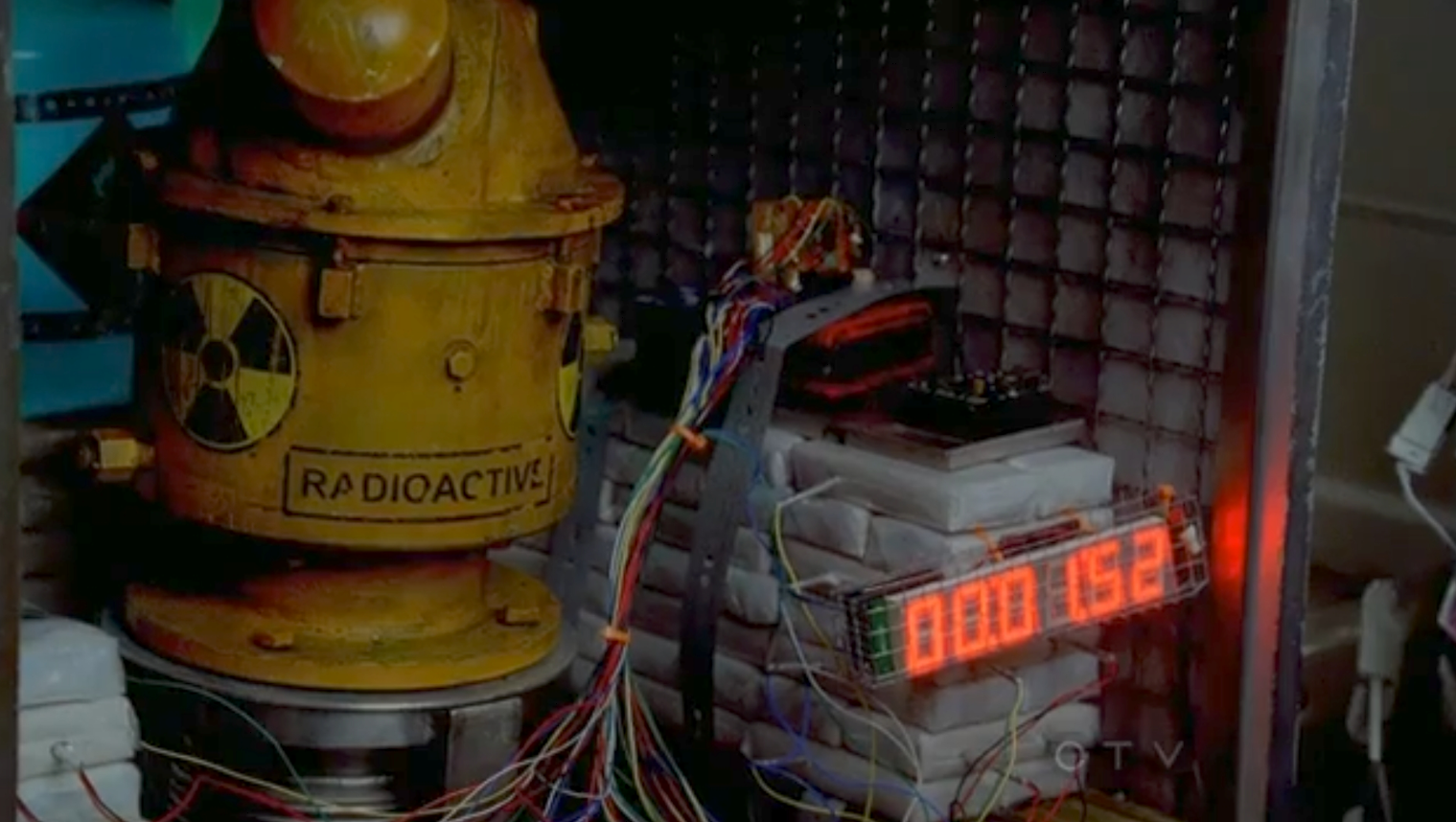
The scariest part of any dirty bomb is the high explosives. This is not a flippant dismissal: high explosives really are terrifying, as we’ve covered before. Just ask the survivors of the Oklahoma City bombing in 1995 (about 700 of whom were injured, along with 170 killed), the Omagh bombing in 1998 (220 injuries and 29 deaths), or the Dublin and Monaghan bombings in 1974 (300 injured and 35 killed). When I see a TV dirty bomb like this (from Castle, “Countdown” episode):

I’m not too worried about the big yellow thing with the trefoils on it. After all, the thick metal casing is what’s shielding the source inside from causing me harm. As long as that container isn’t blown open, I’m fine. And if it is blown open, the ~50 kg of explosive will give me a lot more to worry about than the radioactive material.
The real threats from an RDD, which, to be fair, many of the films and TV shows above do acknowledge, are:
- The mass panic it would induce in the populace
- The exorbitant expense of the cleanup operation, especially in a built environment
Conclusion: The psychological threat is real
Just because the primary threat from a dirty bomb is psychological, doesn’t mean it isn’t real. Having said that, it’s yet another exaggerated threat we’re faced with, while the quite serious threats from explosions and gunshots get downplayed on screen.
It’s worthwhile at this stage comparing perception with reality for the WMDs which we’ve discussed so far:
| Type of WMD | Perception | Reality |
|---|---|---|
| Chemical weapons | Huge terroristic and military potential kept in check by international agreements and a stern moral code | Of niche military importance at best, and relatively limited effect for terrorists too |
| Biological weapons | Potential world-ending viruses just waiting for a lucky terrorist to set them free on a poor unsuspecting world | Very few terrorists want to end the world (thankfully). Plus, this stuff is hard. Some biological toxins can be effective (e.g. ricin) |
| Radiological weapons | Deadly radiation could be spread in our cities, leading to slow agonising deaths from radiation | Not likely to be effective, besides their conventional (i.e. explosive) elements |
The common theme so far is that these are more like weapons of mass “distraction” rather than destruction. So far, then, you might be thinking that the “CBR” part of “CBRN” is a bit of a damp squib, and you might be worrying/hoping that the same comforting story will apply to nuclear weapons. Well, without giving the game away too much… it will not.
But, as always, far be it from me to dismiss what is very real suffering at the end of the day. Just because terrorists would cause more harm and suffering with a car bomb than with an RDD, doesn’t mean that the eventual victims of the RDD matter any less. Radioactive material can pose a serious hazards to health, and there’s very good reasons why hospitals and other industrial users of radioisotopes keep them under strict lock and key (or at least they should).
But what do you think? Is it comforting to know that the risks from a dirty bomb are overplayed? Or is it unnerving how easily human resolve and rationality could descend into panic and disorder? Let me know in the comments section below! Also please comment if I’ve missed any good film, TV, or real-life examples. As always, thanks for reading! And if you haven’t already, please subscribe with the link below and you’ll never miss a post. Until next week!
Featured Image: Castle Season 3 Episode 17, “Countdown”, ABC Studios (2011). Link to clip here.
- The number after the element name (the “137” in “Caesium-137”) means that it’s an isotope, i.e. a version of the atom with a different number of neutrons. Probably the most well-known isotopes are Uranium-235, used in nuclear reactors and weapons (Uranium-238 is the “normal” one) and Carbon-14 used in archaeological dating (Carbon-12 being the more common version found in our bodies). In short, if you see a number after it, it’s probably radioactive. ↩︎
- To be pedantic, the “D” in RED, for “device”, implies a greater level of technology than what occurred in Litvinenko’s case. His tea was poisoned with the radioactive Polonium-210. ↩︎
- As usual, I’m using “Hollywood” in a generic sense to refer to English language film and TV in general. ↩︎
- How a virus is supposed to have survived the high explosive bombs is not explained. ↩︎
- Sorry about the Serbian subtitles (unless you’re a Serbian speaker, in which case, you’re welcome!). ↩︎


Leave a Reply