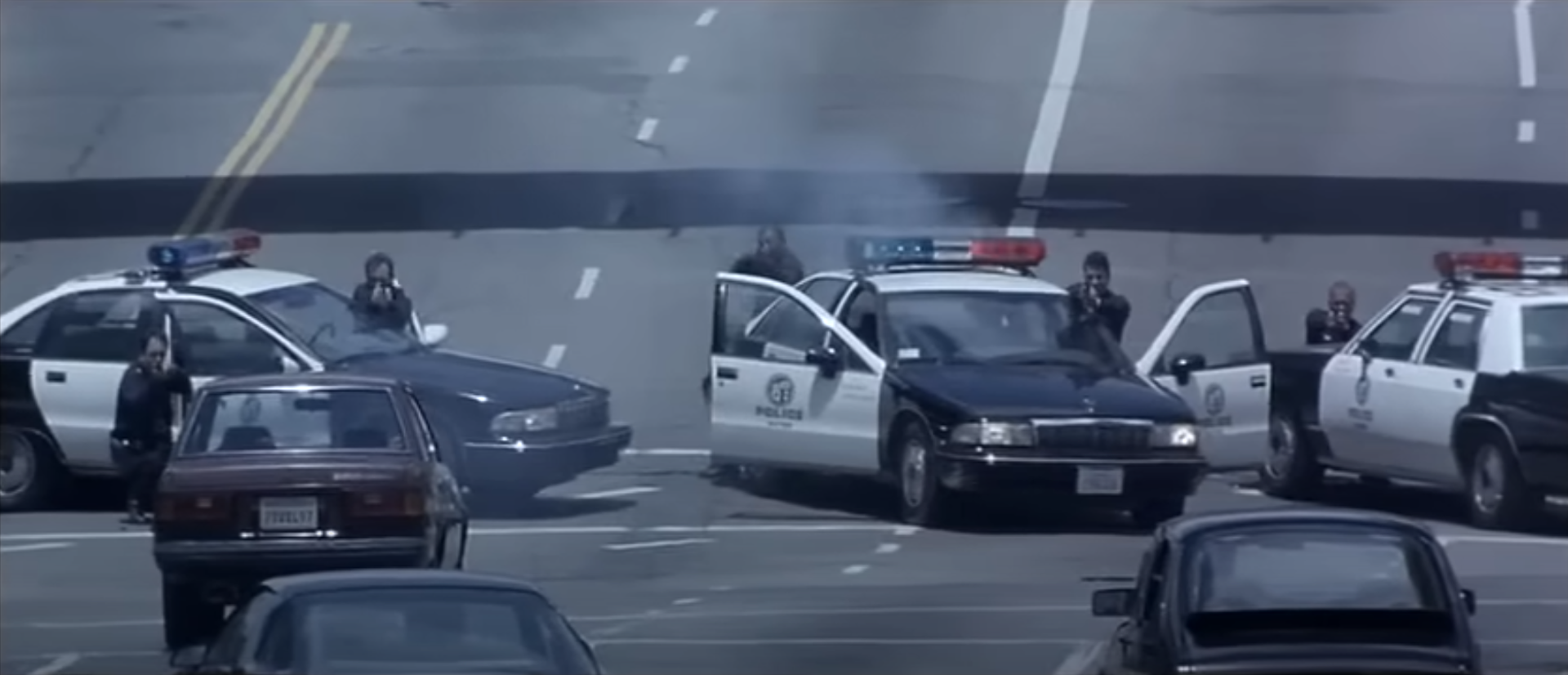
Historical and tactical confusion.
| << Just stepping out to the Andromeda Galaxy for a coffee | Firearm fails: Pushing the envelope of pistol performance (Part 2: The limitations of biology and physics.) >> |
Handguns get the worst firearm treatment
This is the first in what I plan to be a recurring series about “firearm fails” in film, TV, and video games. As you’ll appreciate, there are rich pickings here, and I won’t be the first commentator to cover this area. There’s no shortage of internet content on guns, some of which is even accurate. I would be grateful, as always, for any suggestions on particular firearm fails I should cover: let me know in the comments.
This week we’re going to talk about how pistols are inaccurately depicted in the media as smaller versions of rifles with roughly equivalent utility and effects. In fact, they are very different weapons with distinct characteristics and use cases, and I’ll talk about the origin of the pistol and their “place” within the military to illustrate this. This doesn’t stop Hollywood1 from treating them like mini-rifles, however, and we’ll see some particularly woeful examples of this.
I’m going to follow up next week with a more technical look at the improbability or downright impossibility of some Hollywood trick shots, so please watch this space.
Thanks, as always, for reading! If you like what you see, please subscribe. Comments below are always appreciated, and you can email me or comment for any topic requests.
If you enjoy this blog and want to support it, please consider a donation. Keeping this blog going doesn’t cost much, but it isn’t free either, so any help would be very much appreciated👍
Pistols are not just smaller rifles…
A pistol is not just a smaller, easier to conceal rifle. As far back as the flintlock technology of the seventeenth century, muskets and pistols were distinct weapons, carried by different types of soldier for different ends. The pistol evolved as a weapon for horsemen, and it complemented their existing weapons, which were the sword and the lance. The pistol was not a ranged weapon designed for accurate fire. It was designed to fire at very close range (but just out of pike stabbing distance) into a wall of infantrymen, or at even closer range into an individual target, as depicted in the drawings below:


Note how close the firer and target of the pistol are! They are clearly a close alternative to the sword, and probably about as effective.
Technology has, of course, progressed for all firearms since the scenes above, and similar technologies have been incorporated into handguns and what we now call “rifles”, e.g. integrated cartridges, smokeless propellants, magazines, and even rifling3. They remain distinct weapons, however, and some of the main technical differences are:

Broadly speaking, rifles are the primary or default weapon for an infantry soldier. As you can see above, they are effective to a few hundred metres, further if the section is firing together4. Many infantry soldiers use heavier weapons such as mortars, heavy machine guns, or anti-tank weapons, but they will normally always carry a rifle as their primary weapon.
Pistols, on the other hand, are not a primary infantry weapon, and never have been, because of their different characteristics outlined above. What are they used for? Well, their main (only, really) advantage is that they are small and therefore easy to carry. This makes them useful for two purposes:
- As a sidearm for cavalry (this was true when cavalry rode horses and carried lances and swords, and is still true when cavalry drive tanks),
- As an officer’s weapon, since an officer’s soldiers, and their rifles, are his/her tool of battle.
Since officers traditionally also rode horses and carried swords, there is a bit of crossover here too. We can see in Blackadder Goes Forth how the officer’s tools of battle differ from those of his men. Although this scene is obviously comic, it is the most poignant of the series, and provides the ending note:

So, to sum up, who carries a pistol, and for what purpose?
| Who carries a pistol… | …and why? |
| Officers and certain NCOs5 | Because it marks their authority, and because they don’t need to lug around a heavy rifle: the men6 do that |
| Military police | To keep their hands free to |
| Civilian police (in certain jurisdictions) | As above, but replace “soldier” with |
| Criminals | Easy to conceal, can fire them “gangsta’ style” for maximum inaccuracy |
| [USA only]: Second Amendment enthusiasts | Because it’s their God-given right to increase the amount of uncontrolled lead flying through the air7 |
In the military, the pistol is still a symbol of authority. During my officer training, the pistol was the last weapons system we trained on, having trained with the rifle, light machine gun, grenade launcher, grenade, and section-level anti-tank weapon. We learned the pistol at the same time as we learned sword drill, about two weeks before being commissioned. In fact, the two are probably about as useful as battlefield implements of violence, although the pistol is admittedly more compact.
Apart from exercises and deployments, my main occasion to carry (“wear”) a pistol was in barracks as orderly officer, which is a daily duty officer role. The orderly officer and orderly sergeant carry pistols to denote their authority and indicate to others that they’re on duty. When a mate covers duty for a few hours so that you can go for a run, they are said to be “holding the pistol”.

This is all well and good, you say, but what about police forces? They carry pistols as their standard weapon. Does the same logic hold? Well, firstly, this is not true universally. Where I come from, police are routinely unarmed. I remember the first time travelling to the USA, as a child, and staring wide-eyed at cops with guns. It was scary to think of people having that casual ability to inflict violence (this was long before I had exposure to real guns are realised how ineffective pistols are as a tool of violence).
This was pre-9/11, 7/7, Bataclan, Madrid, and other such attacks. Now, police forces in Europe are more likely to carry firearms. However, it’s still not routine and, crucially, you are as likely to see them with submachine guns or even assault rifles as pistols: weapons which are far more suited to the range of tactical situations which might require a kinetic8 response from the police.
Even where police carry a pistol as standard, however, it would be wrong to see this as equivalent to an infantryman’s rifle. An infantry soldier’s rifle is the primary tool for their job (I’m talking, of course, about a conventional battlefield scenario. Once you bring in counter-insurgency, peacekeeping, and peace enforcement, the requirements change a bit. This is one of the reasons these types of operations are notoriously difficult). A police officer’s pistol is not, at least I would hope, the primary tool of their job. Their physical presence and their authority or “badge” are the most important tools in their toolbox.
A pistol is not a tool for targeting criminals at a distance, and any police officer who uses it like this is either poorly trained or a film/TV character. Why? Because Hollywood thinks that pistols are like rifles.
…but their on-screen depictions suggest otherwise
Film and TV writers prefer to think of pistols as “rifles, but smaller.” They have similar range, accuracy, magazine capacity, and target effect, but conveniently stow away into a trouser or jacket pocket when not in use.
There are (as usual with film and TV) multiple levels of unreality going on here. Firstly, they make a hash of describing how pistols are employed as part of an overall unit, i.e. there is no distinction between the pistol, shotgun, and the rifle.
Secondly, they expect all heroes who are cops or agents to have levels of pistol marksmanship on par with world champions. Thirdly, they sometimes break even this fragile layer of reality with levels of accuracy and precision which exceed the technical possibilities of pistols.
I’ll deal with the first layer on this week’s post and go down the rabbit-hole of marksmanship and minutes of angle next week—watch this space.
The best way of illustrating this misunderstanding of how pistols fit into the broader tactical scenario is through some examples of gross misuse of pistols in film. There are two species of this. The first is the “pistols akimbo” setup where everyone has a pistol drawn and is pointing it at the target. Nothing gets in the way of your pistol and the target: not distance, not movement, not your buddy cop who’s standing almost exactly in front of you, not the cops who are standing on the other side of the target, also with pistols drawn. The aim is to achieve a hail of inaccurate lead. Who knows, some of this lead might actually hit the target:

The second is the “Freeze! Police! Hands in the air!” scene, of which some examples below. The cops are usually hiding behind the door of a car for cover, or the engine block (the latter is a better choice, since it will stop a lot more lead than a sheet metal door). They might also employ the overlapping arcs of fire we’ve seen above, showing a casual disregard for the safety of their buddies. And if some of their buddies have rifles or shotguns, who cares? I’m still going to point my peashooter. The more lead the better, right?

The worst example of all, however, has to be the shootout scene from Heat. I feel slightly conflicted about this because, in many other respects, it is a realistic depiction of squad-level fire tactics, at least on the part of the baddies. However, I can’t defend the cops using their pistols to fire from at least 50 m away, which is simply too far to lay down any effective fire:


Perhaps this is the point, i.e. we are being shown how slick the bank robbers are compared to the LAPD? Let me know what you think in the comments.
Conclusion: Heroes need real guns, but don’t want to carry them
We discussed above how the pistol is one of the symbols of authority traditionally used by military forces. No-one likes carrying a rifle, because it’s heavy, it’s clunky, it occupies your hands, and it needs cleaning. Pistols, by contrast, are small, sit in a holster, leave your hands free (because they stay in the holster), and rarely need cleaning (because they are rarely fired). It’s no wonder that Hollywood characters prefer carrying pistols to rifles: in that respect, they are just like millions of officers and NCOs who jump at the convenience of the pistol, not to mention the fact that it marks one out from the crowd.
However, take the officer away from the truculent bosom of his/her platoon or company, and things change. Without one’s soldiers to direct, then an officer with a pistol is quite a helpless creature. If the goal is self-preservation, then every sane person would carry a rifle9 as well as (or instead of) a pistol.
In Hollywood’s classic way, the symbol of authority and importance (the pistol) got passed on and coded to the heroes of the film, be they military, cop, or civilian. At the same time, since the hero is generally operating alone or with a small team, they need the “oomph” that a rifle gives you. This is why our heroes end up with seemingly magical pistols that can take out an entire company of enemy goons or do trick shots from improbable or impossible distances.
This leads nicely on to the discussion of just how far Hollywood stretches reality when showing the effects of handguns on screen. Keep an eye out for next week’s post, which will discuss just this.
Until then, that’s it from me. Thanks, as always, for reading! I’m keen to see what you think in the comments below. Don’t forget to like (if you liked it) and subscribe (if you want to see more).
- You’ve probably realised by now that I use the term “Hollywood” as a shorthand for all film and TV, although of course plenty of the stuff I reference doesn’t come from Hollywood. Please forgive the shortcut. ↩︎
- Dutch for “Three horsemen in battle.” ↩︎
- Rifling is the term used for the helical grooves engraved on the inside of the barrels of most modern guns. Rifling imparts spin to the projectile, thus improving accuracy. Why does it improve accuracy? If you’re interested, please let me know, I would happily do a whole post on this. Pistols and rifles (hence the name) have rifled barrels, as do machine guns, cannons, artillery pieces, and some tank guns. Weapons without rifling are called “smoothbore.” ↩︎
- If you’re wondering why a group of soldiers has a greater effective range than a single soldier, it’s not because any individual round is more accurate, but the combined effect on the enemy of more rounds landing nearby, even though they are less accurate because of the long range, is enough to get them to keep their head down. The goal of infantry rifle fire is not necessarily to hit your target, but to get them to keep their head down while your own forces move closer and close with them. If course, if you hit them in the process, that’s a big plus! ↩︎
- Non-commissioned officers. Confusingly for a layperson, when a military person says “officer” they mean “commissioned officer”. In other words, NCO ≠ officer, even though linguistically you might assume that NCOs are a subset of “officer”. ↩︎
- And women, of course, in a contemporary context. I think inclusive language is to be encouraged, and try to use it as much as possible, but there’s an undeniable ring to “Officers, NCOs, and men” that you can’t quite replace with “Officers, NCOs, and soldiers”. ↩︎
- I sneer, but I’m jealous. I would totally buy a handgun if I lived in the USA. ↩︎
- This is a piece of military jargon which means “shooty”. ↩︎
- In practice, at squad and platoon level, commanders will carry their rifles (even though they might not use them much) for this very reason: they are operating in small groups, potentially in fireteams of two or four, so every rifle counts.
Featured image: Heat, Warner Brothers (1995)
The Internet Movie Firearms Database was an invaluable resource in putting this post together, I highly recommend it. ↩︎

Leave a Reply to Firearm fails: Pushing the envelope of pistol performance (Part 3) – Military Realism ReportCancel reply