What Hollywood and the media gets wrong about anti-tank weapons.
This week I want to talk about anti-tank1 ammunition, specifically, what we in the business call “HEAT”, or high explosive anti-tank warheads. We see these often enough in movies, but usually as generic “big explodey” rockets, rather than as specific weapons to be used against armoured targets.
The war in Ukraine has added to popular discourse around technology like this, especially with the evolution of new weapons (e.g. first-person drones) and armour sytems:

My motivation for writing is to set the record straight on an understandable misconception many people have regarding HEAT ammunition. Along the way I’ll also tackle some of Hollywood’s fails when it comes to armour and anti-armour weapons as well, such as using these weapons against people and soft targets like cars.
Please subscribe if you haven’t already—there’s a handy link below—to never miss a post. Please also consider sharing any articles you like with like-minded friends and family. And finally, please weigh in with any thoughts, questions, or opinions on the comments section below. As always, thanks for reading!
If you enjoy this blog and want to support it, please consider a donation. Keeping this blog going doesn’t cost much, but it isn’t free either, so any help would be very much appreciated👍
HEAT warheads punch through steel
HEAT is one of two ways to attack armour…
Ever since the tank emerged on the battlefields of the First World War, there has been a literal arms race between designers of armour and designers of anti-armour weapons. Today the design challenge of penetrating armour manifests itself in two different methods2:

Although these mechanisms are different, they both involve forcing a dart/rod of metal through the armour very quickly. The kinetic energy penetrator sends a lot of metal at about 1,500 m/s over a long distance, whereas the shaped charge3 sends a smaller amount of metal at a ludicrous 8,000 m/s over a very short distance. The latter effect is going to be the focus of this article (although “long rod penetrators” are quite cool in their own right and deserve an article of their own sometime).
…but it has nothing to do with heat
As I mentioned above and in the title of this article, the “HEAT” designation has nothing to do with “heat” as we understand it. It stands for “high explosive anti-tank” and it relies on a neat effect whereby the energy of an explosive charges can be focused, somewhat counterintuitively, by taking some of it away. This is called the Munroe Effect, and can be used in all sorts of industrial applications. My favourite illustration of this was when I took a large leaf, pressed it into some sheet explosive, removed the leaf so that only the indentations were left on the sheet, and then detonated the sheet explosive next to a steel plate. Viola:

Weapons designers use this effect to penetrate thick tank armour. They can amplify the natural shaped charge effect greatly by putting a liner of dense, ductile metal next to the explosive. When the explosive detonates, the liner deforms into a linear shape (usually, and unhelpfully for us, referred to as a “jet”) which is accelerated at great velocities (the tip of it up to 14,000 m/s4) into the armour. This happens when the shell reaches the target.
Below is an animation of the process:

Yes, the explosive gases and the liner themselves get very hot by any measure (i.e. hundreds of degrees), but they remain below the melting point of the liner material5 and, more importantly, the armour material. The material deformation happens so quickly (tens of millionths of a second)6 and the stresses on it are so high that the material’s strength becomes negligible and it flows like a fluid7. The same thing happens when the liner material hits the armour: it behaves like a fluid due to the massive velocity of the impact. You might argue that this is a semantic distinction, but it’s important for our understanding of what’s going on. The lance8 of deformed liner material cuts through the armour not by melting it, but by pushing into it so quickly that the armour “doesn’t have time” to resist it like it would a normal impact.
You can see a shaped charge jet in action against a dummy in ultra slow-motion in the video below by the always awesome SlowMo Guys. What you’re seeing is a detonation wave travelling first through shock tube (the “slow” part, at about 2,000 m/s, from top to bottom on the dummy on the right), then detonating cord (the faster, more energetic part travelling at about 6,500 m/s upwards on the same dummy), then the shaped charge on a stand next to the second dummy, then the jet/lance from the shaped charge shooting through the second dummy at about 8,000 m/s:
It’s super effective, despite protections
It’s hard to overstate how effective shaped charges are at penetrating armour. With the proper conditions, a shaped charge can penetrate armour eight times thicker than its original, pre-explosion cone diameter. For the FGM-148 Javelin missile system, this is 30 inches or 760 mm of armour9. That’s two and a half feet of armour:

Their effectiveness is somewhat dependent on having the right “standoff”, or distance the jet needs to travel before hitting the target. Over the last few decades, engineers have realised that actually putting more distance between the charge and the armour is a good thing, up to a certain point:

Here are some results for a real example of a shaped charge with 10 cm cone diameter. As you can see, maximum penetration is 70 cm (7 cone diameters) and occurs with a standoff of 60 cm (6 cone diameters):

Okay, you might say, we can drill a thin hole in the tank. So what? Unless you happen to be sitting behind this hole, what’s the big deal? In fact, destruction comes about by three main mechanisms (although, in a cramped tank, sitting next to the hole where the jet penetrates is also pretty likely):

Tanks are built to keep everything inside nice and safe. When something punctures this hermetically-sealed environment, it’s like bursting a bubble. The spalling effect is mitigated somewhat by fitting the tank with interior Kevlar lining to catch some of these fragments11, and the risk of secondary explosion can be reduced by not putting all your ammunition in the turret, like the Russian designs call for. Nevertheless, overpressure alone is enough to stop most tanks in their tracks (sorry). Here’s a compilation of some shaped charge weapons attacking armoured vehicles from above:

I was reminded about this level of destruction over Christmas while watching the traditional Xmas movie that is Die Hard, and seeing the police armoured car withstand not one, not two, but three hits from an anti-tank weapon:
There’s no way those poor policemen are still alive inside after an explosion like that, which is big enough to indicate that the shaped charge penetrated and then set off a secondary explosion inside the armoured car. But this is Hollywood, and it sure as hell looks cool. Normally, the mistake films make is by assuming that shaped charges work the same against all types of target, and this is what we’ll discuss in the next section.
But they overmatch softer targets like cars, houses, and people
HEAT is a very inefficient way to put energy into a soft target…
The beef I have with many movie depictions of anti-armor weapons is that they’re usually used against non-armoured targets such as cars, light buildings, or even people in the open:

This is a bit like using a monster truck to get around the cobbled streets of a medieval city centre: doable, but not at all practical, and sometimes counterproductive. A shaped charge jet will do a helluva lot of damage in one direction (that’s its job), and will have some effect in all directions against people etc., but it’s not an efficient use of your explosives:

If you don’t have HE weapons or ammunition on hand then sure, use your HEAT however you see fit. It will have some effect, but it will be less than ideal, and it may not even work properly.
We were always prohibited from firing HEAT rounds at soft targets on the range, which I believe was due to concerns that the lack of a hard armoured target would increase the risk of a “blind”, i.e. the round not initiating. I’m not sure whether a HEAT warhead would go straight through a car without initiating, but I know they have plunged into earth banks and not detonated, causing a later problem for EOD teams. It’s another reason to use HE against soft-skinned cars and trucks: imagine how embarrassed the Joker would be in the scene below if his RPG just punched through the window or soft skin of the police car without detonating?

As a brief aside, check out the rocket trails on the S.W.A.T. clip above… we’ll talk about this (and all things rockets) next week.
…and is hard to fire safely and economically
As I mentioned above, we’ll devote a whole post to this next week, so I won’t go too deep into the rabbit hole now, except to say that firing rockets or recoilless rifles indoors is a very bad idea, not that you’d know from the clips above.
To go forward, a rocket needs to send hot gases backward (this is thanks to Newton’s pesky Third Law), and this is why launchers have a hole at the back. If there’s a wall or ceiling close to the back of the launcher, then this gas is getting turned right around and hitting the firer again.

The other safety consideration with shaped charges is to do with the fact that they travel at up to 14 kilometres per second. Firing any weapon is fraught with consideration for the unintended targets who may be out of sight and out of mind, but certainly not out of harm’s way. Firing a weapon as powerful as a shaped charge magnifies this consideration greatly. When I used to dispose of old munitions, we would put huge safety distances on anything with a shaped charge, or else point the thing into the side of a big thick earthbank.
Obviously most of the baddies and mooks we see in Hollywood don’t care about collateral damage, but the good guys certainly should, and perhaps they would be less keen to use shaped charge weapons as a result.
One final consideration is cost, which everyone should care about, goodies and baddies alike. Using even a basic disposable shaped charge anti-tank armour weapon against personnel is wildly cost-ineffective. You can get hurt and kill unarmoured troops with grenades or small arms fire for less difficulty and a fraction of the cost. You see, in order to have the super effective penetration characteristics described above, shaped charges need to be precisely manufactured to very high tolerances. Impurities in the material or imperfections in the machining will lead to asymmetry in the jet and poorer performance, especially at larger standoff distances.
Of course, if you want to go the whole hog, you can use a $100k Javelin missile against a few troops in sandbags:
This isn’t just a fictional construct: the coalition forces used Javelins, on occasion, against lone infantry targets in Afghanistan. It would need to be a very high value target indeed to justify this amount of resources, and economics like this might illuminate why the war was ultimately lost for the allies.
Conclusion: Hollywood undersells the effect of HEAT weapons
That’s about it for this week, folks. I hope you have a better understanding of shaped charges now. More importantly, I hope you’ll “well, actually” the next person who says that they melt through armour. Because this blog is all about making you more popular with your friends and family. I also hope you can bring a new critical eye to some of the on-screen depictions of these weapons. Because what this blog is definitely about is ruining your favourite films and TV shows.
As usual with these critiques, I don’t object to Hollywood taking shortcuts or ignoring the more complicated design features of weapons. More often than not, it still makes for cool television. As always, though, I would like to see more variety in their offerings. There are many different types of explosive weapon out there, and they could really make us sit up in our seat if different rockets had demonstrably different effects on targets. Or if they showed us the truly devastating directional effects of shaped charge warheads12. It would make for better entertainment, but, on a more serious note, it also makes us appreciate the cold logic of engineering for maximum death and destruction.
On that happy note, let’s break until next week. Thanks, as always, for your attention and for your support. Please subscribe using the link below if you haven’t already, and please comment below if you feel I missed anything.
A special thanks this week goes to the to Internet Movie Firearms Database, an incredibly valuable source for, in this case, clips of rocket launchers in movies.
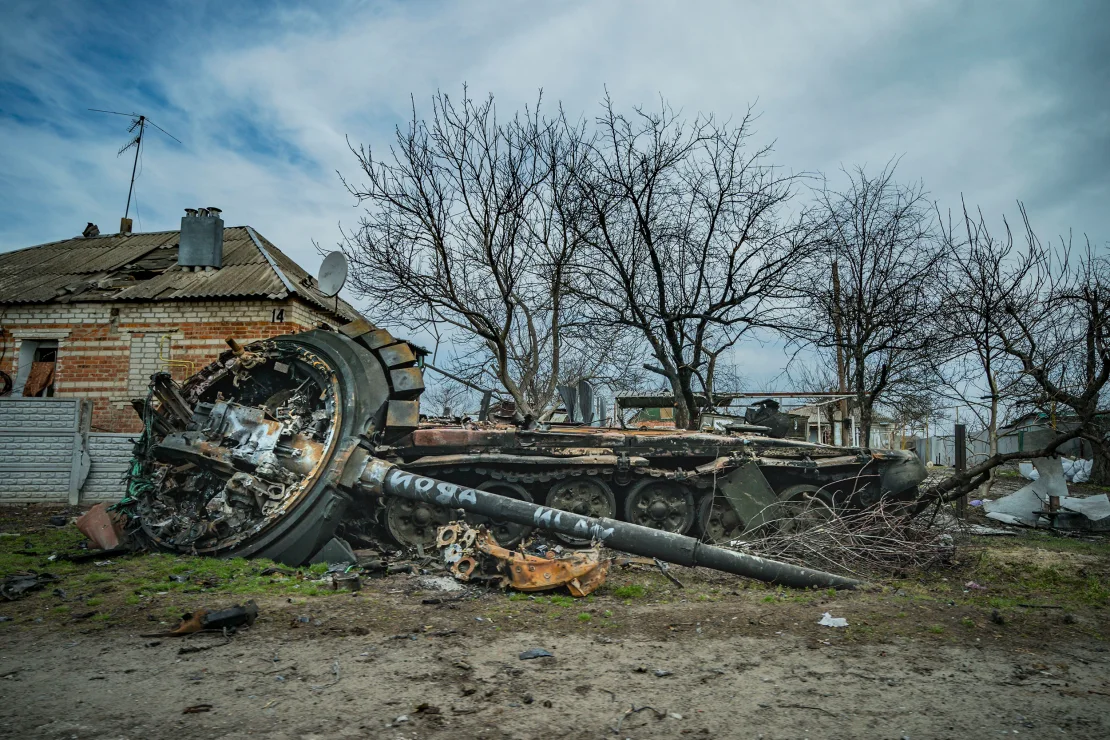
Featured Image: A Russian tank lies destroyed, its turret blown off, after a battle near Kharkiv, Ukraine.Celestino Arce/NurPhoto/Reuters. From CNN World
- Throughout this post, I’ll be using the term “tank” in a very generic way for most of my examples, which apply equally to most armoured fighting vehicles (AFVs). This will annoy some purists. To be honest, it would annoy me in most circumstances, but I don’t want to turn this post into a terminology tirade—I can bore you with that some other time. But since you’re still reading, here’s the sparknotes version: main battle tanks (MBTs) are a subset of AFV. For MBTs, think about the Abrams, the Challenger 2, the Merkava, and the T-90. Other non-MBT “tanks” include light tanks such as the FV101 Scorpion and FV107 Scimitar. In addition, we have infantry fighting vehicles (IFVs) such as the Bradley (which is the subject of the hilarious film The Pentagon Wars), and the BMP-1. There’s also armoured personnel carriers (APCs) (many of which are wheeled, not tracked), self-propelled guns (SPGs), and other categories. ↩︎
- There is a third, high explosive squash head (HESH), which I’ll discuss in a bit more detail below. This is still used in British main battle tanks (MBTs), but is out of favour elsewhere. ↩︎
- Another terminology footnote. A “shaped charge”, as the name suggests, can refer to any, well, “shaped” charge. This includes shallow dish-like charges such as explosively formed penetrators (EFPs), linear shaped charges, and even the explosive lenses used in implosion nuclear bombs. Today, however, we’re talking specifically about the conical shaped charges used in and anti-armour context. ↩︎
- Yes, that’s not a misprint. Yes, that is 14 kilometres per second. That’s more than eight miles per second, if you’re reading this from the freest country on Earth. ↩︎
- Although for some lesser-used liner materials such as alumin(i)um, it’s very close. ↩︎
- In the animation above, I’ve estimated the total time for the animation to be 150 μs (microseconds), and the liner deformation happens in the first few tens of μs. I could be wrong on the timing: I don’t have the link for what this animation is based on, so have made some assumptions of the size of the charge and the velocity of detonation of the explosive, but it will be in the right ballpark. ↩︎
- The technical terms here are “extremely high strain rate” (very fast deformation) and “high speed plastic flow” (it moves like a fluid). ↩︎
- If I call it this instead of a “jet”, it makes more sense. ↩︎
- Note, not just mild steel, but so-called “rolled homogeneous armour” (RHA), which is normally taken as the benchmark for anti-armour weapons. ↩︎
- This serves two purposes. Firstly, it initiates explosive reactive armour (ERA), a specific type of anti-shaped charge armour. By initiating the ERA “early”, the precursor charge neutralises the ERA before the main charge jet arrives. Secondly, the precursor charge blows away the seeker and other electronics in the nose of the warhead, which prevents them getting in the way of the main charge jet, again making it more effective. ↩︎
- Which, incidentally, is why ammunition types such as HESH, mentioned in a footnote above, have fallen out of favour. HESH ammunition doesn’t actually penetrate the armour, but spreads out a lump of explosive on the front of it like a pancake. When this explosive initiates, it generates shock waves within the material that can cause lumps to violently break off from the inside. Inside the cramped crew compartment of a tank, you can imagine how destructive this is. ↩︎
- Hollywood depictions of shaped charges seem to go against the usual tendency to make explosions bigger and cooler. ↩︎


Leave a Reply to Weapon critiques: Rocket fails – Military Realism ReportCancel reply