
Two very different (but oft-confused) explosives.
This week I’d like to spend a bit of time talking about two interesting explosives1 which people often think of as interchangeable: TNT and dynamite. At least I thought they were the same until I started my technical ammunition training (and I had several years of mainstream military experience at that point—perhaps this says more about me than about the general public though).
I’ll go into a bit of detail on what the difference between the two explosives is (it’s large), along with some of the historical and contemporary developments of each type. In short, dynamite tells us an interesting story about the development of commercial explosives, whereas TNT has always been central to the story of military explosives.
As always, please “Like” and share this post if you’ve enjoyed it, and weigh in in the comments section below: I always love hearing from you. If you haven’t already, please subscribe using the link below and never miss a post. Hope you enjoy this week’s article!
If you enjoy this blog and want to support it, please consider a donation. Keeping this blog going doesn’t cost much, but it isn’t free either, so any help would be very much appreciated👍
TNT ≠ Dynamite
Let’s get this out of the way first, before getting into the weeds. TNT and dynamite are very different things, despite what AC/DC or Wile E. Coyote would have you believe:

These are both explosives, but that’s about where the similarity ends:

To take a food analogy, it’s like comparing vinegar (TNT) with Tate & Lyle’s Golden Syrup (Dynamite). The one doesn’t contain the other, and both are used for very different purposes. With that in mind, let’s take a look at how each one developed, starting with dynamite.
Alfred Nobel invented dynamite…
“One of the most famous Swedes of all time,” according to The Swedish Technical Museum, is Alfred Nobel:

Nobel invented dynamite2 in 1867 for use in commercial blasting. Dynamite was the first product which could safely harness the tremendous explosive properties of nitroglycerine. Nobel soaked the liquid explosive in diatomaceous earth, a crumbly, powdery rock he found on the banks of the river Elbe. This made the nitroglycerine much safer to store and transport, and therefore commercially viable.
The other invention that made dynamite usable was the blasting cap, or detonator. Alfred Nobel used mercury fulminate (which you might remember from the infamous Breaking Bad scene which I talked about before) as a way to initiate the de-sensitised nitroglycerine in the dynamite. These two components—the stick of dynamite and the blasting cap—make up a basic explosive train3, a concept we’ve discussed here many times before:

The blasting cap is so integral to the functioning of dynamite that the two are usually depicted together, as my Google image search demonstrates4:

In fact, any blaster with any sense will wait until the last possible moment before inserting the blasting cap into the stick of dynamite. The former is easy to set off but unlikely to kill you, the latter is hard to set off but will blow you to pieces. Put together, you have something which is easy to initiate and deadly (which, of course, is the point: or at least to be deadly to rock formations).
Because, of course, that’s why dynamite was invented: to break apart slabs of rock. It was very good at this, and it made its inventor quite a lot of money.
…and it probably did not consume him with guilt
The invention of dynamite made Nobel and his companies quite a bit of money. By the time of his death in 1896 he had amassed a fortune of 33 million kroner52 and had ownership or managerial stakes in 93 companies. As well as dynamite, he invented gelignite (blasting gelatin) and ballistite, a smokeless gunpowder.
When Nobel died, his will gave the vast majority of his fortune to a new foundation to set up annual prizes in physics, chemistry, medicine, literature, and peace. The now-famous Nobel prize is worth about 1 million USD to each recipient. I had always heard that Alfred Nobel set up the prizes in remorse for how he had built his fortune on death and suffering. There’s a story that, after his brother died, he read a mistaken obituary of himself in a French newspaper which called him a “merchant of death,” and this shocked him so much that he changed his will to set up the prizes. I’m sceptical about this story for two reasons:
- Nobel made his coin in commercial explosives more so than military explosives. Dynamite was his first breakthrough, and it was almost entirely6 a commercial product. True, he did own a company which made cannons (Bofors), and ballistite was and still is used in many military propellants. Nevertheless, dynamite was never a military weapon, so Nobel would have no reason to feel ashamed of it.
- There’s practically no evidence for it.
In fact, there’s every reason to assume that Nobel would have been proud of his big invention, dynamite. It enabled large-scale tunnelling and mining, and so in turn allowed the building of extensive infrastructure and the extraction of vast mineral wealth from the earth.
The real legacy of [dynamite]—besides the Peace Prize named for its inventor—is the lithium in your cell phone battery and the silicon in your computer processor, both blasted out of mines. “Every bit of this comes from Nobel,” [Lee Fronapfel, mine manager of the Edgar Experimental Mine for the Colorado School of Mines] says. “It’s all thanks to dynamite.” If you’re going to rebuild the world, you’ve got to start by blowing it up.
Kate Morgan, How Dynamite Shaped The World, Popular Mechanics (2020).
Meanwhile, TNT replaced earlier military explosives
In contrast to the glowing review given to dynamite by Popular Mechanics above, TNT would get a harsher judgement, and probably deservedly so. It is probably the most ubiquitous military high explosive, and so is responsible for quite a lot of death and devastation, like any military technology7.
TNT was discovered around the same time that Nobel was developing dynamite, but it wasn’t widely used in munitions until a few decades later, exploding (sorry) in popularity during the First World War. TNT had two great advantages over existing military high explosives:
- TNT is less impact sensitive than picric acid, which was the most popular military high explosive used before and into WW1. This made it safer for militaries to store and move their artillery shells during the rough-and-tumble of rough terrain, trench warfare, and counter-battery fire. It also meant that a shell would not explode until the fuze sent the required signal to the main charge, in contrast to picric acid8 shells, which would usually explode on impact. This matters if you want to design a short delay between impact and detonation for the shell to bury in the ground or pierce the armour of a ship. Impact or shock sensitivity was the reason that explosives based on nitroglycerine (e.g. dynamite) could never be used in conventional artillery guns: the tens of thousands of Gs of acceleration would cause the shell to detonate in the barrel, a very bad day for all the gunners involved.
- Low melting point compared to its detonation (decomposition) temperature. TNT melts at 81°C and decomposes at 300°C, meaning there’s a very safe range where it can be melted and poured into shells, grenades, bombs, or any suitable munition. Most other common explosives have melting points much closer to their ignition temperatures, so this kind of processing is simply not an option.
TNT, for all its advantages, is not a particularly powerful explosive, at least in comparison to nitroglycerine, which has a TNT-equivalence of 1.5, compared to TNT’s 1.0. But the very fact that we measure the power of explosives9 with reference to TNT shows you how ubiquitous it is. It’s relatively easy and cheap to manufacture in comparison to many other explosives, and its physical properties make it easy to mix with other explosives.
Just like “dynamite” was a brand name for an explosive containing nitroglycerine, there were many TNT-branded explosives, each mixed with a different cocktail of other explosive and non-explosive ingredients:

Military and civilian explosives have been gradually getting less and less sensitive
When the UK originally drew up legislation governing the storage and use of explosives in 1875, TNT was not on the list of scheduled explosives, because it had only just been discovered. But it was exempted from the act in 1910 because it was so insensitive that it was not considered a “real” explosive, at least from the point of view of licencing for storage and transport. Military technology has come a long way since then, however, and what was acceptable in 1914 doesn’t fly in 2025 (like many things from 1914).
TNT, although much safer to store over time than something like dynamite10, does have a tendency to ooze through the threads of a shell or bomb and then crystallize in the air. These crystals, in contrast to the TNT inside the shell, can be very sensitive to impact, turning a supposedly explosive train into a hair-trigger one. Moreover, the TNT inside shells can crack and form voids as it expands and contracts with the external temperature. These empty spaces are very dangerous when the shell is fired, because they cause the explosive fill to smash against itself. TNT is not very impact sensitive, but everything has its limit, and flaws like this can cause a gun barrel detonation. See above: not a good day.
For these reasons, and other ones related to explosive propagation, have led in recent decades to the rise of insensitive munitions, which are explosives designed not to initiate even when subjected to some pretty serious stimuli such as being in a fuel fire, being shot at, and even being hit with a shaped charge jet.
At the same time, the commercial world has moved on from dynamite as well. While it paved the way (almost literally, I suppose) for much of the modern world, this explosive was still too sensitive and unstable for comfort. Even before his death Alfred Nobel had invented the more stable alternative gelignite. Over the years that followed, miners began to add more and more cheap and insensitive ammonium nitrate11 (AN) to their nitroglycerine-based explosives. AN was then often combined with fuel oil (ANFO) to make a cheap but effective fuel-and-oxidiser explosive mix.
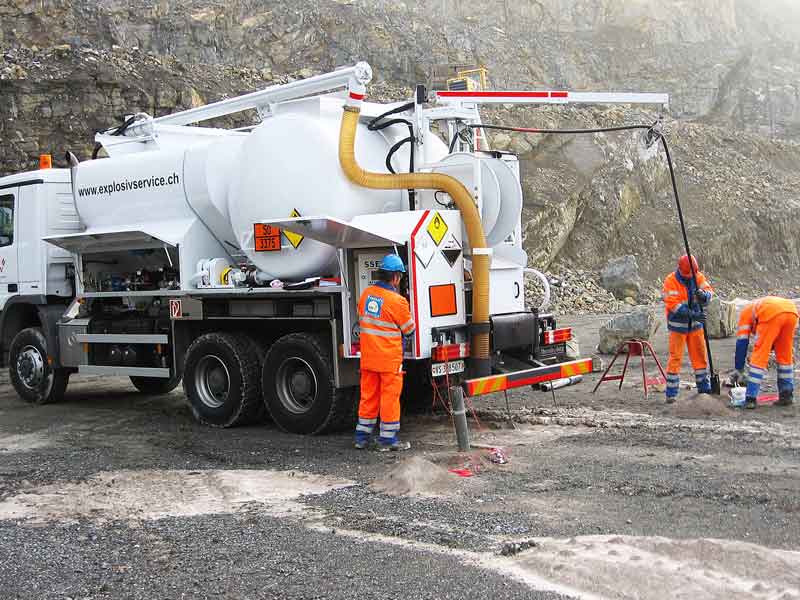
Ammonium nitrate isn’t waterproof, however, and mines tend to be wet places. A solution, developed in the 1960, was to “emulsify” the AN inside a droplet of oil, protecting it from the water. These emulsion explosives remain popular today, but another novel solution is the hilariously acronymed “MEMU” or “mobile explosives manufacturing unit.” This is a vehicle carrying two tanks, each containing a non-explosive ingredient, which are mixed together and pumped into a bore-hole on-site, much like a cement mixer:

The MEMU is a great win from a regulatory point of view, because the blasting company no longer has to comply with all the onerous regulations of storing and transporting explosives. The ingredients don’t become explosive until they are mixed, and they aren’t mixed until the MEMU is at the site.
Conclusion: There’s one similarity between TNT and dynamite
There is a similarity between TNT and dynamite, and that’s the fact that they both are technological archetypes of the industrial era, and both were considerable improvements in safety in their time. Dynamite was far safer than black powder, while also being much more effective at blasting rock. TNT, by the same token, was safer then picric acid (although not quite as powerful), while being easier to fill in shells through melt-casting. However, both technologies have shown their age in modern times, and have been replaced with safer alternatives which leave less room for error.
While miners and militaries are undoubtedly benefitting from safer explosives, there is one loser in all of this, whom we ought not to forget: the Acme Corporation, whose revenues depend on selling both TNT and dynamite to Wile E. Coyote in vast quantities, again and again:

Let’s not forget the real victims in this misguided drive for safety.
That’s it for this week, and I hope you enjoyed this rant which has been bouncing around my head for some time. Please let me know what you think in the comments below, please like and share, and please subscribe with the link below, if you haven’t already. In keeping with this week’s theme, and with thanks to Warner Brothers:

Featured Image: “Operation: Rabbit” (Warner Brothers, 1952), picture from Amino Apps
- I was originally going to say “two of my favourite explosives”, before realising how deranged/nerdy that made me sound. Oh well, this is who I am. ↩︎
- The name comes from the Greek word for “power”, e.g. dynamic, dynamo, etc. ↩︎
- In case you’re wondering why you would go to the trouble of desensitising an explosive only to “re-sensitise” it with a blasting cap, it’s because this way gives you much more control over when and how the critical impulse gets delivered to the dynamite to make it detonate. ↩︎
- I’m sorry to burst another bubble, but the “red” sticks of dynamite are mostly a concoction of popular culture. As seen in the photo above, the wax paper is usually brown. Other pictures of “real” dynamite show white or grey wrapping. In any case, it’s the colour of the wrapping that gives the “stick” its colour, so there’s nothing significant about red. TNT doesn’t usually come in sticks, but in blocks (because it’s a solid at room temperature). Some plastic explosives do come in sticks, however, but these don’t have TNT in them. And they aren’t red either. ↩︎
- Using current SEK to GBP exchange rates and the Bank of England’s inflation calculator, this works out to be about a quarter of a billion pounds in today’s money. These types of comparison are always hard to make, though: he could have been worth a lot more, relatively. ↩︎
- As always, there are exceptions, which I confess to being ignorant of before researching this piece. Popular Mechanics talks about “dynamite guns” which were used as coastal defence weapons. These weapons used compressed air to propel their dynamite-filled projectile at the target. Why they used compressed air we’ll find out in the next section, when we talk about TNT. ↩︎
- TNT does have some commercial uses, e.g. in fracking, but it is considerably more expensive than dynamite or its modern replacements such as ammonium nitrate. ↩︎
- Like TNT, picric acid is the chemical compound. It gave its name to many different explosives such as Lyddite (UK) or Melinite (France). Chemically, picric acid (tri-nitro-phenol) is very similar to TNT (tri-nitro-toluene), being based on the phenol rather than toluene, both of which are derivatives of benzene, a six-carbon ring. Picric acid is 20% more powerful than TNT, but TNT’s better safety characteristics outweighed this. ↩︎
- And quite a lot else: nuclear explosions, meteor impacts, anything violent and terrible. ↩︎
- Another reason for their different applications. Militaries need to keep large strategic stocks of artillery shells and other explosives, since they don’t usually know when a war is going to break out or, when it does, whether the fighting will intensify or diminish. These shells might sit in a magazine for years or even decades before being fired, so they need to be stable for a long time. Commercial miners, on the other hand, will have a fairly good idea of what blasting they’re going to need to do and when, so they can schedule deliveries of the explosives they need and avoid having to keep large stocks on hand. Dynamite isn’t very shelf-stable, but it doesn’t need to be. It does mean, however, that when old stores of dynamite are found, they pose a problem for EOD crews. ↩︎
- Ammonium nitrate deserves a post all of its own. You will be familiar with it from the shocking Beirut explosion of 2020. ↩︎


Leave a Reply to The DirectorCancel reply