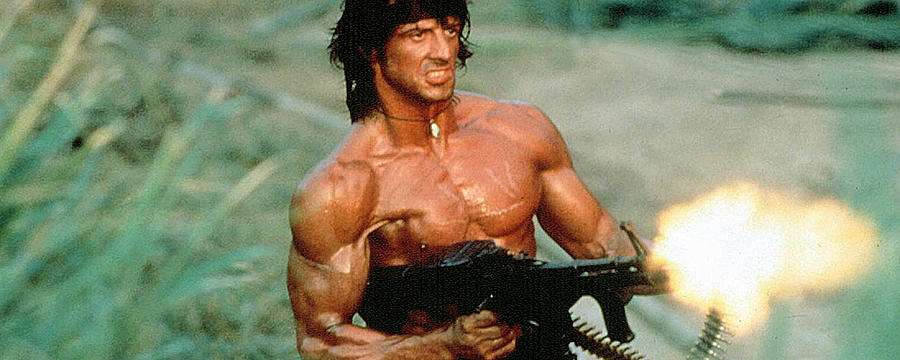
And why this person is an (oxy)moron.
Hello again. This week I’m going to go on a bit of a rant about “lone wolf” operators in movies and TV (as well as novels). You know what I’m talking about: the one-man army who takes down a whole battalion of enemy troops, or an entire criminal enterprise, or a supervillain’s army, or all three.
I was thinking about this topic recently as I read The Terminal List by Jack Carr. If you haven’t read it (or seen the TV show1, it’s not a huge spoiler to describe it as a libertarian revenge fantasy, but a page turner despite (or, depending on your outlook, because of) this.

I’m going to first go through some examples of the cliché, then discuss why it’s absurd. Then we’ll look at how Hollywood stacks the deck in favour of the lone wolf hero. We’ll wrap up by discussing the differences between Hollywood and the real world.
As always, if you’ve enjoyed this post, please share it on your social media channels. Don’t forget to subscribe using the link below if you haven’t already, and please let me know what you think in the comments below.
If you enjoy this blog and want to support it, please consider a donation. Keeping this blog going doesn’t cost much, but it isn’t free either, so any help would be very much appreciated👍
The “lone wolf” occupies a special place in storytelling
Lt Cdr James Reese, the hero of The Terminal List (MILD SPOILERS AHEAD) loses his unit of US Navy SEALs and then, for good measure, his wife and child, to a domestic conspiracy. He goes on a killing spree to avenge his men’ and family’s murderers, bringing righteous, merciless2 retribution down upon them. It’s one man against the entire apparatus of the US Department of Defense and (BIGGER SPOILER), he succeeds, because he’s a Navy SEAL and the author is a Navy SEAL and that’s what Navy SEALs do.
Reese is far from alone3. Jack Reacher, whose latest TV series was the subject of unfavourable commentary in these very pages a few months ago, is another classic lone wolf. In fact, there’s a whole book (Never Go Back) where he ruminates at length on his unusual genetic predisposition to metaphorically walk away from the campfire, with everyone huddled around it, and strike out alone into the woods.

James Bond is another archetype. Whether he’s taking down Spectre or space stations, he does it alone, with many one-man-army sequences:

In Commando, Arnie is a one-man army. I mention Commando mainly as an excuse to use my favourite “tooling-up” sequence of all time:

Rambo (any of them) has it too, as does Enemy at the Gates (in fact, anything involving snipers is usually suspect in this regard). The Rock, Under Siege, The Punisher, and Man on Fire are just a few examples of this trope in Hollywood.
In all of these examples the conceit is that the hero, by virtue of their military training and experience (usually in special forces), has a generalised all-purpose ability to single-handedly plan and execute complex plans. Said plans often involve killing and/or blowing up many people and/or things.
And before you say it, yes, I know that these folks usually have some sort of help. But this help is almost always limited to technical or logistical support, and/or a love interest. This character is not an equally-ranked team member, but someone who contributes to the hero’s magical lone wolf aura either through nerdy technical skills or badass sexiness.
Sometimes, however, we do see these supporting characters operating in close quarters combat with the hero, but this brings its own problems, which we’ll discuss in more detail below.
In the military, no-one operates alone
The main problem with these many examples is that they fly in the face of military experience. Anyone who’s spent time in the military, special forces or otherwise, has spent all this time operating in small teams as part of larger organisations. The idea of doing something as elaborate as a revenge killing spree by oneself would barely occur to someone with a military background. If they gave it any consideration whatsoever, they would quickly dismiss it. There are three big reasons for this.
There are biological necessities to consider
Let’s start with the small ones: eating and <coughs delicately> “abluting”. As human beings we need fuel to power our body for physical activity and our big hungry brains for mental activity. This fuel is traditionally known as “food”, and it’s rather important. It takes time to prepare hot, nutritious food three times a day and time to eat said food. This can be done alone, with little gas cookers and ration packs, but it’s easier to buddy up with at least one other person. Your buddy keeps watch while you make a brew for two.
Then there is the unfortunate necessity to excrete and evacuate the remnants of this food from the body. You don’t need somebody literally watching over you as you do this (it might not be helpful), but once again this is something that can be taken in turns, with one person keeping watch at a time.
In the Jack Reacher and James Reese novels this is usually hand-waved away with “energy bars” or some other snack which sustain the hero while they keep watch on a target for days at a time or rampage through a boss level full of baddies. At least they’re acknowledging the problem, but… Have you ever tried to subsist on energy bars or chocolate or sweets for days at a time? It’s not been pleasant, or effective. I’ve tried it, as I’m sure have most soldiers in training at one point or another. Seems like a great idea: time saved cooking is more time to clean your weapon, prepare your orders and sleep (more on that below). It’s a false economy: without the nutrients of real meals, your performance quickly degrades, and a valuable lesson is learned: sweets alone won’t cut it.

The bigger problem for sustained military operations, alluded to above, is the bizarre human requirement to spend at least 25% of our day unconscious and completely vulnerable.

This is where teams really come into their own, because members can take turns sleeping and keeping watch. A four-person reconnaissance detachment is about the practical minimum number you need to sustain observation and reporting indefinitely:

Jack Reacher (in the novels at least) does refer to the difficulties of staying awake, but this is usually hand-waved away with lots and lots of coffee. Black coffee is one of the key tenets of Reacher’s personality. Once again, however, as anyone who’s served can tell you, mild chemical stimulants will only get you so far. Every military man and woman has reached a point on a training exercise when they simply cannot function any longer due to lack of sleep. This can be partially the point of these exercises: to show the trainee how much their mental faculties degrade through lack of sleep (and therefore to learn to look after their own troops in the future and ensure they get sleep). I remember sitting in the back of an armoured car after a reconnaissance patrol, trying to write my patrol report to radio it in. I made about ten attempts to fill in one particular box labelled “number of enemy sighted”, but kept falling asleep before finishing writing the number. I was utterly useless at that point, and the work I had done on the patrol was a dead loss (or would have been, had a buddy not taken the report card off me and filled and called it in himself ). This is why we don’t operate alone.
Robots wouldn’t have this problem, but we’re not robots… Yet. I’ll give Terminator a pass.
Teams can plan better and use specialist skills
Even when they’re not watching each other eat, sleep, or do other things, teams serve a very useful purpose in the military by making better plans together. This makes intuitive sense at unit headquarters level, where you have dedicated staffs for operations, logistics, intelligence etc. It’s just as true at small sub-unit level, however. A platoon4 commander will come up with their plan, and the platoon sergeant will give their input before the orders session. During orders, the section/squad corporals or even the riflemen will chime in with questions or points of uncertainty which can serve to tighten up the plan and make it more robust. Contrary to the stereotype, the military is a place for honest conversation and feedback (or at least it should be). Its hierarchical structure actually helps in this process, because the commander always has the last say, so there’s very little social risk for a subordinate to ask questions or make comments (respectfully, of course).
Contrast this to what we see in one-man armies where, even if there is a sidekick, they are rarely consulted or even told about the plan. It’s usually a case of “follow my lead” or “don’t get in my way”.
Another big advantage of teams is the ability to have multiple specialists in different skillsets. It’s a truism in civilian as well as military life that multidisciplinary teams are better at achieving outcomes. Yet in many of these one-man-army movies we see the hero excelling in a ridiculous number of specialised skills, e.g.:
- Sniping
- Defensive driving
- Combat marksmanship
- Martial arts
- Bomb-making and EOD
- Espionage tradecraft
- Driving (or flying) specialist vehicles
- Operating specialised weapons, often crew-served, alone
Of course, the movies need to show the hero doing all of these things, because there’s one basic skill they can’t show us: fire and manoeuvre.
Fire & Manoeuvre requires multiple people
“Fire and manoeuvre” is the most fundamental rule of military movement. It applies from the highest formations of multiple armies down to a buddy pair of two soldiers. The rule is simple: You keep one foot on the ground at all times. In military parlance, a “foot on the ground” means a stationary element firing at the enemy. Why? To keep their head(s) down so that the other element can move:

By keeping the enemy’s head down, they can’t shoot at your vulnerable moving element (remember, as I’ve written before, firing while moving is a fool’s game). As soon as your moving element has reached a suitable piece of cover, they will stop, start shooting, and let you move. It’s obvious that buddy pair is the smallest unit that can accomplish this tactic, and therefore the smallest viable military team size.
A rare example of fire and manoeuvre in film is the shootout from Heat5:
Fire and manoeuvre is the foundation of pretty much all military fire tactics, and is reliant on having more than one person. How, then, do movie stars manage to annihilate their enemies single-handedly?
Films stack the deck for the hero
The hero is many “levels” above the grunt baddies
This, of course, is not a surprise, but the heroes in all action movies, especially one-man rampage flicks, possess extraordinary abilities with firearms along with their other skills. Conversely, their enemies have uniformly awful accuracy, even if they’re supposedly highly-trained military operatives themselves. Because of this, the hero can abandon the universal military tactic of fire and manoeuvre, using instead an innovative new tactic called “spray and slay”: they aim their automatic weapons one-handed and fire off bullets which have miniature homing mechanisms inside so that each one finds a target. The targets, obligingly, get up out of cover in time to meet the incoming bullet.
The only person this tactic doesn’t work on is the “Boss”, or main baddy, who gets a skill level close to (but not quite matching) that of the hero. One wonders why these supervillains hire mercenaries or guards who are much worse shots than they themselves: perhaps they haven’t heard of, or don’t believe in, economic specialisation.
Sidekicks seamlessly integrate into the team
When heroes do get a sidekick for limited periods of the rampage, a funny thing happens. The sidekick manages to integrate seamlessly into the hero’s tactical framework and even seems to have a telepathic link with them. The two operate like a special operations team who have been training together for years, even though they only just met a few hours previously, and at most one of them has special operations training.
This is another flight of fancy, as anyone who’s spent time laboriously rehearsing contact drills will tell you. It takes a lot of trial and error to figure out even the most basic things, like “when we clear a room, you shoot to the right and I shoot to the left. And you’re the one to throw the grenade.” Or “when you peel past me as I’m firing, go to my left so that you don’t cross my line of fire.”
Conclusion: Lone wolves are not an effective military unit
I hope I’ve been able to show you just a few reasons why “lone wolves” are not an effective military fighting force. Military training confers a lot of skills and abilities, but they are almost all ones which are only relevant in the context of a wider team to work with and help you express those skills.

That’s not to say that lone wolves can’t wreak havoc. There are plenty of examples of people acting alone to kill large numbers, but military veterans don’t feature heavily on it, certainly no more than a statistical sampling of the population would show. Of the most infamous lone wolf killers: Franz Fuchs, Anders Behring Breivik, Ted Kaczynski (the Unabomber), and Timothy McVeigh, only the last had military service. Notably, however, he didn’t act fully alone: he had the help of a former squad leader.
Military lone wolves don’t have a special ability to kill and rampage. This is, on balance, a good thing, even if it means that our wronged heroes will need to resort to the justice system, like the rest of us.
That’s all for this week folks, I hope you enjoyed it and please let me know your thoughts in the comments below. Am I too harsh? Is there a place for kick-ass one-man armies in today’s post-woke world? Is this something that could complement Mark Zuckerberg’s “masculine energy” in the workplace? So long as they do it in buddy pairs, I suppose it’s okay.
Please like and share if you’ve enjoyed this, and don’t forget to subscribe using the like below. See you next week.
Featured Image: A.H. Lloyd, Geek Guns Part 14: Rambo’s M-60 Machine Gun, from Bleeding Fool.
- Which I haven’t yet; please let me know if it’s worth the watch, and how it stacks up against some of the criticisms here. ↩︎
- Not a contradiction, in his world. ↩︎
- Ironic, since we’re taking about lone wolves. ↩︎
- 30 soldiers. ↩︎
- Which I have criticised before, but because of the police tactics (which I think are ludicrous and not very realistic). ↩︎


Leave a Reply to Send in the troops – Military Realism ReportCancel reply