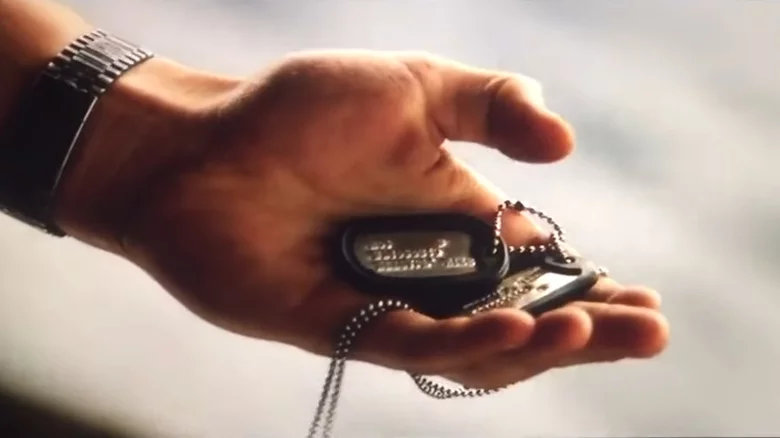
How military dog tags became a style accessory.
Hi there. This week I’m taking / giving you a break from the ballistics series1. As a reminder, so far we’ve covered wound ballistics, intermediate ballistics (with a deep dive on silencers), internal ballistics, and external ballistics.

Today, instead of talking about bullet spin or barrel pressures I’m answering the call of a reader2 and addressing the topic of military dog tags:

The question arose because his daughter is at the age of asking questions non-stop. She had a T-shirt with pictures of dog tags on them, and was naturally asking “what are these?” This got him thinking about how unthinkingly civilian (and kids’) fashion emulates military motifs, and he put in a request.
Sure enough, once I decided to write about this topic, I started noticing civilian dog tags everywhere. We’ll start today’s piece by looking at some of these examples. Then we’ll dive into the actual purpose behind identity tags (to give them their proper name). If you’re not aware, it may shock your delicate sensibilities. Finally, we’ll talk about military culture and my favourite topic, admin.

Before we start, let me encourage you to subscribe to the blog using the link below. As always, I’d love to see your comments below, or you can contact me via webform here or email here. Finally, if you’ve enjoyed this post, please share it with a friend.
If you enjoy this blog and want to support it, please consider a donation. Keeping this blog going doesn’t cost much, but it isn’t free either, so any help would be very much appreciated👍
Dog tags have cropped up in the most unusual places
Let’s begin by looking at the cross-pollination of civilian fashion with dog tags. I saw an egregious example on Netflix last week:

He’s not alone. TheDogTag.Co (who might have a dog in this fight) tell us that “Wearing dog tags has become a symbol of style and self-expression… [they] reflect the fusion of military heritage and contemporary fashion trends.” They are part of the “military chic” style:

According to the FT, they were popularised by such style icons as Eminem, Noel Gallagher, and Justin Bieber. In the same article, they list precious metal and stone-encrusted dog tags which cost up to £20,000:

Bad taste in dog tags is not limited to the über rich, as you can see in the Reddit AITA3 below:
The blowback from a military friend which prompted the AITA question seems to be a common aspect of any “dog tag as fashion” conversation (thanks, America). Here’s a snippet from the always batshit Quora:

We can go deeper down this rabbit hole, to an Anonymous user on GirlsAskGuys asks the world4 “Do you think ”Dog Tags” is an offensive fashion accessory?” They provide the following helpful voting options, which really does capture all scenarios (with a picture of Justin Bieber in case you’re on the fence):

It’s great that keyboard warriors and self-appointed gatekeepers have their finger on the pulse of what really matters in this world, isn’t it?
Dog tags are not the only type of “military chic,” of course, but they do have a very practical but also very morbid purpose which we’ll discuss in the next section.
Identity tags have a morbid purpose
You haven’t earned the right to wear dog tags.
—Anonymous keyboard warrior (probably)
You don’t “earn” your dog tags, you get issued them5. Normally, at least in my service, ID tags are only issued to personnel going overseas. They are part of the pre-employment admin, along with making your will and telling the military who your next of kin is. In other words, they are for when you get killed.
More specifically, and morbidly, they are for identifying your body when it’s otherwise unrecognisable. When, for example, your nametag and ID card and even your facial features are no more. Identity tags are a durable record of your name, service number, and other critical “in case of death” details:

The tags might also show critical care information such as blood group, known allergies, and religion (although arguably this is just as important in death).
The tags need to be duplicated and easy to detach, in case the tactical situation is too dangerous to evacuate your body:
- One tag stays with your body for identification when it’s eventually recovered
- The other tag gets sent back to your higher headquarters so they can record your death
The scene in Saving Private Ryan where Tom Hanks and his team search through a pile of tags demonstrates their utility6. It also shows how it’s a pretty morbid utility, at least to the fellow Airborne soldiers whose erstwhile buddies are now the subject of this callous scrutiny.
On the other hand, Tom Cruise throwing Goose’s tags overboard7 in Top Gun is a sure-fire way to piss off the unit adjutant. Extra paperwork is sure to follow. Although, and some internet sleuths even sadder than me have pointed out, the tags actually have Viper (the Commanding Officer)’s name on them. Which means that… he will simply need to requisition a new set. But the whole scene makes so little sense as a conclusion, especially when in light of Maverick’s ongoing hang ups about Goose in the 2022 sequel.
Another Hollywood quirk is that we only ever see the oblong two-tag system, i.e. the US one. Plenty of countries use a break-apart tag instead of two separate ones, with some examples shown below:

The beauty of the one-piece design, apart from its simplicity, is that it avoids having two tags clinking against each other. This is something which the sneakier types of soldier8 take very seriously, but they’ve invented a solution for the two-tag situation in the form of rubber silencers, as seen below in the aforementioned Top Gun destruction of government property scene:

Of course, why naval aviators need to worry about stealth is a whole other question. Another very simple way to keep dog tags from clinking is to keep them under your shirt, which of course is what boring non-Hollywood soldiers do.

Other, equally sensible ideas I’ve seen include looping the tags around your belt buckle or between the tongue and laces of your boot (although I can see how this could go wrong if they slipped into the shoe). Around the neck makes sense in that someone will always be able to find them, but the downside is that there’s always the slim possibility they get caught in a weapon or strap or (god forbid) a piece of rotating machinery. Again, just tuck them away.
In movies, dog tags are just one of those must-have accessories that defines a warrior, probably because of their morbid association. This coolness has bled into the world of fashion. When a celebrity wears of identity tags, no-one is anticipating having to take one from their body, but they still retain some vestigial cool.
In reality, dog tags are just another item of admin. Another thing (however small) for the soldier to carry, another item to get made and get issued with prior to deploying, and another article to present every week for inspection by the platoon sergeant. Why the fuss? Let’s discuss that next.
They underscore the military’s obsession with admin
I’ve written a whole article on the importance of military administration and the amount of time it takes up in the day-to-day of the military. I won’t reprise these here, but I will put up a quick reminder of the structure of military staffs according to the “Continental” system first popularised by Napoleon:

Admin is the first and (arguably) the most important function of a military staff. If you don’t know how many people you have and what state they’re in, then you can’t do much else. Dog tags are an important part of this, since they are physical (almost) proof of a soldier’s demise.
In Catch-22, the Dead Man in Yossarian’s Tent reports to the Operations Room before the Orderly (Administration) Room. He gets assigned to a mission, leaves straight away, and is killed when his plane is shot down. Because he never officially reported to the squadron Orderly Room, he doesn’t exist to them. His equipment and personal effects exist in a state of perpetual limbo which vexes the admin staff to no end. If his transfer paperwork, or even his dog tags had survived, then they could have taken him on the unit strength and marked him as a casualty.
Joseph Heller wrote a satire, of course, but like all satires, it is based on a grain of truth. Real militaries need robust systems for when they are facing hundreds, thousands, or tens of thousands of casualties in a short space of time. When you wear a set of fashionable dog tags, you’re really paying homage to the dull but effective pen-pushers who, over the course of the last century or two, have turned war into an efficient administrative process.
Conclusion: Military utility evolves into fashion
There’s nothing new about military motifs finding their way into civilian fashion. From jackets and boots to epaulettes and camouflage patterns, utility in combat is the starting point of an evolution into haute couture, usually with considerably less utility. Dog tags are an obvious part of this cycle.
There’s another reason beyond “military chic” for dog tags’ enduring popularity as accessories, at least in my opinion. As we discussed above, they have a morbid purpose in the field, which is to identify a dead soldier who may be otherwise unidentifiable. Wearing them outside this context could be seen in the first instance as a shocking or transgressive display, but which loses its sting as the usage spreads from the top influencers down to the masses. Some fashions that have gone through a similar transition are:
- Tattoos have gone through this cycle more than once, starting out as the preserve of the wealthy, before spreading to lower classes, and then making their way back to the mainstream in recent decades.
- Fetish fashion such as chokers, corsets, fishnet stockings and thigh-high boots has undergone a transition in recent decades from transgressive subculture status to (somewhat) mainstream fashion.
- Sagging or low-riding jeans started as an homage to prison regulations (ill-fitting clothes and no belt to use as a weapon or to hang yourself), becoming widely imitated on the street, provoking a moral panic which looks almost quaint now, and eventually falling out of style. Recent designer trends have emulated this look for $1000 plus, provoking outrage against supposed gentrification and cultural appropriation. Seriously.
The most enduring example, however, is the crucifix. It’s so common to see people wearing this that we forget what it means, but hundreds of millions of people are walking around right now wearing a tiny depiction of a gruesome Roman method of execution. If they give any thought to the iconography of it, it represents a symbol of hope for humanity, of Christ’s sacrifice for mankind and his resurrection.
This wasn’t always the case. The early Christian symbol was the fish (ichthys), and it took a few centuries for the cross to become the favoured symbol. Early Christians had to defend themselves from the accusation that they were “adorers of the gibbet,” i.e. that they worshipped a structure used to show off executed criminals.
I’m not saying that dog tags will ever come to symbolise a new religion—I hope not! But symbols and fashions evolve, just like language, and that’s okay. Perhaps in some future, better world, young men and women won’t need these metal tags to identify their remains. Maybe dog tags will be even more common as a fashion accessory, and their real origin will be lost in the mists of time (or the internet Wayback Machine). We can only hope.
In the meantime, while I’ll indulge in a little sneer at people who wear dog tags as an accessory, I’ll also sneer a bit harder at those military gatekeepers who froth at the mouth and go on about “stolen valour” and “earning the right” to wear a set of cheap metal discs. Wear what you want, but read this article first so you can clap back at the haters.

That’s all for this week, folks. Thanks for reading and please remember, if you haven’t already, to subscribe using the link below. Please also share this article with a friend. See you next week.
Featured Image: Things In The Top Gun Movies That Made No Sense, Duncan Carson, Looper.com (6th Sep 2022)
- To be honest, it’s the former. I need a bit of breathing room before diving back into this meaty topic. ↩︎
- Honestly, the things I do for you! ↩︎
- If you’re unaware of “Am I the Asshole?” you’re in for a treat. It’s a subreddit where people post their social conundrums online for all to judge. Sometimes they are the asshole, sometimes not, and occasionally it’s complicated. ↩︎
- Or the few dozen people who have read it. ↩︎
- In the original US military regulation for identity tags, they were to be issued to [enlisted] soldiers only, but sold to officers at cost price. This was a time when officers (who had money) would clothe and equip themselves. There were still some vestiges of this old idea when I served. I was issued pretty much everything but had to buy my own service and dress uniforms, whereas my enlisted colleagues were issued theirs. But because officers like myself mostly come from middle-class backgrounds, there’s an allowance for buying and maintaining one’s uniforms. The allowance, of course, more than covers the cost of the uniforms. Funny that. ↩︎
- It also seems to be a pretty realistic depiction of the number of paratroopers from the 101st Airborne Division who were killed on D-Day of Operation Overlord. ↩︎
- Apologies for the awful quality clip. ↩︎
- The type that will bag their own shit and take it back to base with them or will rub dirt on the tiny piece of exposed bark left when you cut off a branch, so the enemy won’t see it. ↩︎


Leave a Reply