A Military Realism Report on WMDs
Hi there. This week I’m serving up some re-heated content which you may have seen before. Apologies, but I’m travelling a bit this week and know I’ll be unable to devote my usual quota of time to a “proper” post.
I’ve created a new longer form explainer on weapons of mass destruction and added it to the “Realism Reports” section of the site, along with the first How Guns Work article I put together a few weeks ago.
Weapons of mass destruction (WMDs) used to be all the rage. You couldn’t throw a stone in a cinema without hitting a supervillian who was running some kind of plan to kill all or most of the world’s population with an ultra-toxic chemical or a deadly engineered virus.
WMDs have fallen out of most popular narratives in recent years, probably due to a combination of factors:
- The resurgence of conventional war in Europe
- The increasing visibility of the cyber domain as a threat vector
- Lingering cynicism from the lies preceding the 2003 Iraq War
I don’t think it’s entirely irrelevant, though, to be talking about weapons of mass destruction (WMDs) or, as I somewhat flippantly called them when I first penned this series of articles, weapons of “mass distraction” (not to be confused with the modern description of smartphones or the 1997 TV movie of the same name).
With the current War in Iran, I’ve spent the last two weeks explaining how:
- The US and Israel have demonstrated a truly awesome1 capability to deal tremendous destructive power from the air. This capability does not come cheap, either financially or politically.
- The US (and, to a lesser extent, Israel) are experiencing tactical triumph, operational obscurity, and strategic shambles as the full implications of an asymmetric war start to become clear.
The parallels with the 2003 War in Iraq have been made by many commentators. Anyone who’s ever read a book (which excludes many of those making big decisions right now) knows the potential for Western allies to get drawn into an interminable asymmetric war again.
One of several reasons being offered for this war was the necessity to stop Iran getting a nuclear weapon which, when combined with its ballistic missile capability, could threaten the United States. So, although the term “WMD” hasn’t been used (yet) for the 2026 Iran War, the very same primal fears (whether legitimate or not) are dictating foreign policy.
Nuclear weapons, as we discussed in the WMD series, are by far the most devastating of the CBRN “quad” (this is a hateful abbreviation which strikes fear into the heart of every soldier2):

In the run-up to the 2003 Iraq War, the narrative was all about “WMDs,” largely because no-one believed that Saddam Hussein’s regime had nuclear weapons. The “WMD” umbrella was a way to make decades-old chemical weapons or an ineffective biological weapons programme seem as scary as a nuke. It worked, insofar as the US got a critical mass of allies to support its invasion.
Will we see another “WMDs” narrative? Perhaps, but the focus is different this time. Instead of a non-existent chemical weapons programme we have a very real ballistic missile capability (albeit one that’s still vastly outclassed by Western and Gulf allies’ air power).
Instead of the fantastical claim that the enemy could deploy biological weapons “in 45 minutes,” the narrative will be around their very real capability to hit ships transiting the Strait of Hormuz with unmanned drones or bottom mines.
I wrote the WMDs article to dispel some of the wilder claims about chemical, biological, and radiological weapons that you see in TV and movies. You can read the full page here. Please check it out and, if you like this longer form explainer, then you might also enjoy my first one, How Guns Work.
Sorry again for the shortage of fresh content this week, but thanks (as always) for reading. Please remember, if you haven’t already, to subscribe using the link below.
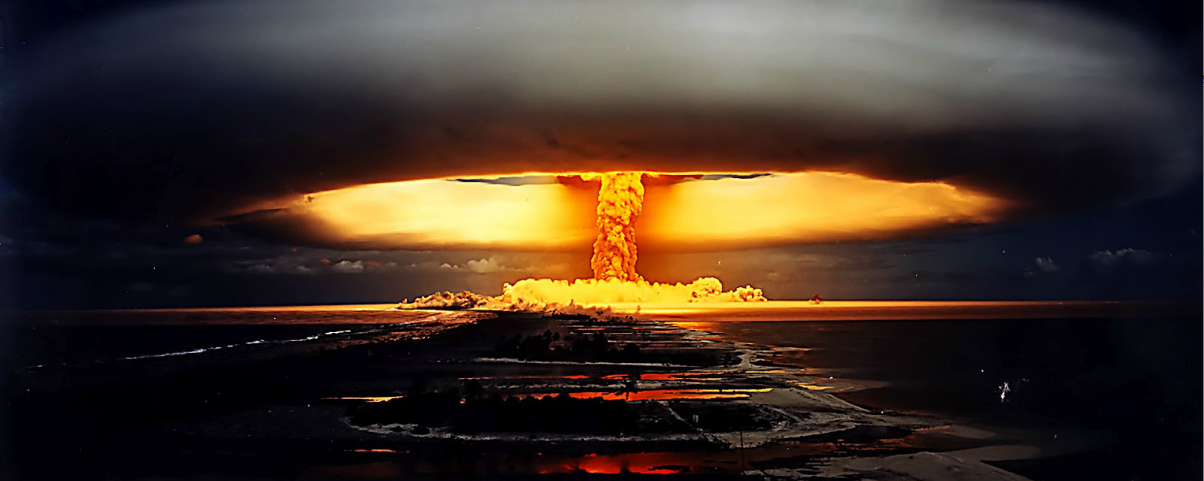
Cover Image: CTBTO, Licorne test 1970, French Polynesia. Available on Flickr.
- In the original sense of the word. ↩︎
- Not, I hasten to add, because of the fear of the effects of CW. No, it’s because of the fear of carrying extra kit, and ultimately having to do all the normally painful parts of soldering (crawling along ditches dragging a machinegun and 25kg of kit), but with an extra uncomfortable layer of clothing and a mask which seriously restricts your breathing, vision, and communications. ↩︎

Leave a Reply