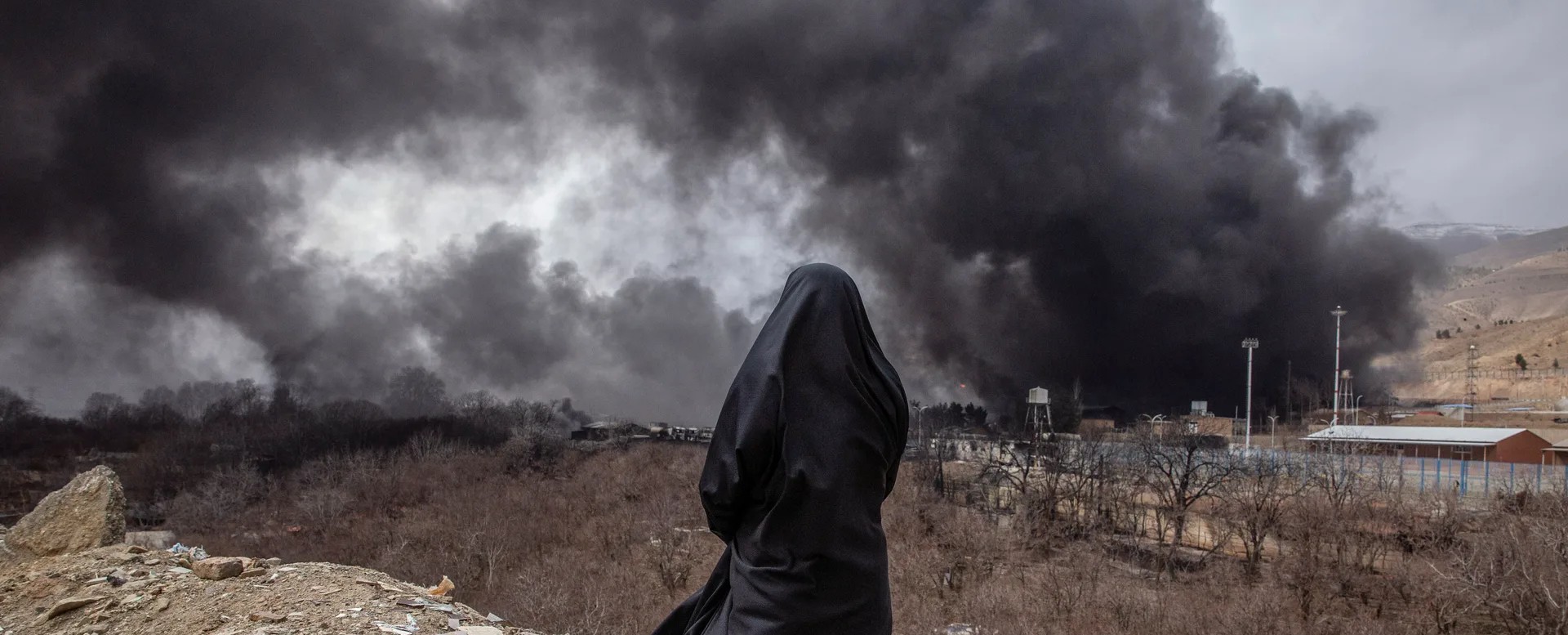
What the US-Israel-Iran war has taught us… so far.
🎧 Audio narration available for subscribers. Sign up below to access.
Hi there. As I promised last week, today’s post includes some of my thoughts on the current Iran war, or the Third Gulf War. I’m writing in March 2026, about a week and a half after the outbreak of the conflict.
Although the situation is changing rapidly, there are some things which are constant. One of those is Jim Hacker’s First Rule of Politics: “Never believe anything until it’s been officially denied.”

But much and all as I’d like to dig into some of the unbelievable rhetoric we’ve seen in this conflict1, I’m going to focus on the three most important lessons which I’m taking from this war to date.
The first is that American air power is absolutely unmatched. It is probably the most impressive tactical military machine the world has ever seen. The second is that this incredible capability comes at a tremendous financial cost. The third is that using this military machine in the way they currently are brings huge political costs as well.
Before we start, let me encourage you to subscribe to the blog using the link below. As always, I’d love to see your comments below, or you can contact me via webform here or email here. Finally, if you’ve enjoyed this post, please share it with a friend.
If you enjoy this blog and want to support it, please consider a donation. Keeping this blog going doesn’t cost much, but it isn’t free either, so any help would be very much appreciated👍
Lesson 1: The USA’s air power is unparalleled
The first week or so of the war has seen the US completely dominate Iran in the air. In the first day alone, they struck more than 1,000 targets in Iran with more than 20 different platforms, from F-22 fighter jets to MQ-9 Reaper drones. In the first week the US struck over 3,000 targets and started using larger munitions at closer ranges.
This progression from using long-range “stand-off” weapons (designed to keep the crew at a safe distance when launching) to using close-in laser-guided bombs2 is a sure sign that enemy air defences have been degraded.
Complete air superiority is achieved by systematically destroying the air defences, air bases, and air forces of the enemy (although, given its age and decrepitude due to sanctions, Iran’s Air Force has barely contested the skies in the first place).
The US is delivering such an immense amount of destruction to Iran from half the world away. The ability to project power from across continents and oceans has been a feature of American superpower dominance over the last century. It’s what you get when your Navy’s air force is more powerful than your top rival’s actual air force:

The graphic below, taken directly from Airwars, shows how much ordnance was dropped in the first 100 hours of the war in comparison to the first stages of some other recent conflicts.

Of course, the figures above include Israel, who have impressive air power in their own right. I’m focusing on the USA, however, for two reasons:
- Israel’s air power is heavily (though by no means entirely) based on US equipment.
- Israel is fighting in its own back yard, compared to the globe-spanning reach of the USA.
The US and its allies also seem to be avoiding the trap which many commentators pointed to after NATO shot down a Russian drone in Polish airspace in late 2025. The disparity in cost between the threat (about $10,000) and the response ($500,000 to $1 million) highlight a strategic problem for NATO/Western countries when dealing with high-volume, low-cost barrages.
In the Gulf, the “Western” allies are indeed having to shoot down many incoming missiles at enormous cost (and more on that below). But they’re not just doing that.
They’re also proving adept at tracking down and destroying the launchers as they break cover to launch their missiles. As the FT puts it:
When an Iranian ballistic missile launcher breaks cover to dash towards a firing site, its tiny cabin suddenly becomes one of the world’s most perilous places.
—The hunt for Iran’s ballistic missile crews, Jacob Judah, Bob Haslett and Alan Smith, The Financial Times (8th March 2026)
Another memorable phrase used by the OSINT specialistic and YouTuber Ryan McBeth is “shooting the Archer, not the Arrow.”
Of course, a strategy of archer-hunting relies on having complete air superiority in the first place, from the satellites which can see the infra-red heat signature of the launching rocket, to the drones which loiter overhead, ready to destroy these valuable targets.
These efforts at “shooting the archers” have been relatively successful, with sharp drops in the numbers of ballistic missiles and drones launched by Iran since the war started. What’s less clear, however, are the limits on each side’s endurance. Can the USA sustain its incredible tempo of operations? And can its forces and allies in the region continue to defend against Iranian drones and ballistic missiles, even at a reduced rate?
Let’s turn to these questions as we discuss the next big lesson of the last two weeks.
Lesson 2: This overwhelming air superiority comes at a cost
America’s overwhelming military might does not come cheap. The country spends close to a trillion dollars every year on military capabilities, which is more than the rest of NATO, plus China, plus Russia combined. It’s also more than every other country in the world combined. The US does not skimp when it comes to defence spending, nor has it for a long time:

America’s military budget accounts for roughly 40% of global military spending. Take a moment to appreciate the scale of this number. For every dollar that’s spent in the world on military power, forty cents goes to American capabilities.
What about the Third Gulf War itself? Two numbers stand out for me:
- $5.6 billion dollars is the Pentagon’s own estimate for the cost of the munitions dropped in the first two days of the war alone. Given that the munitions budget in FY24 was $30.6 billion, this immediately puts a lie to the notion that operations at this pace can be sustained “forever.”
- $1.9 billion dollars is the cost of US military equipment (aircraft, radars, other infrastructure) destroyed in the first four days of fighting. Although no doubt serious for the asset owners, this is only a drop of water in the ocean of the US military’s total asset base. But that’s what is scary from a financial point of view. The US is burning far more value in its own operations than the enemy is inflicting upon them.
In a separate analysis, the cost of the war is estimated to be somewhere between $1 billion and $2 billion per day for US taxpayers. That’s 1-2% additional defence spending for every ten days of conflict.
Who is paying for this extraordinary military spending? Well, you are. The USA doesn’t come close to balancing its books, so its deficit (which the military is a significant contributor to) needs to be financed by the largesse of creditors: people willing to lend money to the spendthrift United States Federal Government. And you are one of these people, whether you realise it or not.
Okay, I’m going to have to make some assumptions here. You’re paying for this war through your own investments in US debt, your indirect investments such as pensions, and the taxes you pay to your own government to buy US debt on your behalf. Let’s take a look at some examples:
- In 2025, the average person in the UK loaned about $1,700 to the USA through Treasury purchases3.
- Likewise, in Canada, in 2025, the average person loaned about $2,400 USD to their southern neighbours.
- The average European paid about $400 to the US in debt purchases.
- Americans themselves, on average, paid about $3,700 per annum to finance their own government’s liabilities (just to be clear—that’s not taxes, that’s a small portion of their taxes plus a sizeable chunk of their private investment portfolio, their pensions, etc.).
On an absolute level, i.e. not annual cash transfer, the average American has loaned about $40k to his or her government. Now, they might be comfortable with that figure, since the strength of their own government is critical to their own well-being. But what about the average European, who has spent around $10k financing their transatlantic neighbour?
Perhaps the massive security guarantee which the US provides is ample reward for these investments. However, this $6 trillion (or $240 billion per annum) which Europe lends to the USA could go a long way toward building a credible EU defence capability.
Coming back to the defence budget: A trillion dollars a year might seem like a lot of money—okay, it is a lot of money—but it doesn’t seem quite so drastic when you put it in the context of America’s gargantuan economy. It’s about 3.4% of GDP, which is the same as Estonia or Colombia and a lot less than places like Armenia (5.5%), Russia (7.1%), or Ukraine (34.5%).
In short, the US can afford to massively outspend everyone else on military capabilities because its economy massively out-performs all others. Furthermore, because it’s the home of the world’s reserve currency, it doesn’t need to care about balancing its budget. The money will flow in regardless.
Besides, the USA’s money problem is much bigger than a military issue. Its deficit is nearly twice as large as its military spending, so you could reduce military spending to zero and still have to cut the same amount from non-military programs just to balance the books. So it’s not that the US can’t afford its military spending (although it can’t), but that it can’t afford any of its spending4.
The USA continues to borrow to live beyond its means, and we continue to lend it the money to do so, because America is the pre-eminent global bastion of stability, the American dollar reigns supreme, and it pays its debts along with a decent chunk of interest which makes our pensions and savings look that little bit better.
This all works fine… until it doesn’t.
Lesson 3: The cost is political as well as financial
There’s a non-financial cost to launching a war like the USA and Israel have done in the last fortnight. The attacks are considered illegal under international law, although this has rarely restrained American power in the past. It has, however, forced an attempt or pretence at complying with international bodies such as the United Nations. This no longer seems to be even a minor consideration.
One-time stalwart allies are humming and hawing (and mostly hawing) about joining the cause, much to the consternation of the US:

Sure, in their rhetoric, they condemn Iran, but that’s easy: there’s much to condemn. They’re not, however, rushing to contribute their own air forces and navies to this attack, even though it’s a laughably one-sided conflict and their countries lie well outside the retaliation zone.
I’m not saying that countries like the US and Israel should never make unpopular choices. Political capital exists to be spent, provided you get something valuable in return. War, disagreeable though it is to many people (and awful as it is to its victims), is just another way of doing politics.
The problem with the current war is that it’s not clear to me (or, I think, to anyone) what strategic benefit it’s supposed to bring to the United States.
The first American principle of war is:
Objective – Direct every military operation toward a clearly defined, decisive and attainable objective. The ultimate military purpose of war is the destruction of the enemy’s ability to fight and will to fight.
Looking at the current operations in Iran, it’s like they read the second part of that definition but forgot completely about the first. Let’s run through some of the potential options for a “clearly defined objective”:
- Destroy Iran’s nuclear weapons programme. But this was supposedly already destroyed in last year’s “12-Day War”, which I wrote about at the time (spoiler alert: even then, we knew it likely wasn’t). In all seriousness, the scale and scope of strikes are too broad for this to be the objective.
- Regime change. They killed Ali Khamenei, the Supreme Leader, on Day 1. So… success? But the war has continued. The chosen successor is “unacceptable” to President Trump. If the goal is regime change, then bombing is an expensive and ineffective way to achieve that.
- Get their oil so that Americans can enjoy cheaper energy. Like with Operation Absolute Resolve (the kidnapping of Nicolás Maduro, for those of you not up to speed on your American operational codenames), bringing war and destabilisation to an oil exporter has actually increased oil prices. This is something that even the dogs in the streets could have told you.
- Protect and defend their allies in the region. The Gulf states are under fire and have seen an exodus of expatriate workers and tourists, their lifeblood, not to mention the damage or at least interruption of oil and gas infrastructure (their more important lifeblood).
- Distract from the Epstein files. Perhaps we’re getting somewhere with this one. I hate that US Foreign Policy is so incoherent that it’s changed me into a slight conspiracy theorist.
- Provide a pretext for President Trump to impose “emergency” security measures at home in time for the mid-term elections in November 2026. See above.
In summary, the political benefit to the USA is unclear, whereas the financial and political costs are great. And here’s where these two intersect. America is able to get away with not balancing its books because it’s the world’s pre-eminent superpower and the dollar underpins the global economy.
Nobody knows how resilient this system is. It might be proof against all kind of shocks. Perhaps the global instability caused by war will cause capital to move into safe, dollar-denominated assets, increase the price of US debt (and therefore lower its yield, or cost to the US), and pave the way for future investment in the region that will benefit the USA. America is invincible, and pounding Iran’s cities into dust might be the best way to prove that.
On the other hand, maybe the bump in military spending and the spike in energy prices cause a double whammy where the markets take a hit but so do bonds, as investors from all over the world doubt America’s ability to pay its colossal bills. This could trigger a positive feedback loop5 of increased debt servicing costs leading to higher deficits and further bond market distrust.
Conclusion: Is this the zenith of American power?
In 1980, the US sent a team of special operations forces to Iran to try to rescue over 50 embassy staff who’d been taken hostage when the Iranian Revolution took place the year before. Operation Eagle Claw was an infamous debacle. Two aircraft crashed into one another at a desert rendezvous, eight servicemen died, and the hostages remained in Iranian custody.

This failed operation was the genesis of many changes within the US military, particularly when it came to special forces, as I’ve written about before. It’s interesting to contrast the dangers which the US faced in Iran not even fifty years ago with the complete and utter dominance they have over the country’s skies today.
It would be more interesting still to consider how any future (as of time of writing) American ground operations in Iran might fare, because to date none of the operations have put boots on the ground, as was the case with Eagle Claw (and, to be fair, with the recent operation in Venezuela).
If you want to read more analysis about this war, then I highly recommend the 1919.review, one of my favourite bloggers, who has a piece on comparative advantages and potential future scenarios as well as a more recent piece on what he calls “the machine war.” In terms of podcasts, Anthony Scaramucci on The Rest Is Politics (US) does a great job explaining the Kremlinology of the Trump administration when it comes to this war.
I’m not brave enough to make a prediction on how this war will play out. It might end tomorrow. It might even end before this article goes to press. Or it might go on for another decade.
What I will predict, however, is how this operation will come to be viewed by future military historians, especially American ones. For the reasons I outlined above in Lessons 2 and 3, I think that their country’s relative economic and political heft will ebb. Not at once, and not by any alarming degree, but enough to constrain America in its ability to project massive air power halfway around the world.
I think that the overwhelming air superiority which America has seen in the opening weeks of the Third Gulf War will come to represent a high-water mark of its global power.
On that highly speculative note, let me finish for the week. I’d love to hear your thoughts, though. Please let me know in the comments below if you think I’m on the right track or are spouting nonsense.
Thanks for reading and please remember, if you haven’t already, to subscribe using the link below. Please also share this article with a friend and help me broaden my reach. Every little helps! See you next week.
Cover picture: The Lawlessness of Trump’s War in Iran, Isaac Chotiner, The New Yorker (10th March 2026)
- Oh, okay. Here are just two. Pete Hegseth thinks that his forces sank the first enemy ship with a torpedo since WW2, and an Iranian general is claiming that 650 US servicemen have been killed so far. ↩︎
- The only type of “LGB” which the new Secretary of “War” wants to acknowledge. ↩︎
- $121.6 billion purchases through the UK in 2025, divided by 70 million people. Yes, of course, it’s not divided equally. ↩︎
- If you want to see this for yourself, try the Debt Fixer online tool. ↩︎
- Positive feedback loops, despite their name, are usually very bad things. ↩︎


Leave a Reply