Unravelling the hype and misconceptions about modern military technology and tactics.
Hi there. The US-Iran deal-or-no-deal intrigue goes on. There are many aspects of this I could write about, but, like most of us, I’m on tenterhooks seeing what happens (or doesn’t happen) next. Also, if I’m being honest, I don’t want to write something that becomes overtaken by events a few hours or days later.
One thing which does deserve a bit more commentary is a quote I heard from one of my favourite podcasters a few days ago. Scott Galloway, speaking on the Pivot podcast with co-host Kara Swisher, was talking about the aforementioned. He made lots of great points (e.g. a memorandum of understanding is not the same as a deal, even if it was a “deal”, it would be an awful one, etc.). One howler, however, came when he turned his focus to the US military and said this:
Our military budget should be cut in half, and it should be focused on one word: asymmetric warfare
Let’s break this down:
- The US spends far too much on defence/defense: So far, so good. You’ll find no argument from me on that point. In fact, I’ve made the point myself quite recently.
- It should embrace asymmetric war because that’s what works: Oh dear. What? Scott, no. Have you not been reading my posts on asymmetric war? I suspect not.
Right, let’s break this down with another lesson in Asymmetric War 101. I’ll start with the obscene military spending of the USA, and why it is that way. Then I’ll go on to talk about why “asymmetry” isn’t a doctrine which the US (or any superior power) can just drop into their military system. Finally, I’ll talk about Ukraine, which is what inspired the above quote, but which isn’t an example of asymmetric war1.
Before we start, let me encourage you to subscribe to the blog using the link below. As always, I’d love to see your comments below, or you can contact me via webform here or email here. Finally, if you’ve enjoyed this post, please share it with a friend.
If you enjoy this blog and want to support it, please consider a donation. Keeping this blog going doesn’t cost much, but it isn’t free either, so any help would be very much appreciated👍
1. The USA does not get enough bang for its trillion bucks…
When I last wrote about the US’s military spending way way back in March 2026, the official budget was between the high $800 and low $900 billion dollars per annum. That’s pretty hefty: nearly one Elon. Since then, President Trump has announced a budget increase for FY2027 to $1.5 trillion (1.25 Elons2).
Let’s take a beat to reflect on the magnitude of that figure. That is:
- A whopping 42% increase on FY26 funding levels, even when adjusted upward to take account of additional spending in-year
- About $4,400 for every man, woman, and child in the USA
- About $1.5 million for every uniformed service member in the US military
It’s a good thing the US is in such a strong fiscal position with control over its deficit, stable and predictable interest rates, and a manageable debt the magical money merry-go-round is still spinning.
Seriously, though, this level of spending is obviously a problem. It’s a problem of success, to quote Scott back to Scott, but a problem nonetheless.
And yes, part of the reason for this spending is because powerful military capabilities aren’t cheap. The ability to drop bombs into a mountain halfway around the world and then pluck an enemy’s leader right from his presidential palace and then mount a daring rescue of a downed helicopter crew in enemy territory… these things don’t come cheap. That’s before we get to the nuclear arsenal, a.k.a. the ability to burn hundreds of cities around the world at ~30 minutes’ notice.
Great and all as these capabilities are, you’d be right to question whether they’re worth spending 14% of each US household’s annual income3 on, especially when it still doesn’t enable you to win a war of choice against a country that spends $8 billion on its military, or less than 1% of what you spend4.

There are clear laws of diminishing returns here and any sensible person would ask where the money is going, but for the fact that it would provoke howls of anguish among the hawks. Coming from the (Irish) military myself, there’s a part of me that envies that unquestioning devotion to funding one’s military. To put it delicately, over-investment in Irish defence capabilities isn’t something I’ve ever experienced.
What’s obvious to the outsider is the misaligned incentives of the US military spending system. Pork barrel politics5 means that lawmakers have an interest in spending by military contractors in their districts, a long-running trend which has shifted into overdrive under President Trump.
With inflation only going up and full employment, the arms factories can name their price to the Department of Defense War, thus contributing to even greater price inflation and the accelerated burning of public money.
Regardless of your views on military spending (I lean toward thinking it’s a good thing, at least when my own or friendly countries are doing it), it’s hard to argue with the assertion that the US military is a financial black hole with not enough bang coming out to justify the many, many bucks going in.
So, what’s the answer? Should the US embrace this hot new crazy thing called asymmetric war? Well, it’s not so simple. Let’s talk about this next.
2. …but “going asymmetric” isn’t a viable option
Asymmetric warfare is a struggle between belligerents whose military power varies significantly. In other words, the weaker party is the one who “does” asymmetric warfare. If a bloated defense budget is a problem of success, then asymmetric warfare is a reaction to weakness.
I showed how this relates to the US-Iran conflict in a recent post, but here it is again in case you missed it:

Why can’t the USA save a bunch of money by “doing” asymmetric war? Sure, you can tilt the scale on the power/supply side (the top seesaw) by cutting federal funding in half. But you can’t do anything on the bottom seesaw, the constraints one. Messing about with this side would involve tarnishing one’s international reputation, ignoring the rule of law, and potentially even democracy at home.
Hmm, on reflection, let me rephrase that. You shouldn’t want to mess with the constraints side of the ledger, even though the current US administration seems hell-bent on doing just that. Even if you ignore laws, however, you can’t get around the fact that your public might not have the stomach for the fight.
I’m getting a bit technical here, so let’s step back and put it in really simple terms. If you want to US to do asymmetric warfare, then whom should you target with it? Who has a much more powerful military than the US while being constrained by rules, laws, and public opinion? I can only think of a few examples, none of them real:
- The United Federation of Planets from Star Trek
- The Culture society from Iain M. Banks’s science fiction books
- The kingdom of Equestria from the extended My Little Pony universe
So, unless you’re planning to take on one or all of the above, making the USA pivot into “asymmetric warfare” is practically impossible by definition.
If the US military really wanted to become an asymmetric warfighting force, here are some of the things it should consider:
- Training its soldiers in improvised explosive devices and homemade explosives, then sending them undercover to attack targets in the enemy’s turf
- As above, but targeting civilians for mass casualties
- As above, but using suicide bombing as a tactic
- Transforming its military hierarchy into an Iran-style mosaic defence with decentralised command authority
- Ending the flag ceremonies for fallen servicemen and women: you’re going to have a lot more casualties, and you don’t have time or emotional bandwidth for this
- Hardening the civilian population and bringing it in line with purges and reprisals where necessary
Is the US prepared to do any of these? I expect (and hope) not. Asymmetric warfare isn’t an option.
What about Ukraine, I hear you ask? Didn’t it work for them? They didn’t have to go down the pathways I’ve outlined above, right? Let’s talk about the Russo-Ukraine War next.
3. What we’re seeing in Ukraine isn’t really asymmetric warfare
As I mentioned above, I don’t hold that the war in Ukraine is a good example of asymmetric warfare. At least not at the tactical or operational levels:

By contrast, the Third Gulf War shows how this model works in practice, with asymmetric warfare at the Strategic, Operational, and Tactical level:

The bigger story in Ukraine right now is technology rather than asymmetry. Cheap drones and ground-based robots have transformed the battlespace, rendering certain assets like tanks less relevant.
Although Ukraine is ahead on this metric, Russia is also innovating with new technology. The important thing to remember is that Ukraine asked for heavy matériel like Patriot missile batteries or main battle tanks, and it hasn’t struck these off the wish-list.
That’s the thing about asymmetry: it’s rarely a deliberate choice, but rather something which is imposed due to a lack of “normal” options. This further demonstrates why it should not be seen as a goal in and of itself.
There is one big element of asymmetry in the Russo-Ukrainian War, however, and it would be remiss of me to not point it out. That’s the nukes. Nuclear weapons are the ultimate backstop of Russia’s power. Whatever might happen on the (as we said above) symmetrical battlespace in Ukraine itself, the latter country can only do so much and go so far in its violence on Russia without suffering a catastrophic nuclear counterstrike.
It’s not a simple answer: there are aspects of symmetrical and asymmetrical warfare with this conflict, but I’d be wary of taking it as an example of asymmetric warfare in its own right. Especially considering that we did a whole Global War on Terror in living memory: use that as your example of successful asymmetric warfare (successful from the enemy’s point of view, of course).
Conclusion: The answer isn’t easy
When people throw out glib statements like “we should go asymmetric,” what they’re really saying is: “Look at Ukraine and Iran, they’re both successful against much bigger powers, let’s be more like them.”
This is an understandable ambition, but it utterly fails to account for the fact that:
- Ukraine and Iran are two very different situations
- No country in its right mind would choose to be either Ukraine or Iran right now
If you want your military budget to stretch further and achieve more with less, then I’m right there with you. I’ve worked in defence procurement. I’ve seen how a coating of olive-green paint can add a zero to the end of a pricetag.
You can make savings, but beware of the temptation to throw everything out the window:

The uncomfortable truth is that being the world’s pre-eminent military superpower costs a lot, as it always has, but still doesn’t guarantee that you can win wars of choice.
Is some of that money wasted? Undoubtedly. Is half of it wasted? Possibly. But, to paraphrase the old adage about advertising: which half? That’s the hard part, I’m afraid.
That’s all for this week, but what do you think? Please let me know in the comments below. Also remember to subscribe if you haven’t already. Thanks again for reading and see you next week.
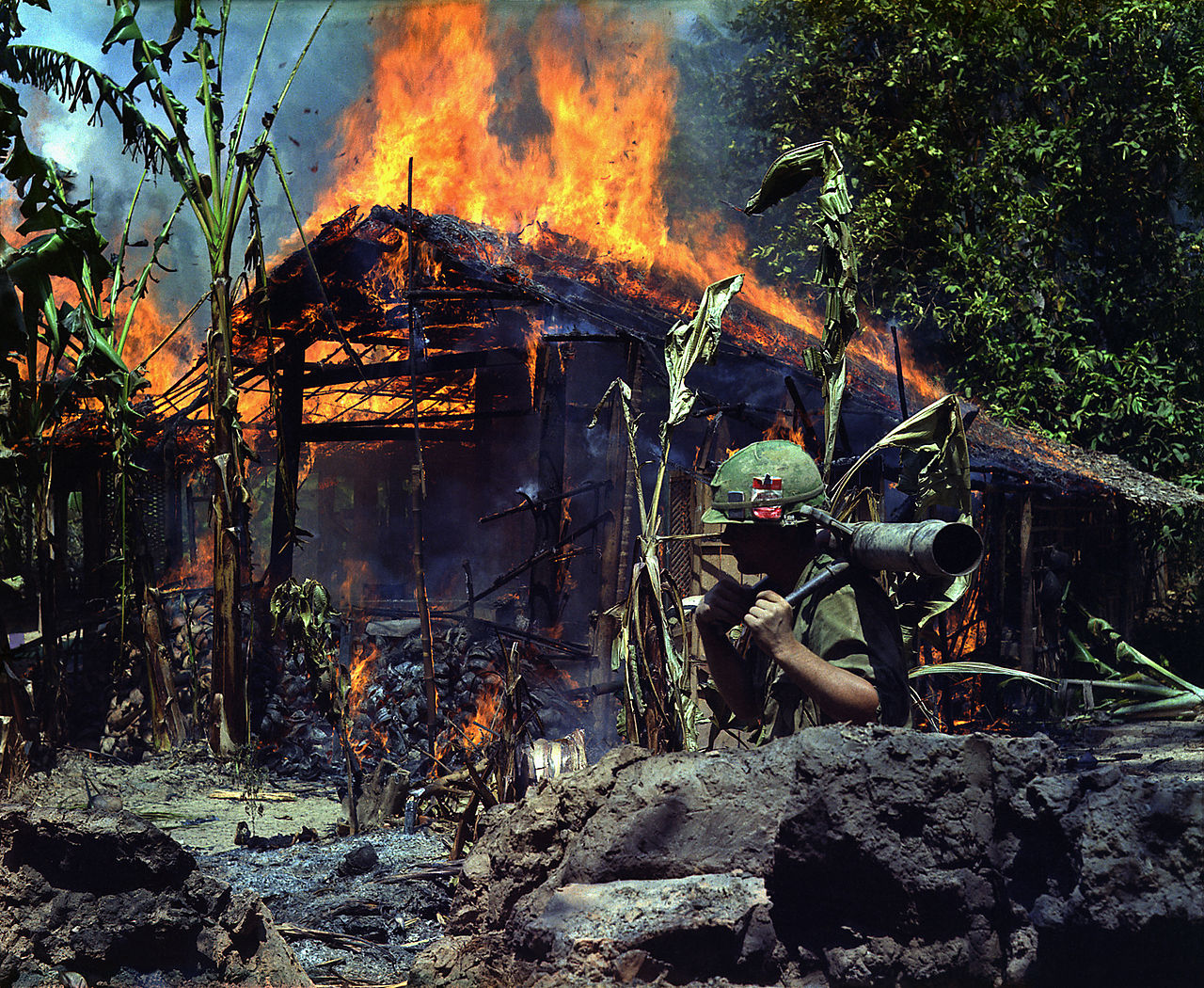
Cover picture: Vietnam, 5 April, 1968. A Viet Cong base camp being burned down. National Archives at College Park, Public domain, via Wikimedia Commons
- This might be controversial, but I’ll stand by it. Two forces locked in a stalemate along a wide frontier and fighting a brutal war of attrition does not look like asymmetry to me. Sure, on side is making better use of modern technology to change the way the war is being fought and offset some of the material advantage of the other. This isn’t asymmetry, this is evolving tactics. If you want a different view, however, there are plenty of folks who call this an asymmetric war. This article from September 2023 talks about symmetric and asymmetric aspects of the in the Russo-Ukrainian War, although it seems to conflate “symmetric” with “battlefield tactics” and “asymmetric” with “hitting enemy population centres.” By that logic, the strategic bombing campaigns of WWII were asymmetric. ↩︎
- The “Elon” is not a great unit of account, owing to its volatile nature and wildly speculative value. It makes Bitcoin look stable. ↩︎
- Assumptions based on some quick Googling: US population is 346 million, household average size is 2.53 people, average household income is $80,700. Do the math, as the Yanks would say. ↩︎
- You might complain that I’m not comparing like with like here. The US didn’t, after all, devote all its military resources against Iran. The estimate is that it spent $132 billion as of the 19th June ceasefire announcement, so only 16x Iran’s entire annual budget. ↩︎
- A.k.a. parish pump politics, a.k.a. the patronage system. ↩︎


Leave a Reply