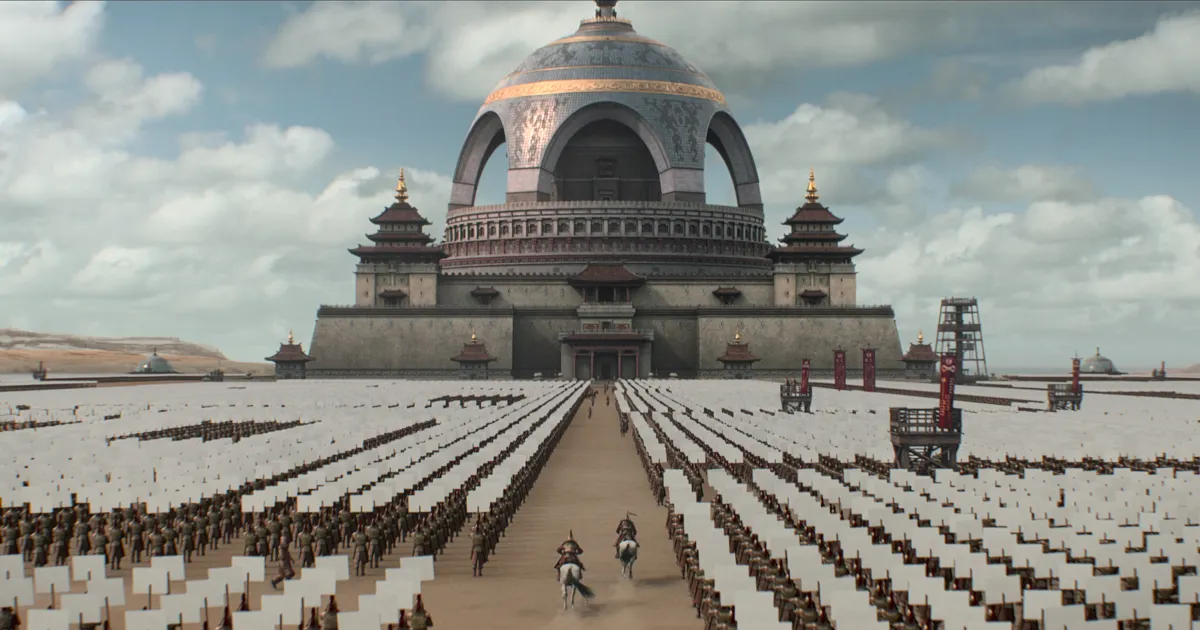
A [short] review of 3 Body Problem and its relevance to today’s conflict.
Hi there and Happy Thursday. This week’s post is going to be short and disjointed because I spent most of the long weekend travelling. Any time I wasn’t travelling was spent eating chocolate. I didn’t get much chance to write.
I told myself that I’d get loads of writing done on the plane on the way home, but I naively failed to account for the distraction of a squirming and restive toddler who was way past her bedtime. My wife points out that I could have written while said toddler slept throughout the flight, but also failed to account for my own sleepiness which, let’s be honest, is the real reason you’re getting a slap-dash post today.
Anyway, as luck would have it, I spent a considerable portion of the weekend re-watching Season 1 of 3 Body Problem on Netflix. I saw it within seconds of it first coming out in 2024, but decided that I needed to see it again in advance of the next season coming out. Here’s the trailer for Season 1:
Of course, having finished the last episode (again), I checked the release date for Season 2, and although there’s no official date yet, the best estimate is the latter half of 2026. Le sigh. You might have gathered this by now, but I’m an ardent fan. I devoured the trilogy by Cixin Liu which the TV series was based on:


I may have to wait for more on-screen adaptation of my favourite tales of alien destruction, but unfortunately there’s plenty of real-world asymmetric warfare going on that’s quite resonant with some of the themes of this piece of fiction.
That’s what I’m going to do today: a quick review of 3 Body Problem but through the lens of the current Third Gulf War / US-Israel-Iran War.
First I’m going to talk about some of the similarities we can see between both situations, and then I’m going to delve into some of the strategic relevancies for today’s conflict. By way of major caveat, I am aware that 3 Body Problem is a work of fiction. I’m not using it to predict the future. For one thing, the humans and aliens in Liu’s novels and the Netflix series behave according to game theory, making decision based on their strategic objectives.
The humans on planet Earth, or at least some of them, appear to be acting irrationally. That’s the nicest way I can describe what President Trump is doing, although in the interests of balance I should point out that some people still see a coherent plan behind all this.
Enough preamble, let’s get into this. A warning, there are major spoilers ahead, including from the books. In other words, if you haven’t read Books 2 and 3, but have seen Season 1 of the TV show, you will find potential spoilers below.
Before we start, let me encourage you to subscribe to the blog using the link below. As always, I’d love to see your comments below, or you can contact me via webform here or email here. Finally, if you’ve enjoyed this post, please share it with a friend.
If you enjoy this blog and want to support it, please consider a contribution. Keeping this blog going doesn’t cost much, but it isn’t free either, so any help would be very much appreciated👍
1. The similarities
3 Body Problem is about an advanced alien race whose own planet faces an unpredictable but eventual cataclysmic destruction. They hear about Earth and its bounties, decide to take it to save themselves, and prepare an invasion fleet to cover the four light year distance.
The aliens send an advance guard of “sophons,” quantum-entangled multi-dimensional particles which can see everything that humans say and do, and can mess with computers and eyesight to boot. Things don’t look great for humanity. These aliens are so far advanced that we might as well be bugs by comparison, a point which the aliens subtly reinforce by way of their aforementioned sophons:

The TV show roughly (but not entirely) parallels the first book in Liu’s trilogy. Humanity struggles with the implications of its impending doom. The aliens will take four centuries to reach Earth, so we have time to prepare, but their sophons mean we can’t achieve any more scientific progress in the time we have. We’re stuck fighting the aliens with 21st century tech.
Some people realise the implications of this early on. They realise the need for asymmetric war, a term which I spoke about a few weeks ago and is relevant in today’s conflict.
Once the asymmetric war clip above caught my eye, I started noticing the other similarities between this fiction and reality.
The aliens can project power across vast distances, just like the US can against regional powers anywhere on Earth. Our planet is an open book to the aliens, just like the skies (and probably cyberspace) in Iran is to the US. The aliens can mess with human technology and make it do what they want, just like the US can mess with power grids or malware in uranium centrifuges.
To be clear, I’m not saying that Iran are the good guys here. The TV show isn’t saying that humans are the good guys, either. Ye Wenjie calls the aliens only because of the extreme brutality she witnesses during the Cultural Revolution. And Liam Cunningham’s Thomas Wade character is an amoral ends-justify-the-means sort of guy, as we can see most graphically during the attack on the Judgement Day. Warning: the clip below is extremely graphic.
Perhaps the most striking similarity is the “Wallfacer” program. The alien sophons can see and hear everything that humans do, but they can’t see inside our brains. The planetary defence folks hatch a plan to make use of this. So-called “Wallfacers” are tasked with devising anti-alien strategies. People have to do whatever they say, within reason, but they must never reveal the intent of their plans to anyone.
Iran prepared for the current war by decentralising command and control. No matter how many political and military leaders were killed (and quite a few were, due to the overwhelming technological disparities), lower level commanders were empowered to use their own initiative against Iran’s actual (or perceived) enemies. Hence the overwhelming attacks on Gulf States, when a rational leader might have used diplomacy and the threat of further attacks to get valuable concessions from them instead.
But we’re straying into the realm of strategic effect here, which brings me on to my next point. Again: serious spoilers ahead if you haven’t read the novels.
2. The strategic lesson (with major spoilers)
I’ve already written about how the US is kicking ass in this war from a tactical point of view, but is pretty muddled about its operational aims, and utterly devoid of a broader strategy. “Tactical triumph, operational obscurity, and strategic shambles,” was the quote I used nearly a month ago, and the picture hasn’t changed.
This brings me to the biggest parallel between fiction and reality. In 3 Body Problem, the aliens set a course for Earth to kick us out and take our house. They have an overwhelming technological advantage over us and can interfere in our affairs to prevent us ever getting the upper hand over them in that sense. Nothing to worry about.
Or is there? In the second book, the weaker humans, the “bugs” in the aliens’ reckoning, figure out a way to defend themselves. They set up a communications system with a dead-man’s switch which will broadcast Earth’s location as a message in all directions. The aliens are afraid of other, more powerful aliens who might hear this and come and destroy them.
There’s a teaser for this in the enigmatic conversation between Ye Wenjie and Saul Durant in the graveyard. It’s ostensibly a bad joke about Einstein playing the violin in heaven, but it works as a metaphor for the Dark Forest hypothesis which got its name from the second Liu book (and hopefully the second season of the Netflix show).
Does this have any relevance for the current war? Absolutely. This work of science fiction illustrates the asymmetry of a conflict of survival.
The weaker party in any encounter can prevent the stronger party achieving their strategic goal if the weaker party is willing to sacrifice itself to harm the stronger one. A regime (e.g. Iran’s) which is facing an existential threat, can lash out in all directions and close the Strait of Hormuz, its lifeline to the world. Although it may be dealing extraordinary damage to itself, it is also dealing an unacceptable level of damage to its stronger and more powerful adversary (the USA).
We also see a form of this in the cold logic of mutually assured destruction, which I’ve also written about on these pages before.
Conclusion: My verdict on 3 Body Problem
The situation in the Gulf is changing quickly. As I write, President Trump appears to have accepted an Iranian ten-point plan as the basis for negotiations. In other words, the Iranian regime has gotten what it wants. In other, simpler words, it’s won.
Or, at least, it’s won in its own telling of the narrative. For the weaker party in an asymmetric war to “win,” it only needs to avoid defeat. For the thousands of dead civilians in Iran, this may not feel like a “win.”
In the fictional world which inspired this post, the strategic “win” for humanity is similarly bitter. It happens only after a humiliating military defeat at the hands of the aliens. More importantly, it commits humanity to a policy of willing self-destruction and destroys any ideal of interstellar peace and love and cooperation.
I’m such a lover of this science fiction franchise that I can’t give an honest verdict on its TV adaptation. There are plenty of valid criticisms about how they changed the setting and chopped up some of the plot points. Honestly, any book adapted for the screen needs to go through a process like this. I think it’s a faithful representation of an extraordinarily ambitious and rewarding book.
I sincerely hope that the next two seasons are as good. Season 1 was expensive to make, at about $20 million per episode. The next two seasons will have fewer episodes to cut costs: six episodes in Season 2 and five in Season 3, despite their source material being longer. It words out at:
- Season 1: 50 pages per episode
- Season 2: 85 pages per episode
- Season 3: 120 pages per episode
I’m quietly optimistic. More isn’t always better, and too many film and TV franchises today err on the side of bloat simply because they can. The third book, Death’s End, will be a particularly challenging one to adapt for television.
I won’t give away the ending but anyone who has read it will agree with me when I say that I sincerely hope there are no parallels between what happens at the end of Cixin Liu’s story and what may happen on this fragile world of ours.
That’s all for this week. Thanks for reading and please remember, if you haven’t already, to subscribe using the link below. Please also share this article with a friend and help me broaden my reach. Every little helps! See you next week.
Cover picture and all figures not otherwise noted: 3 Body Problem, Netflix (2024)


Leave a Reply