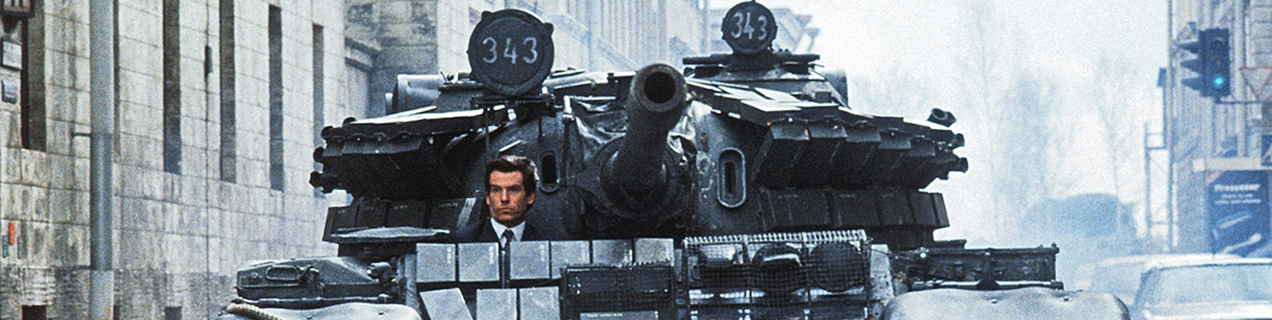
And other nuances of armoured fighting vehicles which Hollywood gets wrong
Hi there. I was re-watching GoldenEye on DVD1 recently. For once, I was well-behaved and didn’t attempt to ruin every scene by explaining how silly it was. I give Bond a pass (and I slate it enough in this blog). But Mrs. Director did ask me one question (she’s used to my rants and no doubt wanted to make sure I was okay, the dear).
Could he actually have driven a tank like that?
The “like that,” in case you haven’t seen it, or need a reminder, is this scene:
Short answer, of course, is “no2.” The longer answer, which she got (but didn’t ask, poor dear) is “no… and here’s why not.” An abridged version of my rant is below. I’ve removed the sound effects of my wife plugging her ears and throwing things at me to shut up3.
I’ll start by describing just how big and heavy main battle tanks are, then talk about how they need multiple crew members to more or less go anywhere. Finally I’ll discuss the absurd maintenance requirements of modern tanks, before finishing up with the question of whether they still have a place in today’s “battlespace4.”
A note on terminology before I get started: the word “tank” is almost universally used as a shorthand for what military purists would call a “main battle tank,” i.e. a “big, fuck-off tank.” Civilians (bless them) will use the term far more loosely, using it to refer to anything with tracks and a big gun, or even anything with tracks, or even anything with armour.
Here are some “tanks” vs. “non-tanks:”

Everything I write below that applies to tanks also applies, to a lesser extent, to other armoured fighting vehicles.
Before we start, let me encourage you to subscribe to the blog using the link below. As always, I’d love to see your comments below, or you can contact me via webform here or email here. Finally, if you’ve enjoyed this post, please share it with a friend.
If you enjoy this blog and want to support it, please consider a donation. Keeping this blog going doesn’t cost much, but it isn’t free either, so any help would be very much appreciated👍
Section 1: Tanks are even bigger than you think
We all know that tanks (by which I mean main battle tanks, or MBTs) are big. But until you’ve seen one in the iron, it’s hard to appreciate just how big they are.
Let me help. Here’s a tank alongside (or, rather, atop) a normal-sized thing for scale:

“Really?” I hear you say. “It’s not that big.” Oh, but it is. If you count how much stuff is in a tank, a.k.a. its weight, then the scales tip alarmingly in one direction only:

Being so heavy has some pretty important implications. Certain bridges will never take a 50+ tonne loading. Some smaller roads will just crumble into the ditch. And sure, you can go cross country (see below), but good luck getting across a swamp, through a forest, or over or large body of water in one of these.
Tanks are not subtle machines. There’s no way to be when you’re that big and heavy. That’s why I had to laugh when Bond “sneaks up” on the train in his tank right after the car chase:
Contrast this with the scene in Saving Private Ryan where we hear nothing but the tanks. We even see the rubble shaking loose as they clatter past.
Tanks are so heavy because of their armour. As anti-tank weapons have improved (a topic I’ve covered here and here before), tank designers have responded by slapping on more armour. Sure, there are innovations like explosive reactive armour or defensive aid suites, but these systems also add weight, as do ever-heavier weapons.
What are they like to drive? A dream, according to a former British tank commander who told me of his experience driving a Challenger 2:
It eats up terrain, going 60 km/hr cross country no problem. And of course knocks down walls if you’re not careful. Oh, and you can run over cars. It’s all quite fun.
Tanks are among the largest vehicles on our roads, and it’s impossible to miss them. From the inside, however, it’s not easy to see out. Let’s talk about that next.
Section 2: Driving a tank is not a one-man-job
Although one person will have the job of “driver,” he or she will not be the only crew member keeping an eye on the vehicle and its surroundings.
All armoured vehicles above a certain size will have a mandatory minimum of two crew: someone in the driver’s compartment and somebody in the turret or commander’s cupola. The person up on top will keep an eye out to the side and rear and talk to the driver constantly to help with their situational awareness.
Back to my British Cavalry colleague:
When you are driving with hatch closed you are actually lying down and looking through a periscope to look forward – feels like driving a car through the mouth of a letterbox.
“Hatches closed” is your standard way of operating when you’re under fire or anticipating fire. Take a look at the GoldenEye clip above: it’s what Bond does at 2:20 when the Russians belatedly start shooting at him. He doesn’t actually close the hatch, which probably affects his ability to use the periscopes as well as leaving the top of his head exposed.
With a real crew, the commander would also have gone hatches down at this stage but would have their own set of periscopes (possibly with 360-degree coverage) to see all around and advise the driver. Either way, and even with a full crew, their visibility becomes seriously constrained.
One last point on the “hatches down” is that without a helmet, Bond is asking for a series of minor head injuries. Everything inside a tank is sharp and made of metal, and any movement creates jostling. A car chase through St. Petersburg would definitely leave James Bond shaken and stirred.
For most crews in peacetime, most of their driving will be done hatches up, with their head and shoulders up and out of the driver’s cab and turret, respectively. The tank might also have detachable road mirrors. For most of their time, the main concern of the crew will not be enemy fire but damage to the roadway, other vehicles, and public property.
This is obviously not something that James Bond cares about, let’s be clear:

Although the damage done to the city is immense, Bond also showed a flagrant disregard for the integrity of the tank itself. This, to be fair, is a trait he displays toward all his modes of conveyance, whether or not they are issued by the long-suffering Q. But tanks do need maintenance, and quite a lot of it, as we’ll see next. Not that we would expect a naval officer such as James Bond to know anything about that.
Section 3: Tanks need a lot of maintenance
A tank is not a simple vehicle to keep on the road. Even driving it in a straight line involves learning a new skill:
Another key difference is you use sticks rather than a wheel- pull left to go left, right for right, and one left and other right to turn on the spot (called a neutral turn).
Another commentator on Quora describes the same neutral turn, but warns:
[this is] best avoided doing it on tarmac (makes a mess and upset the local council) or in heavy mud (risks pulling a track off and upsetting the crew).
But the biggest problem with driving a tank?
When [hatches are] closed down the driver is lying on his back, so as soon as you stop for any length of time he (or even she, now) inevitably falls asleep.
This might pose a problem because starting up a tank is not simply a case of turning an ignition key. There’s a complicated startup procedure for the Challenger 2:
Starting up is a bit of a business – power switch, fuel switch, generator unit electrical (GUE), some other buttons I forget, then main engine start.
A tank is a much bigger collection of systems than your car, and these systems in turn are far more complex. These systems require much more intensive maintenance procedures. This is because military people plan for the worst and put their equipment through the wringer, but also because it’s military and therefore prone to breaking. Cynicism aside, more complexity means more scope for failure.
To get around this, crews are trained to carry out maintenance on a continuous basis:
- Taking the armour out for a spin? Better do your “BOS” or “before ordinary service” checks.
- Stopped for a spell? What better time than now to break open the power plant compartment and do and “AHS” or “at the halt service?”
- Broken down? Better troubleshoot the problem and get that bastard moving again.
- Finished for the day? Make sure you do your “AOS,” your “after ordinary service.”
- Another week has passed? Your fleet sergeant will be on your neck until you do your weekly maintenance checks.
- Another month passed? Lucky you, now you get to do monthlies. Prepare to get deep in there with the grease.
- Rough conditions? Let’s do our weekly checks every other day, and our monthlies every week.
You get the picture, I hope. The life of a crewman is one of near-constant maintenance. The infantry might (justifiably) gripe about having to walk everywhere, but their feet require much less maintenance than an armoured fighting vehicle.
We haven’t touched on the specialist servicing from transport fitters or the weapons maintenance by the ordnance artificers, all of which require crewmen and women to help lift, carry, and offer their opinion on problems (yes, speaking as former Ordnance, we really did listen).
A tank requires an extraordinary amount of maintenance to operate. Here are some rough, indicative figures based on what I’ve heard over the years (and which may be significantly off):

Even if there’s some error in the above, it makes the right directional point. Tanks require a hell of a lot of maintenance. You can’t just hop in and turn a key.
We can see that it needs to be complicated. But the next question is: do we need tanks at all?
Conclusion: Do we need this specialised skillset?
Does the tank have a place in today’s battlefield? A lot of the commentary out there suggests not. With evolving threats from drones and well-established anti-tank guided weapons out there, tanks might represent a vulnerable white elephant, something that looks impressive but fails to achieve operational results.
The experience of Russia since its full-scale invasion of Ukraine in 2022 gives a striking example of this. Similarly, Israel suffered unexpectedly heavy tank losses against Hezbollah in the 2006 Lebanon War, and even the mighty US, in the otherwise unalloyed triumph of Gulf War 1, noted their armoured vulnerability to anti-tank guided missiles.
Some militaries are voting with their pocketbooks, with the UK said to have as few as 20 operational Challenger 2s.
On the other hand, others have pointed out that the failure of tanks in the Russo-Ukraine War is due to a failure of Russia, not a failure of the tank. Unsophisticated tactics, in this telling, are the reason for large tank losses. Poor logistics could play a part too, like the cheap Chinese tyres which hampered many of Russia’s wheeled convoys. The argument goes that Ukraine, after all, is still trying to get its hands on as many tanks as possible from the West to replace its attritting fleet of Soviet-era ones.
It seems to me that tanks will keep their place for the time being. They can’t do everything, but then again, they never could. They are vulnerable to cheap threats, but this was always true too. But they bring a protected firepower capability which is unparalleled.
Besides, how else would you stop an armoured missile train? (so many ways… there is so much wrong with this. But it’s a great scene!5)
That’s all for this week. Thanks for reading and please remember, if you haven’t already, to subscribe using the link below. Please also share this article with a friend and help me broaden my reach. Every little helps! See you next week.
Cover picture: GoldenEye, United Artists (1995), via HuntingBond
- Yes, really. For those of you born in the 21st century, a DVD was an antiquated way of watching movies. It was based on the medieval premise that it was possible to own a physical copy of what we would now call “content.” The irony is that I got the DVD from my local library. For those of you born in the 21st century, a library… well, you get the idea. ↩︎
- It’s always “no.” That’s how military realism works. Sorry. ↩︎
- Thankfully, her aim is terrible. ↩︎
- This means the same as “battlefield,” but it has the advantage of making you sound like a military
wankerexpert, since it encompasses “air, land, sea, outer space, cyber, and (sigh, yes) the information environment.” ↩︎ - No, I don’t know how the tank got so far ahead of the train. And yes, it bothers me, as a former ammunition technical officer, that the Russians were keeping live tank ammunition in their vehicles. ↩︎


Leave a Reply