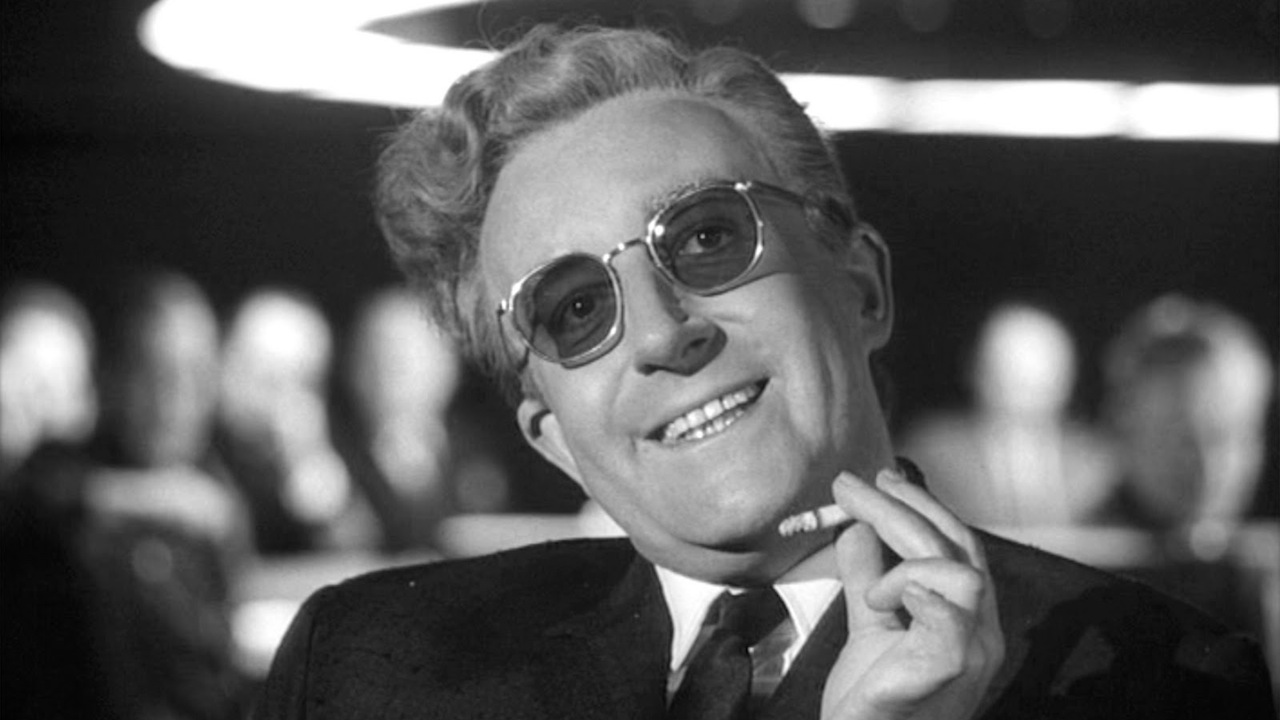
A very MAD sort of logic
Hello again. I recently had the pleasure of seeing Steve Coogan in the stage version of Stanley Kubrick’s legendary Dr. Strangelove. Coogan plays the same characters as Peter Sellers did in the original, plus one more, and it’s a spectacularly funny show which I’d highly recommend if it comes to a city near you.
Watching the stage version and recalling the original, which is one of my favourite films ever1, got me thinking about the logic of mutually assured destruction (MAD), which is the story’s central plot point. I decided to sketch down some of my thoughts, so that you could also engage in this light-hearted, frivolous topic, viz. the end of the world as we know it. There are pretty significant spoilers here from Dr. Strangelove, so if you haven’t seen the film:
- Oh dear. Go away and watch it this instant. I don’t care what you’re doing: it can’t more important than the apocalypse, can it? The film’s alternate title is “How I learned to stop worrying and love the bomb,” which tells you exactly what kind of affair it is.
- Come back here and read my ramblings.
I’m going to go through the basic logic of MAD, then tease out some of the funny (read: scary, crazy, “oh no” funny. Not “haha” funny) implications of the doctrine. Then I’ll weigh up whether (in my humble opinion) the logic actually works2.
As always, my ideas are all well and good3, but what makes these conversations really special is when you weigh in with your own thoughts in the comments section below. Let me know what you think, especially if you disagree with any of it. If you haven’t done so already, please subscribe using the link below to never miss a post. Finally, please “Like” and share this article (if indeed you did), to spread the word. Thanks, and I hope you enjoy.
If you enjoy this blog and want to support it, please consider a contribution. Keeping this blog going doesn’t cost much, but it isn’t free either, so any help would be very much appreciated👍
Update: A final introductory note is on some background reading which you might enjoy:
- Nuclear Deterrence 101, by the always excellent Brett Decereax over at ACOUP. Thanks Malcolm for suggesting!
- Command and Control: Nuclear Weapons, the Damascus Accident, and the Illusion of Safety, by Eric Schlosser
MAD raises the stakes of the game so high that no-one will play
Let’s start with a quick overview of what, exactly, is meant by MAD. This is a bit more complicated than it first seems, because the big superpowers have changed their doctrine for using strategic nuclear weapons as their own situations have changed. But before we get into the history and the complications of it all, let’s get the basic idea down, using the analogy of the “Mexican standoff” from the movies:

Mutually assured destruction is a promise to a potential adversary that, in a nuclear conflict, you have the capability and the resolve to destroy their country, even if they fire the first shots. Like many crazy ideas, it originated in the USA after the Second World War. The Americans realised that they couldn’t effectively challenge the Soviet Union toe-to-toe in a European land war because the latter were far too numerous and powerful. They did, however, have one thing which the Soviets did not: the atomic bomb.

Nuclear weapons were a way of levelling the capability gap between the Russian and American armed forces in Europe. They were a one-way MAD, or a “singularly assured destruction.” This, of course, was pretty intolerable for the Soviets, and they developed their own nuclear weapons within a few years. MAD wasn’t truly born, however, until each side had enough nukes to ensure a “second strike” capability. If you’ve ever seen graphs showing the size of the major powers’ nuclear stockpiles4 you probably did a double take: why on Earth does anyone need enough firepower to destroy that very same Earth? There is, like everything MAD, a grim logic to it:

Perhaps the USSR’s 40,000 was a bit much, but you can see how the logic of MAD demands redundancy. If the USSR lacked faith in the reliability of their own missiles or warheads, then redundancy made sense. After all, “quantity has a quality all of its own,” as Joseph Stalin never said.
Deterrence is improved by diversifying the sources of your nuclear retaliation. This is achieved with the famous “nuclear triad” of sea-launched missiles, air-dropped bombs, and land-based missiles:

The idea behind the triad is that any first strike is unlikely to take out all three legs of the triad (with the submarine-launched ballistic missiles the most resilient of the lot). MAD is central to the plot of Crimson Tide, the classic submarine drama starring the great and recently departed Gene Hackman. The sub receives an order to fire its strategic (read: city-destroying) missile payload. In this situation the ship’s crew have very limited information and must make a decision of monumental consequences based on this:
Another level of MAD comes with MIRVs. What’s a MIRV? If you think a nuclear missile is scary, imagine a nuclear missile which spits out multiple nuclear warheads, and these are MIRVs, or “multiple independent re-entry vehicles,” to give them their proper euphemism:

MIRVs can overwhelm any attempt at missile defence by the target. A particularly sneaky trick of missile designers is to include, along with the actual warheads, several metallic balloons as well. When the MIRVs separate from their carrier (the missile), the balloons inflate and, space being a vacuum, fall at the same rate as the warheads. Because they are roughly the same size and shape as the warheads, the decoy balloons will have a similar radar cross-section. This will make it more difficult for the enemy to predict where the real warheads are going to strike, and will also divert valuable and scarce interceptor missiles.
We saw what ought to have been a MIRV in our rocket fails article a few weeks ago:

A nuclear warhead re-entering the atmosphere won’t be firing its rockets, and in fact probably does not have any rocket engine at all (there’s plenty of gravity available to get it to the target).
The “Doomsday machine” in Dr. Strangelove takes MAD to its logical conclusion, with a network of “salted” hydrogen bombs5 designed to maximize fallout and render the world uninhabitable for a century after the event6. The idea is that the Russians don’t have to do anything to trigger the end of the world: any nuclear explosion will automatically set off the device, as will any attempt to disarm the device. Once the enemy (i.e. the USA) know this, they will have an extremely strong incentive to not start a nuclear war with Russia.
The Russians do, in fact, have a computer-controlled system for nuclear retaliation known as “Dead Hand,” but it is only activated in a crisis (that’s a relief… I guess?) and may also require human intervention—details are alarmingly unclear.
MAD has some fairly mad implications
MAD is a type of game theory, a set of ideas which analyses how rational beings behave within a set of defined rules with defined win or lose outcomes. The theory presupposes rational beings are in control, which is of course one flaw in the theory. Even taken at face value, however, MAD throws up some funny implications.
There’s a strong first-mover advantage in everything to do with nuclear weapons. If you can hit the enemy first, then you stand a good chance of neutralizing a large number of their nuclear weapons. This, in turn, will limit their ability to retaliate. It will also put them on the back foot with their ability to respond (two weeks ago I talked about the military OODA loop: imagine how badly your OODA loop would be if your capital city has just been hit with nuclear weapons).
Having a strong missile or bomb superiority over your enemy would seem to be a big advantage, but it can lead to some uncomfortable moments. If you have many more missiles than the other guy, then you have a much better chance of survival in a MAD-type situation, because they probably won’t have enough to survive your first attack and still respond with overwhelming force. While this might make you sleep easier at night, it will keep your enemy awake. They will be thinking of strategies to overcome their disadvantage. One such strategy, of course, is to be the first mover and strike with a surprise attack, as outlined above. So, you might not sleep so well at night after all, despite your missile advantage.
One of the best (and bleakest) scenes in Dr. Strangelove comes when General Turgidson outlines his thinking on why the US ought to follow General Ripper’s unauthorized attack on the USSR with an all-out missile launch to annihilate the Russian nuclear capability. It’s vile, it’s inhuman, and it’s perfect MAD logic:
The President doesn’t entertain this suggestion, showing that humanity can prevail even in the face of the cold logic of game theory. The irony, of course, is that neither man realises yet that the Russians have built their doomsday machine which brings MAD to its most extreme logical end. This raises the question: does the doctrine of mutually assured destruction work?
MAD: does it work?
The simple answer, at least going by Dr. Strangelove, is no, MAD does not work. The film’s whole premise is the abject failure of both American and Russian controls around nuclear weapons. But we can dig a layer deeper and ask: what if the Russians had told the Americans about their doomsday machine (which they assuredly should have)? What if they had “told the world,” as Dr. Strangelove chides?
After all, nuclear Armageddon hasn’t happened, at least not yet. This is item No. 1 in the ledger, and it’s a big one:

On the other hand, we have a few historical examples where some new weapon or other factor was supposed to prevent, or at least limit, war by making it so unattractive to both sides:
- In the years before the First World War, many economists noted how inter-dependent the economies of the major European powers were. A prolonged war would be catastrophic for the great powers’ economies, and therefore any war would be short, they reasoned. The economists were right in their assessment of the economic effects, but were wrong in thinking it would limit the duration of the war.
- In the years between the World Wars, the growth of air power promised to make any future war far more destructive for civilians than prior wars had been. This, it was felt by some, would act as a natural brake on powers going to war, or at least shorten any war (sounds familiar), because they would be afraid of strategic air retaliation against their own civilian populations. Once again, the theorists were right in their assessment of the scale of destruction, but wrong in their assessment of its effects.

One big argument in favour of MAD’s effectiveness, and two medium ones against it. This is hardly a comprehensive evaluation of mutually assured destruction. Far smarter people than I have tried to figure this out. One telling (and rather alarming) additional piece of evidence comes from the behaviour of world leaders in the decades since nuclear weapons arrived.
We mentioned above that the US’s early nuclear doctrine was based on the overwhelming conventional military power of the USSR. The USA knew it couldn’t win in a “fair fight” with Russia, so they developed tactical nuclear weapons to level the playing field. These are designed to win battles and advance operations, not pummel population centres into submission. However, the Russians had a stated policy of responding to tactical nuclear weapons with strategic nuclear weapons, so this “escalation ladder” would be climbed very quickly.
Another mark against the validity of MAD comes from actual policies which world leaders pursued throughout and since the Cold War. Many of these have served to actively destabilise the delicate nuclear balance, bringing the prospect of war closer but giving one side a distinct advantage in this war. Some examples are:
- Submarine-launched ballistic missiles can be deployed much closer to an enemy’s landmass than land-based missiles in silos. This would lower the warning time from ~30 minutes from launch to impact to less than ten. This, in turn, increases the ability of the side with submarines to carry out a decapitation sneak attack on the enemy, lowering the risk of a destructive response and undermining MAD.
- Missile defence systems, such as Reagan’s “Star Wars” or Trump’s American “Iron Dome” are destabilising in the context of MAD because they enable one side to attack the other and shield themselves from most of the retaliatory consequences.
In conclusion, we have our success to date as a data point in favour of the theory of MAD, and historical and behavioural examples against.
Conclusion: War is too serious to be left to the generals and the politicians
In Dr. Strangelove, General Ripper subverts Georges Clemenceau’s quote that “War is too important to be left to the generals.” Of course, he’s not a reliable character, and the film gives us a partial rebuttal of this through the diplomatic efforts of the President and Russian Premier. It’s all for naught, however, as Major Kong validates Stanley Baldwin’s inter-war prediction that “the bomber will always get through.”

MAD and game theory are fine as frameworks for writing histories, but are woefully inadequate at predicting, let alone controlling, the chaotic and irrational monkeys who have, in the evolutionary blink of an eye, developed stone tools, fire, and nuclear weapons. “I’m not playing cards,” as Volodymyr Zelenskyy recently said:

Coming back to the Russian “dead hand” mentioned above, a perfect illustration of the inadequacy of MAD is the case of this man, Lt Col Stanislav Petrov:

On 26th September 1983 Petrov was on duty as an air defence watchkeeper when the board lit up with warnings of US missile launches. The protocol in these instances was clear: Petrov was to report the launch immediately to his superiors, who would in turn order retaliatory strikes under a “launch on warning” philosophy underpinned by MAD. Instead, Petrov reported it as a false alarm, which of course it was7, thereby saving the world.
You’d think Petrov might have been commended for his calm and rational8 response under the most extreme of pressures, but you would be wrong. He was chastised for his poor record-keeping9 and the incident was hushed-up for many years. The system, which would have started World War 3 and unleashed mutually assured destruction, was bypassed in favour of human judgement.
War is too serious to be left to either the generals or the politicians, or to any system which they might put in place to try to control it by means of crude IF-THEN rules. Mutually assured destruction is a neat idea, but I can’t put my full faith in it to prevent nuclear Armageddon.
What do you think? Let me know your thoughts in the comments below. I hope you’ve enjoyed this week’s article, and please share it on any and all your social feeds using the links below. Don’t forget to subscribe if you haven’t already, so that you’ll never miss a post. Thanks for reading, and I’ll see you again next week.
Featured Image: Dr. Strangelove, IFC Center
- Which I might have mentioned once or twice here before LINKS ↩︎
- If you happen to be a P5 world leader/autocrat and are reading this, then you are welcome to use my evaluation when you next decide to revise your geopolitical strategy. I’ll even waive my usual fee for such considerations. ↩︎
- At least I hope they are. ↩︎
- Around 60,000 warheads globally in 1985, of which the USSR had 40,000. ↩︎
- Specifically, the idea is to surround the bomb with a non-radioactive isotope of Cobalt which, when inundated with neutron radiation from the explosion, becomes stunningly radioactive. ↩︎
- As I’ve written previously, such a device was never actually built, and “salted” bombs are not guaranteed to work in this way. ↩︎
- Specifically, it was the reflection of the sun off clouds in the atmosphere which looked (to the watching satellite) like the infra-red “bloom” of a missile launch. ↩︎
- One crucial piece of information for him was the fact that the system only reported several missile launches. Surely, he reasoned, a sneak attack from the USA would involve launching all their missiles. ↩︎
- Which might have been true, but this is one of those things you can always nail somebody for in the military: there’s always a mistake to be found somewhere, no matter how diligent you are. ↩︎


Leave a Reply