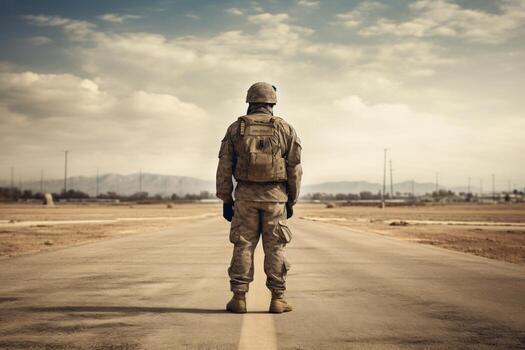
Why the military commissioned profession is like no other.
Hello and Happy Thursday. This week I’m going to attempt to answer a question posed by one of my long-time readers. Like myself, he spent his “first career,” fifteen years or so, as an officer in the Irish military before leaving for the bright lights and air-conditioned offices of civvy street.
I was hoping to answer this last week, but I went off on a bit of a tangent about military officer and enlisted rank structures. It wasn’t a complete waste of time, however: last week’s discussion gives important context for this week’s question.
Here’s his question in full:
What about the irreversible nature of the army officer? Seems a bit limited that there’s no way back. Can’t be many professions where once you’re gone, you’re gone regardless of experience gained while gone. Strikes me most people move out to move up in an organisation. It would be interesting to know why we are the way we are.
What does he mean? Let’s break it down:
- Once you stop being an army officer, you can’t pick up where you left off
- You definitely can’t come back in at a higher rank
- This is something which limits the organisation’s ability to get fresh experience
There’s an important distinction to make before we go further. In many militaries (the Irish included) you can retire as an officer and become a reservist. You keep your rank but it goes into the back pocket, only to be produced for occasional training courses or if the shit hits the fan. This isn’t the question.
The question is about leaving the forces, doing another job, getting experience, and then coming back in in another (presumably higher ranking) job than you were before. In other words, the exact model that prevails in lots of civilian jobs: move out to move up.

I’m going to start by talking about why militaries are unique and not at all like other jobs, but then undermine it by showing all the ways that they are similar. I’ll discuss how organisations resist change and conclude with an examination of the incentive structures for a military.
Before we start, let me encourage you to subscribe to the blog using the link below. As always, I’d love to see your comments below, or you can contact me via webform here or email here. Finally, if you’ve enjoyed this post, please share it with a friend.
If you enjoy this blog and want to support it, please consider a donation. Keeping this blog going doesn’t cost much, but it isn’t free either, so any help would be very much appreciated👍
Military skills are unique…
This shouldn’t need to be stated, but here goes: the military is a unique profession. It has unique rules (regulations with the force of law, and some pretty hairy consequences for messing up), it has a uniquely <ahem> “robust” culture, and it involves unique skills which are not immediately convertible to civvy street. Below is a non-exhaustive list of things I’ve learned to do during my military career which have little or no relevance to civilians:
- How to walk on polished floors without scuffing them
- How to identify various armoured vehicles and no, most of them are not tanks
- How to stand still for hours at a time, eyes fixed on a point in the distance
- How to safely get rid of a chemical shell
- How to frank mail
- How to fire an anti-tank gun on an obsolete armoured car
- How to write on wet laminated sheets of paper
- How to prepare charges (explosive and legal, neither are relevant for the outside)
- How to fire my rifle while wearing a respirator
I could go on, of course. But of course, even if the skills themselves aren’t transferable, surely there are personal qualities and behaviours which the miliary teaches you, and which you can apply to the real world? Well, yes and no. For the yes, we’ll talk about that in the next section, so bear with me. For the no, you need only look at what we discussed last week.
…Can’t be many professions where…
One obvious answer to the question is to dispute the term “profession” when it comes to the army officer. Being an army officer is not a “profession.” It’s simply part of who you are by virtue of your birth, your station in life. So, the framing is wrong. And you can certainly move in and out of the organisation. Sell your Ensign commission, for example, and come back a few years later once you’ve made a bit of money to purchase a Lieutenant Colonelcy.
Oh, wait, sorry. You’re right. It’s not the 1830s anymore. Okay, times have clearly changed. We no longer buy and sell commissions (thankfully, for a middle-class oik like myself).
Looking at the rest of the question:
…once you’re gone, you’re gone regardless of experience gained while gone. Strikes me most people move out to move up in an organisation…
Here I think the mistake is in assuming that experience gained while gone (to a civilian job) is something that can be transferred back into the military. The military values its officers (and enlisted, for that matter) because of the experience they gained in the military.
Sure, in most jobs, you might move on to move up, but the military is based less on merit-based promotion according to ability and more on a system of time served and seniority. This might sound awful (and it has its downsides, for sure) but it ensures one thing, which is that both officers and enlisted ranks focus more on getting the job done and less on looking good and ticking boxes so that they can get the “next” job on the ladder.
That’s not the whole answer, however. Meritocracy has started to come into officer and enlisted career progression systems, so the above doesn’t strictly hold. So, does a more meritocratic and less “unique” system result in a situation where people can come and go?
…but not that unique
The differences between military and civilian jobs can be overstated at times. There was an excellent comment on last week’s post which talked about manufacturing organisational structures and how there were similarities to the military. And it’s true: every organisation has do-ers, leaders, and managers in between. These aren’t distinct sets of people, but highly blurred and overlapping sets:

It should be no surprise that militaries resemble civilian organisations in many ways. Last week I talked about how military officers evolved over the centuries from warrior elites to leaders by dint of social class, to specially trained and educated managers. These changes didn’t happen in a vacuum. They happened alongside agricultural and industrial revolutions, the birth of factory production, unionisation and workers’ rights, an explosion in education, the information age, and so on.
Along the way, ideas about how to do things flowed back and forth between the military sphere and the world of civilian work. Have you ever sat in the office War Room, holding a debrief after a product launch? Perhaps you sent the report up your chain of command. Did this military leakage into your civilian world upset you? If it’s any consolation, the same was happening in the other direction. Commanders briefed their troops on the need to be Agile when innovating, logisticians furiously tried to make Lean principles work in a supply chain that wasn’t focused on churning out cars, and equipment procurement teams obsessed over user experience of combat body armour.
Where does the humble army officer fit into this maelstrom? As an officer, you are a generalist. The skills I mentioned in the last section were broad for a reason. You have to know enough to lead your troops, but they are the experts, the specialists. Your real skills (supposedly) are the softer people skills, the managerial skills, the ability to translate higher instructions into actions on the ground.
This sounds an awful lot like the job of a middle manager. So why can’t it be treated the same way? My friend who asked the question knows this. He isn’t an idiot (although I’d never tell him that to his face), but he’s mistakenly trying to rationalise the military’s behaviour against contemporary norms and values. He’s taken notice of the commentary in recent years which predicts the end of the career for life. Modern workers will, it appears, have to transition between different jobs in different industries throughout their working life. This is what’s happening on civvy street.
Despite all the social and professional changes which have happened, the Irish military (like, I suspect, most militaries) is very slow to change, so it’s not surprising that this new “model” of work hasn’t made its way into the military’s human resources and career progression models. Let’s unpack that a bit next.
Organisational inertia is real
Organisations cannot change on a dime: the pivot (another civilian to military term) takes time and effort. Militaries, being large and conservative organisations by nature, don’t tend to innovate quickly.
Except when they do. The German Wehrmacht’s Blitzkreig from 1939-41 was the original “move fast and break things” doctrine. It arose, in part, because of the limitations imposed by the post WW1 Treaty of Versailles. With an army limited to 100,000 men and limited tanks and artillery, the Germans needed to think long and hard about how best to employ their limited resources. The full story is obviously more complicated1, but a constraint forced them to innovate and this led to initial success.
Ukraine and Russia provide a more current example. The latter has more men, matériel, and resources, but is losing a war of attrition (as we speak, June 2026) against its smaller, weaker enemy. There are many reasons for this, but one is the contrasting response of each side to new technology.
In Ukraine, control and target acquisition of drones has filtered down to the smallest tactical units: platoons and sections. Low-level commanders find targets and execute “kill chains” without waiting for clearance from higher headquarters. What would have been specialist expertise in indirect fire, electronic warfare, or building and repairing drones is now embedded at the platoon level. A common operational picture is provided by the Delta software, bypassing layers of reporting hierarchy. The organisational structure has changed, with less need for staff officers at various headquarter levels.
The Russians, by contrast, have largely maintained their strict command and control doctrine, with the massive human cost of over a million casualties. They weren’t forced into innovating by necessity, so they didn’t. There are some signs that they are learning lessons, but it’s too soon to evaluate the impact.
If there’s a lesson from this, it’s that militaries don’t change their operating system unless there’s a real and pressing need. Coming back to the original question, is there a need to let the officer come back in?
Conclusion: What’s the incentive?
Coming back to Ireland and away from the grim horror of full-scale war, let’s look at the incentive structures and see if we can finally answer the question.
The Irish military is quite understrength—this is not a secret. You might, therefore, assume that the powers in charge would pull every incentive lever to entice people back. They’re doing some of this, with a campaign to entice former service members back into the fold. For officers, however, this requires an application to the Minister for Defence, so it’s hardly a streamlined process.
Why the lack of urgency? I wrote above that the officer’s abilities were in the softer skills. Getting people to do things rather than doing things directly. These skills are important, but they are also somewhat fungible: someone else can do them instead of you. When you leave, another officer slots readily into your spot. This is the great and humbling thing about military service. You’re only ever a small cog in the machine.
The pyramid structure which I spoke about last week has an important part to play. When a vacancy arises (e.g. when someone retires, like yours truly or my learned friend with the question) then there’s a slot for someone coming up from below. If you were to fill this slot with an outsider, even someone who had once been part of the fold, then it would seem unfair to the person who missed out on a chance of advancement.
Promotion from outside would annoy the people lower down on the pyramid. But what about those folks higher up? After all, they’re the ones making the decisions. Why should they care? Well, for one, it might undermine the loyalty they’ve given to the service. They’ve done the hard yards and come up the pyramid, why should someone who left for greener pastures be rewarded with a route back in? There’s also the very practical consideration that if this principle was continued to its logical extreme, then even the highest-ranking officers could be replaced with veterans from business or public administration, and this wouldn’t do at all.
In summary, here’s why the decision of an officer to retire is such a consequential one, with no way back in:
- Your military skills are unique and your civilian skills won’t be a perfect fit for the military if you came back
- Even if they were, it takes an organisation time to change, and it will resist change unless there’s a powerful incentive
- There’s no incentive for people on the inside to encourage this
We can talk about the military like it’s a normal job. The military itself often talks about it like it’s a normal job. But it isn’t. Once you’re gone, you’re gone.
That’s all for this week, but what do you think? What are things like where you come from? Please let me know in the comments below. Also remember to subscribe if you haven’t already. Thanks again for reading and see you next week.
Cover picture: Google image result, AI generated
- For one thing, there is some dispute over the term “Blitzkreig” as a tactic. What the Germans achieved at the outbreak of WW2 is better thought of as manoeuvre warfare (a Prussian/German classic) using modern technology and delegated authority to lower-level commanders. They didn’t use the word as a description of what they were doing, it was adopted and popularised by Allied commentators. ↩︎


Leave a Reply