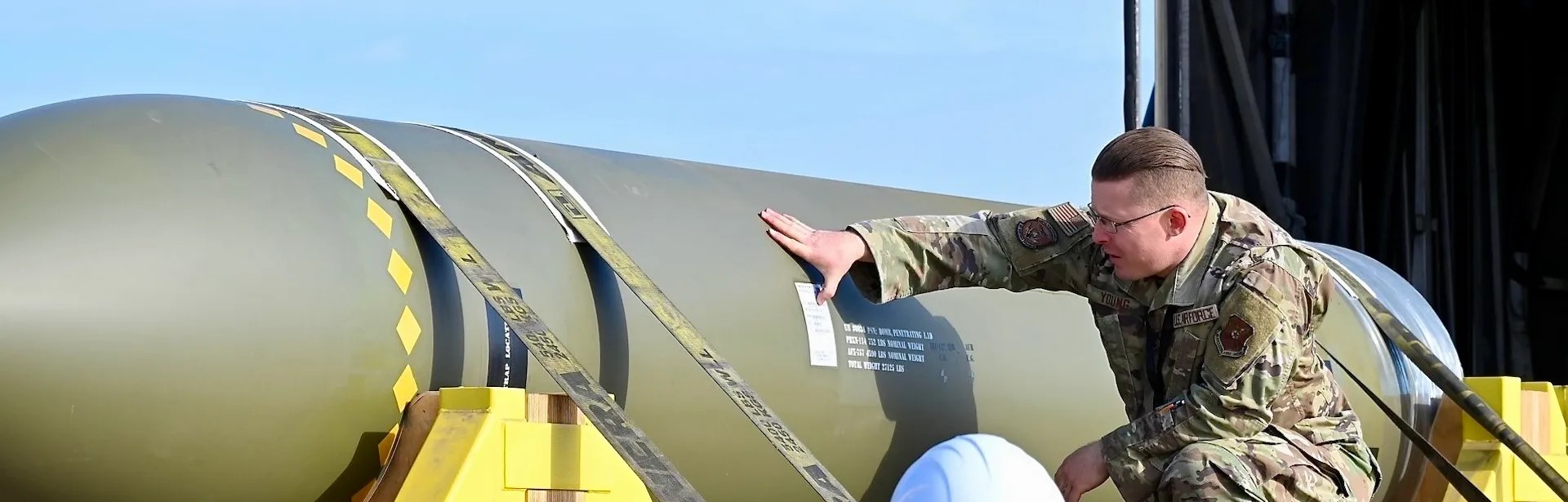
A quick guide to bunker-busting bombs.
Hello again. This week I rejigged my editorial calendar a bit in order to write about the “bunker busting” bombs which you’ll have seen in the news this past week, unless you’ve been hiding under a mountain… actually, then you’ll definitely have heard about this.
My goal today is to explain the science and engineering behind bunker busting munitions, and to look at the possible outcomes from using them on a target deep underground. This is as rapidly evolving situation, and here’s what we know at the time of writing (23rd June 2025):
- In the early hours of 22nd June, the US launched a surprise bombing raid on Iran’s underground Fordow uranium enrichment facility1.
- The raid was carried out by six US Air Force (USAF) B2 Spirit stealth bombers. The planes flew from Missouri to the target, a round trip of 36 hours, with several in-flight fuel fills enroute.
- Each B2 carried two GBU-57 “Massive Ordnance Penetrator” (MOP) munitions.
- The outcome of the attacks is uncertain, but Fordow seems to have suffered serious damage in the attack.
- The USAF also struck two other Iranian nuclear facilities at the same time, in Natanz and Isfahan. The operation was called “Midnight Hammer,” with typical United States subtlety.
Today’s article, although another deviation from my ballistics series (so far we’ve covered wound, intermediate, and a tangent on silencers), is actually quite relevant to both external ballistics (things flying through the air) and terminal ballistics (things penetrating a target). So this is really a case study before we get to the main event.
One of my favourite parts of teaching weapons and ammunition was getting students to dissect the wild marketing claims made my arms manufacturers or militaries themselves. Critical analysis like this is an important part of being an engineer. It’s important for all types of engineering, but claims made about weapons even more prone to hyperbole and disinformation. When it comes to the attack on the Fordow underground uranium enrichment facility, here are some of the competing claims:
| USA claims (public) | USA claims (anonymous) | Israeli claims (anonymous) | Iranian claims |
|---|---|---|---|
| “Completely and totally obliterated” (President Trump) | “Even 12 bunker-busting bombs could not destroy the site.” | “Serious damage… but has not been completely destroyed” | “No casualties” (Iranian Red Crescent) |
| “Extremely severe damage and destruction” (Chairman of Joint Chiefs of Staff) | Iran moved uranium from the site before the bombing | No damage and no uranium kept there in any case |
There’s also contradictory information about how deep the Fordow facility lies beneath the mountain (anywhere from 45 m to 800 m, a considerable difference); and how far the MOP bombs can penetrate (5 m to 60 m reinforced concrete). We can’t know for sure what’s true, but we can look at the known facts and determine what’s probable or improbable.
With that in mind, let’s look first at how bunker busting bombs work, and what differentiates them from general purpose bombs. Secondly, we’ll look specifically at the GBU-57, aka the “massive ordnance penetrator,” or MOP2, aka the bombs that the USAF recently dropped on Fordow. Thirdly, we’ll talk about what the likely effects on the target might have been, although this section will necessarily be speculation until we get verified information.
As always, if you enjoy this article and want to support me, please “like,” subscribe (there’s a link below), and share this post. It really helps! Please also comment below if you want to join in the conversation. Alternatively you can contact me via webform here or email here.
If you enjoy this blog and want to support it, please consider a donation. Keeping this blog going doesn’t cost much, but it isn’t free either, so any help would be very much appreciated👍
How do bunker-busting bombs work?
To understand how bunker-busters work, we need to start with understanding how conventional bombs work, and how they fail against heavily reinforced or buried targets. Here’s a rough comparison of some common types of air-dropped bomb:

General purpose bombs (or worse, blast/high-capacity bombs) will have limited effects on hardened targets because the impressive explosive effect will take the path of least resistance and send most of the energy away from the target. Penetration munitions get around this problem by burrowing their way into the target some distance before the explosive within detonates:

How does the penetration bomb achieve this? There are a few crucial design features to tweak to ensure you get right in there on top of the target:
- Mass: More material means more penetration. Some of this material will be the weight of the explosive itself, some will be the external casing, but it all adds up. For the same shape, a greater mass will mean less drag3 and so faster speed in air. It will also mean better penetration through the target.
- Shape: A long and thin shape is ideal for penetration4, because the object’s mass is concentrated into a smaller area to present to the target. Would you rather a nail fell on you flat end or pointy end first? An aerodynamic shape5 also means the bomb hits the target as fast as possible.
- Material: Penetration goes up with hardness6 because it allows the bomb to keep its heavy, long, thin shape together as it pushes the target material out of the way. It also helps to protect the fuzing and explosive fill inside.
- Fuzing: The fuze probably shouldn’t be in the nose, since this will take the brunt of the impact. You could put it on the tail section. You’ll be limited to some kind of inertia sensor, but you can program it to wait a delay or even count a certain number of decelerations (e.g. multiple floor slabs being penetrated) before initiating the fill.
- Explosive fill: This needs to be relatively insensitive so it doesn’t detonate on impact with the target. As a bonus, it can be enhanced with fuels like aluminium to increase the blast effect and cause more internal damage.
- Impact velocity: Faster impact means more penetration. With an air-dropped bomb, this means dropping it from higher (and relying on mass and shape to minimise drag while it falls).
- Guidance: You need to hit the right target, but, since the bomb’s nose is hardened steel, you can’t put in a fancy optical or radar seeker.
Bunker buster munitions have their origin in World War II, particularly the British Tallboy and Grand Slam bombs. The modern pinnacle of bunker-busting design is the aforementioned GBU7-57 Massive Ordnance Penetrator (MOP), and it’s this which we will turn our attention to next.
What’s so special about the MOP?
Fordo’s Bane, also known as the GBU-57, also known as the Massive Ordnance Penetrator, is one of the rarest, heaviest, and (in terms of its capabilities) one of the most impressive weapons in the US’s arsenal.

Let’s see how it stacks up against each of the criteria we spoke about in the previous section:
- Mass: The weight of the bomb is variously given as between 27,000 and 30,000 lbs (12 to 14 tonnes). The variation probably reflects different iterations of the munition.
- Shape: The nose has an aerodynamic but also penetration-maximising shape. The rest of the munition is long and thin (although at 800 mm / 31″ in diameter, this is decidedly relative).
- Material: The bomb has a thick steel alloy casing to protect the explosives from the forces of impact.
- Fuzing: Exact details are scant, but this source speculates that the “Large Penetrator Smart Fuze” (LPSF) contains “void-sensing” technology, or the ability to detect when it’s passed through the wall and into the open space where detonation would be most effective.
- Explosive fill: 5,300 lbs (2.4 tonnes) of high explosive. This is mainly AFX-757 (4,600 lbs) with the remainder PBXN-114. What do these letters and numbers mean? The explosive fill is insensitive (so it won’t detonate when the bomb hits the target) and has enhanced blast characteristics (to maximise damage when it does detonate).
- Impact velocity: The MOP is dropped by the B2 Spirit, which has an operational ceiling of 50,000 ft. Its impact velocity is classified, but estimated at faster than the speed of sound (~350 m/s)8.
- Guidance: The MOP is guided onto its target by an inertial navigation system (INS)9 as well as GPS.
Clearly this munition has been optimised for getting deep underground or through hardened walls. The $3.5 million dollar10 question, therefore, is: how deep can one of these things penetrate?
The excellent diagram from the FT below states “60 metres in depth”, without specifying what’s in those 60 metres: soil, rock, reinforced concrete?

The BBC and Jane’s state in this excellent explainer that the bombs can penetrate up to 61 m of earth, or 18 m of concrete. There are reports out there that say they can penetrate 60 m of concrete, but these are likely to be due to a unit confusion error (60 feet, not metres, which is 18 metres). We’ll discuss this in more detail in the next section. Before we get there, there’s one more very important effect to talk about: blast.
The MOP might seem like a hard-nosed customer, but beneath its steely shell lies a soft centre. Unfortunately for you, this soft centre comprises 2.5 tonnes of high explosives. This, of course, will wreak enormous havoc on the internal space where it eventually detonates. With practically nowhere for the blast wave to go, the results would be grisly. We can do some more back-of-the envelope11 calculations and overpressure damage tables12 to determine how much damage a MOP would do in enclosed spaces of various sizes:
| Length | Width | Height | Overpressure | Effect on people | Effect on structures |
|---|---|---|---|---|---|
| 5 m | 5 m | 5 m | 176 psi | Brown bread | Total destruction |
| 10 m | 10 m | 5 m | 44 psi | Brown bread | Total destruction |
| 20 m | 10 m | 5 m | 22 psi | Probably dead | Total destruction |
| 20 m | 10 m | 10 m | 11 psi | Very badly hurt | Total destruction |
| 50 m | 10 m | 10 m | 4.4 psi | Very badly hurt | Serious damage |
| 100 m | 20 m | 10 m | 1.1 psi | OK or minor injuries | Minor damage |
| 120 m | 25 m | 20 m | 0.4 psi | OK or minor injuries | Minor damage |
What is it likely to do to the target?
The target in question was the Fordow uranium enrichment facility. This is13 a series of linear tunnels filled with centrifuges like this:
If you’re interested in learning more about why uranium needs to be enriched, then check out my nuclear weapons explainer. And don’t for a second believe the official Iranian line that this (and all their enrichment facilities) were for peaceful nuclear purposes only. They are clearly trying (probably successfully) to enrich uranium to weapons grade. After the debacle of the JPCOA and last fortnight’s Israeli and US strikes, I would be doing this too.
How deep are the centrifuges buried? This is not very clear, with answers ranging from 45 m…

…to half a mile (800 m):
Rafael Grossi, head of the International Atomic Energy Agency, has said that some of Fordow’s most sensitive facilities may be buried even deeper, as much as half a mile underground. “I have been there many times,” he told the FT this month. “To get there you take a spiral tunnel down, down, down.”
—Financial Times, 18th June 2025
This is a very important distinction, and, at risk of stating the obvious, is fundamental to understanding of how much damage it’s possible to do with a bunker buster bomb:

It’s possible that the truth is somewhere in the middle, and the enrichment chamber is directly underneath a lot of mountain, but with a shorter direct path to the surface. Still, that wouldn’t explain the discrepancy above.
How deep can the MOP penetrate? From the previous section, we saw that it was somewhere between 18 m and 60 m of rock and/or reinforced concrete. Luckily for us, we know a lot about the physical characteristics of the MOP, and I found an exciting15 paper from Sandia National Laboratories which had penetration equations into natural earth materials and concrete16.
The strength and density of the rock make a big difference, and can change the expected penetration depth from 73 m at one extreme to 15 m at the other. I would go with a middling value of 23 m which assumes average rock quality and compressive strength17. What does this mean for the enrichment chambers? Let’s look at some permutations of possibility:
| Chamber depth | MOP penetration depth | Effect |
|---|---|---|
| 800 m | 23 to 60 m, it doesn’t matter | Likely none |
| 500 m | 23 to 60 m | Possibly some vibration damage. Centrifuges are very sensitive |
| 90 m | 23 m | Damage to structure of chamber, equipment likely seriously damaged |
| 90 m | 60 m | Likely destroyed through vibrations, spalling, and possibly collapse |
| 45 m | 23 m | Likely destroyed through vibrations, spalling, and possibly collapse |
| 45 m | 60 m | Definitely destroyed |
The above are, like I said, rough rules of thumb. And remember, there were at least six strikes on the ridgeline, as seen in the satellite imagery below:

Multiple strikes on the same target would have maximised the destruction of equipment within and maximised the possibility of collapse. However, it all depends on how deep the chambers are, a question which is still open.
One last point is that the strikes may have targeted access roads as well as the centrifuge chambers themselves, although this is based on limited sources:

If so, it would make sense: the tunnels would be closer to the surface and therefore easier to penetrate. Planners would be hoping that the explosions would collapse the tunnels and render the facility inaccessible.
I’m afraid I’ll have to end on an inconclusive note until we get an admission of the damage done from Iran or a realistic battle damage assessment from the US. In the meantime, we should take the word of the head of the International Atomic Energy Association, who says he expects “very significant damage” at the site. Then again, he’s the same guy who said that the chambers were half a mile underground.
Conclusion: Did it work?
Now that we’ve seen how the MOP works and what the range of possibility is for damage dealt, we can take a step back and try to figure out who the winning and losing nation states from this attack are:
- Iran: Big losers. Even if the damage was limited, and even though they moved their uranium out of there before the attack, this attack shows how the USA can get at even its most protected sites. In the wider context, the country’s performance against Israel during the current war has been woeful.
- Israel: Big winners. They got the world’s superpower on-side in a war they were already winning. They’ve set back Iran’s nuclear programme, even if it’s just for a few months. And world leaders have stopped criticising them for the genocide in Gaza, instead supporting them for taking action against the common threat of Iran. The hugely popular war against Iran has been a moment of national unity after internal divisions over the war in Gaza.
- USA: Winners, but up to a point. They showed Iran and the world their sheer military might: not a nation on Earth could have done what they did to Fordow and the other two nuclear sites. On the other hand, they used over half their estimated stockpile of GBU-57s to achieve inconclusive results. The cost ($50 million just for the munitions) is a drop in the ocean of the US’s defense budget, but it’s an ocean which threatens to break the sea defences and does not need more drops.
- Palestine: Bunker-busters and bombastic leaders draw attention away from the ongoing genocide18 in Gaza, which has accelerated since Israel attacked Iran, with over 500 deaths in that time alone. At the same time, ethnic cleansing19 in the West Bank continues.
In that context, it doesn’t really matter whether the MOPs penetrated to 20 m or 60 m, or whether the enrichment chambers were unscathed, damaged, or obliterated. Even if the attack didn’t work, it worked. Its strategic effects are mostly uncorrelated with its tactical ones. After the dust has settled20, Iran looks diminished and Israel and the USA look enhanced.
What do you think? Please let me know in the comments below. If you haven’t subscribed already, please do so using the link below, and “like” and share this article with like-minded cynics. Thanks, as always, for reading.
Featured Image: Our Best Look Yet At The Massive Ordnance Penetrator Bunker Buster Bomb, Oliver Parken on TWZ.com (2023)
- Also spelled “Fordo” by many sources. “Frodo,” however, is something else altogether. ↩︎
- I was going to call the article something like “deep penetration,” but bottled it because I was worried about what that would do to my SEO. Probably wouldn’t hurt my views, to be fair. ↩︎
- Technically, the drag force is exactly the same, it does not depend on the object’s mass (it scales with velocity and shape). But the gravitational force pulling on it does scale with mass, whereas the drag stays constant for a given velocity. This means that the heavier object will fall faster and reach a higher terminal velocity, which is where the gravitational force balances the drag force. ↩︎
- Stop giggling down the back please. ↩︎
- Aerodynamic is not exactly the same as long and thin, but it’s close enough. ↩︎
- Oh, really now. ↩︎
- GBU: Guided Bomb Unit ↩︎
- We can test this a bit. For starters, if we neglect air resistance altogether, anything dropped from 50,000 ft will reach a velocity of nearly 550 m/s (1,230 mph) when it reaches the ground. Obviously air resistance is not something we can ignore. My brute force calculation using the equations of motion, the drag equation, and known parameters of the MOP gives a velocity at impact of 508 m/s. ↩︎
- An INS is a system of dead reckoning, where if an object knows its starting point and measures all the accelerations that happen since then, it should know its location at any point. It has the great advantage that it can’t be jammed, but it can be prone to errors which compound. ↩︎
- The rough pricetag of one of these behemoths, based on a 2011 order of eight munitions plus ancillary equipment for $28 million. ↩︎
- Very back-of-the-envelope. If you’re interested, here’s what I’ve done: I looked up my trusty copy of Akhavan, which has a section on the thermochemistry of explosives. Assuming (for now!) that the explosives in the MOP are roughly similar to a TNT/aluminium mixture in terms of gas generated, Akhavan gives a value of roughly 600 dm3 gas per kg of explosive. Assuming 2,500 kg of explosive, this gives 1.5 million dm3 or 1,500 m3. ↩︎
- From the US’s NOAA, or National Oceanic and Atmospheric Administration. Have they been defunded by DOGE? You bet. ↩︎
- Or maybe “was.” ↩︎
- Pro tip: be wary of any source that throws out comments like “it can penetrate up to 200 feet of soil, rock, or concrete.” These are very different things! ↩︎
- Well, exciting for a nerd like myself. ↩︎
- If you’re interested in the specifics, the equation is: D = 0.00178 S N (W/A)0.7 (V – 100). D is penetration in feet, W is weight in lbs, A is cross-sectional area in square inches, and V is velocity in fps. S is another factor based on the rock’s characteristics. It’s: S = 12(fc‘Q)-0.3, where fc‘ is the rock’s compressive strength in psi and Q is a rock quality factor ranging between 0.1 for very poor to 0.9 for very good/excellent. Finally, the projectile nose performance coefficient N = 0.25 Ln/d + 0.56, with Ln being the length of the penetrator nose and d being its diameter. Whew! You know a formula is useful when it’s full of random decimals and has a strong dependency on the units used. It shows that some real honest-to-goodness experimental work has gone into this. ↩︎
- A fair assumption, I think, because the Iranian’s would hardly build their sensitive uranium enrichment facilities underneath a pile of terribly weak rock. ↩︎
- Or “alleged genocide,” whichever you are more comfortable with. For me, unfortunately, it’s the first one, but we can respectfully disagree. ↩︎
- Same comment as above. It’s clear to me, but it may not be to you, and that’s okay. ↩︎
- At the time of writing (evening of 24th June 2025) a truce seemed to be just about holding. ↩︎


Leave a Reply