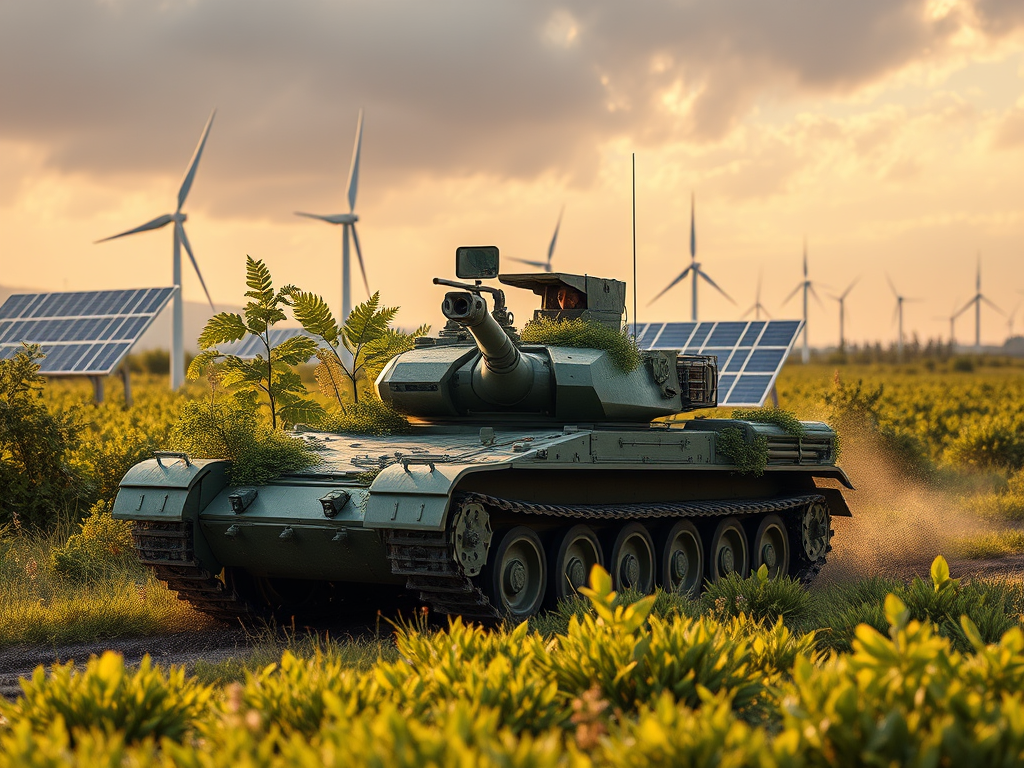
Can military operations be sustainable? Should they be?
Today I want to look at sustainability in the military context. I’m talking about “sustainability” in its everyday meaning relating to the environment, and focusing on full-scale combat operations. If you think these are contradictory, you are partly right, but also partly wrong.
War, as we’ll see below, is an inherently unsustainable activity, but there are narrower definitions which can apply the “sustainability” filter to military activities with some success. When we think about how a future “sustainable war” might work, the obvious question (which we’ll conclude on), is whether or not this is a good thing.
I’ve been meaning to take a tilt at this topic for a few weeks, but was distracted by the rioting and crackdown in LA and by the bunker-buster bombing of Iran. I have an interest in all things sustainability, having studied sustainable energy systems in undergrad and postgrad. I also, quite obviously, have experience and huge interest in anything military and geopolitical. I’m often bemused by how little these two spheres of understanding actually intersect. People talk at cross-purposes and don’t even acknowledge the existence of the other.

As always, please support this work by liking, subscribing (there’s a link below), and sharing this post. It really helps. Please also comment below if you want to join in the conversation. Alternatively you can contact me via webform here or email here.
If you enjoy this blog and want to support it, please consider a donation. Keeping this blog going doesn’t cost much, but it isn’t free either, so any help would be very much appreciated👍
War is unsustainable
Mankind must put an end to war–or war will put an end to mankind
I think nearly all of us can agree with JFK’s sentiments above. I’m not going to talk about the desirability of war, but we’ll come back to that question at the end. Right now, I want to talk about the environmental impact of war, since that relates to our everyday understanding of “sustainability.”
You won’t be surprised to hear that military operations have a negative environmental impact. To take just a few examples:
- Tanks burn over forty times more fuel than cars2
- Artillery shells produce several tonnes3 of CO24 each, and Russia alone is firing roughly 10,000 per day
- Electricity generally comes from diesel generators, a method which is at least twice as carbon-intensive as the regular grid electricity mix
We can see this in Ukraine, where a team of analysts led by the Conflict and Environment Observatory managed to estimate the direct and indirect emissions caused by the war:

Even though military operations have large environmental impacts, countries are not obliged to report them in the same way as they are other sectoral emissions. But with a few nuggets of information and a bit of guesswork, we can start to fill in the gaps and see what the global environmental impact of war is:
- The carbon footprint of the US military in 2022 was 48 million tonnes of CO2
- This is 0.13% of global emissions in 2022
- Scaling the US figure by money spent ($916 billion vs. worldwide $2,400 billion) gives a military global estimate of 0.34% total emissions
- It’s estimated that at least 5% of global emissions come from war investments.

The large error bar above is probably due to the inclusion or exclusion of Scope 3 emissions, i.e. emissions from the whole supply chain of military equipment and its eventual use or disposal. Here’s a good explainer of Scope 1 vs. 2 vs. 3 emissions. On the subject of definitions, let’s spend a few minutes on these now.
Definitions
Now that we’ve gotten a glimpse of the environmental impact of war, we should pause and take a step back to get onto the same page. Let’s have some definitions:
What do I mean by “sustainable?”
We spoke in a previous article about various countries’ principles of war. Sustainability is there, at least for two of the three major powers, but not quite as we’re talking about it today:

This is not the “sustainability” we’re talking about today. The UK definition5 is: To sustain a force is to generate the means by which its fighting power and freedom of action are maintained.
The Russian definition of “logistics,” which I’ve lumped together with the British sustainability, is: Restoration of reserves and restoration of combat capability is of paramount concern of the modern, fast paced battlefield.
In other words, both powers see the importance of having the ability to keep the fight going. Which is a pretty good definition of sustainability, but we’re using a broader definition. So where military sustainability is about keeping the fight going, general sustainability is about keeping society, the economy, and human life going.
What do I mean by “war?”
Today I’m talking about war. I’m using a broad definition to include total war, counterinsurgency, so-called asymmetric war, phoney war, and plenty besides. I’m categorically excluding peacetime activities such as training and aid to the civil power, as well as “operations other than war,” e.g. peacekeeping and peace enforcement.
As I’ve discussed here before, these latter categories are a very important part of military life, so I’m not discounting them based on any lack of importance. Militaries spend a lot of time not fighting, and plenty have made impressive strides at reducing the carbon impact of all this “not fighting,” not least my own. But insulating buildings, installing heat pumps, and buying electric vehicles for the administrative fleet can only go so far. Our current way of waging war has aspects which are very difficult to decarbonise. Let’s look at what it would take in the next section.
Could war ever be sustainable?
War, at its most fundamental level, is about using concentrated energy to achieve kinetic effects on the enemy. Modern technologies allow militaries to concentrate more energy than before. For example, a rifle bullet delivers more than 15x the energy of a longbow arrow6. Increased energy delivery brings an increased logistical burden and added risk for militaries:

Armies need to be able to move, so their sources of energy need to be compact enough to move with them. The (in)ability to carry enough energy (i.e. food) for men and horses was one of the limiting factors for army sizes in pre-industrial times7. In other words, the limiting factor is energy density. We want an energy source that isn’t too heavy and isn’t too bulky. What are our options?

As you can see, the options aren’t great. We can go with batteries, which are much heavier and bulkier than fossil fuels, or hydrogen (probably via fuel cells) which is also heavier once you factor in the pressurised tanks, and has an explodability problem, among other issues.
If we solved the energy density problem (let’s assume some sort of super battery), then we’ve solved the bulk of our emissions problem, since, as we saw above, transport is the biggest contributor. We do need to make sure, of course, that our electricity is generated by renewables or nuclear, or else the emissions are just shunted up the line. If we can assume a super battery, then we can also assume near-limitless nuclear fusion or similar.
Decarbonising our electricity mix will also get rid of the bulk of ammunition and equipment emissions, since these are mostly bound up in the supply chain too. The next step would be to replace polluting high explosives with battery-powered lasers. Damaged and destroyed vehicles would need to be recycled, while bombed-out buildings would be replaced by passive homes.

There is another way to make war more sustainable: nukes. A limited nuclear war killing tens of millions would prevent hundred of millions of tonnes of CO2 from being emitted (the average annual carbon footprint of a person is 7 tonnes). A full-scale nuclear apocalypse, as modelled by Max Tegmark in this article, could kill up to 5 billion (35 billion tonnes CO2 saved, or almost all of our present emissions!). As an added bonus, a nuclear winter could drastically reduce temperatures, offsetting the warming effects of climate change. I am, of course, being entirely facetious here to beg the question: is sustainable war something we want? Let’s finish up on that.
Conclusion: Is this something we want?
If it wasn’t for those damn Yanks, we could have kept the war going another 10 years!
—“Fighting” Jack Churchill, British Army Officer, 1945
I’m a passionate believer in sustainability, but I can’t help feeling a bit uncomfortable when I read and write about the climate impact of ongoing wars in Ukraine and Gaza. I feel like putting a “tonnes CO2” figure alongside a “dead” figure implies some equivalence in moral crime. If you accept the equivalence, then you might just start to think about anti-humanity arguments. How many lives can you justifiably take to “save the planet?”
At the same time, it’s naive to think we need to have world peace before we can make any progress on climate change: that’s a recipe for never getting anything done.
So, on balance, I think it’s good that people and agencies are counting the environmental costs of war, just so long as we don’t lose sight (or shift focus from) the human cost.
As of 2025, the United Nations is struggling for funding while its bodies and its rules are being increasingly ignored in international relations. The body that was set up after the worst war in history, to prevent another one, looks increasingly incapable of doing so. That, for me, is a far more depressing thought than our collective lack of progress on climate change (which is depressing enough).
In conclusion, war is not and should never be sustainable. That way madness lies, or at least “Mad” Jack Churchill, the British officer quoted at the top of this section. Now there is someone who would be a big fan of sustainable war, in his own way.
That’s all for this week folks. There’s so much more I’d like to write about on this topic, but it will have to wait. Let me know what you think in the comments below: what did I leave out? What would you like to see more of? Please also share this article with a friend, it would really help me. Finally, if you haven’t subscribed yet, please do so using the handy link below.
Featured Image: Automatically generated with WordPress AI tool based on article content.
- Prompt: “Can you please create a high-quality image to use as a background graphic to illustrate the contrast between two concepts. The first concept (on the left hand side of the image) is environmental sustainability, so should convey themes of sustainability with green landscapes, renewable energy sources, and cooperative vibes. The second concept, on the right, should illustrate military might and realpolitik. It should feature tanks, guns, realistic and gritty-looking explosions, and a dark, grey, ambience. Use warm golden light on the sustainability side, transitioning to harsh, cold lighting on the military side. Ensure the image is high resolution, highly detailed, and in sharp focus to capture the contrast effectively.” ↩︎
- Using the UK as an example, the Challenger 2 main battle tank has a range of 550 km on the road from a diesel tank of 1,592 litres, giving fuel consumption of 289 l/100 km. The average UK diesel car has a fuel economy of 43 mpg, or 6.6 l/100 km (assuming UK gallons for conversion). ↩︎
- A bit more “finger in the air” with this calculation. The first data point is this report on the Gaza War, which says that Israel’s 100,000 artillery shells have led to 12,000 tonnes of CO2 emissions. This implies 8.3 tonnes CO2 per round, which does seem like a lot. So I found a report from the Conflict and Environment Observatory saying that roughly 98% of an artillery shell’s emissions occur during the manufacturing of the shell and its raw materials, with 2% during the use phase. Now it’s time for some very rough assumptions and good old thermochemistry! Assuming 10 kg of high explosive per shell (roughly right for a 155 mm), and assuming that the explosive fill is TNT (probably only half right, but it will be a useful proxy for most explosives), and assuming full decomposition of all carbon to CO2, you get 308 g of CO2 for every 227 g TNT detonated. So our 10 kg of TNT per shell will give us ~14 kg CO2. If that’s 2% of the total emissions, then the shell’s footprint would be 700 kg CO2. But I’ve neglected the carbon footprint of transporting the shell, which is also going to be a lot more than the emission from detonation… we’re within 10% of the original figure, so I’m happy enough (and don’t have the time to do the transportation calculations!). ↩︎
- I’m going to stick with carbon dioxide, a.k.a. CO2, throughout this article. In many other places you might see references to “tonnes of carbon,” or something like that. A tonne of carbon binds with 2.7 tonnes of oxygen to make 3.7 tonnes of CO2. ↩︎
- Via Wikipedia, so don’t take this to the bank. ↩︎
- Roughly 1,800 J for a 5.56 mm bullet at the muzzle vs. 114 J for a longbow. ↩︎
- If you want a brilliant explanation of this topic, check out this series. ↩︎
- To be fair, I gave it free rein to be silly: “Can you please create an image combining the concepts of sustainability and war? I want to juxtapose the horrors of war with the bright outlook of a sustainable future. It can look silly. I’m thinking it will have smiling faces of soldiers as they shoot each other, solar panels on armoured vehicles, that kind of thing.” ↩︎


Leave a Reply