Security as military principle
Hello again. I hope the weather’s been as nice for you as it has been for me; the only downside being the reduced desire to sit in front of a computer. If my post is a bit more rushed this week, know that it’s the sun’s fault.
Last week I reviewed Warfare, the film by Ray Mendoza and Alex Garland which was based on the former’s experience as a US Navy SEAL. I wrote the fire and manoeuvre tactics which are well-depicted in this film. As I reflected more on how the troops on- and off-screen acted, I realised that I needed to write about security.

Security is one of the nine/ten/twelve/how ever many1 Principles of War. It’s one of the less-understood ones, or at least it was by me before I joined the army. I might write about some more of these principles some other time, or at least the ones that are common across different doctrines. Learning about security changed my understanding of how militaries worked, but it’s rare that Hollywood gets this. Warfare, of course, is an example where it does, and that’s one of the reasons it stands out as a military story.
My emphasis today is on tactical security rather than operational security. First I’ll define what I’m talking about, and give some examples. Then I’ll go into some film and TV examples where they fail to grasp this concept. Finally, I’ll talk about the exceptions to the rule.
As always, if you like what you read, then please do me a huge favour and like and share this story in your own network. If you haven’t signed up as a subscriber yet, please do so using the link below. Thanks and I hope you enjoy.
If you enjoy this blog and want to support it, please consider a contribution. Keeping this blog going doesn’t cost much, but it isn’t free either, so any help would be very much appreciated👍
“Security” gives the commander freedom of action…
Security is a fundamental principle of war for most people you ask (at leats the important ones):

Each of the countries above has their own definition (all taken from here), and these sometimes differ quite a bit:
UK:
Security is the provision and maintenance of an operating environment that affords the necessary freedom of action, when and where required, to achieve objectives.
USA:
Never permit the enemy to acquire unexpected advantage. Security enhances freedom of action by reducing vulnerability to hostile acts, influence, or surprise. Security results from the measures taken by a commander to protect his forces. Knowledge and understanding of enemy strategy, tactics, doctrine, and staff planning improve the detailed planning of adequate security measures.
Russia:
Security complements surprise. All aspects of security, from deception and secrecy, to severe discipline of subordinates who through action or inaction allow information to fall into the hands of [the enemy] are to be vigorously carried out.
As I see it, a commander who implements security properly preserves his or her forces, which he can then use to carry out his operational goals. We can make a distinction here between operational security2 and what I’m going to call “tactical security.” The first is about controlling information and not letting the enemy see your plans (and it aligns more with the Russian definition of security above). The second is about protecting your own forces so that you can achieve the missions assigned to you—this is more like the British definition above. The USA’s definition is a bit more comprehensive (or wordy, if you want to be critical) and encompasses security at the tactical and the operational level.
Security means taking steps to protect your own forces. It sounds like plain old common sense, and, quite often, it is. There’s nothing wrong with common sense: the best military plans are simple (although only the Yanks have elevated simplicity to a principle of war in the taxonomy above). Although the best plans are simple, getting them done is the hard part. Military success is about doing simple things well, and tactical security is an important part of that.
What does it actually entail? Helmets and body armour are an obvious one. Not just issuing them to the troops, but making sure these are on their heads and torsos, not sitting in the back of the jeep3. Moving in armour is another important one. We saw both of these play out in Warfare: the guys quickly armoured up when the house came under attack, and there was no question of sending a soft-skinned vehicle to pick up the casualties (even though it would be much quicker).
It’s not just about protective equipment. Commanders need to protect their units by posting sentries whenever their unit stops, designating flank security personnel when manoeuvring toward an enemy position, and keeping 360-degree awareness when patrolling. In all of these cases, the commander achieves security by assigning interlocking “arcs of observation” to their troops or subordinate units. They will pick prominent features on the ground marking the “left of arc” and “right of arc”. This way, any enemy movement will be detected (in theory) by at least one observer.

Sitting on a sentry position is boring. Looking out at an empty flank while your buddies go in on a high-octane assault on the enemy position is dull. Doing a silent “listen and watch” after every stop is mind- and body-numbing. Wearing a CBRN4 suit is extremely uncomfortable. Sitting inside an armoured vehicle induces claustrophobia and headaches. All of these things are foisted on troops by their commanders (and foisted on them by their higher commanders, and so on) because militaries will tolerate a lot of discomfort and boredom in the name of tactical security.
Tactical security is not just a PITA5, a “nause”6, or “геморрой”7. It also puts serious limits on what the commander can actually do (ironically, in the service of giving him8 freedom of action).
…by severely constraining his freedom of action
The requirements of tactical security are not just a pain for the footsoldier, but they impose limits on the commander too. The most obvious example of this is the required 3:1 ratio of attacking to defending forces. In other words, you will never attack without at least three times the numbers and firepower of the enemy. This ties into another one of the principles above, “Concentration of Force,” or “Mass” as the USA simply calls it. It’s an important part of force protection as well, however. You will never attempt to attack without having 3:1 odds.
In my pre-military days I naively though that this was something to do with attrition: if you start the battle with superior forces, you’ll lose some along the way, but when all the enemy “die,” then you still have men “left,” and this counts as a victory. I suppose this came from reading lots of accounts of bloody battles with huge losses on one or both sides. I had a particular interest in the First World War, where attrition played an grim but central role. It was a “Risk” model of how armies attack and defend: you need numerical superiority because it’s easier for the defender to kill the attacker.

The purpose of the 3:1 ratio, however, comes back to my old favourite topic of fire and manoeuvre. You need to suppress the enemy with a heavy weight of fire so that they will keep their heads down (and not shoot back at you). While they’re not shooting back at you, you can move another element of your force up close to assault with grenades and take the position. You simply cannot do fire and manoeuvre with balanced or (God forbid) inferior forces to the enemy. They will end up suppressing you, and at best it will be a stalemate until one side can call in more support.

The “section9 in attack” depicted above is a standard template. It’s not rocket science, and it looks very simple on paper (or on a screen). As I said above, the art of military success is doing the simple things well. When a section commander is faced with the problem of “take position A”, there are many considerations they could consider:

Nobody wants a commander who will spend all day pondering his or her choices. Besides, the requirements of tactical security put constraints on what the commander can do. The boundless possibilities implied above boil down to three (but really two) options: left flank, right flank, or up the middle (with smoke). The last option is less of an option and more of a last resort. If you find yourself doing this, you’ve probably gone wrong. This might seem too basic, simplistic even, but bear in mind that you are:
- Tired and wet
- Laden with up to 25 kg of ammunition and other supplies
- Carrying a weapon (maybe even a machine gun)
- Crawling
- Being shot at and shouted at
Even doing the simple option is going to be difficult for all involved.
This simplicity of tactical option planning is good for military effectiveness, but it also means that the commander “loses” half of their section between the fire support group, the flank protection, and the point of fire. If they discovered a secondary enemy position beyond the first, they would have no “spare” troops left to keep the fighting going toward this position. Remember, simply running towards it Hollywood style is not an option. Speaking of Hollywood style…
Hollywood is not a fan of security
It’s no great surprise that film and TV battle scenes gloss over this particular military principle, it being one of the least sexy. Concentration of mass and effort? Cool, this means lots of soldiers on one small screen. Cooperation? Awesome, that implies naval bombardments and air strikes. Offensive spirit? Hoo-rah! But security… that’s a damp squib.
I’ve written at length in a previous post about the military lone wolf or one-man army, and how ridiculous a concept it is. And it is, but at the same time it’s probably one of the main ways that film-makers can get around the strictures of security. A hero can put themselves at risk and still be cool, but if they put their troops in harm’s way, that’s frowned upon.
The most notorious example I have of this is Tom Hanks’ character in Saving Private Ryan. He doesn’t need to take the German machine gun nest, he’s woefully underneath the required 3:1 ratio (in firepower, if not in numbers), and he ends up unnecessarily losing a squad member as a result.
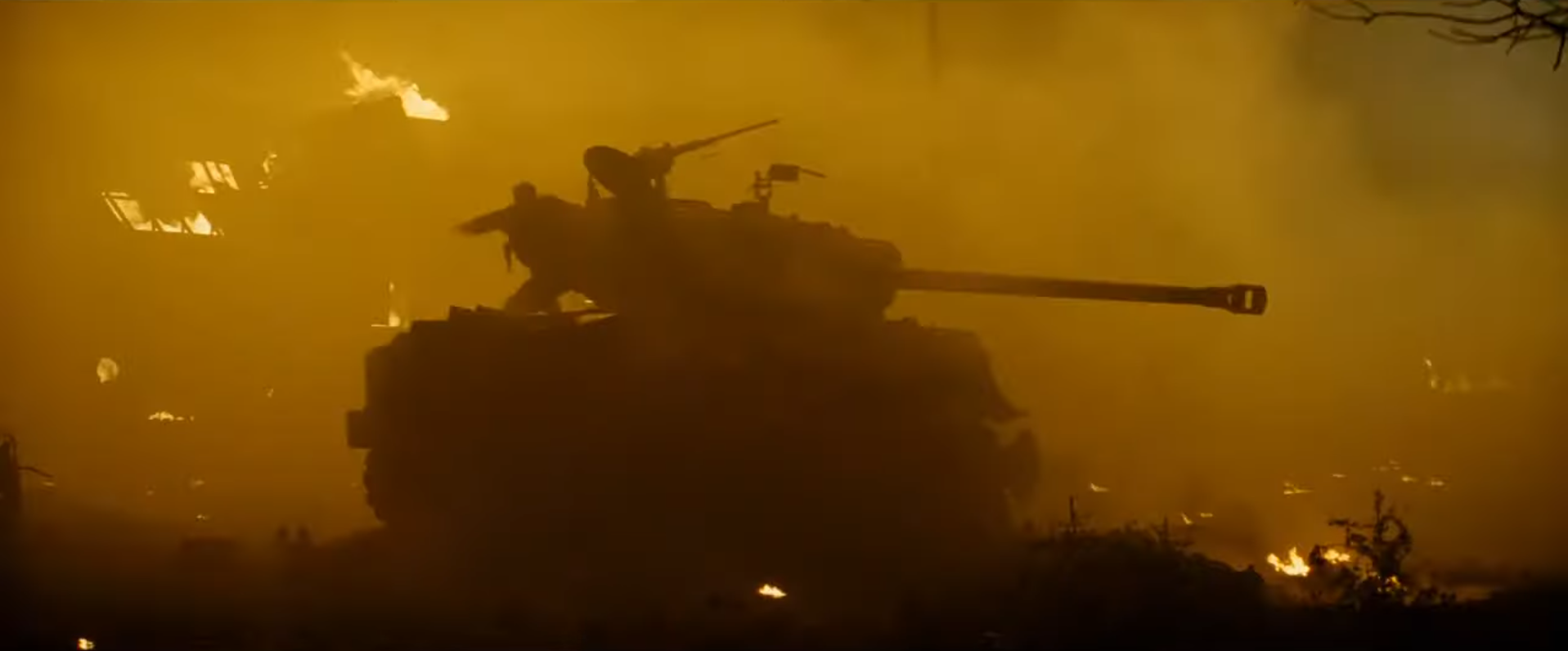
Fury is another example, where Brad Pitt’s character insists on making a stand against hopeless odds, when all military logic would dictate a retreat and call for reinforcements:
Finally, we have the 2002 classic Black Hawk Down, where “No one gets left behind,” even a body. This is based, of course, on a true story, but I wonder how true that aspect of it was.
Contrast this “no man left behind” mentality with Warfare, where the team are initially denied armoured vehicles for a medevac because of the IED threat. Commanders will do everything in their power to get casualties out, but they quite rightly will not put another team in jeopardy to do so. Like everything in the military, there are exceptions.
Security only goes so far
Notwithstanding all I’ve said above, you do occasionally come across aspects of training which acknowledge the grim reality of the military profession being full of risks. This is usually accompanied by a “Wait… we can do that?” moment.
One example of this is during CBRN (chemical weapons10) training. Part of the standard chemical weapons “kit” includes electronic sniffers and old-school chemical detector paper to check for the presence of a chemical agent. You’d think that when the detection kit reads all clear, the commander gives the order to unmask. Not so. The squad must first go through a ritual known as the “two-man sniff test.”
- Commander designates two individuals to carry out the test.
- Sniff tester #1 breaks the seal on his mask and is observed by sniff tester #2 (and the rest of the squad) for a set period of time.
- Provided sniff tester #1 had no adverse effects (e.g. pupils dilating which indicate a nerve agent), sniff tester #2 also unmasks.
- Sniff tester #2 is observed by #1 and by the rest of the squad.
- Once another set period passes with no adverse effects, the commander gives the all-clear and the squad unmasks.
The r/Military subreddit puts it well:
If you think about it, of course, the two-man sniff test still fits in with our earlier focus on security: rather than the whole squad taking off their masks when the coast is declared clear, two soldiers get to take the risk first. Security is maintained for the unit as a whole, albeit potentially at the expense of the two nominated individuals. Pretty grim, but then again nothing much about chemical warfare (or warfare in general) isn’t.
Conclusion: Soldiers need to be alive to be effective
So there you have it: even when we’re taking blatant risks, we’re doing it in the name of tactical security.
Western (i.e. NATO and NATO-adjacent) military culture puts a lot of emphasis on “mission command,” which is the idea of empowering lower-level commanders to come up with their own way of achieving the objectives you set them, within acceptable guardrails. Its contrast is rigid obedience to specific and detailed orders (with Russian military doctrine usually presented as the archetype). I’m not sure whether I fully buy into the validity of this clear distinction, but that’s a debate for another day. What is clear is that the acceptable guardrails are quite directive when it comes to how and where a commander can deploy their forces. These guardrails (i.e. standard tactical drills) derive from military principles such as security, and they ensure that even a mediocre commander will do nothing rather than do something stupid which wipes out his or her unit.
In summary, security as a principle filters down into drills which all soldiers are taught. You learn to protect yourself and your troops. This is one of the biggest contrasts professional militaries have with untrained or irregular forces. Coming back to Warfare again, the final scene after the departure of the Bradley IFVs shows the Iraqi insurgent forces slowly emerging from the alleyways and rooftops around the house. They are unladen apart from their weapon and a few ammunition pouches. They’re taking a ridiculous risk of being spotted and attacked from the air. No-one is covering off the various directions from which US forces could return. In short, they aren’t demonstrating any regard for their own security.
Irregular forces who throw caution to the wind and take extreme risks can achieve occasional tactical successes, but they will lose to the professionals in aggregate, over time. The slower, methodical, but secure way of doing battle means that the professionals can take the fight to the amateurs again and again. This gets us into the whole popular meme of “Hard times create strong men, strong men create good times, good times create weak men, weak men create hard times,” which one of my favourite online historians Bret Devereaux has comprehensively debunked as being a “thing,” at least based on the evidence (highly recommend reading his series on this topic).
Now, you can indeed argue about the (in)effectiveness of the Coalition’s presence in Iraq on the strategic or the operational level11. That’s separate from its tactical capability, however, which was depicted pretty well in Warfare as being boringly12 effective13.
That’s all for this week folks. Thanks for reading. As always, I’d love to hear your thoughts in the comments section below. Please subscribe if you haven’t already, and please share this with anyone who might like it on your social media. Until next week, stay secure!
Featured Image: Fury, Sony (2014). Via YouTube
- Different nations emphasise slightly different principles, as we’ll see below. ↩︎
- Usually called “OPSEC” for short. As I mentioned at the top, I’m not going to focus on OPSEC today, it’s its own fascinating topic. The Blackadder quote above and the episode it comes from are all about OPSEC. ↩︎
- If you’re surprised that soldiers would willingly go without these, you should try wearing them for a day yourself. Then think about how long it took society to normalise wearing seatbelts in cars without the threat of fines and penalty points. ↩︎
- Chemical, biological, radiological, and nuclear. I wrote an article on each one last year: check them out! ↩︎
- Pain In The Ass (what the Yankee infantryman might say). ↩︎
- Nausea-inducing. What the British Tommy would say. ↩︎
- Literally “haemorrhoids”, figuratively also a pain in the arse. What I’m guessing the Russian “Ivan” might say. ↩︎
- Or her, of course. I tried using him/her or “their” for this sentence and the next heading, but it looked bad, so I went with the most common option. But obviously, commanders can be and are female too. ↩︎
- Remember, a section (USA: squad) is nine soldiers. It has one machine gun (for us, the FN MAG) for suppressing the enemy. ↩︎
- Technically this is just the “C” part of CBRN, but the drills I’m talking about and most of the detection equipment are applicable only to the “C” part. ↩︎
- Definitely a topic for another day, but the principle of war “Objective” is the key one here. ↩︎
- Not meant as a criticism. The “boring” is twofold. First, the boring routine of the OP which we see before this shit hits the fan. Very realistic. Second, the fact that the tactical outcome is “boring.” No great victory, no insurgent scalps, no heroics. ↩︎
- They went in, they did their observations, they got attacked by a superior force, and they came out with only one serious (American) casualty (no-one seemed to care much about the two dead interpreters). ↩︎


Leave a Reply