World-building for creators Part 2: Behaviour
Hi there. I’m continuing my series on military world building which I started a few weeks ago. Today I’d like to speak about individual character behaviours and motivations: how to build your characters and anticipate what they’re going to do, at least if their military experience is anything like mine.
In Part 1 I spoke about “character” as part of my “4Cs” of culture, character, conflict, and context. This week I want to focus on the individual and their granular actions, so I hope there won’t be too much overlap.
I’ll frame this topic as a series of questions: the questions that you should be asking when you’re thinking about and writing your screenplay, video game, blog, or next Great American Novel. These questions, in turn, reflect the most basic tenets of military life. The questions [and tenets] are:
- What’s your character’s personal motivation? [The military makes you do dangerous, disagreeable things]
- How does your character interact with the military hierarchy? [Militaries are composed of strict hierarchies]
- How disciplined is your character? [Military life requires a lot of discipline]
Of course, as always, please chime in in the comments below if you think I’ve left anything out. You can also contact me via webform here or email here. Also, please subscribe to the blog using the link below. Finally, if you’ve enjoyed this post, please share it with a friend.
If you enjoy this blog and want to support it, please consider a donation. Keeping this blog going doesn’t cost much, but it isn’t free either, so any help would be very much appreciated👍
What’s your character’s personal motivation?
In your fictional military setting, you probably want your main character to do a thing or two. Unless you want them to spend the whole story doing nothing, which would be pretty realistic, but wouldn’t make for a great plot.
So, I’m going to go out on a limb and assume that your characters will do things. I’ll go one further and venture that some of these things will be dangerous, disagreeable, disgusting, or otherwise demoralising. Therefore, you will want to ask, as a Cadet School instructor used to with us: “But WHY did ya do it?1“
This, in turn, means you’re going to want to give them a set of motivations. This is intrinsic to your character, and must be distinct from the things we discussed in Part 1, e.g., the group dynamic of the military unit, and world-view of the society in which they operate.
Even if your character completely aligns with their social expectations of their peers and society (e.g. the heroes in Starship Troopers), you’re going to have to explain to us, the reader, why the character thinks this way. And even at that, you’ve only answered the first part of this question, which is: Why is your character there in the first place?

The second part of the question, as we see above, is about why your character does the things they do. The idea of the reluctant soldier has been a defining archetype throughout history (we’ll come back to this point) and in fiction too. Maximus Decimus Meridius just wanted to get back to tend his farm with his family, but political intrigues which he wanted no part of put paid to that.
The Flashman books by George MacDonald Fraser are a another, more cynical example of this. The titular (anti)hero is a lazy, lecherous, cowardly cad who does his best to avoid every danger and discomfort which is inevitably thrust upon him. But because he has a reputation to uphold, he pretends to love the cut and thrust of battle.
Fictional military characters, however, are all too often prepared to put themselves through excruciating mental and physical anguish, not to mention danger, without enough of a motivation. To give just three examples:
- Jack Reacher pushes his physical and mental faculties to breaking point to take down minor criminal enterprises. Yeah, we’re told he’s got an innate sense of justice. But he also likes his coffee, diner breakfasts, and beautiful young women. How many of these has he foregone while staking out baddies or infiltrating their compounds?
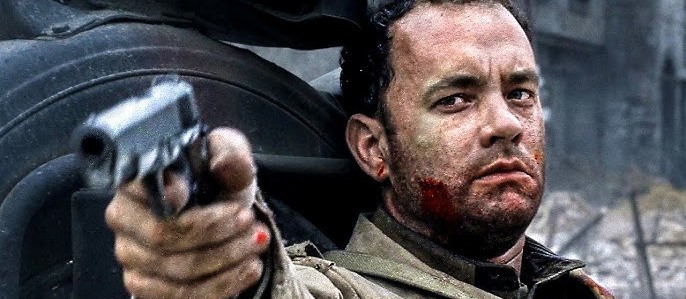
- Tom Hanks’s Captain Miller is given the job of Saving Private Ryan. But he can’t resist the danger, discomfort, and admin involved in trying to take out a German machine gun nest.
- Arnie’s “Dutch” Schaefer has a dodgy mission to carry out in the jungle in Predator. But when he’s attacked by a monstrous foe and takes casualties, does he retreat with the rest of his squad? Not a hope! He fights to the death. To their deaths, specifically, and gets very wet and cold in the process.
This is Hollywood, of course. Nobody (at least nobody “good”) shows a human frailty like tiredness, laziness, or cowardice, even though these are very real drivers of human behaviour. A uniform doesn’t change that, but it raises the stakes of falling short.
Military social bonds (i.e. not letting your comrades down) and formal discipline (i.e. not wanting to get shot at dawn) are very strong motivations for any person. No matter how “good” or “bad” your character is, these negative feedback loops should play just as important a role in their personal motivation as should their sense of honour, justice, freedom, Mom’s apple pie, etc.
How does your character interact with the military hierarchy?
We all know that military life involved strict hierarchies. After all, recruits must learn rank insignia and forms of address very early on in their training, and the tolerance for even simple errors is small.

You shouldn’t fall into the trap, which Hollywood often does, of thinking that the basic training environment is the same as the “real” military. In fact, much of the “bullshit” (a technical term, at least by Norman Dixon in his famous On The Psychology of Military Incompetence) that happens in training stays precisely there, with trained soldiers getting much more freedom to think and talk honestly to their superiors.
I read an anecdote once (it was on Reddit or Quora and I can’t find it now, so take with a pinch of salt) which compared the US Air Force to the US Marine Corps. It went something like this:
- In the Air Force, if your superior officer suggests a dumb plan, you don’t make a scene in public. You agree and support them, then you do everything in your power to undermine the implementation of the plan.
- In the Marines, if your superior officer suggests a dumb plan, you argue back with all your passion and reason. If and when the decision is made, however, you roll in 100% behind the plan and do everything in your power to make it work just the way your boss intended.
I’m not sure how true this really is—there’s a lot of hoo-rah bullshit on Quora. If you can confirm or deny this, please let me know in the comments. In my own experience, in the Irish Army, we always aspired for the latter (it’s one aspect of “Moral Courage,” a core value), but personal politics often tended toward the former. You should think about the culture of your fictional military, and whether you want it to be more like the supposed Air Force or Marine examples above.
Command itself can be a lonely place, and your character (if they are a commander) should reflect this.
Don’t assume, by the way, that your character should be the most senior officer. If they are, then they are sitting on a very lofty perch and are unlikely to see the gritty details and personal intrigues which hopefully exist down on the ground to make your story interesting. And you can’t get around this by making your character one of these easygoing, cool, relatable COs. They don’t exist or, if they do, they are more like David Brent than Napoleon:

Wait a minute, are you telling me that the military is just like any job that has bosses and teams? Well, yes. If those bosses could tell you to run up and take out a machine gun nest and please don’t get killed in the process. That last bit is a much-overlooked part of military storytelling and serves as a bridge to our next section. Getting killed is, in military logic, an entirely preventable result of bad discipline, and is to be frowned upon.
How disciplined is your character?
Getting yourself killed or wounded is an awful lapse in personal discipline. If you were wearing the right protective equipment and following the right procedures, then this wouldn’t happen. How dare you get shot!
This might sound cruel and perverse, but it’s much better than the alternative, which is to acknowledge that, in a combat situation, you have very little control over whether you live or die. If you can engender a culture of risk-aversion and maximum protection, then you’ll lose fewer soldiers overall, which is obviously a good thing for you (and a great thing for those few soldiers). But it’s an awful thing for the much larger number of soldiers who won’t die but wouldn’t have died anyway; or those who will die anyway, but will die in less comfort than they would have.
In the battle between safety and comfort, comfort is usually the far more attractive option:

All of this should feed into a big question you ask of your character, which is how disciplined they are. Are they a stickler for the rules who insists their soldiers wear their fireproof underpants? Or do they gain brownie points with their men by thumbing their nose at the “rules, man” and letting the troops run riot?

Military operations are painful and uncomfortable. Helmets, weapons, and ammo all weigh a lot. Body armour and load-carrying equipment chafes. Feet inevitably get wet. Everything else gets wet when it rains.
This is why I was happy to see, in Warfare, how the SEAL operators were delighted to ditch their heavy gear at the first opportunity. And these were super-fit warriors who fetishise physical prowess.
Another omnipresent and annoying aspect of military life, which I’ve written about before, is admin. If you want to paint a realistic picture of the issues which will plague your soldier character, think about them writing orders, filling out sentry rosters, requisitioning transport, or doing a serial number check for ordnance. If they’re an impatient, careless sort, then they will half-arse this stuff (but may pay a price later, if you want to make a point). If they’re diligent and trustworthy, they will do this stuff somewhere properly, but will probably still hate it. As an instructor of mine once said:
Being a good platoon sergeant is not about being a warlord. It’s about having good admin. And being a fuckin’ WARLORD!
Conclusion: Most people optimise for an easy life
I hope the questions above gave you some food for thought when it comes to writing your main character, whether they are a Field Marshal or a Feldwebel.
Whatever rank, role, or routine they inhabit, remember that your character is, first and foremost, a human being. Their military training will go some way toward inuring them to military hardship, but only some way. They will still grumble, drag their feet, and make small mistakes which might lead to immense consequences.
Doing “stuff” is hard at the best of times, and military conditions are usually not the “best of times.” Military organisations, therefore, are just machines which get people to do things they really don’t want to do, through explicit and implicit coercion. Remember that in your writing and you won’t go too far wrong.
Thanks for reading and please remember, if you haven’t already, to subscribe using the link below. Please also share this article with a friend. See you next week.
Saving Private Ryan, Paramount Pictures (1998), via YouTube
- Unlike with your writing process, however, this was a rhetorical question. The purpose of the self-reflection was not to generate insight or gain any sort of enlightenment beyond reinforcing what a bad cadet one was. ↩︎


Leave a Reply