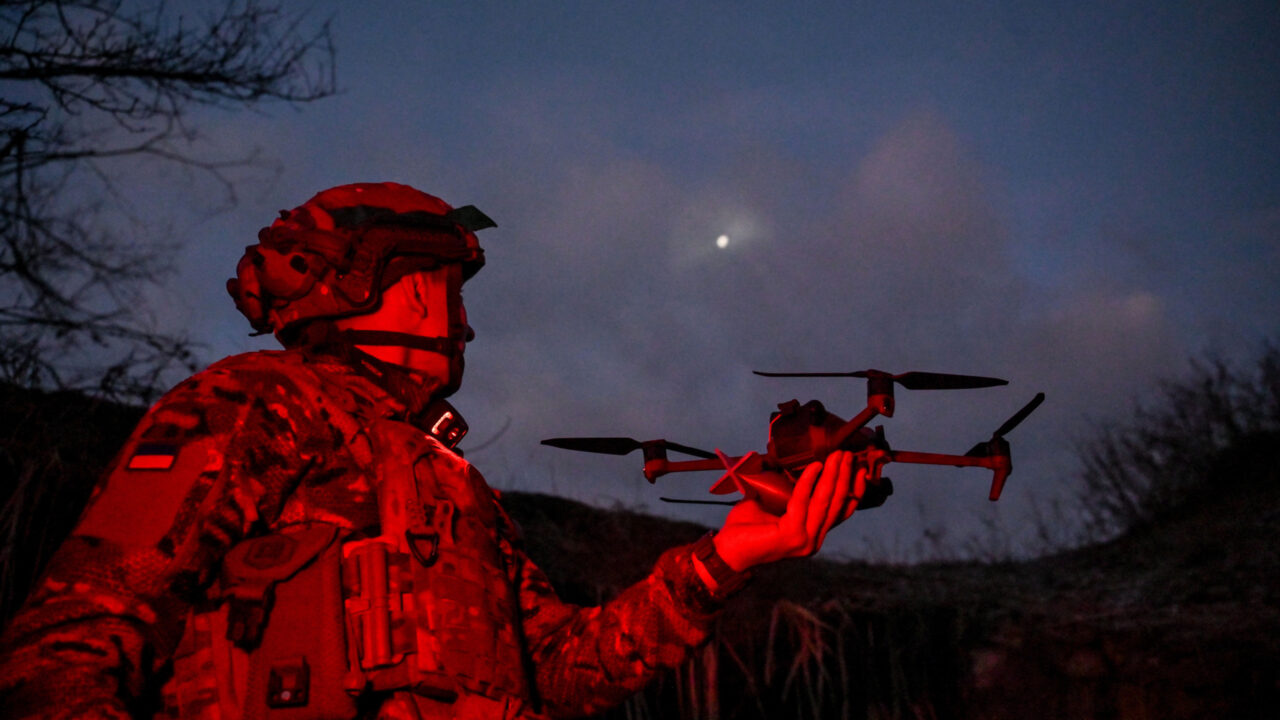
Some harsh realities about doing war on the cheap.
Hi there. I hope you’re all enjoying the summer. For my US-based readers, I hope you had a wonderful 250th Independence Day celebration, crazy heat aside. We hear a lot of sneering about the USA on this side of the pond, but let’s see how we’re all doing on our country’s 250th anniversary (21st January 2169, if you want to book your tickets early).
I’m not going to avoid sneering today, but I will promise to keep it to a single topic, and that’s defence defense military spending. And to be fair, this article is actually something of a defense defence ah screw it, apology for the USA’s colossal, staggering, and incomprehensible military budget (planned to be $1.5 trillion in 2027). I did say “something” of an apology, not a complete one.
Today’s post was prompted by recent think-pieces and commentary around the need to ditch the expensive, old-fashioned way of doing war and focus on disruptive new technologies to achieve better military outcomes at lower cost.
The great Prof. G had a flippant comment recently about “cutting the US defense budget in half and pivoting to asymmetric warfare.” I explained two weeks ago why the second part of this makes no sense at all, so today I thought I should focus on the first piece.
I had intended for this to be a single article, but it ran away from me and I’ve had to split it in two, the second part coming next week. I’ll focus today on breaking down the technical and economic reasons why modern weapons, equipment, and ammunition are so expensive. The “legit” reasons; there are some. I’ll also look at some opportunities that new technology brings for doing war on the cheap(er).
Next week I’ll cover the more wasteful stuff, the sort of thing that seems like low-hanging fruit but still may not be as simple to cut as people think. I’ll finish by talking about some promising new trends and companies bringing new models of defence investment, and whether these trends could bring us to the scale of cuts that some people call for while maintaining the same level of strategic ability (spoiler: no).
Before we start, let me encourage you to subscribe to the blog using the link below. As always, I’d love to see your comments below, or you can contact me via webform here or email here. Finally, if you’ve enjoyed this post, please share it with a friend.
If you enjoy this blog and want to support it, please consider a donation. Keeping this blog going doesn’t cost much, but it isn’t free either, so any help would be very much appreciated👍
1. Why is military hardware so expensive?
It’s taken as an article of faith that military kit is way more expensive than the equivalent civvy kit. At least, that’s the feeling within the military. We used to say that “military spec” meant that something was painted green and had an extra zero on its price tag1.

Before we get too cynical (and I will, don’t worry), let’s take a few minutes to look at some of the legitimate reasons why weapons, ammunition, and other military kit are so expensive.
1.1 Military kit has got to perform
There’s a simple answer for a big part of the gap between military and civilian specifications: performance. Military kit has to be far more durable because it’s subjected to extremes of temperature, shock, immersion, and other environmental hazards, and it still has to work with high reliability. Equipment destined for civvy street can be designed to operate within much narrower conditions. If the user goes outside these conditions, that’s a “them” problem, not a manufacturer problem.
When it comes to munitions, the performance requirements are higher still. Let’s think about a fairly basic piece of kit such as a 155 mm high explosive artillery projectile. Here’s what it looks like cut open:

Not too complex, right? Okay, the electro-mechanical doo-dahs in the fuze might be complex, but surely we can still assemble it from off the shelf components. Right? Wrong. Let’s look at some of the performance requirements of this humble shell:
- Acceleration: The projectile weighs about 45 kg. Let’s assume (conservatively) that half of this weight is in the section forward of the red SECTION A-A line.
- When the projectile is fired its acceleration reaches about 30,000 g (that’s about 300 kilometers per second per second3).
- Normal Earth gravity is 1 g (about ten metres per second per second).
- So the ~22 kg in the front half of the shell weighs the equivalent of 660 tonnes, which the thin shell wall with a thickness “t” shown in the diagram above needs to support.
- The monster excavator below weighs about 660 tonnes. So, picture that sitting on top of the shell and you have an idea of the stresses it’s experiencing in the gun barrel:

- Storage, handling, and transport. The ammo has got to be okay for ten years or more in storage.
- If you’re thinking “so what,” then remember that this isn’t just steel and copper, its biggest component by volume is a complex chemical which is designed to decompose violently.
- Then, once you take it out of stores, it needs to be safe to transport and handle (often roughly) before it gets to the gun line.
- At the gun line it will be further abused and will get wet and dirty before (if ever) it gets to travel down the barrel. And it needs to travel down that barrel successfully, because:
- Safety in firing. This complex exploding machine needs to not explode after it’s been hit with a 30,000 g push and continue to not explode while it clears the gun, the gun line, the crew, and any friendly forces underneath.
- Reliable functioning. After all those non-explosions, the munition needs to explode when the time is right. A bad job at this stage means that the post-conflict battlefield is littered with unexploded ordnance.
- How big a problem is this? Just ask the farmers and EOD specialists who are still clearing out fields in Belgium from WW1 explosive remnants or war.
- Not to mention the enemy who got away because your shell didn’t explode.
- Insensitive explosives. As if the above weren’t enough, many modern munitions need to fulfil so-called “insensitive munitions” (IM) criteria to be accepted into service.
- This means that instead of using good ol’ TNT or RDX like a normal, well-adjusted munition, it uses a gnarly new chemical like IMX-1014.
- Insensitive high explosives like IMX-101 need to pass a rigorous series of tests to prove they won’t detonate unexpectedly.
- These tests include shooting it with a bullet, setting it on fire, detonating something else nearby, and hitting it with a shaped charge (HEAT) jet.

Military munitions need to perform in conditions that would be unthinkable in most civilian applications. This drives up the price, because you’re using the best (priciest) materials, with the best (slowest and/or most expensive) manufacturing processes, stringent quality control (more salaries or fees), and extensive independent testing (expensive and destroys some of your stock).
Speaking of testing, there’s a bigger cost problem when it comes to military kit and munitions.
1.2 Low volumes and high research costs
Research costs for military kit are high, mainly because of the performance considerations discussed above. Procurement processes in most militaries are convoluted and byzantine, optimised for transparency and procedural integrity rather than speed or value for money.
Manufacturers charge high prices because they can (more on this below). But they’re also forced to charge a lot if they want to cover their costs and make a profit. While their research costs are high, the demand for their products isn’t steady, so they need to make back their original investment over a comparatively small number of units. Spreading the R&D costs so thick means, you guessed it, that prices go up:

Another cost which isn’t research related but does impinge on manufacturing cost is the fact that explosives tend to, well, explode. For safety reasons factories and stores of raw materials have to be in remote places. They also have to work in batches, never putting too much explosive or too many munitions together. This limits the ability to work on manufacturing economies of scale and forces up costs.
Now, at this point I should add a caveat. Not all ammunition is the same. Something small and cheap like a 5.56 mm rifle round is treated as a commodity like oil or barley. Rounds are made in batches of millions on highly automated production lines for tens of cents per unit.

By contrast, a guided missile is hand-assembled by a skilled technician on a workbench. It costs tens to hundreds of thousands of dollars per unit.
Somewhere in between is an artillery projectile like we discussed above, which might also be made in a large factory but will require a lot more hand working and assembly compared to a small arms round. This will cost in the low thousands of dollars per unit. If you want extended range through base bleed, double or triple that. If you want guidance and control (e.g. Excalibur shell) then you can triple it, triple it again, then add a zero.
But why would we want the more expensive Excalibur shell? What’s wrong with the basic one? Let’s unpack that a bit in the next section.
1.3 Requirements ratchet up
The M982 Excalibur projectile I mentioned in the last section was developed to give militaries the ability to turn the traditional unguided artillery barrage into a precision strike against confirmed targets only.
This desire to control fire more precisely is one of the two forces pushing a technological ratchet when it comes to military kit. Once you have the ability to control where each individual shell goes, then you can’t really get away with a far cheaper but indiscriminate unguided barrage. This ratchet is driven by external constraints affecting military capability (e.g. pesky constraints on the use of force).

The other ratchet is force protection, i.e. wanting fewer of your own troops to die or be injured. This is related to the first in that there’s a public acceptance issue here. Nothing sours public opinion on a war quite like the body bags coming home, so if you want to keep your wars going then you’ll need to find better ways to protect your troops. As with the Excalibur artillery round comparison, once you figure out how to do this, it’s very difficult to go back, no matter how expensive it is.
Is there no end to this ratchet? Can militaries escape from this ever-increasing spiral of spend? Novel technologies are supposed to provide the answer. Let’s look at those next.
2. What opportunities do new technologies bring?
This week I’m going to talk about technology itself and its tactical employment, next week I’ll focus on innovations in the supply chain and procurement space.
There’s no doubt that drones have changed the battlespace significantly in Ukraine. They loiter in the air, ready to pounce on an armoured vehicle or infantryman unlucky or unwise enough to venture out of cover. Their payloads are small but delivered precisely to the target’s most vulnerable point.
An artillery shell needs to be big and expensive to survive the journey from the gun to the target (see above), but it also needs to be precisely engineered to fragment into lethal pieces which travel as far as possible. An anti-tank guided missile needs to find and lock onto its target using sophisticated electronics, then fire a precise series of rocket motors to close the distance to the target as quickly as possible. A tank’s kinetic energy round needs to be twice as fast as any other munition out there and precisely engineered for stability and low drag so it conserves as much energy as possible for when it reaches its target.
Drones have none of these problems. They can be made of cheap materials because they operate well within their comfort zone. They loiter, swoop, and drop. They’re too fast for infantry to escape and too small for tanks to see, with no rocket heat signatures. Because they get so close to their target (the infantryman himself; the weak top armour of the tank), the munitions they use can be small and cheap. These grenades or disassembled cluster munitions are as close to “off the shelf” as military kit gets.

The drone option provides at least thirty times more bang for your buck than the conventional option, at least using my finger-in-the-air figures above. That’s an impressive game-changer.
Both sides are now starting to use unmanned ground vehicles (UGVs) as well, for resupplying the poor troops who are stuck in the middle of the aerial drone kill zone. Ukraine has also deployed armed UGVs, a.k.a. actual science fiction killbots to hold ground against Russian incursions.

These ground drones are considerably more expensive than the aerial quadcopters, in the tens or hundreds of thousands of dollars. It’s still at least an order of magnitude less than what manned fighting vehicles cost. Armour is one thing that these vehicles can skimp on, with no bags of jelly inside to protect.
Do drones mark the the end of the military money furnace? Will we see military spending being streamlined through the use of drones? Maybe, but I won’t hold my breath. For one thing, I have a lot of faith in the ability of defence companies to turn technology like this into fat profits for themselves, but I’ll leave that point until next week.
But even leaving aside the politics of it, it’s not clear to me that drones spell the end of traditional (and expensive) military kit. Only yesterday US President Trump announced that Ukraine would be given the right to produce Patriot air-defence missiles. These cost roughly $5 million apiece, so they are the epitome of expensive, highly specialised military kit.
Both sides are also still using tanks (albeit up-armoured against drones) and artillery. It’s just that they’re using them differently. Let’s discuss some of the reasons why in the next section.
Conclusion: it’s complicated (and unfinished)
The drone revolution in Ukraine is often framed as an either-or situation, i.e. you can fight in the old-fashioned way with tanks and artillery, or you can fight in the new way with drones and pockets of infantry. This new way is often implied to be “better” (although no-one disputes that’s it’s worse for the infantryman and the civilian). It’s certainly seen as a cheaper way of waging war.
In fact it’s not an either-or choice. This FT piece has an interesting quote from a senior NATO officer:
“The logic of future weapons needs is not about choosing tanks or drones. It is tanks and drones,” says a senior European army officer. “It’s about hybridisation of capabilities.”
There’s no doubt that drones have enabled Ukraine to stave off Russian superiority in numbers and equipment and fight them to a stalemate on the battlefield. But they’ve also used tanks, artillery, air defence missiles, and other types of traditional military kit. I don’t think we can say that these latter capabilities are less important in contributing to the outcome.
But the probable effect from the drones has been to make both sides use their “traditional” kit more judiciously. No more tank charges. Artillery pieces pack up and change position after every fire mission. Air interceptor missiles are hoarded and used sparingly (in contrast to what happened/is happening with the Third Gulf War).
There are things that cheap drones can’t do, such as:
- Find and destroy an incoming hypersonic missile
- Send 10 kg of explosive downrange 30 km and use it to scatter deadly fragments dozens of metres in all directions
- Break through a fortified position to allow infantry to mop and take ground quickly
So no, new technologies won’t replace all complicated and expensive military kit. But it will force strategists to think about how many big, expensive platforms they need and how they might balance that capability with smaller, simpler, and cheaper items.
There’s another aspect to this which we haven’t touched on, and I’m going to leave until next week: the tangled web of military procurement, wastage, overspending, and inflexible bureaucracy. I can tell that you’re already excited! Until then, take it easy.
Remember to subscribe if you haven’t already. Thanks again for reading and see you next week.
Cover picture: Drones in Ukraine: Four lessons for the West, Ukrike Franke, European Council on Foreign Relations, 10th Jan 2025.
- If you’ve ever had to plan a wedding, you might recognise this business model. ↩︎
- I speak with a little bit of authority here, since it’s a job I did for a time during my service. ↩︎
- Or “per second squared.” It’s a unit of acceleration, which means it’s measuring the rate of change of velocity. Every second, the velocity of the projectile increases by 300 km/s. Of course, it never reaches 300 km/s because it’s only in the barrel and being accelerated for a fraction of a second. ↩︎
- Technically not a chemical, just an insensitive high explosive specification. The actual high explosives in IMX-101 are DNAN, NTO, and nitroguanidine (NQ). But you knew that already. ↩︎


Leave a Reply