
The reality of cluster munitions
Hello again to all my new and regular readers alike. Cluster munitions have been in the news recently, primarily because of the Russo-Ukrainian War. Although banned by international treaty1 and taboo in recent decades, the upsurge in fighting in Europe has re-ignited debate over these weapons. In 2023, the Biden administration agreed to supply cluster munitions to Ukraine, and in 2024, Lithuania withdrew from the international anti-cluster munition treaty. Opinions on these developments range from condemnation to resigned acceptance. What’s been lacking (as is often the case) is a technical understanding of these munitions. That’s what I’m going to write about this week, sharing some of my EOD knowledge with you so that you can better understand these controversial weapons.
To tackle this issue, I’ll start by explaining what a cluster munition is, and why it can be more effective than a single large warhead against certain targets. Then I’ll describe the special threat which these munitions pose to civilians. I’ll talk about the Dublin/Oslo Convention on Cluster Munitions (the legal bit) and, finally, will finish up by addressing (although certainly not answering) the thorny moral question.
Before we get started, a reminder to subscribe (using the handy link below) if you haven’t done so already. Please also weigh in on the comments section below and let me know your thoughts on this. Finally, please share this article with anyone who might be interested.
If you enjoy this blog and want to support it, please consider a donation. Keeping this blog going doesn’t cost much, but it isn’t free either, so any help would be very much appreciated👍
What are cluster munitions, and what’s so great about them?
A cluster munition (or cluster bomb) is a type of ammunition where one large “carrier” munition contains multiple smaller “submunitions”:

In terms of nomenclature, the term “cluster munition” is a generic and well understood catch-all, whereas the term “submunition,” while a bit more jargon-y, actually refers to the part we’re usually concerned with, in terms of its ability to kill the enemy or cause injury to civilians.
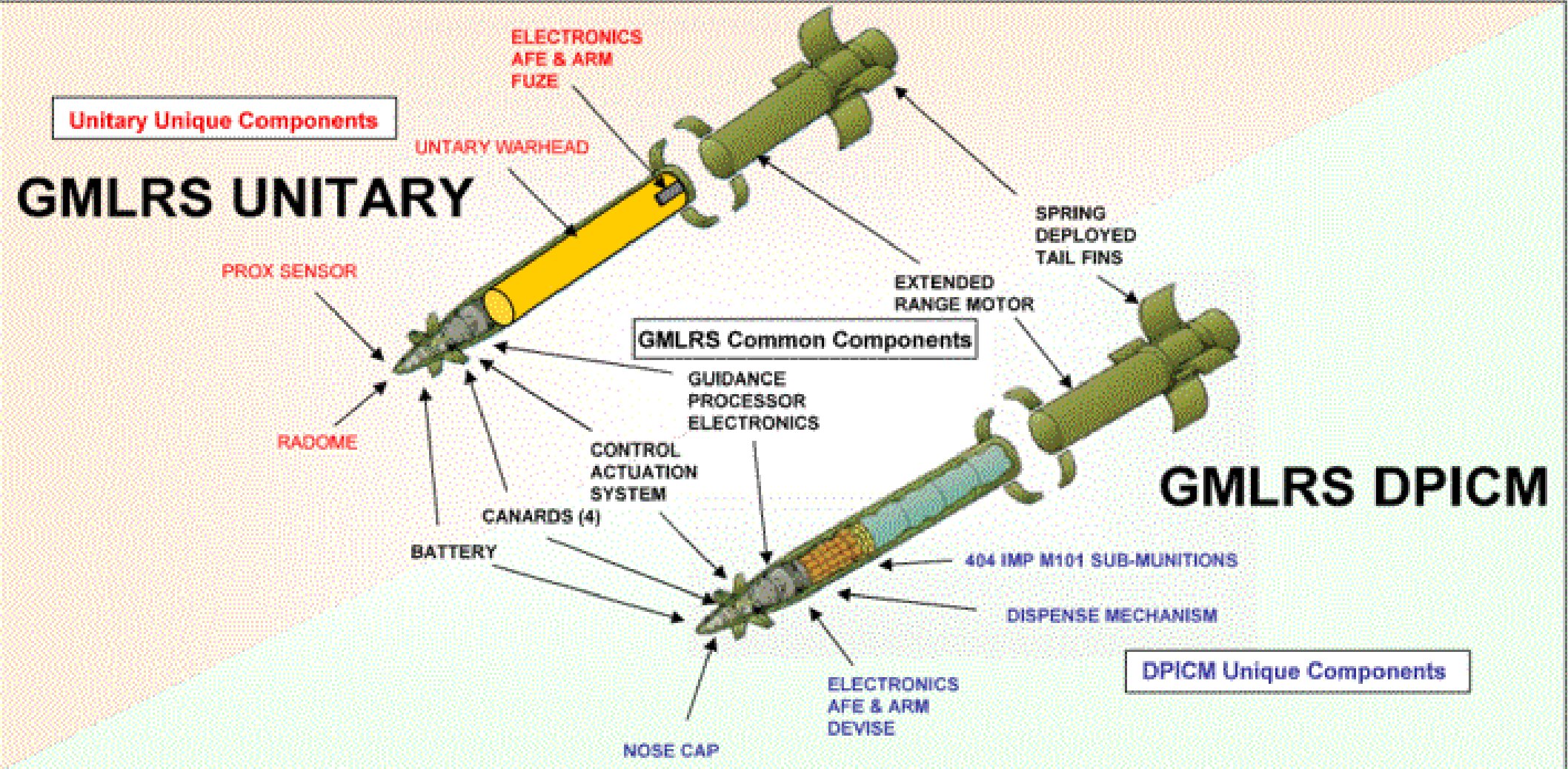
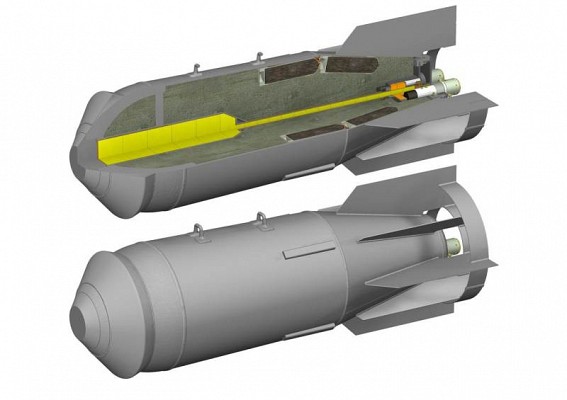
The carrier munition can be an artillery projectile, a rocket, or an air-dropped bomb2:


You might reasonably wonder, from the examples above, what advantage can be gained by putting a lot more complexity into a piece of ammunition. After all, compared to a unitary munition8, a cluster munition loses lots of valuable real estate that could be used to pack in more explosives—just look at all the “wasted” space in the cutaway images above.
The reason is that those extra bits of non-explosive allow us to use the explosives in a smarter way. You see, when a large unitary bomb or artillery shell detonates, it has a devastating effect on the target area, but the effect quickly drops off with distance. To massively simplify, think in terms of D&D9, with a munition having a hit probability which depends on the target’s armour class and a damage score which takes hitpoints:

Using the same analogy, each submunition will have a much lower individual explosive damage effect, but this will still be enough to defeat lightly-armoured targets which are nearby:

By distributing the explosive payload over a wider area, the attacker can cover more area with a potentially lethal effect, getting a better “return” on the chemical energy stored within the explosive (more than twofold in our illustrative D&D example above, but more than this for many real cluster munitions, although these figures are often disputed). The slight reduction in overall explosive weight is worth the improved target effect.

Submunitions can be anti-personnel or anti-armour, but modern trends are toward a dual-purpose submunition which incorporates a shaped charge for penetrating armour as well as a casing that will fragment to maximise the anti-personnel effect. Most submunitions are designed to detonate on impact, but some (e.g. PFM-1 “Butterfly” mine) are designed to lie idle in an armed state, where they act as anti-personnel mines.
Different types of submunition can be used in tandem, such as the British JP233 runway cratering weapons system. This destroyed enemy runways and rendered it difficult for the enemy to repair them. The large SG-357 bomblet used a shaped charge to punch through the asphalt or concrete and create a hole for a cratering charge to fall into and then detonate, maximising the damage. At the same time, the runway was also littered with HB-876 area denial submunitions which were extremely sensitive anti-personnel and anti-vehicle mines. Here’s how the system looked in operation:
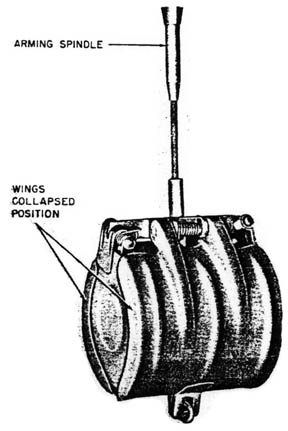
Cluster munitions first came to the fore during WW2, with the German “Butterfly Bomb” or “Sprengbombe Dickwandig 2 kg” being the first to see widespread success:

Cluster munitions are a way for weapons designers to get the most bang for their buck. They are specifically tailored to solve some (but by no means all) problems for armed forces. A cluster munition would be an effective way to attack large numbers of troops or columns of lightly armoured vehicles, but would not be the munition of choice against a large bunker. So what’s the big fuss about them?
What’s so awful about cluster munitions?
The big problem with cluster munitions is that they indiscriminately affect civilians. This is down to two main reasons:
- Submunitions which are designed to explode often don’t
- Submunitions which are designed to wait often do this too well
The impressive battlefield effects I outlined in the previous section unfortunately also apply to civilians who come across these explosive remnants of war after the conflict has ended or moved on. All munitions pose a post-conflict threat to civilians, but several features of submunitions make them especially dangerous:
- Size. Submunitions are usually small, since dozens or hundreds will fit inside the carrier munition. This makes them easy for someone, even a child, to pick up. Picking up a munition you come across is never a good idea.
- Simplicity. Submunitions tend to have simple arming and initiating mechanisms by necessity. This means that it may be easy to cause a found unexploded submunition to detonate:

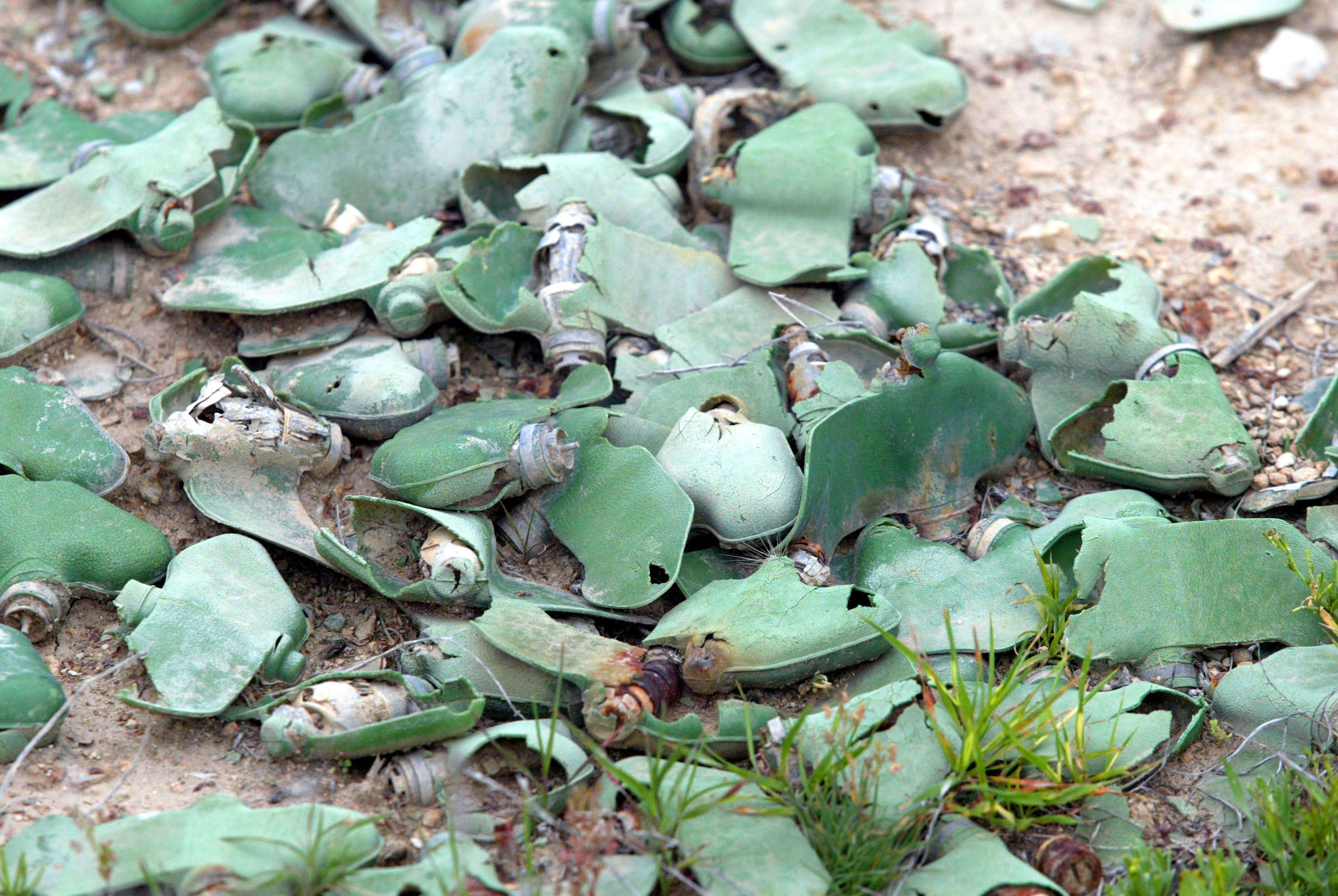
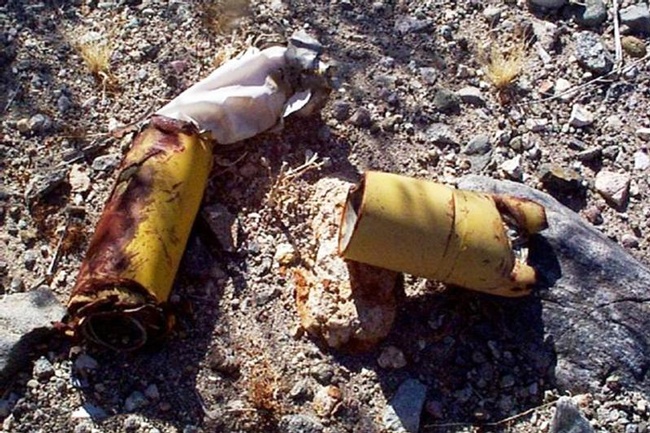
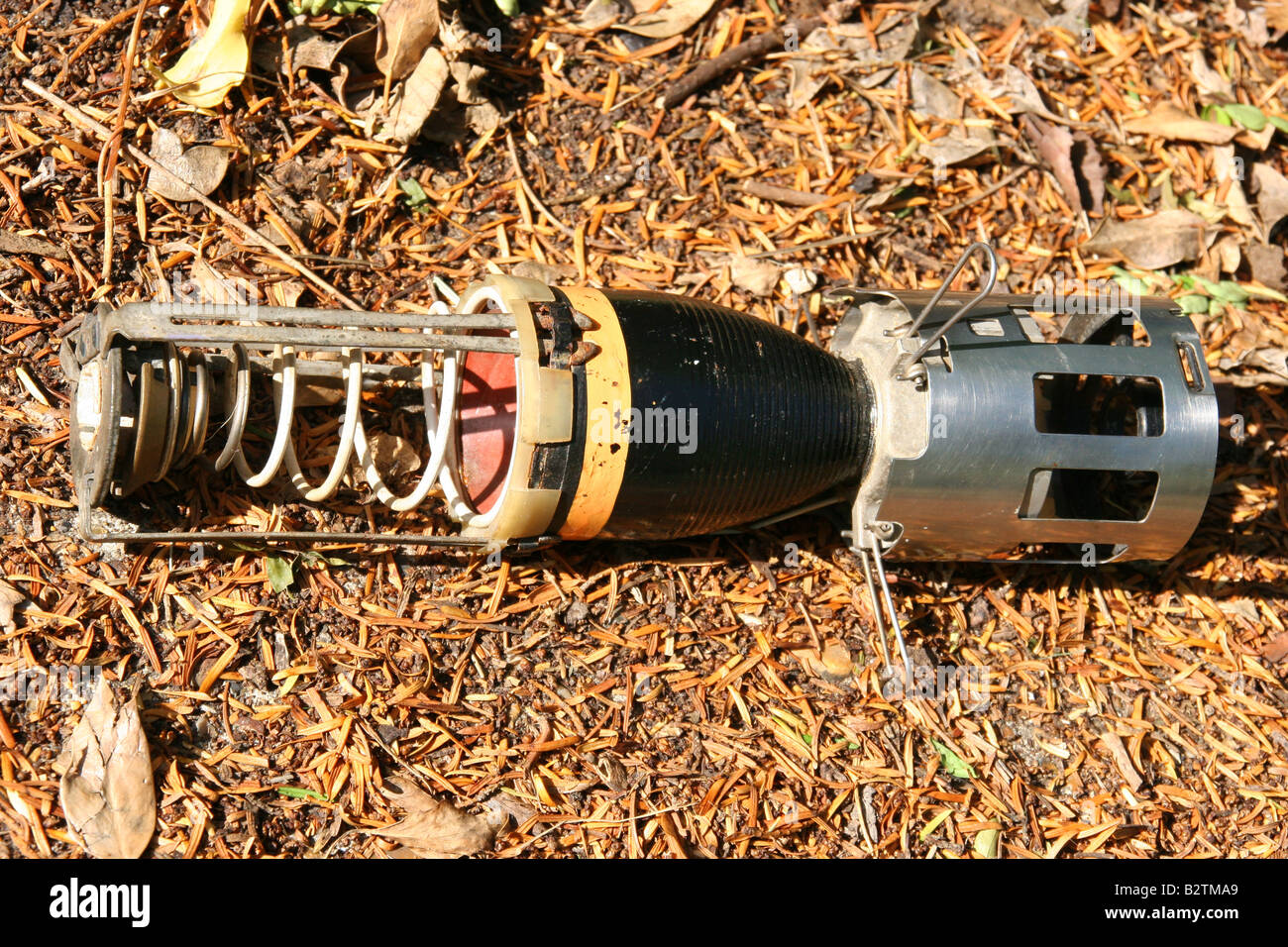
- Stealth. Submunitions often come in unconventional shapes, at least when compared with other ammunition types. This can make them easy to overlook as potentially dangerous items. Tragically, many submunitions have bright colours and shapes which are particularly appealing to children:

Leftover submunitions from conflicts are far back as the US-Vietnam War still explode on a regular basis, killing and maiming civilians. The threat and ongoing damage from cluster munitions makes them taboo. I don’t think it’s a coincidence that the “Jericho”, the novel Stark Industries weapon which asshole-era Tony Stark showcases in Iron Man, is a cluster munition13:
High failure rates are the main problem with submunitions. Some older cluster munitions systems claimed to have failure rates under 10%, but their use in the field (in the 2006 Lebanon War, for example) has shown much higher rates of up to 40%. Even a 10% failure rate would result in dozens of “blind” submunitions from every carrier munition dropped. Unexploded submunitions continue to kill civilians in post-conflict zones from Vietnam and Laos (1970s) to Lebanon (2006).
To address this problem, newer cluster munitions systems tend to incorporate a self-destruct feature which detonates the submunition after a set (short) interval following deployment. This self-destruct mechanism acts as a hedge against the normal fuzing not functioning. Although measured self-destruct reliability falls short of manufacturers’ claims, these munitions do represent a step in the right direction. Another development is “self-deactivating” submunitions. These have an electronic fuzing system which cannot operate once electrical power is lost in the fuze. This fail-safe system means, in theory at least, that these submunitions should be much more difficult for a civilian to accidentally initiate.
So much for the problem: what is the international community doing about it?
What are the legal issues?
The international Convention on Cluster Munitions (CCM) was adopted in 2008. It forbids signatories from:
- Using cluster munitions;
- Developing, producing, otherwise acquiring, stockpiling, retaining or transferring to anyone, directly or indirectly, cluster munitions;
- Assisting, encouraging or inducing anyone to engage in any activity prohibited to a State Party under the CCM.
So far, so good. One hundred and twelve countries have ratified the CCM, with another twelve on a pathway to ratification. Let’s take a look at who the signatories are:

Oh dear, there are some pretty important omissions from this list. The USA, China, Russia, India, Israel, Brazil, and Pakistan are all missing. Together, these major military powers account for roughly 60% of global military spending. As we’ve mentioned before, and seen elsewhere, countries tend not to sign up to international treaties which limit their firepower unless they see no real need to use said firepower themselves. Lithuania’s recent withdrawal from the CCM underscores this point:

The USA, while not signing up to the CCM in 2008, made a statement of intent at the time to restrict its use of the worst types of cluster munition:
After 2018, the Military Departments and Combatant Commands will only employ cluster munitions containing submunitions that, after arming, do not result in more than 1% unexploded ordnance (UXO) across the range of intended operational environments.
—Memorandum by Robert Gates, USA Secretary of Defence, 2008
The USA was, at the same time, developing an alternative to cluster munition artillery using inert flechettes (lethal darts) instead of small explosive warheads. Although it’s hard to see much good in the prospect of a rainstorm of deadly metal arrows, these munitions would undoubtedly pose a smaller threat to civilians after the fighting stops. Cynicism is easy in these situations; there’s a “dual hypocrisy” at play:
- Countries who make, sell, and use cluster munitions refuse to join the CCM14, even though their own policies recognise the threat posed by cluster munitions and seek to mitigate it through better technology;
- Countries who’ve never needed cluster munitions (and don’t sell them) are willing to join the CCM and boast about their humanitarian credentials. NATO countries can go one better, wagging their finger at others who use cluster munitions while relying (at least in the pre-Trump era) on security provided by the USA and their cluster munitions.
In any case, the USA anti-cluster munition policy was amended in 2017 and then overtaken by the events of the Russo-Ukrainian War. Biden’s government provided DPICM cluster munitions to Ukraine in 2023, with the claim that the failure rate was “only” 2.35%, compared with 30-40% for Russian cluster munitions. Real-world experience of EOD operations with the same type of submunition have seen failure rates of 10-30%, however, not meaningfully less than the Russian rates. Let’s take a quick pause to look at the number of implied blinds for some different scenarios and quoted failure rates for these munitions:

Even taking the most conservative estimates for submunition failure rates, it’s clear that the cleanup from these weapons will last for generations to come. Whether this is justifiable or not is a topic we’ll discuss in the conclusion.
Conclusion: What are the moral issues?
Cluster munitions have been causing debates and arguments for decades, but let’s focus on the most recent big decision, which was the USA sending DPICM cluster munitions to Ukraine. It generated significant commentary on both sides of the fence, as the examples below show (emphasis is mine):
For:
It is unlikely that any single weapon or munition will usher in a Ukrainian victory in short order. However, the Ukrainians are in an existential battle for the future of their country. They fully appreciate the risks the use of these weapons imply… Faced with the choice between living under Russian occupation or dealing with unexploded ordnance, Ukrainians have opted for the latter.
—Sean M. Zeigler, via Rand, Why Biden Was Justified to Send Cluster Munitions to Ukraine
Against:
It’s been over five decades since the US dropped cluster bombs on Laos, the most bombed country in the world per capita. The contamination from cluster munition remnants and other unexploded ordnance is so vast that fewer than 10 percent of affected areas have been cleared. An estimated 80 million submunitions still pose a danger, especially to curious children.
—Mary Wareham, via Human Rights Watch, US Cluster Munition Transfers Raise Humanitarian Concerns
I didn’t promise to answer the moral question in this post, and I don’t intend to. The articles above (both linked) any many more in similar veins, make much more eloquent arguments for or against. I urge you to read up on this topic, armed now with a better technical understanding of cluster munitions, and come to your own conclusions (which I’d urge you to share in the comments below, if you’re comfortable doing so).
I do have some thoughts on the morality of this issue:
- All weapons are awful. Any and all weapons devised by humans have the ability to inflict horrendous pain and suffering on the innocent and guilty alike. The corollary to this point is…
- Weapons are as awful as the people using them. Nobody uses a weapon without at least some knowledge of the effect it will have on the people on the receiving end. When cluster munitions are used against civilians, this is quite clearly a war crime, regardless of one’s membership of the CCM. When they are used against military targets, the normal rules of proportionality must apply. However…
- Militaries don’t bear the full cost of using cluster munitions. Cluster munitions, as I’ve described here, can be extremely effective. There’s no inherent reason why they cannot or should not be used in normal military operations. The major caveat is their unreliability, as I’ve described above. The attacker does not have to suffer the consequences of cleaning up the millions of post-conflict submunitions, and civilians suffer instead15.
- The cluster munitions used in Ukraine will kill and injure civilians for generations to come. No matter how the war ends, it’s a grim inevitability that unexploded submunitions will pose a threat for a long time. Yes, the USA-made cluster munitions only added to the problem of the existing Russian ones, but they added a lot to the problem, because…
- Ukraine’s cluster munitions are not the state-of-the-art. The cluster munitions which the USA supplied to Ukraine are not the newest and best, they are legacy munitions from the USA’s extensive stockpiles. Newer submunitions tend to be bigger, smarter, and safer for civilians16, but Ukraine needed ammunition, any old ammunition, and that’s what they got.
This is pretty grim reading, but I’ll end on a note of possible minor hope. While researching this article, I came across the video below17. It shows Ukrainian servicemen cutting open 155 mm shells and taking out the DPICM submunitions within, purportedly for use in drones18:
It would be a happy irony if drone warfare, or killer robots, were in some small way responsible for reducing the amount of indiscriminate death and destruction in the world, even if only on a very small scale.
That’s all for this week folks. I hope you found it enlightening. Please let me know what you think in the comments below, or feel free to ask any more questions about cluster munitions. If you haven’t signed up to be a subscriber yet, please do so using the link below and you’ll never miss a post. You can share this article on your socials with the links below. If you want to know more about cluster munitions, a handy primer is freely available from GICHD, the Geneva International Centre for Humanitarian Demining:
Featured Image: USAF B-1 Lancer dropping CBU cluster bombs. By DoD photo, USAF – , Public Domain, via Wikipedia
- Albeit with many notable exceptions which we’ll discuss below. ↩︎
- You can also have submunitions which are dispensed directly from an aircraft via a carrier which doesn’t detach, such as the British SG-357 runway cratering submunition (which we will discuss later). To my mind, these blur the line slightly between cluster and “normal” munition, but officially they also fall into the cluster camp. ↩︎
- Top War: Not only DPICM. U.S. Capability to Supply Cluster Munitions. https://en.topwar.ru/221303-ne-tolko-dpicm-potencial-ssha-v-dele-postavok-kassetnyh-boepripasov.html ↩︎
- By Mr. Ductri Nguyen – http://www.dtic.mil/ndia/2011gunmissile/Tuesday11528_Nguyen.pdf , Public Domain, https://commons.wikimedia.org/w/index.php?curid=25336450 ↩︎
- TWZ: Navy’s Ammo-less Destroyer Should be Equipped With This Proven Rocket System. Image: https://www.twz.com/wp-content/uploads/content/archive-images/screen_shot_2016-11-16_at_1.49.14_pm.png?strip=all&quality=85
↩︎ - Defence Security Asia: (VIDEO) Russia Modifies RBK-500 Cluster Bombs into Glide Bombs, Ukraine Lacks Countermeasures. https://defencesecurityasia.com/en/video-russia-modifies-rbk-500-cluster-bombs-irussia-bombs-countermeasures-ukraine/
↩︎ - WeaponsSystems.net: FZAB-500. Image: https://photo.weaponsystems.net/image/s-carousel/n-am_bmb_fzab_v1.jpg/–/img/ws/am_bmb_fzab_v1.jpg
↩︎ - A fancy term for a non-cluster munition. Unitary = one warhead. ↩︎
- Dungeons & Dragons ↩︎
- I realised rather too late that the yellow “maybe” sign above the mannequins’ heads looks alarmingly like Donald Trump’s combover. Do with that information what you will. ↩︎
- British Army Technical manual TM 9-1985-2/Air Force Technical Order TO 39B-1A-9 GERMAN EXPLOSIVE ORDNANCE (Bombs, Fuzes, Rockets, Land Mines, Grenades & Igniters), page 34 ↩︎
- Microsoft gives AI-generated alt-text descriptions to all images. Here’s what it says for the four submunitions shown here: PFM-1 “A pile of broken green leaves”; BLU-97 “A close-up of a broken pipe”; BL-755 “A metal object on the ground” BLU-63 “A green object in the ground”. ↩︎
- The submunitions from the Jericho are independently propelled (which seems like a pointless waste of energy) and guided (which is useful, to be fair). The “literature” describes these as MIRVs, which they obviously are not: the “RV” in “MIRV” stands for “re-entry vehicle”, and these submunitions operate in the atmosphere. Other problems with this scene: 1) There’s no way a powerful rocket could launch so close to spectators without burning and/or deafening them; 2) If the blast wave is powerful enough to kick up dust and knock off hats, then it’s powerful enough to burst some eardrums. Stark Industries will need to draw on all its resources just to settle the lawsuits; 3) And this is a very pedantic point that no film gets right, but the sight and sound of the submunitions detonating arrives at the same time, whereas there should be a significant lag between seeing the explosions and hearing them. I don’t want Tony Stark to be on my TV anymore. ↩︎
- I should call out the UK at this stage as a notable exception: they built and used cluster munitions, but changed their policy (against many expectations) to join to CCM. ↩︎
- Anti-personnel mines have this same problem. ↩︎
- By “smarter,” I’m talking about sensors and guidance which make them more likely to hit a target (presumably an armoured one). By “safer,” I’m talking about unintended civilian post-conflict casualties. No design choice will protect civilians from a munition which is deliberately deployed against them. ↩︎
- I normally despise YouTube Reels, but made an exception for this one. ↩︎
- There’s an article here which goes into a bit more detail on the technical aspects of this practice, although it also contains quite a few assumptions. The main takeaway is that any such repurposing is likely to be on a pretty small scale, given the colossal demand for artillery rounds and the large number of submunitions in each round. Basically, this practice will not substantially reduce the number of blind submunitions left on the ground. ↩︎



Leave a Reply