Deconstructing the idea of the “boot camp”
This week I’d like to talk about boot camps. You’re probably aware of boot camps as a foundational part of military life, also called recruit or induction training. You’ve also probably seen fitness boot camps advertised in a big field near you. This second type, as a concept, comes from the first, and I’d like to compare the two situations and hopefully teach you a bit more about “military socialisation.” As always, I’m going to bring in some of the film and TV examples of boot camp and see what they get right and wrong.
The two big questions I want to explore are:
- Is military boot camp just an extended fitness class?
- Do the movies get boot camp right?
The TL;DR answers are: 1) No1, 2) Kinda.
Firstly, I’ll discuss the differences between army fitness and civvy fitness (or just “fitness”, as most sane people would call it). Then I’ll talk about all the other aspects of military training that are not related to physical fitness, and the role of induction training. Finally, I’ll delve into some selected Hollywood examples of boot camp and rate some of the realistic and unrealistic aspects shown on screen.
Before we start, I’ll give my usual spiel: please subscribe if you haven’t done so already. There’s a handy link below, and you’ll never miss a post this way. Also, please comment on this article if you agree or disagree with anything I’ve written, or have any more good examples to add.
If you enjoy this blog and want to support it, please consider a contribution. Keeping this blog going doesn’t cost much, but it isn’t free either, so any help would be very much appreciated👍
Army fitness is different to “civvy” fitness
I started my military career at the tender age of eighteen, in what I thought was reasonable shape. When we did our first fitness test2 after joining, many of my fellow cadets left me in the dust. I was in the company of some very good athletes, and it made me a little anxious about the ordeals to come. I didn’t know much, but I knew that you don’t ever want to be the slowest person in the group, and I was closer to that than I’d have liked.
When it came to the athletes in the class, I needn’t have worried (although there was plenty besides which I could have and should have worried about). When we went running, we went in formation, and the pace was built from the bottom up. It takes a surprising amount of effort to keep your spacing with the people in front and to either side3, not to mention the mental effort of keeping in step, which we had to do on the road surfaces. This was, if anything, more difficult for the fitter people in the group, who were forced to run at a pace which was unnaturally slow. If you’ve never had to run at a much slower pace than you’re used to, this might surprise you.
Take a look at one of the PT sessions from Full Metal Jacket, and ask yourself if this pace would be too fast, too slow, or just right (there’s no right answer!). Granted, it’s in uniform, more on that below:

The real difference came, however, once we started putting on weight. We did this by degrees, building up to the full kit:

We called this “Battle PT” as opposed to regular PT in athletic gear, and it was an eye-opener for just about everyone, no matter how fit they were. Whether you’re a lean cross-country runner with single digit body fat percentage or a bruiser who’s carrying a few spare kilos, making you run with extra weight will put you in turmoil. Since everyone carries the same weight, the relative advantages in fitness are negated:

It’s not just about carrying weight, however. You need to carry your weapon with you at all times. And you need to carry it properly4. That’s not just extra weight, it awkwardly ties up your arms (you only appreciate how important they are for running when you can’t swing them) and gives you yet another thing to worry about besides falling out of formation.

The next step is to add group loads such as logs or stretchers with full-weight dummies6, and really get the recruits working as a team.
Okay, you say. Combat fatigues, boots, backpacks, dummy weapons/iron bars (depending on our budget), and some heavy things to carry. Surely we can do this in a field and replicate a boot camp battle PT session? There’s one more element we’re missing, though, and that’s the not knowing.
Dislocation of expectation, to give it its proper name, is a way to add psychological stress to the already considerable physical stress the trainees are under. You can do this by starting the battle PT session with a 0400hrs surprise wakeup call, or by calling it right after a slap-up lunch:
You don’t need to go to such extremes, however. Just don’t tell them what the plan for the session is, or how long they will be running for. Then they have to try to conserve their energy while you and your staff are yelling at them to give it their all.
Putting all these elements together, the key constituents of the boot camp PT experience are:

Even if you could duplicate all the elements above, including “dislocation of expectations”, you wouldn’t. In fact, there’s no way that you could ethically incorporate military training into a fitness regime. Let’s discuss why in the next section.
Boot camp is about so much more than fitness
I remember once during our cadet training we had a guest lecturer from Saint-Cyr, the French military academy. He was telling us about the timeline of training, and I’ll never forget the euphemism he used for the boot camp phase: “meel-e-tary ‘ardening”. This resonated deeply with us at the time, since we had just come through our own period of military hardening. It’s also a very effective description of what boot camp does to a recruit.
I’ve spent the previous section talking about battle PT during boot camp. Be under no illusion, fitness is an important part of military training. But it’s not the only, or I would argue, even the primary objective of boot camp. It’s not even the only objective of battle PT.
There’s an enlightening thread on Reddit (see below) where a genuinely puzzled runner wonders how militaries keep their soldiers uninjured for years despite going through the type of PT which causes or exacerbates injuries. The answer, as you can see in the replies, is that they don’t. A runner trains (and minds their body) so as to become better at running. A soldier is trained (note the passive voice) to push through physical pain to achieve a desired result. In training, the end result is finishing a PT session with one’s pride and standing intact. In real life, it could be a matter of life and death.
Granted, militaries around the world have become better at looking after their charges. Trainees build up the weight and the intensity gradually. Sessions start with a warm-up, and “normal” PT in shorts and runners stays in the programme on alternate days to give the body a break.
This is good for the recruit (less chance of injury) and for the organisation (fewer injured or dropped-out soldiers). None of it detracts, however, from the fact that the recruit is still taught, and expected, to subordinate their physical wellbeing for the good of the team, even in training. Athletes listen to the signals from their body and respond appropriately. Soldiers learn to tune out these signals.
This takes its toll. Many soldiers will have at least minor back, knee, or other problems by their thirties or forties, despite being fitter (on average) than the general population. This is what you get from an induction culture and programme which is specifically designed to get you to subvert your individual needs to that of the group: military socialisation.
I’ve focused a lot on battle PT up to now, but there’s plenty other aspects of boot camp which also serve to de-emphasise the individual and elevate the group identity. They are an integral part of any military boot camp, but it would be a very unique fitness boot camp which included (in no particular order and not exhaustive):
- Cleaning. The toilets. The billet. The hallways. The little brass plaques outside the staff’s offices. The gutters around the square. One’s own uniforms, weapon, boots just back from a muddy battle PT. There’s always plenty to clean, and another inspection just a few hours away. The entire collective must be up to inspection standard.
- De-personalisation. The uniform is (by definition) common to all. Tracksuits, kit bags, and lots more items can also be made identical. Even the civilian clothes you wear when leaving on a pass must adhere to a uniform standard. You refer to one another by last name only7.
- Collective punishment. Further to the cleaning mentioned above: you can divvy up responsibility (at least for the common areas), but the whole unit suffers if any one aspect is below par. To a much lesser extent, you can do the same with collective rewards. It’s unusual because rewards are unusual.
- Drill. Foot and arms8 drill train the recruit to obey orders instantly and without question, and physically put him or her in the position of being very clearly a cog in a bigger machine. Individuality is, almost by definition, a failing when it comes to drill.
- “Pointless” activities. Running everywhere in formation instead of marching, digging holes and filling them in again, carrying your rifle from lecture to lecture, wearing helmet/body armour/combat webbing at all times. Doing the cleaning mentioned above with woefully inadequate tools (as in Forrest Gump), or simply more drill:
With the group identity elevated and the individual suppressed, the trainee is primed to accept and embrace a new set of behavioural norms, i.e. those norms which the military want from him or her, such as discipline and obedience, personal administration, controlled aggression, and teamwork. The harsh environment of training, with its lack of sleep and physical exhaustion, make it more difficult for the trainee to resist or rebel against the messaging of these new norms.
Hollywood gets it right, some of the time
As usual, Business Insider is on the case with a breakdown of boot camp scenes from films: Part 1 and Part 2. Some recurring motifs are the physical punishments we see in films such as Full Metal Jacket and Jarhead: these aren’t (and were never really) sanctioned as training methods, but all militaries have histories of instructors taking things too far and bullying their charges.
I’d like to discuss Full Metal Jacket (FMJ) in a bit more detail. The first half of the film is set during Marine Corps basic training in Parris Island, South Carolina. We used to quote lines from these scenes endlessly9, revelling in the parallels between the film and our own experience. FMJ hits the nail on the head with its depiction of basic training, which is both:
- Hilarious in recollection and as a third-party observer, and
- Terrifying as someone on the receiving end of it.
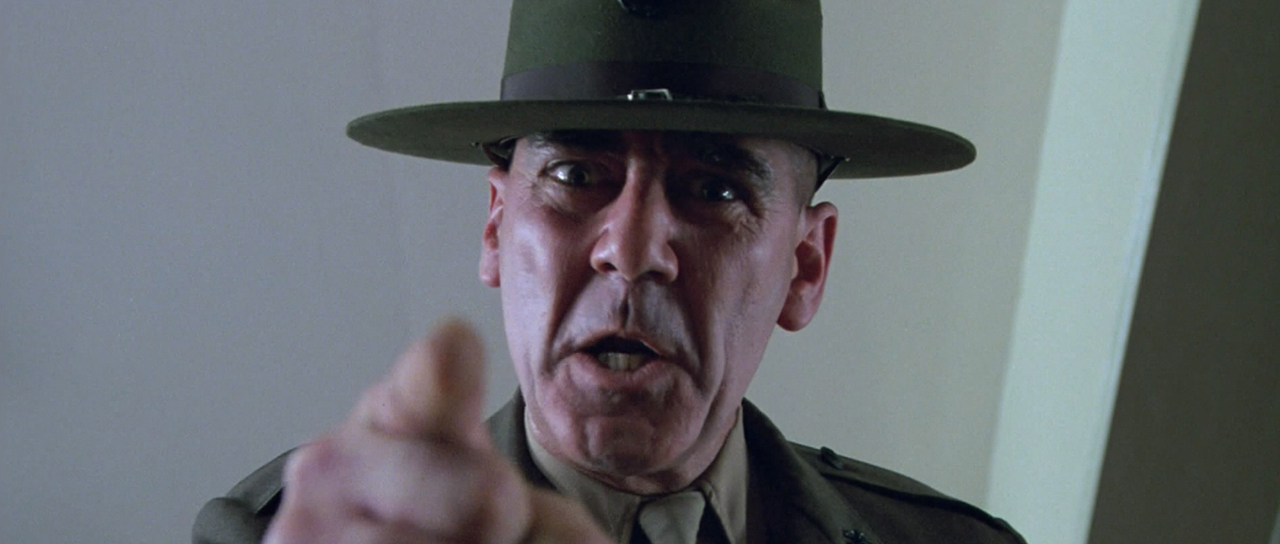
Of course the antagonist for that entire story is “Drill Sergeant Hartmann,” played by R. Lee Ermey, a retired Marine Corps drill sergeant himself. The film is a salutary lesson in the dangers of bullying and hazing. SPOILER ALERT: Private Pyle nominally reaches the bar after being intensely singled out by Hartmann, but kills Hartmann and then himself (the full scene is here). There are limits to the military socialisation method discussed in the last section, and it can’t work on everybody. Filtering out the unsuitable is just as important as moulding the suitable. Of course, it’s also a strong critique of dehumanisation, subordinating the self to the needs of the group, all the things which I discussed above. While I personally think that trainee socialisation is vital in any military, it’s not a perfect system, and anyone that tells you otherwise is mistaken.
One last point I’d like to call your attention to is the importance of shit-talking in recruit training. No day is complete without a good shit-talk, which usually happens during cleaning details late into the evening. It’s not talking shit about people (although there’s plenty of that), but talking shit (as in, utter nonsense) as a form of mental chewing gum while your tired and broken body zombie-walks through the remainder of the day’s many tasks. Shrimp is a great topic for a shit-talk, as in Forrest Gump:
Basic training is less about being shot at by an AK-47 (Heartbreak Ridge) or doing complicated silent arms drill (Stripes), and it’s a lot more about doing pointless and repetitive tasks into the small hours while discussing shrimp or whatever other topic can be dealt with by your two remaining brain cells.
Conclusion: You can’t distil military socialisation
In my last article about the TV show Reacher, I discussed how the show’s writers appear to suffer from “cargo cult” storytelling, i.e. taking some elements from the source text, but missing some crucial aspect(s) and ending up with something that has a different theme or tone or even genre. Likewise, taking a few isolated bits of battle PT and calling it a “boot camp” is a cargo cult approach to what is a much more complex social conditioning process. Moreover, it could be seen as cultural appropriation:

Tongue in cheek, of course: please do whatever exercise makes you happy and healthy. If you feel the urge to pay someone to shout at you, then I commend you for doing your bit to keep a veteran employed. Just make sure to warm up, cool down, pace yourself, and do all the things you’d do for any other fitness class.
Although fitness boot camps are a (mostly) harmless marketing gimmick, it gets darker and nastier when we look at another definition of “boot camp,” which are the “military”-style correctional facilities (including for children) popular in some parts of the world, especially in the USA.
The aim of these correctional boot camps is to serve either as an alternative to prison, or simply for a place that parents can send a troubled teen. There are plenty of critiques of these programmes, with a US Department of Justice report finding that they had very limited benefits. This shouldn’t be a surprise: as we’ve seen above, military socialisation is an intense social and psychological process. It involves harsh conditions and physical stresses, but it also includes a purpose, a positive end goal, and the cohesion that comes from a single unit undergoing the same process from start to finish.
That’s it for this week: thanks for reading! If you enjoyed this article, please share it on your social media feeds using the links below. If you haven’t subscribed yet, please do so and never miss a post. And do weigh in on the comments section if you wholeheartedly agree or vehemently disagree with anything I’ve said. Until next week!
Featured Image: In Character: R. Lee Ermey, by Alex Withrow, And So It Begins… (2014)
- As the title to this post suggests. ↩︎
- We had to pass a fitness test as part of the competition process to get in, and then did a similar (but slightly more stringent) test again very soon after joining. It was a good way for the training staff to gauge our fitness levels at the outset. More importantly, since it was the same as the annual fitness test, it ticked this box and would have bumped up the school’s operational readiness stats in one go. As I’ve written before (and again), admin reigns supreme in the military. ↩︎
- “Dressing”, in military parlance. ↩︎
- The following are not proper ways to carry it: by the carrying handle, over one shoulder, slung around your back, attached to your backpack, leaning on it like a walking stick (yes, I actually saw this one once). Basically, anything that makes it less of a hassle is probably an improper way of carrying your weapon. ↩︎
- Defence Forces of Ireland. Yes, there is another group who claims this title and heritage: we don’t talk about them. ↩︎
- You can use an actual recruit instead of a dummy. A bonus point if you can link the “injury” to some fieldcraft mistake the recruit made which has resulted in them being shot. Now they feel terrible that their comrades have to carry them on a stretcher, and divvy up their weapon, ammunition, and other kit among each other. If you’re feeling particularly sadistic, you can tell them to cry out in pain the whole way. ↩︎
- In larger groups, where people share common last names, it’s not unusual to use fragments of army numbers rather than first names or even initials. E.g., the Sergeant Major in calling the nominal roll: “…McCann. McDaid. Moore. Murphy 27. Murphy 79. Murray…”. ↩︎
- Foot drill is about moving in formation: marching, stopping, turning, wheeling, about-facing, etc. Arms drill is about the myriad ways you can carry your weapon while you march and while formed up on the parade square: order, carry, slope, present, reverse, rest at arms reversed… I’m not making these up! ↩︎
- Mostly in a non-ironic sense. We just thought it was cool, even though the first half of the film is a clear critique of the dehumanisation which the film’s protagonists (and, to a lesser extent, we) go through. ↩︎
- This one took quite a few iterations, right up to the limit of five free images (I’m a cheapskate). The chatbot had a particularly tough time getting the drill sergeant to hold up the sign: the stick kept going through his shoulder lapel. In the end, the machine evidently figured it was easier to have him rest the sign on the ground, and I wasn’t going to fight it anymore. ↩︎


Leave a Reply