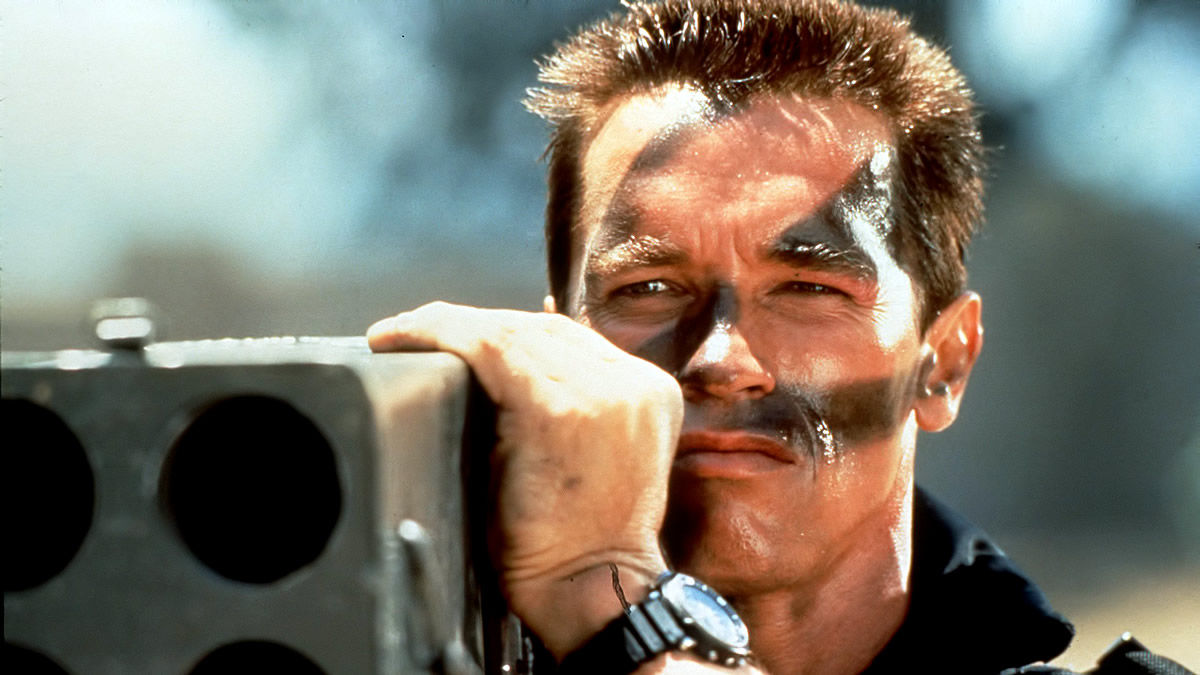
The importance of not being seen.
🎧 Available in audio
Hello and Happy Thursday. This week I’d like to talk about the efforts soldiers make to avoid being seen by the enemy. Not being seen is an essential element in not being killed, so it should be no surprise that modern soldiery places a lot of focus on such “fieldcraft.”
I’ll start off by discussing why camouflage and concealment are so important and what this entails for the modern infantryman. I’ll also point out some of the things that Hollywood gets wrong or leaves out entirely. Then I’ll talk about when it’s taken a bit far, and how this can often be as much to do with hazing or “beasting” recruits as for any practical effect. I’ll wrap up by looking at when a soldier might actually want to be seen.
Monty Python, those military geniuses, knew the importance of not being seen:
Before we start, let me encourage you to subscribe to the blog using the link below. As always, I’d love to see your comments below, or you can contact me via webform here or email here. Finally, if you’ve enjoyed this post, please share it with a friend.
If you enjoy this blog and want to support it, please consider a donation. Keeping this blog going doesn’t cost much, but it isn’t free either, so any help would be very much appreciated👍
Camouflage and concealment are critical
In the middle of the 19th century a new innovation in weapon design—the integrated, metallic cartridge—enabled infantrymen to go from firing several rounds per minute to a dozen or more. This technology, and the machine gun which came later and built on the same idea, changed the tactics of infantry combat from massed close-order formations of firepower to looser, dispersed pockets of men moving under cover and concealment.
Contrast these two paintings of French soldiers, a century apart. In the first, at the Battle of Waterloo, their visual presence en masse is a force multiplier. In the second, at the Battle of Loos, they are obviously doing their best to use the cover provided by trenches and upturned wagons.

Of course, one thing you do notice about the French soldiers at the Battle of Loos is their bright red trousers. The French were the last holdouts against the idea of tactically subdued uniforms, as you can see below:

Proposals before the war to replace the bright red trousers were bitterly opposed by conservatives. A former War Minister Eugène Étienne proved his ability to coin a phrase and doom thousands when he said: “Le pantalon rouge, c’est la France!1“
Now that we all (including the French) have learned the lesson of avoiding brightly coloured uniforms, why else are things seen? We learned in training about how the subconscious mind picks out “unnatural” (i.e. human) elements in a natural environment. These are the “5Ss”2:
- Shape (or Silhouette): Man-made objects have distinctive straight sides, right angles, and other unnatural aspects of their shape. When you stand or move against a light background, unnatural shapes are even more obvious.
- Shadow: When the light is low and your shadow moves differently to the trees and bushes around you, then you’re easily spotted.
- Spacing: Natural things aren’t evenly spaced, so you should spread out more and make it look random. Far easier said than done.
- Surface (or Shine): Anything bright or reflective can be a dead giveaway. Camo up that face and cover up those optics.
- Sudden movement: This will draw the eye of an observer instantly. Learn to move slowly and smoothly.
The photograph below neatly illustrates us breaking at least three of those rules (that we can see).

You’re probably familiar with camo cream from the movies: this stuff becomes the bane of your existence (but more on that below). When we see it on an action hero, it’s almost invariably applied wrong (à la Arnie in the cover pic, which is from Commando). Here’s the right way to do it:

What the Royal Marines above are missing is the kilogram or so of reeds, leaves, moss and other organic matter that you need to attach to the MOLLE3 straps on your helmet and backpack to break up the shape. You never see this in Hollywood either. And while we’re on the topic of inconsistencies in films, let’s discuss “hard routine,” which we never see our heroes having to endure.
Technically known as counter-surveillance control measures (CSCM), this is a matrix of rules for what you can and can’t do to make your life difficult when on the ground. At its most permissive (like when you’re in a patrol harbour4), you can brew up a cup of tea or a hot meal and take a trip to the local latrine when the spirit (or the laxative effects of “Biscuits, Fruit”) takes you.
At its most restrictive, such as when you’re occupying an observation post (OP), you’re eating nothing but cold rations and you’re shitting into a plastic bag (or a sheet of cling film) so that you can (and I’m not making this up) take your waste back with you and leave no trace for the enemy to find. How very considerate!
Hard routine was what Aragorn told the Hobbits to do on Weathertop, but Frodo was the only one who understood the order:
Like in all things military, however, people can lose the run of themselves. Let’s discuss that next.
There’s always someone who takes it too far
The aforementioned shitting in a Ziploc bag is one example where common sense sometimes takes a back seat. Okay, if you’re Andy McNab on a covert patrol deep behind enemy lines in Iraq, you might need to bag up your waste and bring it out5. Special operations demand special measures.
But you, a regular grunt on a standard recce patrol, probably don’t need to worry about sniffer dogs and enemy forensic poo-analysers. Just go somewhere discreet and bury it for God’s sake. Or wait until you get back to camp. Shitting in a bag doesn’t make you special forces, any more than growing a beard or buying a custom drop-leg holster for the pistol you’ve not even been issued yet does. And yet many military folk are obsessed.
I’ve mentioned tactically subdued flashes6 before. These really annoy me. If you don’t want to be seen, then take off your flashes. That’s why they have Velcro on them. Under what possible circumstances would you be camo’ed up, sneaking around and trying not to be seen by the enemy, but still needing to display your unit or national affiliation?
And, as I mentioned before, for the love of God please don’t even think about wearing a tricolour flag in tactically subdued colours. But there’s a market for it, unfortunately:

We had an instructor who inspected our patrol harbour once and told us, with a straight face, to rub dirt on the spots where we’d broken branches away from the trees so that the white bark wouldn’t stand out. As if an enemy could be standing in the forest, ten metres from our patrol harbour, and it would be the broken branches that gave us away rather than the sounds of thirty soldiers snoring, eating, using the latrine, and cleaning their weapons (not necessarily all at the same time, but not necessarily not all at the same time either).
I think that instructor really believed what he was telling us. Most of the time, however, they don’t have to believe it: you just have to do it. Let’s talk about the beautiful power dynamic of the trainer and trainee next.
It’s good excuse for hazing
The military exists to make life difficult for its most junior recruits. This is all part of the euphemistic “military socialisation.” Camouflage is a great way to achieve this. In fact, even thinking about someone yelling “camo up!” is enough to make me shiver in recollection.
It’s not just about the paint, although let’s start with that. It’s awful stuff. It irritates your skin. It is precisely engineered so that the slightest bit of sweat or rain will make it run (and therefore earn you negative attention), but industrial quantities of soap and water can barely budge it. You would resort to using heaps of baby wipes, scouring the crevasses of your eyes and ears and nose to get every last bit out before your next lesson (inevitably an inspection in your No. 17 Service Dress).
For Boots (see picture below) the Marine recruits are clearly dreading having to scrape all that stuff off their skin again. Aside from the white hands, this is a good depiction of the camo cream coverage which is expected.

It doesn’t stop at the face, the neck, or even the hands. I’ve had unfortunate classmates whose trousers split open in the middle of a field exercise. There was a period when the issued trouser had an unfortunate weakness in the crotch which gave way when you kneeled down while wearing a heavy bag on your back8. These failures were tragic (when they happened to you) or hilarious (when it was someone else).
Here’s a quiz question. What does an instructor say when one of their charges, while clambering over a fence, fumbles and tears their trousers open? Do they say:
- A) Oh dear, you poor chap. Are you alright?
- B) Those pants are terribly designed. Am I right?
- C) Camo up that ballsack!
It’s C), of course. It’s always C). Because being seen is not the real issue, it’s about conforming.
Conclusion: Do you want to be seen?
I look back at my training in the late ’00s as a quaint and innocent time. Our greenfield tactics seemed antiquated in light of the then-surging wars in Iraq and Afghanistan. These still looked like they might be winnable for the Western allies, and the future was all going to about low-intensity, counter-insurgency, three block war type conflicts.
Modern tactics, which we were starting to experiment with, involved doing all your operations at night, using image intensification to see. You assumed that the enemy didn’t have this, so you were up the technological ladder. You could see him, but he couldn’t see you in the dark.
Our instructors’ insistence on camo cream and natural camouflage seemed out of touch with this newer way of waging war. Of course, nothing stays static too long in the world of military tactics, and we’re back to seeing large-scale greenfield operations in Eastern Europe. To be sure, there are new nuances relating to drones and AI algorithms, but many of the old lessons of camouflage and concealment are becoming relevant again.
As for me, I never put camo cream on my face in anger or attached a bush to my helmet. For my most consequential deployments I was, in fact, doing the opposite and putting bright blue UN covers on my head and body armour and driving around in big white vehicles.

Sometimes you actually want to be seen.
Thanks for reading and please remember, if you haven’t already, to subscribe using the link below. Please also share this article with a friend and help me broaden my reach. Every little helps! See you next week.
Cover picture: Arnold Schwarzenegger in Commando (1985). From https://film-authority.com/2020/02/11/commando-1985/
- “The red trousers are France!” I first came across this quote in the peerless The Guns of August, by Barbara Tuchman. ↩︎
- Some folks talk about 7Ss, but I can’t bring myself to separate “shape” and “silhouette,” even though there are subtle differences. We also had “aircraft” as one, which annoyingly wasn’t an “S” but, more annoyingly, wasn’t in keeping thematically with the other ones. So, I’ve left it out. Sorry former instructors, but it’s my blog, my rules. ↩︎
- MOdular Lightweight Load-carrying Equipment. ↩︎
- A temporary “camp” in the woods from where you conduct patrols. ↩︎
- Although (SPOILER ALERT), if you’ve read the book, you’ll know that the enemy finding his poo was the least of his concerns. ↩︎
- A.k.a. patches, badges. ↩︎
- Finest and hardest to keep in good order. ↩︎
- Something you do a lot of when you’re patrolling. The worst part about doing long range patrols or infiltrations with full pack is not the walking, but the stopping to “cover off” while the commander gets their bearings or counts the patrol or just decides to stop. ↩︎


Leave a Reply