The biggest, baddest, and boldest movie ammunition fail in Hollywood history.
| << What does the “D” in “D-Day” stand for? | What Hollywood gets wrong about military radio communications >> |
This week we’re going to look one scene from an action movie which has stayed with me for many years, for all the wrong reasons. We’ll use this as a drop-off point to explore explosive trains, fragment and blast damage, and even touch on pistol accuracy and throwing strength. I hope you enjoy!
Thanks for reading and, if you like what you see, please subscribe. Comments below are always appreciated, and you can email me or comment for any topic requests.
If you enjoy this blog and want to support it, please consider a donation. Keeping this blog going doesn’t cost much, but it isn’t free either, so any help would be very much appreciated👍
The Expendables introduced a new way of using artillery
The Expendables (2010) introduces a new use for an artillery shell, as a hand-thrown pistol-initiated anti-helicopter munition. Of all the ludicrous action scenes in Hollywood history, why single this out? I felt personally victimised by this scene, as a freshly minted, know-it-all young officer, and I wasn’t slow about sharing my affront with my (unfortunate) civilian friends in the theatre. Unlike most crimes against military reality, however, this one didn’t fade with time. It stuck with me, all the more so as I became an ammunition technical officer and the sheer enormity of the crime magnified.
If you’re lucky enough to not have seen this film, and aren’t feeling masochistic, then I recommend reading the synopsis on the wonderfully specific “Exploding Helicopters” blog1 . Very short2 version: baddie and damsel are about to escape in a helicopter. Flames block Stallone and Terry Crews, our heroes, from intervening. Crews throws an artillery shell at the helicopter, Stallone shoots said shell with a pistol, thus blowing up means of baddie escape.

After a dramatic showdown and several more explosions, Stallone kills the baddie and saves the girl. So far, so standard for action films. So what’s my beef?
This is ludicrous, even for an action movie
In a crowded field, this scene stands out as the worst ammunition fail of all time. Admittedly, this is my subjective analysis, but, then again, it is my blog. No audiences expect to see perfect realism in an action film. In fact, perfect realism would make for a poor action flick, and would nudge the film into the “war movie” genre, where these things are more important (albeit still with plenty of dramatic licence). It’s a balancing act for creators: too realistic, and the action film lacks excitement. On the other hand, not enough realism, and you’re straying into fantasy or cartoon territory. Think of it like a see-saw:

I believe that a complete lack of realism, a see-saw that’s too imbalanced, detracts from an action movie’s appeal by reducing the stakes for the viewer. We ought to be impressed by the ingenuity, courage, and grit of our action heroes, not their magical mana level. But maybe I’m mistaken, and people really don’t care about any degree of realism in their action movies. In which case, please read on to see why you’re wrong, and then take it up with me in the comments!
This scene is wrong on three very separate levels, any of which on their own would be a bit eye-rolly. Two would merit a derisive snort, but three takes the biscuit.
Level 1: The scene stretches the bounds of human ability
There are two ways that the realities of human ability take a back seat in this scene. The first is how Terry Crews manages to heft the shell high into the air to come down on top of the helicopter. The second is how Stallone manages to hit this small moving target. Some facts, illustrated:

The shell in question is a 105mm HE (high explosive) shell3. This is normally fired from one of the lighter artillery guns. It weighs about 15 kg, or 35 lbs in freedom units. Crews’s throw gives it a horizontal velocity of about 5 m/s and a maximum height of about 15 m (estimated from the highly accurate diagram above). The total energy imparted to the shell is therefore about 2.4 kJ4, and the throw itself takes about a second, so Crews outputs about 2.4 kW of power in this throw. This is a powerful throw. A ludicrously powerful throw, since it equates to over three horsepower.

But what if he throws it really well? What if he’s practiced shell-throwing for years? Luckily for us, this is the perfect use case for Randall Munroe’s XKCD throw calculator . If you haven’t read his book How To, then you should stop right now, find it here, and prepare to be entertained5. He has a whole chapter on people throwing things, and gives the generic set of formulae so that we can apply it to this situation. The result is that Terry Crews can throw a 105mm projectile a distance of 8.6 m (28 feet), assuming he’s a practiced shell-thrower. This distance is well short of the ~20 m we see on screen, not to mention the great height achieved—using the same throw formulae and equations of motion gives us a maximum height of 4.3 m.
Now, once Terry Crews has made that superhuman throw, Sylvester Stallone has to hit the target. With a pistol. Hollywood gives us incredibly unrealistic ideas of what a good guy can hit with a pistol (compared to a squad of bad guys with assault rifles, but that’s a story for another day). To be real: maybe, just maybe, if someone was standing still in the door of the helicopter, and there was no fire, an average shooter might get them with one of several aimed shots from a braced firing position. Maybe. “But Stallone is an ace shot, not your average schmoe!” I hear you say. “Plus, he fires a bunch of shots.” In fact, he fires sixteen rounds in total at a rate of about four per second, which is too fast for any kind of aiming.
Stallone fires at a moving target with an accuracy comparable to some of the world’s best shooters aiming at stationary targets—see below.

A 105mm shell standing on its base would be about as wide as the bullseye zone on the targets above, and top shooters regularly hit the bullseye. A moving target is an entirely different proposition. In fact, there is no Olympic shooting category for moving targets for pistol shooting.
Confession time. When I started writing this section, I had provisionally titled it “This scene ignores physics”. But on doing the research, I realised that the feats shown here were not quite as impossible as I had always assumed. And the two feats are mutually limiting: the farther the throw, the harder the shot, and vice versa. So I’ll climb down a little from my high horse and concede that, yes, if Terry Crews was an accomplished shell-thrower who put in a stellar performance today, and Stallone an Olympic-level target shooter who got lucky, and the helicopter was actually much closer, then maybe there’s a chance they could pull off this shot. However, that’s when their problems really begin.
Level 2: The scene has no idea how ammunition works
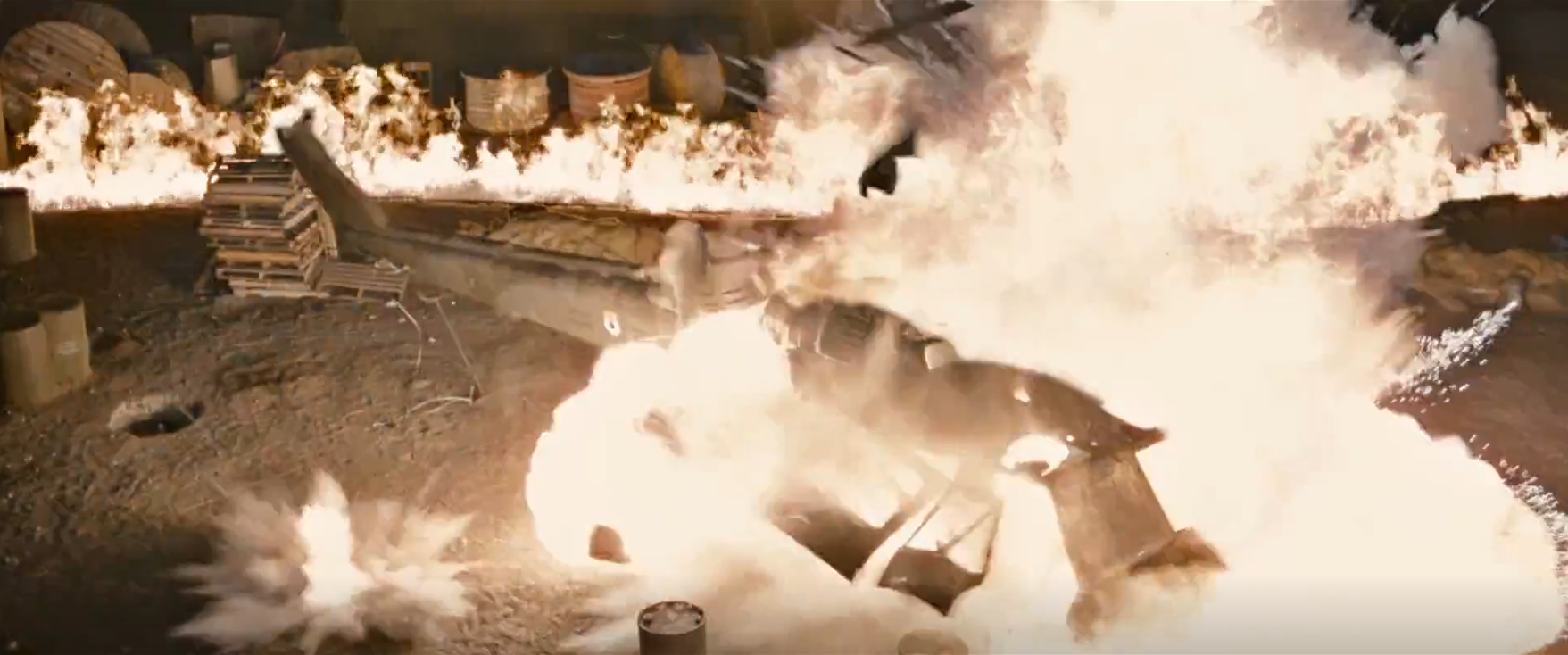
Stallone makes a couple of improbable hits (see screenshot below) and the shell goes kaboom (that’s the technical term). There is a fundamental misunderstanding at play here, and it’s one that’s common in action movies, which is that ammunition is a highly volatile commodity which is just waiting for the slightest impetus to violently explode.

If you think about it for more than a second or two, you’ll realise this isn’t something we desire from our military explosives. Just think about all the knocks and jolts they will get during the rough-and-tumble of moving around the battlefield, let alone the likelihood of being hit by bullets and fragments. Ammunition is rigorously tested to ensure that it doesn’t explode when we don’t want it to, and it does explode when we do. To explain this, let’s quickly define what we are talking about:

How we do this is a via an “explosive train”. No, this isn’t as cool as it sounds, but yes, I would love to see the action movie version of an “explosive train”. I would willingly suspend my disbelief to see this (filmmakers take note). Anyway, back to the real world: the explosive train involves the fuze6, the bit in the front of the shell, hitting the target7. Viable and unviable explosive trains are in the diagram below:

Explosive trains are like a ladder, where you start at the bottom and use incremental bursts of energy to get to the top. Using a bullet or other impact to try to set off the main charge is like trying to jump to the top of the ladder. Here’s how an artillery round is actually composed:

The fuze (the generic lump in the nose in the image above) is the component which is at the core of the explosive train. Here’s how it works:

In summary, you can’t detonate an artillery round without going through the very strong forces of arming caused by shooting and spinning it out the barrel of a gun. Here’s what happens when you do it right:

When you don’t follow this sequence, the round doesn’t explode. In fact, modern munitions are specifically designed to not explode when struck by a 12.7 mm (.5″, or 50-cal) round travelling at 850 m/s, which delivers a lot more energy9 than a pistol round.
Finally, it’s worth mentioning that the shell’s incredible throw puts it on course to strike the helicopter’s rotor. The rotor will probably strike the shell with only half the speed of the bullet, or even less, but will deliver about the same amount of kinetic energy or more, due to its much greater mass. So, Stallone’s trick shots were unnecessary. But hey, teamwork.
Level 3: The scene thinks human bodies are immune to explosions
“Oh come on!” I can hear you say. “You’re going to gripe because the heroes walk away from an explosion?” Well, yes, but I’ll tell you why this is worse than the usual Hollywood “explosive propulsion” trope, in which people, heroes especially, seem to be immune to the effects of ammunition. Whereas lip service is paid to blast effects (see how Stallone and Crews dive away from the secondary helicopter explosion, which seems to reach them at a fraction of the normal blast wave speed), no thought whatsoever is given to the effects of fragmentation or shrapnel10.
Fragmentation is the real killer when it comes to ammunition. Whereas you would recover from the blast effects of 2.5 kg of high explosive detonating 20 m from your head (and you may even be able to carry out a baddie showdown afterward11), you wouldn’t have a hope in hell of surviving the fragmentation. Let’s pause the artillery impact gif from above and investigate this more closely:

An artillery round detonating produces thousands of fragments. Here’s what this looks like:

Fragmentation distribution is probabilistic, and there’s a very wide spectrum between an artillery shell’s 100% lethal distance (about 10m) and the 100% safe distance (about a kilometre). But at 20 m, we are quite firmly inside the danger zone, as the fragment distribution below shows:

While one or maybe even both of the heroes might have a lucky escape from the fragments, the baddie and heroine are significantly closer to the heli and and mincemeat in this scenario. You don’t mess with artillery. Remember: it’s the fragmentation which will get you, not the blast.
Conclusion: Artillery has many uses: but not this
Artillery is the God of War
Joseph Stalin, 1944
He may well have been right, but it’s not the answer when you need to destroy a helicopter that’s about twenty metres in front of you. A human arm—even Terry Crews’s arm—is no substitute for a gun, a bullet is no substitute for a real explosive train, and a high explosive projectile has the unfortunate habit of spraying fragments at people as well as helicopters. People, we should note, are much more vulnerable to fragments than are helicopters.
So what? Why do we care? Coming back to the see-saw analogy above, this scene makes no attempt at balance. The filmmakers are attempting to show the heroes coming up with an ingenious solution to an intractable problem, like a pair of McGyvers but with added ultraviolence. The snag is the solution is ludicrous, and the problem is not really that intractable.
What would I do differently? Firstly, I would have Stallone empty his sixteen rounds into the helicopter. It might not explode spectacularly, but enough lead into the rotor hub or the engine might stop it taking off, which is the goal. If we wanted to add some more drama, we could show these shots failing. Then Terry Crews can show up, find a grenade on the floor, and hurl that at the helicopter for a similar effect. Job done, and everyone is “safe” (until Stallone gets his hands on the baddie).
That’s it for this week: thanks for reading! I hope you enjoyed this more in-depth post. I would appreciate your honest feedback, so please email me or leave a comment below. And if you’d like to read more, please subscribe. Future posts will cover:
- Hollywood explosions: where they come from, and why they’re wrong
- Magical bullets and harmless fragments—ammunition which knows good from evil
- “Over and Out”: How not to use a radio
- Or anything else that you’d like! Please let me know
Featured image: The Expendables (Lionsgate, 2010)
Notes
- This blog does exactly what it promises: it celebrates every film helicopter which blows up. ↩︎
- And, honestly, sufficient. ↩︎
- Strictly speaking, it’s too dark to tell with certainty that’s it’s a HE shell, but the fact that it explodes gives us a clue. A HE projectile would have yellow lettering on an olive green body. ↩︎
- Here are some of the assumptions I used. The distance covered is about 20 m, and the shell takes about 4 s to get there, so it’s travelling at roughly 5 m/s. Of course, that takes no account of deceleration: it’s a rough calculation. The total energy is the sum of the horizontal kinetic energy and the vertical potential energy at the apex of the shell’s trajectory. Of these, the vertical potential energy is by far the most significant. ↩︎
- I cannot overemphasise how much I admire his approach to problem-solving. If you don’t want to buy the book (for shame!), or can’t bear waiting for it to arrive, then you can see a similar calculation outlined in the “ExplainXKCD” wiki for the comic above. ↩︎
- There is some ambiguity about spelling here. Many places refer to the “fuse” of a shell, and this is not incorrect. However, I was always taught to differentiate between a “fuse” as a burning tube which initiates a plain detonator after a time delay, and a “fuze” as a mechanical contraption, full of widgets and doodahs, which makes a shell explode when we want it to and stops it from exploding when we don’t want it to. From a linguistic perspective, I can see how the two terms mean the same thing. From an ammunition design perspective, the distinction is useful. ↩︎
- Hitting the target (“impact”) is just one of several possible initiation mechanisms. Others include deceleration (“graze”), getting close to a target or the ground (“proximity”) and old-fashioned time delay. ↩︎
- Cyclotrimethylene trinitramine (C3H6O6N6) is specially-formulated military explosive which is 60% more powerful than TNT. The name “RDX” comes from the British designation “Research Department eXplosive” or “Royal Demolition eXplosive”, although it was first created by the Germans in the 1920s (Sources: Encyclopedia Brittanica, Akhavan, The Chemistry of Explosives, 3rd Edition, 2011 ) ↩︎
- A 12.7mm round is about six times heavier and travels twice as fast, so the total energy is 24 times greater. ↩︎
- Strictly speaking, fragmentation is bits of the munition’s casing which fly out and do damage, whereas shrapnel is little metal balls or other deadly bits which are part of the shell design and fly out and do damage. An absolute pedant (yes, some people are more pedantic than me) will insist that you can only say “shrapnel” when talking about a specific type of British artillery shell designed by a dude called General Shrapnel. These people are wrong, IMO, since there is a useful distinction to be made between pre-formed and post-explosion bits of fragmentation. Admittedly, since an artillery shell is designed to break up on initiation and make lots of fragments, the distinction here is a little bit academic. ↩︎
- To be more precise, the overpressure from 2.5 kg of a 50:50 RDX:TNT mix detonating 20 m away is about 0.07 bar, or ~1 psi. This formula comes from Kinney & Graham, Explosive Shocks in Air, 2nd Edition, 1985. The typical physiological response to 1 psi of overpressure falls below the threshold for serious injury, but would break glass, shake buildings and leave you with a ringing in your ears. NOAA have some examples of various blast overpressure effects. If we assume that baddie + heroine are only ten metres from the helicopter, then they get a blast overpressure of 0.17 bar, or 2.5 psi, which might just be enough to rupture their eardrums. ↩︎


Leave a Reply