Badly-behaving rockets in film, TV, and video games
Hello again. This week’s post is a bit of a hybrid. I’m picking up a thread I pulled last week when we looked at high explosive anti tank warheads, which is specifically to do with how rockets work. More specifically, I’ll take a critical look at the “rocket trail” which we often see in Hollywood. This will allow me to segue seamlessly into the weapons of Unreal Tournament, starting, of course, with the iconic rocket launcher. I’ve been replaying this classic video game from many years ago of late, and though it might be a bit of fun (for me at least) to cast a tongue -in-cheek critical eye over some of the absurd weaponry here.
As always, please share this article if you liked it, and make sure to subscribe using the button below if you want to never miss a post. Also, would love to hear from you in the comments section below.
If you enjoy this blog and want to support it, please consider a donation. Keeping this blog going doesn’t cost much, but it isn’t free either, so any help would be very much appreciated👍
A note before we start: a reader said that they often found that the embedded YouTube videos break the flow of the article because of the ads before you can play. I was using more embedded videos because 1) It’s easier than making a gif and 2) I worried that too many gifs might make the articles too slow to load. What do you think? Which do you prefer? Please let me know in the comments or in the anonymous feedback field below. Thanks!


Rockets are great for speeding things up
Rockets burn a propellant to make lots of gas, which gets ejected out the back and accelerates the engine. This happens because of Newton’s Third Law (we’ve encountered him before):
To every action, there is always opposed an equal reaction; or, the mutual actions of two bodies upon each other are always equal, and directed to contrary parts.
—Isaac Newton, 1687
This is usually paraphrased along the lines of: “every action has an equal and opposite reaction”, or “If Body A exerts a force on Body B, then Body B exerts and equal but opposite force on Body A”. I never found this to make much intuitive sense, so let’s look instead at an example Newton may not have been as familiar with:

Guns also use hot gas to accelerate a projectile, so what’s the difference? It’s to do with the rate of acceleration:

A rocket burns for longer than a bullet1, often much longer:
| Rocket | What it does | How long it burns for |
|---|---|---|
| Saturn V | Used to send astronauts to the Moon | 168 seconds (first stage) |
| Falcon Heavy | Brings passengers and cargo to low-Earth orbit and beyond | 187 seconds (first stage) |
| R-7 | Launched Sputnik into orbit (although it was designed for ICBM2s) | 104-130 seconds (first stage) |
| Patriot missile | Suface-to-air missile system | 12 seconds |
By comparison, a bullet’s propellant will burn in a matter of milliseconds. Although rockets take longer to burn, there’s no point in keeping them burning longer than needed, as it’s in the firer’s interest for the projectile to reach maximum speed ASAP. Something (very roughly) like this3:

It’s simple, really. It’s not rocket science… Oh, wait. Nevermind.
Military rockets burn up quickly after launch
As we saw in the velocity profile above, most rockets burn quickly to get themselves to the right speed, and then “coast” for the rest of their journey. Here’s how it looks for a Javelin (which we saw last week):
To compare with the rockets in the previous section, the Javelin’s launch motor (the bit that goes ‘pop’ at the start) burns for less than a second, and the flight motor (the loud one that kicks in once the missile is safely in front of the firer) burns for about five seconds. The Javelin attacks tanks from above, so its flight motor is designed to trade chemical energy for gravitational potential energy, which in turn gets traded for kinetic energy as the missile swoops down on its target. Its flight profile looks like this:

You don’t see the flight motor burning during the terminal stage of the rocket’s travel, because it’s already done its job at this stage. To take an extreme example, ICBMs use the same principle, but on a bigger scale. The rocket will burn for a few minutes, accelerating the missile to several times the speed of sound. The rocket burns out, the missile keeps rising into space, and finally reaches its apogee when gravity slows and eventually stops its upward velocity. Then it starts accelerating again as it descends and re-enters the atmosphere, reaching several times the speed of sound again as it approaches its target. Not like this scene from Mission: Impossible – Ghost Protocol, which inexplicably has a missile’s rocket motor still chugging away even during the terminal phase of its descent:

Other, less fancy rocket systems will burn their whole motor on launch, i.e. while the rocket is still in the tube. The LAW is one such motor, despite what we saw last week, especially in S.W.A.T.:

This is doubly wrong, because the rocket doesn’t burn once it’s left the launch tube, so we shouldn’t see a trail. But because it burns in the tube, the rocket recoil comes out the back end, which would get very uncomfortable in an enclosed space.
To sum up, rockets, like all technologies in ammunition, are used to achieve a specific goal. Its job is either to give the projectile lots of speed, or to give it lots of speed and height. With that in mind, let’s take a look at what I’m grandiosely calling a “case study”, but which is really a fun digression into video games.
Case study: Unreal Tournament has an unrealistic (but fun) rocket launcher
I was delighted that last week’s post gave me an excuse to look at rockets in more detail, because that, in turn, meant that I could start my long-awaited series on the weapons of Unreal Tournament, everyone’s favourite first-person shooter… Wait, what’s that you say?
You mean you’ve never heard of Unreal Tournament?
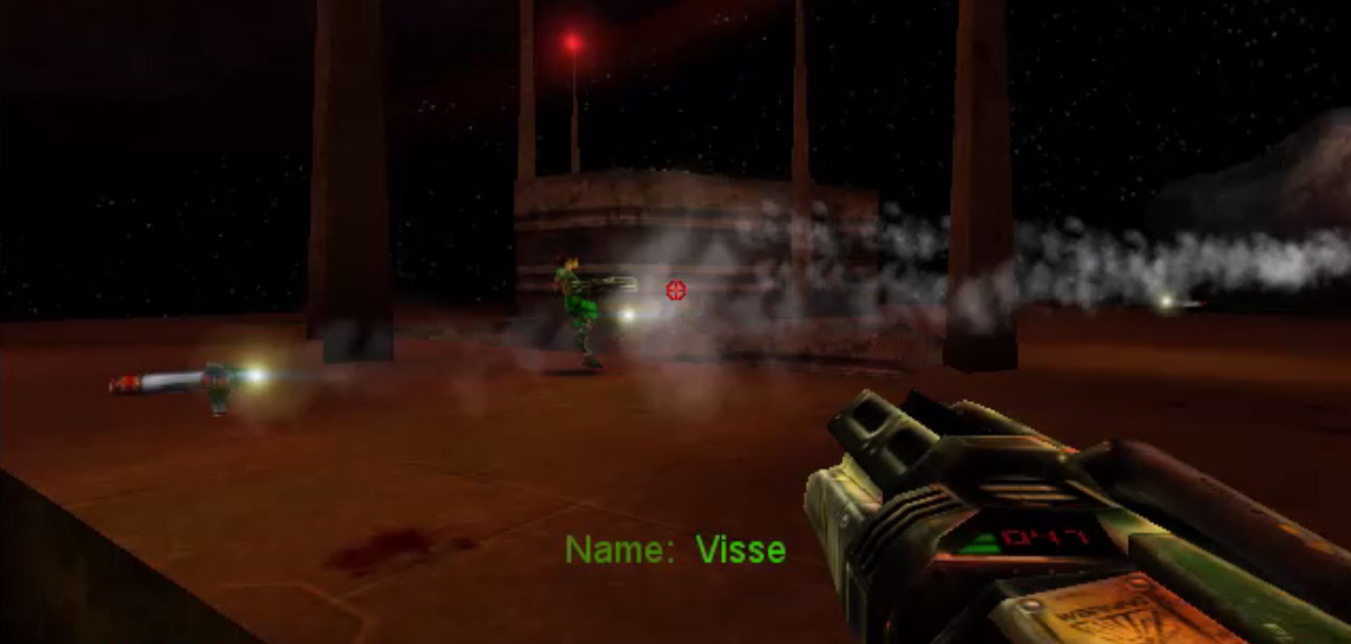
If, unlike me, you didn’t fritter away the best years of your youth in front of CRT4 screens playing high-octane shoot-em-ups, then maybe you don’t know what I’m talking about here. Thankfully it won’t take too long to bring you up to speed. Unreal Tournament (UT) is a game where you shoot people with exotic weapons in exotic locations. That’s about all there is to know. Okay, there’s some variation in game types (team deathmatch, capture the flag, etc.), but the plain old deathmatch5 is where it’s at. There’s also the barest bones of a story bolted on, but, honestly, nobody is there for the character arcs. Here’s what it looks like in action:

The rocket launcher (as seen above) is the “default best weapon” in UT, and if you’re ever fortunate enough to find one before another player snags it (or pick it up after you’ve killed them), the game will automatically swap to the rocket launcher straight away, with a satisfying “chk-chk” sound. Even if you didn’t want it, but then you need to really evaluate your life choices.
So what’s my critical analysis of this weapon?
The rockets don’t fly like rockets should…
Let’s compare rockets in real life (TOW missiles, from this video) to rockets in UT:
 |  |
| Real-life rockets | Unreal Tournament rockets |
|---|---|
| Accelerate while the rocket motor is burning | Travel at a constant speed while the motor is burning |
| Can be faster than a bullet (with huge variation) | Much6 slower than a bullet |
| Are affected by gravity (like all things with mass) | Gravity has no effect |
| Motor burns out after a certain length of time (see above) | Motor burns for as long as the rocket is flying |
…they cause no harm to the firer…
UT’s rockets have an unusual launcher:

An unwelcome effect of a launcher like this would be the burns suffered by the firer when a rocket or five leave the tubes with engines ablaze. Although we are talking about fighters who can survive the point-blank impact of an enemy rocket, so maybe they’re just so hard that they simply shrug off the flash and burn effects of the rocket’s launch.
The rocket launcher’s secondary fire mode just spits the same rocket out to bounce around on the floor and detonate after a few seconds. While this is actually plausible from a fuzing point of view7, it raises the questions “How” and, more importantly, “Why”:
- How can a rocket launch from a tube without using its motor or (seemingly) any internal chemical stimulus?
- Why the hell would you want to do this (maybe I’m biased, since this fire mode is not a game tactic I ever put much stock in)?
What about the effect of the rocket on the target?
…but they have decent “terminal” effects
We’re on solider ground here, I’m relieved to say. The rockets detonate on impact (inertial or impact fuze, no problems there) and cause damage in a “splash” zone nearby. Of course, the fact that a player can survive more than one rocket impact is absurd, but these guys and girls have superhuman immunity to all sorts of weapons, so we don’t need to lose sleep over this.
Another way to think about the splash damage zone is to think of fragmentation, which regular readers will know is 1) a strange bugbear of mine, but more importantly, 2) the main cause of injury and death with most munitions. In UT, multiple rocket impact can quickly catch a player in an overlapping zone of death. Very satisfying.
A final note on these weapons: they have a homing mechanism, although I never had much patience for it. If you track a target with the crosshairs for a second or two they turn into a “lock” and your rockets will steer themselves towards the target:

It’s not clear what the guidance mechanism is. Infrared light (heat signature) is the obvious candidate, for which you’d normally see a transparent seeker on the nose of the missile:

Real-life anti-personnel rockets aren’t guided, for three main reasons:
- Technical challenge. Heat-seeking missiles rely, as you would expect, on something hot to chase. The exhaust of an aircraft is a useful one. Some missiles track colder things, like the engine of a tank (e.g. Javelin). These require careful discrimination of the heat signature by the firer to result in a good “lock”. A human target, colder still, would be very hard to discriminate against background heat signatures.
- Cost and complexity. The cheapest guided missiles cost tens of thousands of dollars/euros/pounds per pop. There’s almost no rational justification for spending that much on a human target (except for as mentioned last week… LINK)
- It’s not needed. Humans are soft and mushy, and easily shredded by spiky fragments from shells, missiles, or whatever ammunition you send their way. There’s no need to hit them with the rocket, you just need to get it somewhere close and you’re sorted.
One thing I will commend the UT designers on is the fact that the rockets’ homing mechanism:
- Isn’t perfect, with targets able to outmanoeuvre the rocket. In other words, it actually follows the laws of physics here. This is realistic. Furthermore…
- Is a painful hassle to sort out, requiring the player to take valuable seconds to lock onto a very mobile target. This is very realistic.
Speaking of steering rockets, however…
Bonus case study: Unreal Tournament‘s Redeemer was decades ahead of its time
I couldn’t end this without speaking about the Redeemer, UT’s superweapon. This nuclear rocket launcher (yes, you read that right) appears on the map from time to time and leads to usually futile attempts to kill as many opposing players as possible.
I know you’re expecting me to scoff at this, but it’s less crazy than you might think, for two reasons.
Firstly, nuclear rocket launchers are not, I repeat, not, a complete work of fiction. The United States, in one of its more bizarre Cold War moves, developed a man-portable atomic rocket launcher, the Davy Crockett:

This weapon deserves a post of its own some day, but suffice to say it was very much a World War 3 / Armageddon choice.
The second, more interesting reason is because the Redeemer used what was then a novel form of guidance—first-person:

This has only made its way to the real world in the last few years, most notably in Ukraine with the deployment of small, cheap, first-person kamikaze drones. In at least one sense, Unreal Tournament was ahead of its time. Let us fervently hope that it is not any more prescient than this.
That’s all for this week folks. Thanks, as always, for taking the time to read my ramblings. Please share with anyone you think might be interested, and feel free to weigh in on the comments section below. If you haven’t already, then please subscribe using the link below. Until next week!
- So much so that even thinking of a bullet “burning” might seem weird to you, but this is exactly what it does. ↩︎
- Intercontinental ballistic missiles. The real world-enders. ↩︎
- Which considers only velocity in one direction, in this case the “forward” or “downrange” direction. By rights, we should really be talking about the speed of the missile, not its velocity, but I don’t think a tangential discussion on vectors would be welcome here. ↩︎
- For any younger readers, this was an innovative and sadly disappeared technology which allowed screens to be three-dimensional. Not in terms of the graphics (they were awful), but in terms of the physical real world: these screens were as deep as they were wide and tall. ↩︎
- Don’t you love how Wikipedia has a page on this? There’s a whole rabbit hole to descend here. ↩︎
- Infinitely so, technically, since the bullets in UT break all knows laws of physics and travel at the speed of light, but more on this anon. ↩︎
- Just about, if you assume there’s a secondary timed feature that gets programmed as soon as a rocket is “thrown” out of the tube in a secondary fire mode. But it would be a very unsafe design, because it would mean there’s a design way to detonate the rocket without it going through the normal arming forces (see my Expendables post for a diagram of arming forces for an artillery shell). ↩︎


Leave a Reply to Magical instant bullets – Military Realism ReportCancel reply