Season 3: Pedantic points and cargo cult screenwriting
Hello again and welcome back. I hope you enjoyed last week’s analysis of the absolutely ridiculous fight scene between Jack Reacher and Paulie in the Season 3 finale of Reacher.
Although this scene dragged down the rest of the season, there were a few smaller critiques I wanted to cover in what was ultimately a fairly entertaining story. It was no Season 1 (book: Killing Floor), but better than Season 2 (Bad Luck and Trouble), at least in my opinion.
I’m going to start out with the small things which irked me: the niggly stuff which really doesn’t matter and is very forgivable. Then I’ll move on to some of the bigger issues, which are usually related to changes they made from the book. Finally, I’m going to explain why this is an example (and far from the only example these days) of “cargo cult” adaptations of popular stories.
And, of course, there will be spoilers throughout.
As always, please remember to like and share this post on your social media feeds if you enjoy it. Also, don’t forget to subscribe using the link below. Finally, please keep the discussion going in the comments section below. I’d love to hear your thoughts on Season 3, and the show in general.
If you enjoy this blog and want to support it, please consider a donation. Keeping this blog going doesn’t cost much, but it isn’t free either, so any help would be very much appreciated👍
Reacher makes very un-Reacher-y mistakes with firearms
As I’ve mentioned before, Lee Child’s Jack Reacher is a stickler for good firearm discipline. He never shoots haphazardly toward the running baddie or the swerving car, because he always thinks about where the bullets go next. It’s inexplicable, then, why he agrees to this plan as part of the kidnap charade:

The “kidnapper” (a DEA agent playing along) sprays a burst at Reacher, who takes cover behind a van. As Reacher (and anyone with a bit of tactical training) would know, however, “cover from view is not cover from fire.” In other words, just because the enemy1 can’t see you, doesn’t mean their bullets can’t hit you. Look where those bullet holes are: unless that’s an up-armoured van, Reacher is dead. And even if it was armoured, it’s still a huge risk to take a one-handed burst from a submachine gun, a weapon not known for its precision.
This is a change from the book, where only Reacher was armed with live ammunition: the kidnappers (there were multiple) had all-blank loads. Reacher did also mix ball2 and blank ammunition in the book, but went into some detail about how he needed to see into the chambers of the weapon, hence why he chose a big revolver. In the book, Reacher was the one who insisted on this modicum of safety3.
There are a few other, smaller firearm mistakes which we will mention but perhaps not lose sleep over. At one stage, a baddie says, “unload your clips in their faces,” despite the fact that clips are something you put in your daughter’s hair4, and someone in the gun-running “community” ought to know that.
Another quibble is how, when Reacher goes looking for weapons for his final rampage, he breaks open crates and finds the weapons stored neatly along with boxes of ammunition. Assuming that these baddies don’t care about proper ammunition storage and transport, you might still wonder why the ammunition is packed alongside the weapons. It can’t be the most efficient way to pack, and it must have involved a tedious un-boxing and re-boxing of separate weapon and ammunition crates at some other point in the supply chain. The only apparent advantage of this setup is to make Reacher’s rampage a bit easier, logistically:

These mistakes shouldn’t happen in Reacher, which (as I’ve explained before) puts such stock in its authenticity. But they’re not the end of the world.
The series relies heavily on some very stupid villains
Reacher and Co’s success in Season 3 is mostly down to some serious stupidity on the part of the villains. It might be kinder to call it credulity, and it requires credulity on our part to accept that these supposed master criminals are that trusting and naive.
To be fair, this is a problem that starts with the source material: in the book, Reacher gets taken in and Beck, Paulie, et al. get taken along for a ride. However, Lee Child goes to great lengths to explain how Reacher keeps the charade going, and how tenuous the whole thing is. He’s physically exhausted by having to sneak around all night and then put in a day’s work criminaling the next day. It takes a toll. In the show, he just powers on through with seemingly no difficulty.
Patrick Freyne, reviewing the series in The Irish Times, gives Beck’s take on Reacher as an employee (read the hilarious full review here):
He’s constantly taking mysterious coffee and toilet breaks after which he turns up sweaty and covered in blood… I am surprisingly incurious about this and am just eager to get on with the job.
Perhaps it’s the challenge of the visual medium, or perhaps it’s looser writing, but the mooks in the show are that bit dumber than those in the book, and it’s that much less believable when we see Reacher continue to fly under their radar:

Part of the problem, I think, comes from how they updated the story to the present day. The novel was written and set in 2003, and back then Reacher’s hidden shoe-pocket held a little email device: something like a pager5.
The upshot of 2003 technology was that Reacher could only send short emails to Duffy, arranging to meet up or exchanging a simple bit of information. By contrast, 2025 Reacher can have long and meandering conversations with Duffy, Neagley, his old unit, his therapist… the man seems to never be off the phone in Season 3.

The excessive phone use helps the writers get some of the thoughts that were in Reacher’s head in the novel spoken aloud to the audience in the show. On the other hand, it also undermines Reacher’s “loner” persona and makes this much more of a team sport: not in keeping with the Reacher spirit.
In 2003, Reacher checks his room for cameras before taking out his email device. He assumes the room has a microphone, but doesn’t care (because, in true book fashion, he “says nothing”). In 2025, Reacher makes a cursory check, but otherwise seems unconcerned with people outside the door or around the corner hearing him talk to the Feds.
Let’s be honest: the phone is a more realistic gadget for him to have in 2025. It does, however, undermine the illusion of him as a secret undercover agent inside the enemy camp. Speaking of changes to the source material…
Neagley is an unwelcome addition to the story…
Reacher’s right-hand woman, Frances Neagley, is back in Season 3. Like with Season 1, she is a show addition only, not appearing in the novel (for Season 2, Neagley was in the novel as well as the show). She was added, presumably, so that we could have a break from staring at Reacher all the time, and Reacher could tell someone else that they’re smart (although, as we established in our review of Season 2, she really isn’t smart).
Her role in Season 3 is superfluous. She finds out some snippets of information, survives an assassination attempt, does the least covert tailing of a suspect ever, and takes part in the final shootout. And who does Neagley muscle out of the show? Richard’s mother.
In the book, Elizabeth Beck is still very much alive and well (although certainly not happy). She is the first one to meet Reacher at the house, and she realises he’s not all he says he is (she sees him swimming late at night). She is a victim of Paulie’s sadism. The giant torments and degrades her sexually, and there’s nothing she can do because she’s deathly afraid for her and Richard’s lives. In the end, Reacher saves her and Richard.
I’m not sure why the show’s writers replaced Elizabeth with Neagley. Perhaps the plot line with Paulie was too disturbing (especially for a modern American audience), and they sanitised it a bit and made Paulie more of a physical ogre, rather than the giant but almost mutant deviant he is in the novel.
In any case, I think they made a mistake, but then must have decided to add Neagley to balance the lost (female) character. Neagley adds little and her involvement feels tacked on. She’s getting her own spin-off, so hopefully we’ll see less of her in future seasons6.
…but there are some good changes too
Not every change they made was a bad one. Three big ones stand out for me.
Strength test prank. In the book, when Reacher goes to the gym in the morning, he sees Paulie bench-pressing a ludicrous weight. Paulie challenges him to match his bench, but Reacher says:
If I want a four-hundred-pound weight lifted, I’ll just order a dumb private to do it for me.
It’s a great line (and I wish they had kept it), but the show’s response is better still. Reacher challenges Paulie to a “Bavarian arm wrestle” which, as anyone not born yesterday knows, is a way to get the other person to punch themselves in the face:
This is a rare example of the writers showing us that Reacher is smart, rather than telling us. I’m just glad he didn’t have an accomplice to do an atomic situp with Paulie.
Russian Roulette loyalty test. Okay, let’s call a spade a spade: making prospective hires do Russian Roulette is utterly bananas. Why on Earth would you voluntarily deal with the hassle of 17% of candidates getting their brains splattered across your shed? Not to mention the paperwork. That bit of silliness aside, however, the show does a better job of explaining Reacher’s “gaming” of the test. In the book, he spins the cylinder with the knowledge that a weighted bullet will cause the loaded cylinder to rest at the lowest position (i.e. three cycles away from the barrel) almost every time. Reacher reckons that the risk of shooting himself is “1 in 600,” and he’s okay with those odds. I’m not personally familiar enough with revolvers to rule this out definitely (they’re not a military weapon), but it seems a bit unrealistic to me, and Reddit seems to back this up (please let me know what you think about this in the comments below).
In the show, Reacher uses the mark he’s made on the revolver which allowed him to differentiate between the ball and blank rounds during the “kidnapping” setup. I like this solution better, because it relies on his earlier ingenuity.
Homage to Predator. I don’t recall this scene from the books: maybe I’m wrong and this was already there. I think not though. I’m talking about Reacher channelling Arnold Schwarzenegger in Predator by covering himself in mud before dispatching Quinn’s goons one by one:
This is a great scene which is pure Reacher: cold (literally), calculating, and ruthless.
Guns, drugs, and plot twists
In the book, the “guns” reveal is a huge moment…
Every Jack Reacher novel has one big plot twist at the heart of it: a moment where all the tangled threads of evidence fall into place for the hero. He has a moment of clarity where he realises who and what he’s really up against. It’s usually at this moment that he realises what he needs to do, and the epic battle usually follows soon thereafter. For the reader, there’s an “aha” moment where we recall, through Reacher, all the little breadcrumbs which the author had sprinkled along the way. “If only we were as smart, badass, and handsome as Reacher!” we tut to ourselves. “Why didn’t I think of that?”
Persuader is no different, and one of the breadcrumbs is right in the novel’s title. The eponymous shotgun ends up being the weapon Reacher uses in the final battle, but it’s also a subtle hint to the unsuspecting reader: “This story is all about guns.” Other breadcrumbs include Beck’s obsession with what firearms various gangs are toting, and a pervasive smell which Reacher finds familiar but not quite placeable: it turns out to be gun oil.
…but it gets glossed over in the series
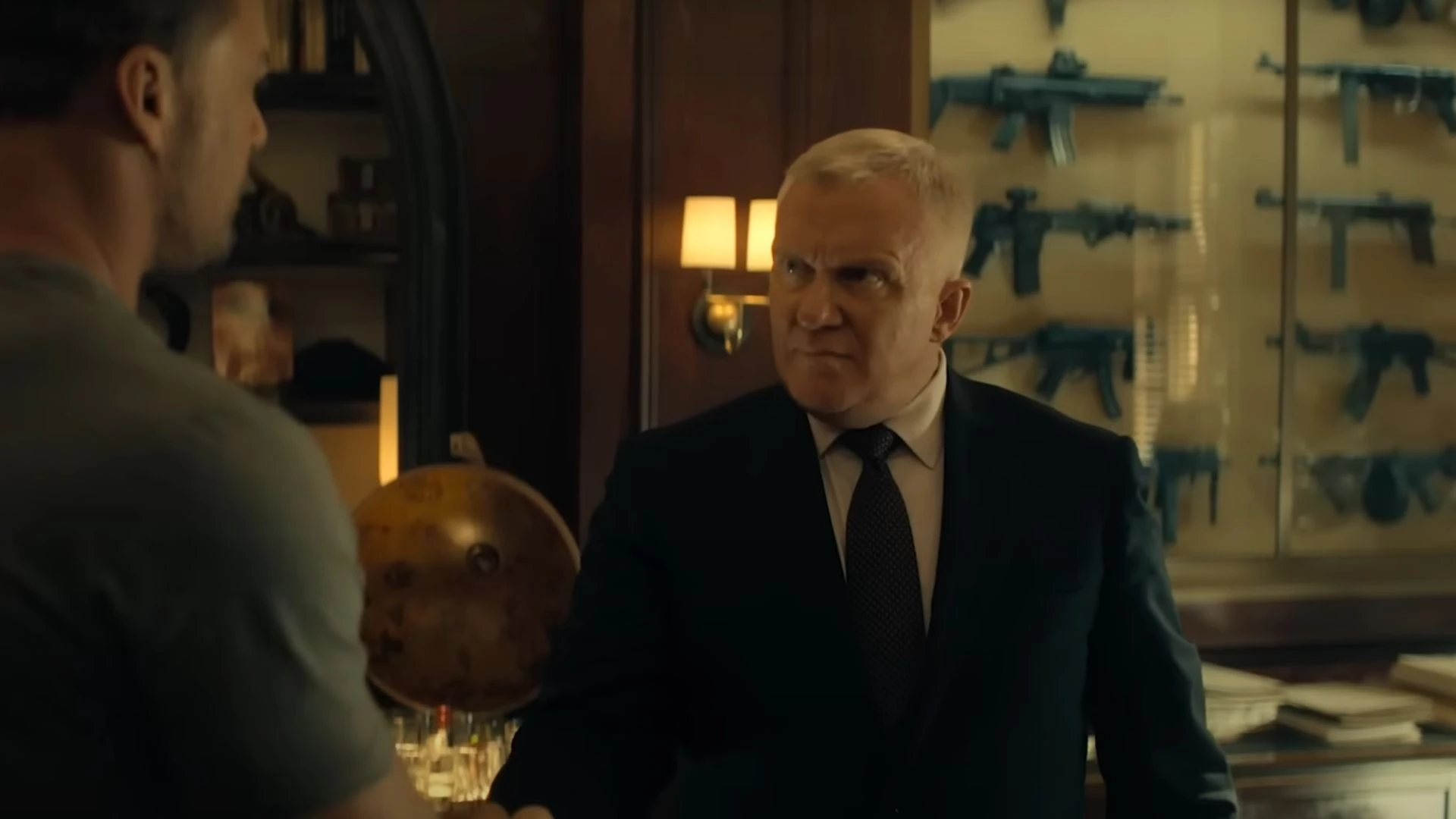
In the TV series, we don’t get any of this subtlety. Instead, we get a wall of weapons:

Beck is much more obviously a gun nut than he is in the book. We see the same breadcrumbs8, although they are more like loaves of bread. It’s so much more obvious in the show that it begs the question: how do Reacher and the DEA agents fail to realise that this guy is a gun runner rather than a drug dealer? The show’s writers make this point moot by downgrading the “plot twist” to just another detail. He realises that Beck is a gun-runner when the baddies tell him that they found the other agent who was in the house.
“Who would be looking for her?” Reacher asks Beck.
“Fucking ATF, stupid,” says the ever-charming Paulie.
This revelation is just another step in the plot: it answers the question of why Beck was dealing with a drug kingpin in LA; it reinforces how ruthless the baddies are and how high the stakes are; and it gives Reacher more motivation to dole out harm on Paulie and the whole crew. It’s a let-down as a “big plot twist,” which is just as well, since no DEA agent or ex-MP on the planet would have failed to realise by now that it was a gun-running operation. Details like this don’t seem to matter in the show, but really do in the book, and that’s because there’s one major difference between them.
Conclusion: Reacher is an example of “cargo cult” storytelling adaptation
At its heart, Lee Child’s Jack Reacher novels are mystery stories with a lot of action thrown in. The show, by contrast, is an action show through-and-through. The writers try to stay faithful to the plot, so they incorporate elements of the mystery almost by accident. This shows in the writing, which is clunky. This is not a criticism you could make of the novels, at least not the earlier classics.
When you’re reading a Jack Reacher novel, you keep turning the pages because you’re desperate to unwrap the mystery at the heart of the story. In the show (at least in Seasons 2 and 3), you’re supposed to keep watching because there’s another baddie for Reacher to torture and/or kill and bring us all once step closer to sweet sweet justice, where all the baddies are dead, and any untidy mysteries are solved or swept away.
I’ve started thinking of this kind of writing as “cargo cult” storytelling. If you’re not familiar with the term, it refers to a belief among certain Pacific islanders after WW2 that their god-ancestors would return with an immense bounty of “cargo”, replicating the valuable “cargo” which US and Japanese militaries had brought to their homes during the fighting, as the war moved across their world. To prepare and perhaps encourage the arrival of this cargo, some islanders built replica wooden ships, aeroplanes, runways, radio towers, and other things they had seen associated with precious goods9.
This inversion of cause-and-effect is something I’ve noticed in recent years with adaptations or variations on a classic theme. A writer will take some of the elements from the original text (in the case of Reacher, the gun-running, the pager in the shoe, the literal big boss baddie) and use them to construct a very different story. Instead of Reacher solving the mystery of the missing agent and the resurrected nemesis with some action along the way (book), the show has him leading a team to take down a crime operation, free an informant, and kill his nemesis, with some mystery elements thrown in along the way.
I’ve seen this in other shows too. The Rings of Power, another Amazon offering, takes characters and scenes from Peter Jackson’s trilogy, weaves them together with a story from The Silmarillion and other sources, and regurgitates something which is very pretty but ultimately meaningless. If you want to read about why that’s the case, I recommend ACOUP’s series on The Rings of Power Season 1 and also his take on the Siege of Eregion in Season 2. You will be entertained! Another example is the 2019 Hulu miniseries adaptation of Catch-22. This managed to nail most of the classic lines and wonderful characters from the book, and also looked and felt great. The problem was that it seemed to completely miss the nihilistic and absurdist dark comedy of the book. It took itself seriously. It felt like (and almost certainly was) the writers read the book cover to cover but didn’t “get” it.
That’s all I have time for this week. What do you think? Do you agree with my “cargo cult” metaphor, or is it a bit harsh? After all, I probably will watch the fourth season. All in all, I preferred Season 3 to Season 2 (I was able to finish it, which is something), with the exception of the Paulie fight scene.
Please make sure to like and subscribe (handy link below) if you haven’t done so already. Please share this article with other folks who might enjoy it, and feel free to add your two cents in the comments below. Thanks for reading, and I’ll catch up with you all next week.
Featured Image: Reacher Season 3 Episode 1: Who is Zachary Beck and how does Reacher get involved with him? Details explored, from Jashandeep Singh via SoapCentral
- Or “enemy”, in this case. ↩︎
- “Ball” is the technical name for what’s often termed “live” ammunition in film and TV. In fact, we regard all ammunition with energetic material inside it as “live.” So blank ammunition is also live ammunition, which you would agree with if you were within a few feet of the barrel. So-called “drill” ammunition is not live: this is usually made of plastic and its purpose is as a training aid for “dry” loading and unloading drills. ↩︎
- Which is a bit of a stretch in both book and show. Mixing ball and blank ammunition is horrendously dangerous, for obvious reasons. Surely they could have rigged one of the same things to one of the tyres that they did to the DEA agents to simulate being shot? ↩︎
- Not mine, she doesn’t have enough yet. ↩︎
- Incidentally, perhaps the writers could have taken inspiration from the Israelis and had the pager/phone contain a small explosive charge next to the battery, which Reacher could detonate as an emergency weapon. It would be very James Bond, but would have been a much more plausible way to kill Paulie (or at least stun him for a crucial few seconds). ↩︎
- Yes, I know I always say that I won’t watch the next season, but we both know that I will. ↩︎
- A cynical idea (which didn’t come from me) is that this office scene with the extravagant display case is just a way for Amazon to sell more merchandise on the back of the show. ↩︎
- Apart from the gun oil, which is hard to replicate on screen. Not impossible, though. Seeing as Reacher spends half his time on conference calls with Neagley, Duffy, and anyone else who cares to dial in, he might have mentioned the smell. But he doesn’t. ↩︎
- I am, of course, generalising massively here. I’m quite sure that the examples I mention above account for a tiny portion or subset of cargo cult beliefs, which I’m not really giving a full and fair hearing here. Besides, I think it’s fair to point out that there’s some academic disagreement over what exactly these beliefs were, and whether the Western interpretation of their faux-planes, runways etc. is just a biased interpretation. If nothing else, it’s a useful metaphor for the kind of writing I’m talking about, even if it never really happened. ↩︎


Leave a Reply