
Ray Mendoza and Alex Garland bring urban warfare to a cinema near you
This week I’m reviewing Warfare, the new film from Ray Mendoza and Alex Garland. I was excited to see Warfare because of the realistic job Garland had done with the urban warfare scenes in Washington D.C. in Civil War. Mendoza was Garland’s military advisor on that film, so my expectations were high going in.
TL;DR: This is a very realistic and visceral war film. There’s not much plot or character development (and this is what makes it work), but if you’re okay with that, then I highly recommend.
The film is about a short but intense encounter between a US special forces team (Navy SEALs) and Iraqi insurgents during the 2006 Battle of Ramadi. Mendoza himself was a “frogman” and Warfare is based on an actual firefight he and his unit endured in Ramadi. It used eyewitness accounts from the team members as its sole source material to ensure accuracy.
This review will contain some spoilers, but they shouldn’t affect your enjoyment of the film. Here’s the trailer, in case you want to check it out and then come back to me:
I’m going to talk about the characters’ behaviours, the tactics we see from both sides, and finally the universality of the setting itself. In my analysis I’m going to focus on the realism: how good a job does Mendoza do of depicting urban combat? Spoiler: a good job, although I have some minor and one medium quibble.
If you like this review, and my other articles, please help support me by sharing and subscribing using the links below. Please also add your voice to the comments, especially where you see something I’ve missed.
If you enjoy this blog and want to support it, please consider a donation. Keeping this blog going doesn’t cost much, but it isn’t free either, so any help would be very much appreciated👍
Before we get into the review proper, I want to do a quick explainer on military branches of service and special operations forces. If you know it all then feel free to skip past.
Why are the navy fighting in the desert?
Ramadi is about 600 km from the sea1, so what’s a naval unit doing there? They are part of a Navy SEAL (SEa, Air, and Land) team, which is the first point to note.
The very short, very unhelpful answer is “special forces stuff.” The slightly longer, slightly less unhelpful answer is that special forces (or “special operations forces”, SOF, if you want a more jargon-y term) do difficult missions, different branches of the US military have their own special forces units, and all special forces are pretty much interchangeable:

Now, at risk of pissing off some very dangerous guys, I should clarify slightly. Of course every special forces unit is a proud and unique flower3 with its own unique capabilities and special, unique reasons why they are the best in the world (and if you want a proper explanation of who does what, check out this post on Reddit. The rest of the thread has the funny answers). But if you’re a brigade or divisional commander and you just need a squad or platoon of very capable operators, then you’ll take whatever special forces you can get4.
Need a particular somebody killed? Get your special forces operators on the case. Want to get behind enemy lines and cause havoc? Ditto. Need urban OPs (observation posts) and sniper teams to support the infantry? Technically, any old Army recon/recce unit could do this, but if you want it done really really well, you’re going to send in your attached SEALs, like what happened in Ramadi.
Behaviour: Coiled like a spring
The action in Warfare arrives with a bang, quite literally, when the insurgents toss a grenade into the room where the sniper team has set up:

Prior to this, we had seen the squad of a dozen men sneak into a house under cover of darkness, making barely a squeak… and then smashing down a dividing wall with a sledgehammer. They herd the civilians into one room and then settle in to watch. The action cuts to mid-morning, and everything from then on is in real time.
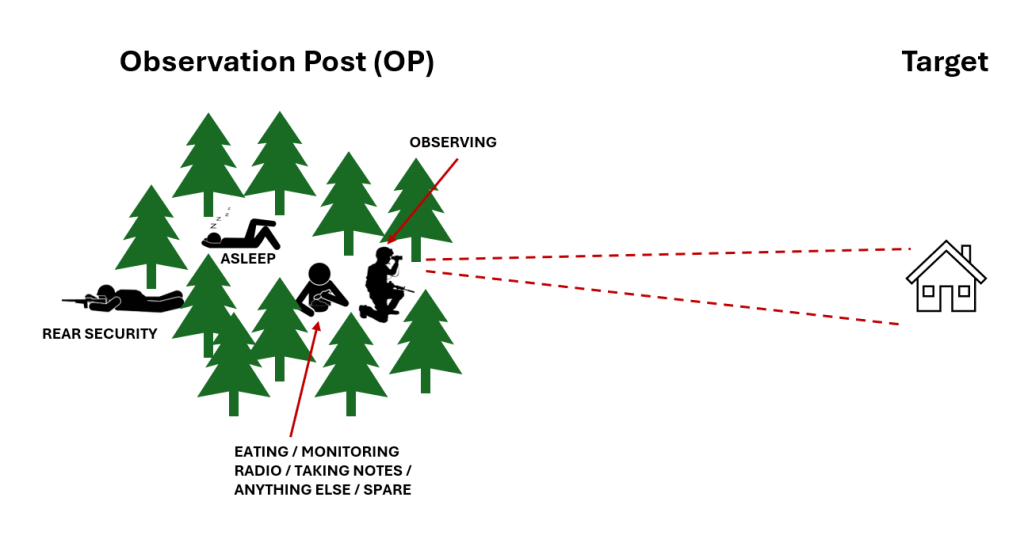
We see the team in their normal routine for a while before the action starts. This part of the film is extremely realistic, because OPs, urban or otherwise, are incredibly boring 99% of the time5. The squad members are taking turns to watch each room and monitor the radios and the sniper rifle. They’re following the timeless military advice of “don’t stand if you can sit; don’t sit if you can lie down“:

You realise how uncomfortable your uniform and body armour and chest rig and helmet and kneepads and boots are when you’re settling in for a long wait. Most of the squad have ditched their helmets, some their backpacks. Now, this would be the part in a normal war movie where the characters wax lyrical about their feelings on the war, or their hometown in Podunk, Illinois, or their sweetheart Susie waitin’ for them to come home. There’s none of this in Warfare (more on this below), and it’s the better movie for it. These guys are professionals, and they have a job to do: sit there, watch, and take notes. As I’ve written previously, on the topic of teamwork:
Speaking of notes, my recurring obsession with admin is borne out in this film, and it’s another all-too realistic element we rarely see. The snipers fill out their range cards and activity logs, the radioman keeps a journal of all communications. Every member of the squad has waterproof pens hanging off their kit.
During this lull, the team gets some warning of what’s about to happen from the garbled snippets of battles happening elsewhere in the city, as well as the urban “pattern or life“, i.e. the behaviour of the men and women on the street, exclusively seen through the sniper rifle’s telescopic sight:

When the grenade detonates, it’s suddenly all business: helmets are on, weapons are up, each operator is covering his arcs. The grenade injures one of the snipers, and the team call for a casualty evacuation (casevac). Things go badly from here (and we’ll discuss why in the next section).
Before evacuating the injured sniper, the team leader needs to make sure that they’re up on “gear,” i.e. that every member has his equipment. This entails a risky two-man sweep of the previously “grenaded” room to pick up body armour, rifles, helmets, etc. Later on, with much heavier fire in the street, the team risks an excursion under heavy fire to retrieve a sledgehammer. I found myself smiling and nodding along to these scenes, because everyone who’s ever served as a section6 or platoon second-in-command (2IC) knows, accounting for all your gear is not a matter of life and death… it’s far more important than that.
One minor problem I had at this point was that the SEALs kept referring to the M2 Bradleys which were coming to pick up their wounded buddy as “tanks.” Now, maybe the US military are particularly lax about this kind of thing, or maybe this is because they’re supposed to be ignorant frogmen, but every soldier knows that a Bradley is not a tank. Never was, never is, and never will be.
Here’s a picture of some not-tanks from various militaries:

And here’s some examples of a different kind of not-tank:

Here are the tanks:

Getting to the back of the Bradleys means that the team needs to leave the relative safety of the house and do some fire-and-manoeuvre. Let’s discuss how this comes across on screen in the next section.
Tactics: Shoot and scoot
From my article on the unrealism of military lone wolves:
“Fire and manoeuvre” is the most fundamental rule of military movement. It applies from the highest formations of multiple armies down to a buddy pair of two soldiers. The rule is simple: You keep one foot on the ground at all times. In military parlance, a “foot on the ground” means a stationary element firing at the enemy. Why? To keep their head(s) down so that the other element can move:

Warfare has lots of fire and lots of manoeuvre (F&M) in contrast to other films. Every time one of these operators moves so much as a metre, it’s under fire or the cover of fire from one of their buddies:

Using F&M properly means that, despite the insurgents’ advantage in numbers and firing positions over the SEALs, they don’t actually land any hits from their fire. It’s hard to get an accurate shot off when you’re constantly ducking and moving firing positions. By the same token, of course, it’s unlikely that the SEALs killed more than a handful of insurgents, despite the thousands of rounds expended.
Speaking of ammunition, Warfare is unusual in that we see how often the characters need to change their magazines to maintain the weight of fire necessary to suppress the enemy. It’s a good thing that their rides home came when they did, because they probably could not have sustained the necessary weight of fire for much longer with only the ammunition they carried in on their backs.
With this in mind, it’s interesting to compare the tactics used by each side in this firefight. The US forces are slow, deliberate, and do everything with a high degree of security (e.g. those Bradley “tanks”). This constrains how they can use the urban terrain. The insurgents, by contrast, use the full battlespace (e.g. rooftops and moving through buildings), but have much less protection and assets they can call on.
Strong spoiler ahead: when the SEALs try to extract one of their casualties, an IED is detonated right by the Bradley. The two Iraqi interpreters are killed8 and two SEALs are injured:

This attack was a classic “come-on”. The insurgents were used to fighting coalition forces, and knew the latter’s tactics. They probably emplaced the IED before starting their attack with the grenade, in the hope that the US forces would call in an armoured medevac. There’s nothing new in tactics like this: the Provisional IRA used a two-bomb come-on to devastating effect Warrenpoint ambush in 1979, and the Taliban would use the same against British forces in Afghanistan in 2009:
As IED attacks increased in Iraq and Afghanistan, US and allied forces painstakingly learned to improve their counter-IED drills and reduce the risk of attacks of opportunity such as happened to the real-life Warfare squad. This commonality of IED tactics, however, is not the only universal military experience which Warfare shows us.
Conclusion: The military experience is universal
This film, as many critics point out, does not do character development. We barely get the names of the main characters, let alone a glimpse of their motivations, their narrative arcs, their complex internal thoughts on the Iraq war. Some might see this as an omission, but it fits nicely with Mendoza’s desire to present a clean and faithful narrative of this event.
This is not to say that soldiers don’t think or care (or even talk) about the rights and wrongs of their job. They do, and they often have a more informed view than many worthies back home. However, they do this at the right place and time, and they don’t dwell on it. At any given moment, they’re much more likely to be worrying about staying alive, or getting to the cookhouse before the rush, or getting a second gym session in, or finding a window of decent internet connection to call home. Or dancing suggestively to the Call on Me video9 while tooled up and ready to deploy, which is what we get in the opening scene.
This anonymity extends to the pre-firefight scenes too. We hear snippets on the radio about the operation which is going down, but it’s not enough to make a coherent narrative for us. We don’t know what “B Company’s” objective is, or indeed what the objective of the brigade is. This hour of action could be, and no doubt was, the same in any urban OP in any warzone.
Fast forward now to the end of the action sequence, when the blessed Bradleys finally arrive for the second time10 and don’t suffer an IED attack. The squad extracts in the safety of the armour, the houses get one last destructive barrage, and the dust settles as the dozen or more insurgents wander out onto the street.
What was the point of all this death and destruction? We don’t know, and I daresay Mendoza and his team didn’t know either. They set up an urban OP and then they collapsed the urban OP. One guy lost his legs and the Iraqi ‘terps were killed. This engagement was probably a footnote in the official unit history. It didn’t advance or detract from the conduct of the war in any great way. It was not important.
But for the men involved, it was probably the most important, most consequential, and most intense hour of their lives. As I’ve written before (although I got the idea from Quartered Safe Out Here: A Recollection of the War in Burma by George MacDonald Fraser): Sometimes the most action-packed moments of danger happen in a context that bears little significance to the overall narrative of the great campaign.
With all the above in mind, I thought the end credits scene was unnecessary. In fact, it undermined the “any soldier, any war” message which I thought was the most powerful part of Warfare. After spending 90 minutes with these generic, undifferentiated characters, we then sit through a reel of their real-life photos next to the actors. We also see clips of the veterans running the actors through the fire and manoeuvring. I’m sorry, why? What’s the point? What next, a bloopers reel? Never mind the Bradleys shooting into the top storey or the lads beating down the bricked-up stairwell with a sledgehammer: this end scene is the real smashing of the fourth wall, and it doesn’t work for me.
That aside, I enjoyed this film immensely. Other critics have written that this is not a film you “enjoy,” per se, as much as you suffer through. I can see where they’re coming from, but let’s take a step back from the hyperbole for a second. I watched this on a reclined plush cinema seat with a bucket full of popcorn next to me. It was a fine bank holiday evening in a peaceful, prosperous country. It’s just a film, albeit a loud and bloody one. No film can recreate the experience of being under fire or bleeding out, but this is the closest I’ve seen. Should you go see it?
Reasons to watch:
- You like action movies
- You’re curious about military life
- You’re a military nerd
Reasons to stay away:
- You get squeamish at blood and gore
- You don’t have the patience for military jargon
- You want to get to know your characters very well
- You want to understand the broader context of the war
- You want a jingoistic recruitment film or a scathing anti-war critique.
That’s my two cents. Let me know what you thought of Warfare in the comments below. If you enjoyed this review you should check out my Civil War review. Please subscribe using the link below if you haven’t already, and like and share this post with as many military nerds as you can. Thanks, and I’ll speak to you again next week.
Featured Image: Warfare, A24 (2025). Via YouTube
- I thought it would be quicker to ask ChatGPT this question rather than trying to measure it on Google Maps. I was very wrong, as you can see in this transcript. Interesting how badly wrong it gets it. You can see where I gave up on getting the right answer and just got curious and frustrated with it. ↩︎
- It’s worth noting is that all of the special forces units from each service come under a single special operations command (SOCOM), albeit with their own service-specific sub-commands. For example, if Rangers and Green Berets were working together on a single operation, this would be an Army-led affair. If, however, Rangers were working with Navy SEALs, then it would come under the joint sub-command within SOCOM. Confused yet? There’s more. The cream of the cream, the units on the bottom row of the diagram above, are all part of this same joint sub-command. ↩︎
- The Marines’ showing looks the least impressive when I compare it to the other services, but, of course, a Marine would argue that their whole service consists of special forces when compared to the other branches. This was the line they held, until it started becoming clear that extra money would flow to the services via their special forces units. This was a good inducement to jump on the bandwagon. ↩︎
- Who are the best special forces? I’m not even going to attempt to answer this one, but you can check out this USA-specific and global video and come to your own conclusions. When Obama decided to kill Osama Bin Laden, he chose SEAL Team 6 to do the job. ↩︎
- This is an under-estimate. ↩︎
- Reminder on terminology: a squad/section has 9-12 soldiers, a platoon is 3 sections, a company is 3-4 platoons, a battalion is 3-5 companies, and a brigade is 3 infantry battalions plus support elements. In a normal army the commanders at each level are a Corporal, a Lieutenant, a Captain/Major, a Lieutenant Colonel, and a Brigadier General. For special forces it’s a bit different, and you might expect higher ranking soldiers/sailors in command of equivalently sized groups of operators. ↩︎
- Why are these not tanks? The designations of armoured fighting vehicles is admittedly a bit of a technical area, but anyone who works with them quickly figures it out. I might do a full post about this some other time, but the short answer is that IFVs are for carrying troops, whereas main battle tanks (MBTs, or “tanks”) are for shooting directly at the enemy with a very big gun. Self-propelled guns (see next picture) are for shooting indirectly at the enemy with a very big gun. Directly means you can see the target, indirectly means you cannot. ↩︎
- With very little reaction, I might add, from the Navy SEALs. The interpreters had worried (correctly) that they were being used as bullet stoppers at the front of the column. I don’t know how US forces interacted with their embedded Iraqi allies, but if this film is true to life (and I suspect it is), then it’s another reason to not be at all surprised at how things ended up. ↩︎
- The reviewer for the New York Times felt the need to describe this video as if she and the readers had not seen it before. Was this really necessary? Maybe this says more about me than about her. Suffice to say that this is very on-brand for a 2006-era male space. ↩︎
- Quick aside: the Bradleys only arrive because one of the SEALs pretends to be the Brigade Commander on the radio net. This is certainly plausible (any station can speak on a radio net, and the Brigade Commander is probably too busy to be listening in), but is a ballsy move. I assume it really happened if it’s in the film, but it could lead to an almighty shitstorm for the offender if they were ever found out. ↩︎




Leave a Reply to Indiscriminate killers? – Military Realism ReportCancel reply