The case in favour of Irish non-alignment.
Hello again everyone. As I mentioned last week, I’m away on holidays right now. I’m away from my laptop and driving across vast distances in sunny climes (so you know I’ve left Ireland). Rather than leave you defenceless ahead of the weekend, however, here’s a (short) one I prepared earlier. This week and next week I’ll be posting two mini-posts on a topic very close to my heart and home, namely Irish neutrality.
If you’re someone who doesn’t know a thing about Ireland or its military stance, then this is a complicated topic. If you’re someone who knows lots about Ireland and its military stance, then it’s still a complicated topic. Sorry! This topic has been increasingly in the news of late, with the current government (as of summer 2025) seemingly eager to move toward the European consensus position1.
Irish neutrality can be a divisive topic, so I’ll come at it from two different angles this week and next. I’m hoping this will also help me with my own thinking, because I also go back and forth on it. Anyhow, this week we’re going to look at the case in favour of military neutrality. We’ll do an incredibly concise history of how we got to here and also compare Ireland to some other small nations. Then we’ll look at a case study, namely “The Emergency” (a.k.a. the Second World War!).
As always, please support this work by liking, subscribing (there’s a link below), and sharing this post. It really helps. Please also comment below if you want to join in the conversation. Alternatively you can contact me via webform here or email here.
If you enjoy this blog and want to support it, please consider a contribution. Keeping this blog going doesn’t cost much, but it isn’t free either, so any help would be very much appreciated👍
A brief rundown of Irish neutrality
I won’t get into the history of Anglo-Irish relations except to say that this long and often chequered history is the foundation on which Ireland’s modern policy of neutrality is built. Britain (mostly, though not entirely, England) has had a strong influence in Ireland’s affairs long before either nation was recognised as such. Irish neutrality was a non-existent concept, since Irish military efforts were either:
- Directed against England’s enemies, via Irishmen fighting for the British armed forces, or
- Directed against England, via Irishmen and women fighting for freedom from British rule.
Ireland was never neutral, therefore, inasmuch as Britain wasn’t neutral on the world stage and British rule in Ireland was never fully accepted by the majority of its population.
Fast forward to the early 1900s. Irish nationalism was about to culminate in political semi-independence from the rest of the UK2, when the First World War intervened. Irish nationalists were split on how they should respond:

Neither extreme was neutral, and this split has remained to this day, evolving into roughly “pro-Western” and “anti-Western” foreign policy blocs within Ireland’s political establishment. Although, to be fair, the former has by far the most adherents.
Irish neutrality today is defined by three big ideas:
- It’s not a NATO member (although it is a NATO Partner nation).
- It cannot deploy its military overseas without a resolution from either the UN Security Council or the UN General Assembly. This is the so-called “triple lock.3“
- It spends a paltry amount on defence and lacks any significant defence industries at home.
This is a confused mess which doesn’t make sense from a military point of view. We’ll talk about this more next week. What does make sense, however, is the idea of neutrality as a form of self-interest or Realpolitik. The defining expression of this was Ireland’s decision to abstain from taking sides in the Second World War, which we’ll discuss next.
Case study: “The Emergency”
When the First World War broke out in August 1914, Ireland was automatically a belligerent country because it was part of the United Kingdom. By 1939, however, Ireland4 was an independent country which could determine its own foreign policy. The government, led by Éamon de Valera, decided to remain neutral in the upcoming conflict. This policy had overwhelming support within the elected legislature and was also supported by the public. After all, Ireland had been at war with Britain only a generation before.
“The Emergency” was the euphemistic term given to the war at the time and subsequently. The government gave itself emergency powers during the conflict, including censorship of the media and internment without trial.
Ireland did not prevent its citizens from leaving the country to enlist in the British Armed Forces, and at least 70,000 Irishmen did so. It allowed British and other Allied aircraft to overfly its airspace to get from Northern Ireland to the Atlantic Ocean via the Donegal Corridor, avoiding a much more circuitous (and therefore fuel-intensive) route:

Neutral Ireland would repatriate Allied airmen who crash-landed in the country, as opposed to German airmen who were interned for the duration of the war. The Donegal Corridor and the returning of downed airmen were clear breaches of Ireland’s neutrality, and were kept as secret as possible. De Valera and his government did not want to give any of the warring parties a reason to invade the country.

Ireland faced a threat of invasion from Germany, which had drawn up an invasion plan (Operation Green) to support its planned invasion of Britain (Operation Sea Lion). There is some debate as to how serious this plan was, but it was detailed and chock-full of intelligence gathered by German agents in Ireland during the 1930s. In the event, neither Green nor Sea Lion were ever carried out.
As well as the threat from Germany, Ireland faced a credible threat of invasion from its neighbour and former colonial overlord, the United Kingdom. An invasion by British forces across the land border from Northern Ireland would likely only have come in response to a German invasion and at the request of the Irish government. Plan W was a joint British-Irish plan for exactly this possibility.
Ireland had threats on several fronts so beefed up its military strength accordingly, doubling the size of its army to 50,000 soldiers. Although still a tiddler by international standards, it would have mildly deterred a potential aggressor from invading, especially from the sea. The Irish Army’s two divisions5 would, in theory, have had a decent chance against an enemy with fewer than six divisions. Neither side had the divisions to spare, so the potential gain (ports on the Atlantic, a back door into the UK) was not quite worth the effort.
Another factor against invasion was the near-certainty of guerrilla action against an occupier. This is exactly what led to British withdrawal less than two decades before, and many senior commanders (e.g. Field Marshal Montgomery) had served in Ireland and had no desire to re-open that bitter conflict. The Germans would also have taken note of Britain’s difficulties in the 1920s.
The result of Ireland’s neutrality was, predictably, a far lower rate of military and civilian deaths than any of the belligerent nations:

If a democratic government is supposed to represent the interests of its people, and (if we assume) that people like being alive, then a policy of military neutrality would seem to be the most democratic form of foreign policy. This is close to the idea of “democratic peace,” going back to the ideas of Immanuel Kant, which posits that democracies are less likely to go to war with one another.
Conclusion (for now): The Realpolitik of small nations
Irish neutrality, in its actions (if not its words—we’ll pick it up next week), is a clear expression of Realpolitik. When elephants fight, the grass suffers, and when big powers go to war, it’s the small nations which suffer the most6. Neutrality, therefore, is a pragmatic and practical measure which small nations should take. This was stated explicitly at the time:
… small nations like Ireland do not and cannot assume a role as defenders of just causes except [their] own. … Existence of our own people comes before all other considerations … no government has the right to court certain destruction for its people; they have to take the only chance of survival and stay out.
—Joe Walshe, Secretary of the Department of External Affairs, 1941 (via Wikipedia)
More recently, in referring to the Russo-Ukrainian War, the Taoiseach (Prime Minister) Micheál Martin said:
Ireland’s official policy is to be militarily non-aligned. We are, however, not politically non-aligned.
This is so confused as to be almost meaningless (Clausewitz would be spinning in his grave). However, it also manages to walk that same fine line of staying out of the fray but supporting one side, just like we did so successfully during “The Emergency.”
Think of Ireland as a small kid in a big playground. There are big bullies and groups which tag along with them. We know which bully we like the most, because he laughs at our jokes and sometimes gives us sweets he’s stolen. But we’re not a part of his gang, and we stay on the sidelines when he’s beating up that weird kid or the scarier bully. We might cheer a little bit though. But we don’t get involved… just in case another, bigger bully becomes king.
Does that sound despicable? Maybe it is, and we’ll argue the other side of neutrality next week. But it’s undeniably effective, at least in the century or so that our little country has been around.
That’s all for this week but, as I said, we’ll be back with a list of counter-arguments next week. Feel free to get your points in first though, I’d love to know your thoughts in the comments below. Although this is an Ireland-centric post, I hope it resonates with my international readers. Maybe your own country does something similar? Or perhaps not, and you wish it did. Or maybe you think Ireland’s stance is nothing to be proud of. Let me know! Please share this article using the handy links below, and subscribe if you haven’t done so already. Thanks for reading.
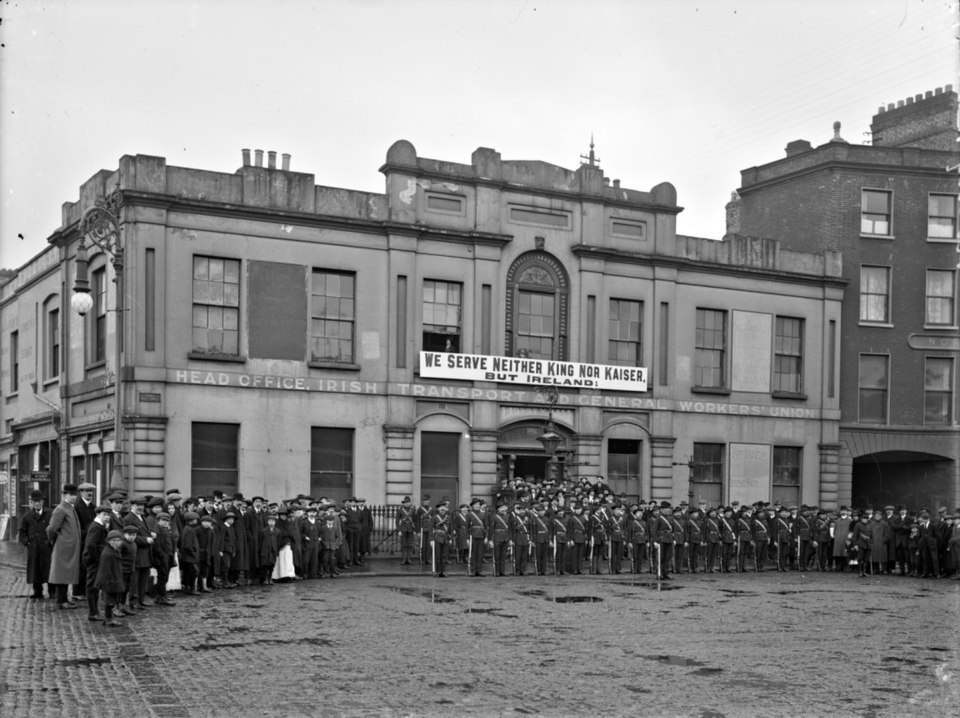
Featured Image: Irish Citizen Army Group Liberty Hall Dublin 1914, National Library of Ireland on The Commons, Public domain, via Wikimedia Commons
- The government and its supporters still claim to be upholding Ireland’s neutrality, while its opposition, predictably, claims the exact opposite. Who is right? It completely depends on your definition of neutrality. That’s not a rabbit hole I’m going to go too deep into, but I can recommend the excellent Is Ireland Neutral? The many myths of Irish neutrality, by Conor Gallagher, if you want to know more about this. ↩︎
- Although not without a fight: the British Army threatened mutiny if so-called “Home Rule” was imposed on the minority of Ireland who did not wish for independence. The outbreak of war in August 1914 rendered this crisis moot. ↩︎
- The other two “locks” are not nearly as strong. One is government approval. Well duh, of course you have government approval if there’s a government decision to send troops overseas. The other is the assent of the parliament. Which, because Ireland is a parliamentary democracy, will vote the way the government wants it to (otherwise the government would collapse). ↩︎
- The country which gained independence in 1922, after the War of Independence with Britain, was called the “Irish Free State.” It consisted of the 26 counties which remain a sovereign country to this day. The other 6 counties in Ulster formed Northern Ireland, a region/nation within the United Kingdom to this day. In 1937, Éamon de Valera, leader of the country, introduced a new constitution which remains in force today. The name of the country was changed to “Ireland,” and remains so to this day (not “Republic of Ireland,” “Southern Ireland,” or “the 26 counties.”). Yes, this is confusing: the island of Ireland has two different countries on it. One is also called Ireland, is a republic, and comprises about three quarters of the land and population of the island. The other is called Northern Ireland, is a part of the UK, and comprises the remaining quarter. ↩︎
- Nomenclature reminder: A division (10-25k troops) is led by a Major General and consists of 3+ brigades. A brigade (1k-5k troops) is led by a Brigadier [General] and comprises 3+ battalions. A battalion (300-1,000 troops) is led by a Lieutenant Colonel and has 3+ companies. A company (100-250 troops) is led by a Major/Commandant or a Captain and has 3+ platoons. A platoon (20-50 troops) is led by a [Second] Lieutenant and has 3+ sections. A section (~10 troops) is led by a Corporal and is broken up into fireteams which, as we discussed a few weeks ago, are the smallest independent entity in a military organisation. ↩︎
- You might take issue with this assertion, given the stats which I presented above. In WWII, it was the biggest powers (USSR, Germany) who suffered the most, proportionally. However, I’ve only included a few examples here. If we took in, say, Poland (17%), Ukraine (part of USSR, 16%), Belarus (part of USSR, 25%), Yugoslavia (8%), and Czechoslovakia (2%), and compared these to the USA, France, and Britain, you can see that they came off a lot worse. ↩︎


Leave a Reply