The case against Irish military non-alignment.
Welcome back. Last week we looked at the case in favour of Irish military non-alignment, or “neutrality,” in the common tongue. We used the Second World War (“The Emergency”) as a case study and saw how neutrality probably saved the lives of many Irishmen and women. I concluded that neutrality, as practised by Ireland1, is an example of Realpolitik or self-interest.
This week we’re going to look at the other side of the coin. What if neutrality is not all it’s cracked up to be? I’m going to argue this in three parts. Firstly, that it doesn’t make logical sense. Secondly, that it’s actually not very pragmatic, and thirdly, that it’s morally repugnant. As I mentioned before, I have too many opinions on this topic. I go back and forth on it, so that’s why I’ve written this two-parter.
Even more than usual, given how unsure I am, I would love to hear your thoughts on this important topic. You can comment below, or contact me via webform here or email here. Please also like and subscribe (there’s a link below). Finally, if you’ve enjoyed this read, please share it with a friend and get their opinion too.
If you enjoy this blog and want to support it, please consider a donation. Keeping this blog going doesn’t cost much, but it isn’t free either, so any help would be very much appreciated👍
It doesn’t make sense
Is neutrality a good thing? When you lack a legal or constitutional definition of the term, then of course it can be very good. It can be whatever the speaker wants it to be. It’s a vague but wholesome sounding positive thing, like motherhood and apple pie. You can see examples here, where each political party talks about how much they value neutrality, while advocating very different policies.
As I mentioned last week, Conor Gallagher’s Is Ireland Neutral? (2023) is worth a read. One of his arguments is that the term “neutrality” has been used indiscriminately throughout Ireland’s history to mean whatever the government of the day want it to mean. I would expand this point further and include the opposition parties who also employ an open definition of the term.
Here’s a non-exhaustive list of non-neutral things that Ireland, a supposedly neutral country, does. You’ll be glad to see that there are examples from both sides of the political divide here:
| Thing | Why thing ≠ neutral |
|---|---|
| A proud history of participation in UN Peacekeeping operations | Impartiality is crucial to maintaining the consent and cooperation of the main parties, but should not be confused with neutrality or inactivity. United Nations peacekeepers should be impartial in their dealings with the parties to the conflict, but not neutral in the execution of their mandate. —United Nations Principles of Peacekeeping: #2 (Impartiality) |
| A secret (but actually not very secret) agreement with the UK’s Royal Air Force that the latter will intercept threats in Irish airspace | Is a country that cannot see or intercept aircraft in its airspace really a sovereign state? And if it relies on a NATO nuclear power to police said airspace, how can it claim to be “neutral?” |
| Spending an absolute pittance on defence (see below) | Neutrality implies and requires the ability to enforce it by deterring a would-be aggressor. You cannot be neutral unless you have the ability to defend yourself |
| Allowing the US military to use Shannon Airport as a refuelling stop en route to conflict zones | Directly supporting a belligerent in a war is not a neutral act |
Okay, so it’s not well-defined. But maybe that’s a good thing? It allows governments to be flexible and perhaps a bit inconsistent, but nevertheless achieve good outcomes. Or perhaps not: let’s look at that next.
It’s not very pragmatic
In last week’s case study of WW2, we concluded that non-participation in the greatest act of bloodshed of the 20th century was probably a good thing. But was it? And is neutrality really a pragmatic policy choice? Spoiler alert: No.
Aside from the moral question of participation in World War 2 (see below), Ireland’s neutrality did come with consequences. It had to wait an extra ten years to join the UN, with its application being vetoed by the Soviet Union due to Ireland’s wartime neutrality. This was especially galling because an Irishman, Seán Lester, had led the League of Nations prior to the war.
Another consequence was economic. Although Ireland did get some Marshall Plan aid after the war, its grant from the USA was small and time-limited, and its economy saw less benefit than other recipients.
Today Ireland consistently punches above its weight in terms of global influence (e.g. ranking 26th in 2024), and its neutrality is cited by some as a reason for this. This seems a stretch: the greatest magnifier is undoubtedly Ireland’s outsized diaspora of 80 million.
Ireland probably does get kudos from its outsized contribution to UN Peacekeeping, which was cited as one of the reasons contributing to its election to the UN Security Council in 2021-22. However, as we mentioned above, UN Peacekeeping is not a neutral act. Plenty of proud peacekeeping nations are non-neutral: India, Finland, France, Nepal2, South Korea, China, Italy, Ghana, and Tanzania are all non-neutral countries I personally have served with overseas3. There are plenty more.
Ireland’s proud history of peacekeeping has declined of late due to chronic underinvestment in defence, something which can be (however illogically) defended by some on the grounds of neutrality. In reality, Ireland’s paltry spending on defence is a source of increasing impatience to European peers:

Yes, you read the chart above correctly. Ireland could increase its defence spending 500% and still fall short of the EU average, which itself is less than half the new NATO target.
For decades, Ireland has been skimping on defence under the guise of “neutrality” and expecting its neighbours to pick up the slack. It’s a fudge which Ireland’s peer countries are losing patience with. It’s also completely unnecessary, since the country is awash with cash. Spending a bit of it on European military kit would please friends in Europe. Keeping Europe onside was very beneficial for Ireland during the Brexit negotiations, and will be for the potential upcoming trade war with the USA.
To keep Europe onside, however, it might behove Ireland to take its obligations seriously given its geographic position on the western flank of the continent. Ireland is the landing ground for transatlantic undersea data cables, but currently lacks the capability to monitor, let alone deter any action against these by Europe’s enemies:

Letting go of the confusing and contradictory policy of neutrality might be popular with our peer nations and bring benefits for Ireland, but surely it would represent a moral backslide? Isn’t neutrality a good thing? Let’s discuss that next.
It’s nothing to admire
There’s a lot of misinformation and misunderstanding out there when it comes to Irish neutrality. The biggest of these is the idea that neutrality is something to be admired. It’s not.
Every culture in every age has developed a social pressure for people to do the right thing in the face of injustice. We can see examples from the parable of the Good Samaritan in Luke’s Gospel to today’s workplace Conscious Inclusion norms which emphasise “allyship,” or speaking out against biases and discrimination. Nowhere is neutrality praised as a virtue.
What’s true for individuals should also be true for nations. It’s not admirable for small countries to stay on the sidelines while the big powers duke it out. Individually, each might not make a difference, but collectively, they/we can influence events.
I used World War 2 as a case study in how neutrality can benefit a small nation like Ireland. Clearly it saved a lot of lives, but can it really hold its head up high today? Sixty years after the worst genocide in history, is Ireland as a nation proud that it stood by and did the bare minimum in the fight against Fascism?

You might think I’m building a straw man. After all, nobody out there, that I’m aware of, is saying that we should completely ignore what’s happening in the world. Many advocates of neutrality are also in favour of strong diplomatic efforts to address global injustice. Many also strongly support UN Peacekeeping4. But diplomacy alone will not always be enough, and our convictions should push us to make real sacrifices for the causes we believe in.
I can tell that I’m starting to sound naive, so let’s cut to the conclusion and then I’ll let you chime in.
Conclusion: What do you think?
“From now on I’m thinking only of me.”
Major Danby replied indulgently with a superior smile: “But, Yossarian, suppose everyone felt that way.”
“Then,” said Yossarian, “I’d certainly be a damned fool to feel any other way, wouldn’t I?”
― Joseph Heller, Catch-22
I’ve written before about my fondness for Catch-22. The exchange above is a recurring motif between the protagonist Yossarian, a nihilist whose main concern is for saving his own skin, and other characters who are either idealistic or at least accepting of their fate.
The quote above also sums up the choice facing small nations like Ireland. Do they take sides, fight for their ideals, and make sacrifices for the greater good of mankind? Or do they focus on maximum self-preservation, using Realpolitik to walk the fine line between neutrality and full participation? There’s no right or wrong answer, just like there’s no right or wrong answer to Major Danby’s question.
The question of neutrality, to me, comes down to a choice between pragmatism and righteousness. I can’t say which one is best, but I’d love to hear your thoughts. Or maybe I’ve put the choice too starkly, and there’s a middle ground which I’m overlooking. Please let me know in the comments below.
Remember, if you haven’t already, to subscribe using the link below. Please also share this article with a friend. Thanks for reading!
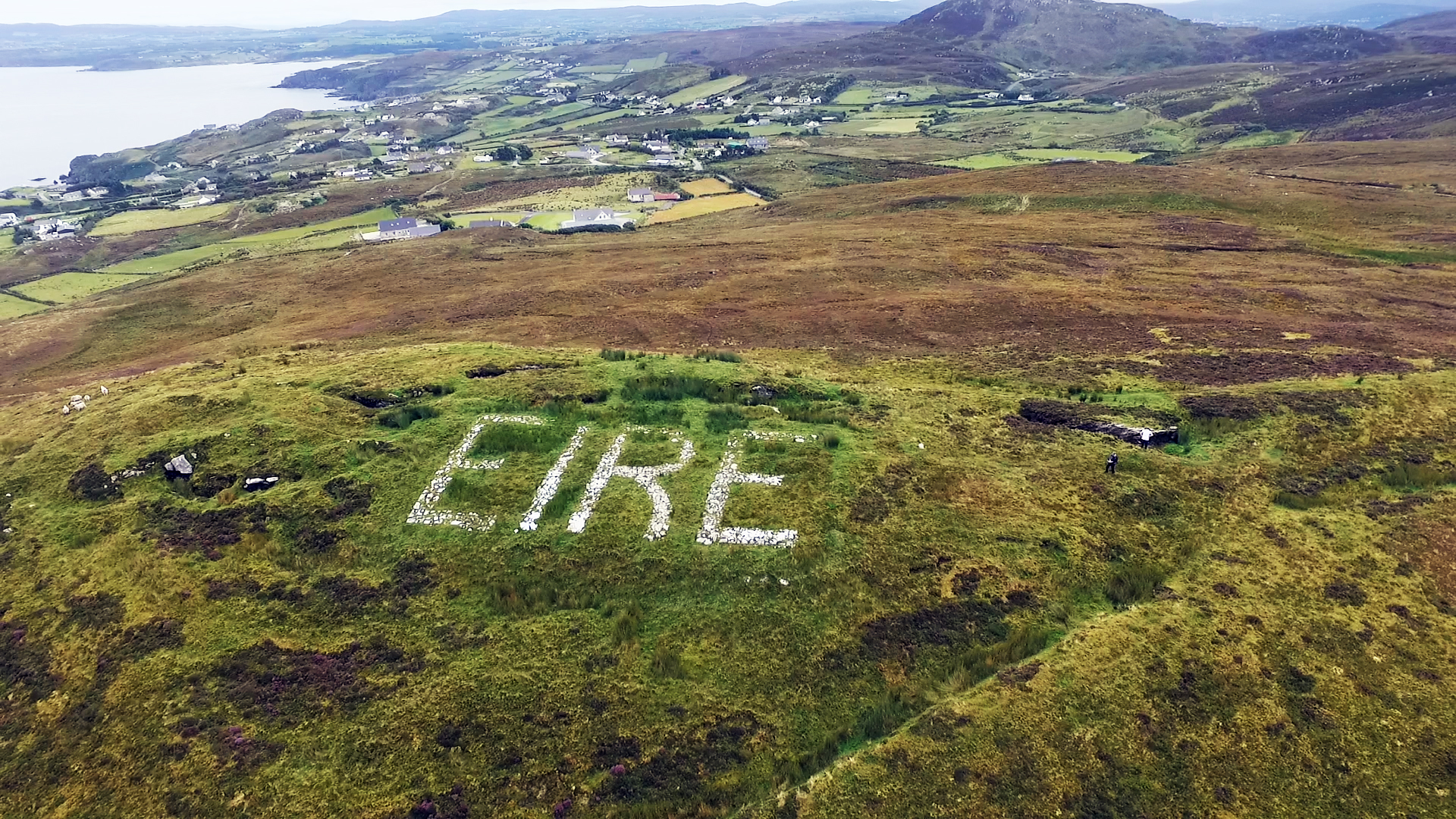
Featured Image: Markings to alert aircraft to neutral Ireland (“Éire” English: “Ireland”) during WWII on Glengad Head, County Donegal, Kmccook, CC BY-SA 4.0, via Wikimedia Commons
- In other words, including the use of Shannon airport by the US military, semi-cooperation with NATO, all those other not-really-neutral things which Ireland does. ↩︎
- Arguably as “neutral” as Ireland, in that they are non-aligned, but they don’t call themselves neutral like Ireland does, so I’m taking them at their word. ↩︎
- For the sake of completeness, I’ve also served overseas on peacekeeping operations with “neutral” counties: Austria, Fiji, and Uruguay are the main ones. ↩︎
- Although, as we’ve seen above, there’s nothing neutral about this. ↩︎


Leave a Reply