Gun design principles and internal ballistics.
Hi there and Happy Thursday. This week I’m picking up the ballistics thread again. We covered wound ballistics and intermediate ballistics a few weeks ago, with a deep dive on silencers.
This week we’re going to look at internal ballistics, which is the bit that happens inside the gun barrel:

More specifically, it’s everything that happens between the moment the propellant is initiated and the moment the projectile leaves the barrel.
I’m going to start by looking at energy conversion, which will tell us why gun barrels look the way they do. Then we’ll talk about some of the big challenges for gun designers in terms of making the propellant and making the barrels. As always, we’ll pull in some examples from film and TV to see where they get it wrong (or, indeed, right).
Before that, however, I’ll encourage you to subscribe to the blog using the link below. As always, I’d love to see your comments below, or you can contact me via webform here or email here. Finally, if you’ve enjoyed this read, please share it with a friend.
If you enjoy this blog and want to support it, please consider a donation. Keeping this blog going doesn’t cost much, but it isn’t free either, so any help would be very much appreciated👍
Efficient energy conversion is the aim, and long, thin barrels are the game
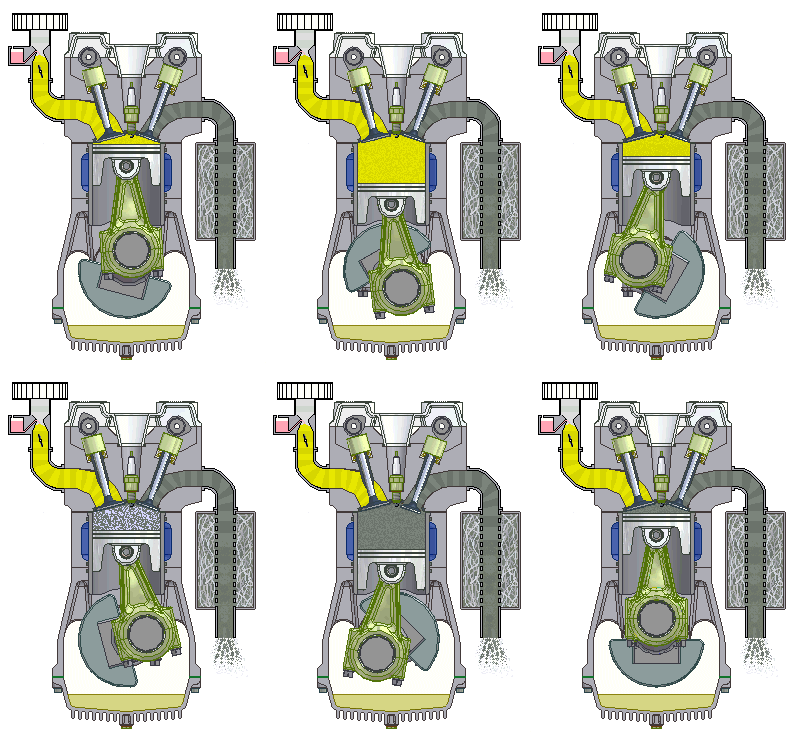
What is a gun? From a thermodynamic point of view, it’s an internal combustion engine with an open cylinder and a single-stroke operation. It’s very similar to a car’s internal combustion engine. Both convert chemical energy (propellant/petrol) to kinetic energy (bullet travel, crankshaft movement).

Just like a car designer, the gun designer wants to build this engine to maximise the amount of the chemical energy that gets converted into kinetic energy. If you do the math(s) on this1, you’ll find out that the maximum kinetic energy is determined by the mass of the barrel (heavier is better), the material strength (stronger is better), and the material density (denser is worse). In other words, the gun barrel has one job to do, and that job does not depend on its length:

In practice, although there are some wicked cool examples of short, fat gun barrels, such as the mortar below from the US Civil War, designers have tended toward the long and thin type of barrel.

Why is this? Longer barrels make for a slow3, smooth increase in projectile speed, as opposed to the short, sharp acceleration in a shorter barrel.
The ideal gun, in theory, would have an infinitely long barrel, or at least one that went all the way from the firer to the target. Obviously practical issues aside (“Sorry pal, can you just hold the end steady while I shoot you? Thanks!”), there’s also the effect of friction.
The longer a bullet or shell stays in the barrel, the more of its kinetic energy is transferred to heat via friction. The designer picks a trade-off between kinetic energy added from propellant gases and lost to friction:

Despite this, there have been some attempts made at ridiculously long barrels. One neat trick is to add more propellant in little sub-chambers along the path of the shell which initiates as it passes. Hitler tried this towards the end of WW2. You probably know about his V-1 (world’s first cruise missile) and V-2 (trailblazing ballistic missile, first object to reach space) revenge weapons. What you might not know about is his V-3, which was a very long gun:

It must be a dictator thing. Saddam Hussein tried to build a gun so big it could launch a projectile into orbit. Project Babylon was never completed, thanks to some timely assassination work by Mossad, but sections of the gun remain as museum pieces. It’s big:

Even the Joker has read the memo about long barrels (but don’t read the description, there are so many things wrong with it that I don’t know where to start):
There are significant engineering challenges to overcome
Propellant shape
You might easily mistake some types of gun propellant for pasta (at least until you try to heat it on the stove):

Just like pasta, the shape of the propellant “grain” matters enormously. Long, spaghetti-like grains burn from one end to another and release their pressure (relatively) slowly4, whereas chopped-up cylinders or flakes (think macaroni) burn quicker.
As well as the speed of burning, gun designers also care about how the speed changes during the burn itself:

In atmospheric conditions, propellant appears to burn violently, as the video below (one of a plethora on YouTube) shows. Please don’t try this at home:
The burn above, while violent by the standards of normal fuel, is glacial compared to the speed of reaction in the gun. This is because it’s happening in ambient atmospheric pressure. Propellant burns faster when it’s under pressure. But burning it releases gas, which raises the pressure quickly. If you confine this reaction (by putting it inside a sealed gun barrel, for example) the positive feedback loop turns a burn into a bang.
All the energy you saw in the ten second burn above is released in about ten milliseconds (a thousand times faster). We discussed this same effect before when we talked about dust explosions:

In short, the shape, the quantity, and the ignition of gun propellants are of paramount importance to the gun designer. Of course, The Simpsons told us this many years ago:
Barrel strength
Once we get the propellant burn right, then we need to design the gun that can handle the immense pressure inside. This involves using quite a lot of steel to contain the high-pressure burn:

It’s not just about the amount of material you put around the ammunition. What you do to it is just as important. Gun barrels have evolved from the early gunpowder designs which involved metal hoops to strengthen it and looked, funnily enough, just like a barrel.
Since the industrial revolution, barrels have been strengthened by permanently deforming the inside face of the material. This might surprise you if you’re not familiar with the miracle of work hardening5. Subjecting the barrel to immense pressures before you ever fire a round out of it makes it better able to withstand said pressures when it’s being used.
At first, barrels were simply made on the understanding that the first round through it made it a bit wider and strengthened the material for every subsequent round. Oil under hydraulic pressure was a more controlled way to achieve this so-called autofrettage. Later still, manufacturers held the barrel in place and ran an oversized tool through the bore to create these stresses.
Nowadays manufacturers use giant all-round hammers to deform their gun barrels into the right shape. The advantage of this is that they can hammer the barrel around a tool which has the grooves for rifling (see below). See below extract for a view of how they do this with giant artillery gun barrels:
If we get this wrong, it’s very bad for the firer. Barrels (like any internally pressurised tube) fail along the axis of the gun, so the resulting damage is like a banana peeling open: a banana whose peel is steel and whose innards are hot propellant gases. This, by the way, is one of the many problems I had with the Reacher vs. Paulie fight scene in Season 3 of Reacher, and which I’ve bored you with enough at this stage.

We’ve already mentioned rifling. Most gun barrels have grooves cut inside them to impart spin to the bullet (we’ll talk about why next week). This is where a “rifle” gets its name, but rifling is in most gun barrels6, from artillery howitzers to small pistols. You’ve seen this before, of course, in the iconic James Bond gun barrel opening sequences:

Barrel wear and temperature
Even if you get the propellant sorted and manufacture your gun barrel to be (well) bulletproof, you have one more hurdle to overcome: temperature. As well as lots of pressure, the expansion of propellant gases also generates lots of heat. For one or two rounds, this isn’t a problem. The barrel is heavy, and the amount of gas involved is small, so the heat dissipates quickly.
If you fire lots of rounds all at once, then heat does become a problem. Just like a drip isn’t a problem but a torrent is, the cumulative heat added by all those bullets can quickly heat a gun barrel to literally red-hot temperatures:
The barrel above is obviously beyond repair (you can actually see the droop), but you don’t need to even go that far to cause irreparable damage. All barrels wear down with use, but extended firing at high temperatures dramatically accelerates this process. The hotter steel is weaker, for one, and the high-temperature propellant gases have a corrosive effect on the inside of the barrel.
Barrel temperature is a serious limitation in real life. Machine guns come with multiple barrels: at least two for the 7.62 mm FN MAG, and three for a .50 cal (12.7 mm) M2 Browning. That’s a lot of extra kit to carry, and the gunners are expected to change the barrels every 100 to 200 rounds. You should be changing the barrel almost as often as you change the ammunition box, but neither of these annoying realities weigh on our Hollywood action heroes:
I wanted to include the .50 cal scene from the fourth Rambo (2008), but it’s age-restricted, so you’ll have to follow this link to see it. It’s not pretty (both in terms of the gore and what he’s doing to that poor weapon). If you want to go on an extended shooting spree, you’d better use a rotary/Gatling gun with multiple barrels:

Even the best-kept barrels can have surprisingly short lifespans. As gun calibres, rates of fire, and muzzle velocities go up, the lifespan of the barrel drops. Whereas a pistol barrel might last a million rounds, rifle’s barrel is good for about 10,000, and a heavy machine gun’s lasts 1,000, depending on the rate of fire (i.e. not like the photo above). Artillery and tank gun barrels have lifespans in the hundreds of rounds7, as Russia is finding out the hard way.
Conclusion: A gun is a reasonably efficient heat engine
Earlier on, we noted the similarities between a gun and a car engine. Like any engine, we care about how efficient it is. Guns, it turns out (and this is a big generalisation) are about 30% efficient:

This doesn’t sound great. In other words, 70% of the energy in the gunpowder is wasted. But it’s roughly the same as a regular petrol engine, which gets useful motion out of 20-40% of the energy in the fuel. Diesel engines are about 45% efficient, and the gas turbines uses to generate electricity give us about 60%. Could we make guns more efficient?8
In short, we probably could. We could use longer barrels, but then we look like the Joker in the clip above. We could load our ammunition with more propellant to generate higher pressures, but then we’d need to make a stronger barrel to contain this pressure, and this adds weight to the weapon. We could use a cleverer type of propellant grain shape, such as a progressive burn design which spreads the peak pressure along the barrel a bit more. But this is more complex to make, and you can be sure it will add cost.
The reality is that you hit a law of diminishing returns. Getting about 30% of your propellant energy back as useful killing energy is a decent return, and gun designers have worked very hard to get even that much. If you use guns every day for work or recreation, then be glad that they’ve done their math properly and kept your gun barrel from banana-peeling in your face.
That’s all for this week. Next time I’m hoping to look at external ballistics, a.k.a. why a bullet spins. Thanks for reading and please remember, if you haven’t already, to subscribe using the link below. Please also share this article with a friend. Thanks, and see you next week!
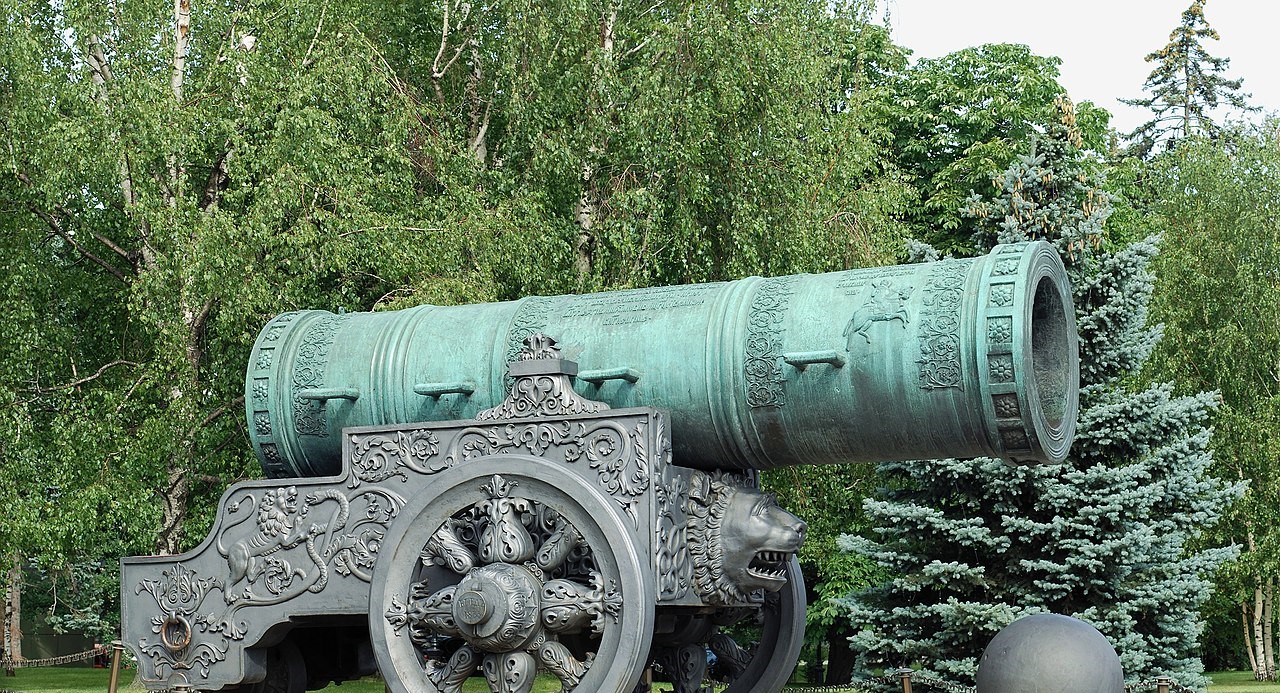
Featured Image: “The Tsar Cannon of 1586 with its huge bore and a barrel exterior which is perceived like a stack of storage barrels.” By Alvesgaspar – Own work, CC BY-SA 3.0, via Wikimedia
- This is your fault for clicking. The energy at the muzzle is the force multiplied by the length (of the barrel). The pressure is the force times the cross-sectional area. The max pressure is (from thin-walled pressure vessel theory) equal to twice the thickness, times the material yield strength, divided by the barrel diameter. The mass of the barrel is given by pi times diameter times thickness times length times material density. Sub all of these together and everything cancels except for mass, material strength, and material density. ↩︎
- The caption is worth including, also from Wikipedia: “THE RAILROAD GUN S EXECUTIVE COMMITTEE, COPYRIGHT, 1911, PATRIOT PUB. CO. These nine men are the executive committee that controlled the actions of the great mortar, and a glance at them shows that they were picked men for the job — men in the prime of life, brawny and strong — they were the slaves of their pet monster. Some shots from this gun went much farther than they were ever intended, carrying their fiery trails over the Confederate entrenchments and exploding within the limits of the town itself, over two and a quarter miles. The roar of the explosion carried consternation to all within hearing. In the lower picture is the great mortar resting in the position it occupied longest, near Battery No. 4.” ↩︎
- Comparatively slow. A rifle bullet accelerates at nearly a million metres per second per second. An artillery piece, about 70,000. These are average figures, so the peak acceleration closer to the start of the barrel will be higher. ↩︎
- Update: This is a bit of a simplification; it depends on where the ignition source comes from and whether it burns in a line, like a cigar, or on all surfaces at once. Sometimes grains are coated on the curved surface with a flame retardant to avoid the latter scenario and burn in a neutral rather than degressive way. Thanks Basil for pointing this out. ↩︎
- The TL;DR version goes something like: most engineering materials are elastic. You load them, they change shape (like bending a metal bar), you unload them, they go back to normal. Every elastic material has a point (called its yield strength or elastic limit) beyond which it permanently deforms (you bend the bar too much and when you let go, it still has a residual bend in it). Work hardening is deliberately pushing a material beyond its elastic limit so that the deformation is already “baked in,” and it can endure the same, higher limit in its service life. ↩︎
- The big exceptions are smoothbore (i.e. not rifled) tank cannons, shotguns, and mortar tubes. We’ll discuss all of these next week. ↩︎
- Potentially a bit more for artillery, where you can dial up or down the amount of propellant used depending on how far you need to fire. A barrel rated for several hundred rounds of “full charge equivalent” (i.e. maximum pressure) might last a thousand rounds or more with lots of sub-maximum charges. ↩︎
- I realise this is a question not many people are asking. ↩︎


_(14576269528).jpg)


Leave a Reply to Understanding External Ballistics for Improved Shooting AccuracyCancel reply