The science of terminal ballistics
Today is the last instalment in my periodic series on ballistics. We’ve ran out of road on this story, and reached our terminus: terminal ballistics, and a whole heap of mixed metaphors. Before now, we’ve covered wound ballistics, intermediate ballistics (with a deep dive on silencers), internal ballistics, and external ballistics.
Terminal ballistics is about the interaction between projectile and target:

Strictly speaking, this definition covers wound ballistics, which we discussed previously. The human body is a unique target, so it’s often treated as a separate, albeit adjacent topic. I’ve treated it separately anyway. Wound ballistics was the first instalment I did in this series, so I’m coming back full circle.
Today I’ll start off talking about the same energy problem that’s present at every stage of the ballistic cycle. Then we’ll skim over some materials science, since that’s a critical part of terminal ballistics. Don’t worry, we’ll only “touch the wavetops,” as an instructor used to reassure us. I’ll move on to discuss the role of high explosives in terminal ballistics, especially in HEAT, HESH, and fragmentation warheads. Then I’ll discuss alternatives to high explosives, namely kinetic energy penetrators. We’ll sum up by looking at the “arms race” in its totality.
Before we start, let me encourage you to subscribe to the blog using the link below. As always, I’d love to see your comments below, or you can contact me via webform here or email here. Finally, if you’ve enjoyed this post, please share it with a friend.
If you enjoy this blog and want to support it, please consider a donation. Keeping this blog going doesn’t cost much, but it isn’t free either, so any help would be very much appreciated👍
We want to leave all the energy in the target
Until this point, the goal of the weapon designer has been to minimise energy lost in various stages of the cycle. Internal ballistics was about minimising energy lost as heat in the gun barrel. External ballistics was concerned with minimising aerodynamic losses on the way to the target, and so on.
Now that we’ve reached the target, the opposite is true. We want the projectile, bullet, shell, whatever it is, to deposit all of its energy into the target(s). Any energy which stays in the projectile after the target will be wasted, like a high-velocity bullet which goes straight through the target’s body and keeps going. Sure, it’s going to hurt (and maybe kill), but it’s a lot less devastating than when the bullet enters and then slows down, tumbling and yawing and breaking apart inside.
The physical make-up of the target is the most important factor in weapon design. Let’s compare a few:
| Type of target | Difficulty in targeting | Difficulty in hitting | Difficulty in penetrating | Difficulty in defeating |
|---|---|---|---|---|
| Human | High: Use unguided missiles (bullets) and weight of numbers to increase chances | Medium: Small cross section, slow to get away | Low: Skin is not an effective ballistic protection | Low: Gunshot wounds cause shock and trauma |
| Vehicle (soft skin) | Low: Lots of heat and noise | Low: Large cross-section, slow to get away | Low: Vehicles are not built for ballistic protection | Medium: Vital areas may be small in proportion to total cross-section |
| Vehicle (armoured) | Low: Lots of heat and noise, and cross-section | Medium: Smaller cross section (comparatively). Not very manoeuvrable, but may have active defence measures | High: Heavy armour protects most vital areas | Low: Vital areas (crew, ammunition, engine) are more concentrated |
| Aircraft | Medium: Lots of heat, but doesn’t hang around | High: Can manoeuvre quickly, far away | Low: Most aircraft are unarmoured | Low: Many areas crucial to being able to keep flying |
On the other side of the coin, designers of armour need to be aware of the threat. For vehicles, this is often expressed as the so-called survivability onion:

Clever design can subvert this “onion” somewhat, e.g. a high-explosive fragmenting warhead, coupled with the right fuze, means you can miss the target and still damage or even destroy it. For the most part, however, the aim is to hit the target, and this is usually how maximum target effect occurs. This is especially true at the smaller end of the scale. We’ll start here, with small arms ammunition, where material design is the most important factor for terminal ballistics.
Materials make a difference
It’s tempting to think of materials (when we think of materials at all) as being on a singular spectrum of weak to strong, soft to hard, etc. The reality is more complicated, and impossible to render graphically, but I’ll give it a go anyway:

If the target is soft (think about an unarmoured person or even a soft-skinned2 vehicle), then the penetrating material of the bullet can be fairly soft. This explains the original and enduring popularity of lead in bullet materials. Lead (or more commonly, lead antimony) is:
- Dense, meaning it packs a greater punch per unit of cross-sectional area
- Ductile, meaning it can squeeze through a rifled barrel, take a spin from the grooves, and also pancake flat on impact with a human target

If the enemy responds to the threat of lead bullets with armour, then the softness of lead becomes a bug rather than a feature. Designers respond to this with bullet tips or cores made from a much harder and stronger material (which is ideally still dense). The dense part of the bullet will push through the useless soft parts and will deliver a decent chunk of the bullet’s kinetic energy into a small area, ideal for punching a hole through something.

Just as important as the bullet material is the target material. There and many different types of bullet-plate interaction, depending on both materials and the velocity of impact. For example, a hard penetrator3 hitting a soft/ductile target might result in ductile hole growth failure mode. In this mode, the armour material effectively absorbs projectile energy as it deforms. The hole is the same size as the bullet. On the other hand, a hard penetrator striking a brittle target might cause sufficient stress waves within the projectile to induce fragmentation. These fragments can themselves cause additional injury to whomever is behind the armour.

All of the above failure mechanisms, to one degree or another, absorb some energy from the projectile before it perforates4 the target (the exception is the “spall failure” diagram at the bottom, where perforation does not happen, but we’ll come back to that). Since energy is absorbed, this means that if a target is strong enough, or thick enough, or a penetrator is too soft, or too brittle, or has lost too much energy in flight, then perforation doesn’t happen.
Thankfully (for the weapon designer), this is where high explosives can come to our rescue.
High explosives can help with this…
HEAT is the OG tank-killer
High explosive anti-tank (HEAT) warheads deserve an entire article of their own. Luckily for you, I’ve already written it. To give you a very quick summary, HEAT has nothing to do with heat, and it doesn’t “melt” armour. It involves a shaped charge of explosive accelerating a metal lance to speeds of over 8 kilometres (5 miles) per second:

This lance or jet of ridiculously fast material cuts through the armour, not because it’s hot, but because it’s travelling so fast that the target material doesn’t have time to get its act together and behave like a normal material which tries to keep itself together.
HEAT warheads are extremely effective. They can penetrate armour up to eight times thicker than the starting diameter of the warhead. They need to be manufactured very precisely, and have some other important requirements:
- Shaped charge material: A dense, ductile metal. It needs to be ductile and dense. Copper is good. Gold is better, but obviously expensive.
- Length: The longer, the deeper the penetration. The length of the jet is a function of the starting diameter of the shaped charge.
- Shaped charge explosive: The higher the velocity of detonation, the deeper the penetration.
- Stand-off: This is crucial. If the warhead detonates too close to the target, it will be less effective. Too far, and it will be much less effective.
That’s enough on HEAT warheads for now. If you want to know more, then read my “Heat doesn’t melt” article from January 2025.
Fragmentation can give you an area effect
If you’re trying to achieve an area effect, e.g. killing several troops in the open, or causing maximum damage to a softer target such as a house or truck, then a normal high explosive fragmentation warhead is your best bet.
Wouldn’t you know it, I also wrote an article about this over the summer. I’m going to re-use another graphic, but only because it explains the logic behind fragmentation damage. Well, that, and because I’m feeling lazy:

The many fragments caused when an artillery or tank round detonates radially outward5 and cause injury to personnel and damage to equipment nearby. Fragments can be deadlier than bullets because of their jagged and uneven size and can account for the lion’s share of casualties in some battlefield situations.
Let’s move on the something new: HESH.
HESH: you don’t need to pierce me to kill me
High explosive squash head, to give HESH its full name, is a type of warhead which makes use of the spalling/scabbing failure mechanisms we saw in the diagram above. We don’t even need to perforate the armour of a target to get an effect with a HESH round, although it’s better more destructive if we do.
A HESH round consists of a big ol’ wad of plastic explosive in a shell, with the fuze6 in the back. When the round hits an (armoured) target, the plastic explosive inside pancakes7 on the outer face of the target. Once it has been sufficiency pancaked, the fuze at the back causes the whole lot to detonate. The detonating explosive causes shock waves in the plate of armour. As these waves bounce off the front and back of the armour, they can interact in a way that causes bits of the material to break away. These just-liberated bits of metal decide to fly off in whatever direction they want, which is not good for the occupants of, say, the interior of a cramped tank.

HESH rounds are falling out of fashion. The stress waves that cause the material to break apart can be disrupted by layering different types of armour material or including voids in the material (spaced armour). The devastating effect of spalled material inside an armoured vehicle’s compartment can be mitigated with a Kevlar spall liner attached to the inside of the armour plate. This slows or stops the lethal fragments. As a neat bonus, it also makes it marginally less excruciating when you bang your head off the inside of the vehicle, which you inevitably will do, because you’re an idiot you decided to take your helmet off for a split second.
For the moment, however, HESH rounds are still used as an alternate secondary ammunition for British tanks (EDIT: Thanks Frank for the clarification: see comments below). This is why the UK’s tank guns are still rifled, whereas most nowadays are smoothbore. However, this is due to change with the Challenger 3 upgrade: Britain will join most of its allies in using a 120 mm smoothbore gun and firing kinetic energy ammunition (see below).
HESH ammunition still enjoys a useful niche against bunkers, fortifications, and buildings in general, since it has the same devastating effect on concrete. Let’s talk next about another chemical explosive warhead which has a great niche use: EFPs.
EFPs are a less discriminating version of HEAT
Explosively formed penetrators/projectiles (EFPs) are a type of shaped charge with a metal liner. Confusingly, however, the term “shaped charge” usually refers only to the conical type we discussed above and elsewhere. The difference between EFPs and “normal” shaped charges is the shape of the indentation on the charge, which has a huge effect on how it behaves:

Below is a time-lapse diagram showing how the EFP evolves from a shallow dish to a supersonic metal slug in less than half a millisecond:

Because EFPs are effective at much longer ranges than shaped charges, they are extremely useful in warheads that need to penetrate a certain amount of armour but cannot get right up close and personal in the way a shaped charge warhead can. Two examples of this are:
- Sensor Fuzed Munitions (SFMs), which are delivered by an artillery shell or air dropped bomb, parachute down, and scan for an armoured vehicle. When they see one, they fire their EFP from about thirty metres altitude onto the relatively weak roof armour of the vehicle. Here’s a good description and diagram of how these smart munitions operate.
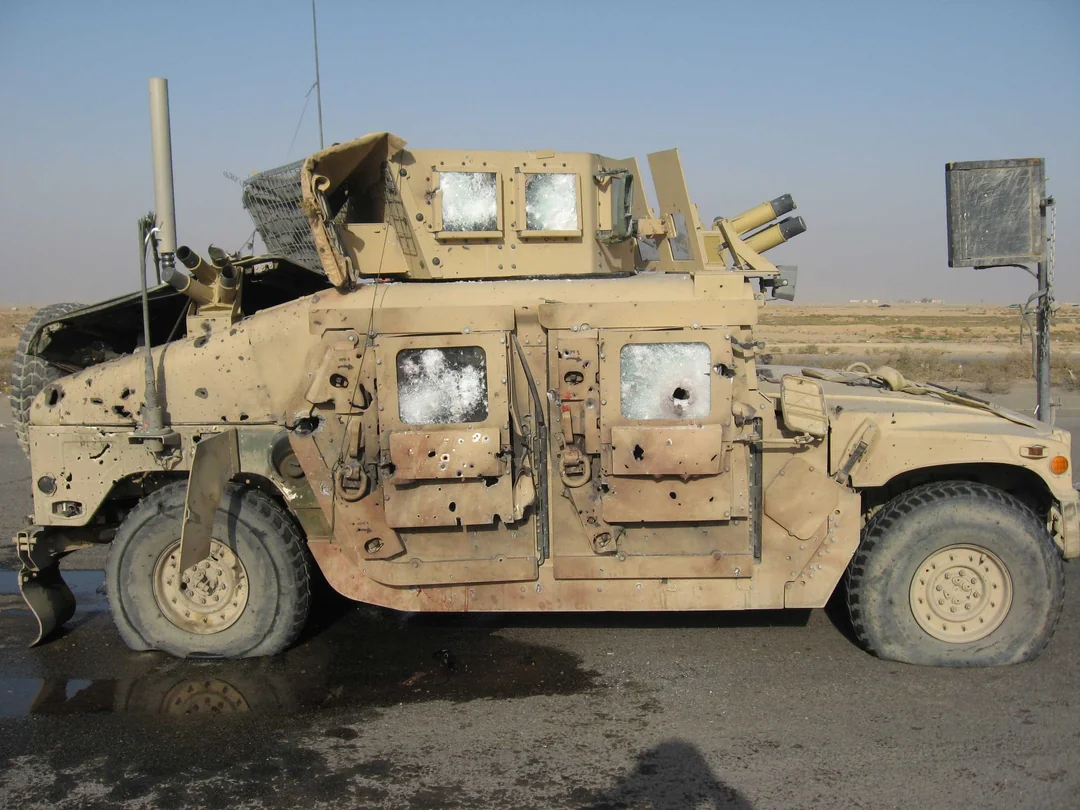
- Improvised Explosive Devices (IEDs) or Roadside Bombs (RSBs) used against the coalition in the Iraq War of 2003-2011. Insurgents learned to make these EFP weapons using ordinary metal pipe and copper discs. Because the EFP can penetrate armour from dozens of metres, there were plenty of places to hide the IED.
In my own training experience, was that it was alarmingly easy to make improvised EFPs from household items. Although we often achieved a shotgun-blast spatter effect (multiple holes from smaller slugs), there was usually a “main” slug which had devastating penetration on whatever target we used.
High explosives, fun though they are to practice and train with, are not the only way to get through armour plate.
…but they’re not the only the only solution
Kinetic energy or “long rod” penetrators (KEPs) are an emerging solution to the problem of tank-on-tank action. Instead of using a warhead, the idea here is to fire a projectile really, really fast. Not quite as fast as an EFP, not nearly as fast as a shaped charge jet, but much faster than a bullet.
I spoke about KEPs in my HEAT article (and used the image below), and touched on them in my external ballistics article too. To compare HEAT and KEP rounds:

The critical point about KEPs is that they use the same mechanism of attack as shaped charges: they travel so fast that material strength doesn’t matter so much. The longer and denser the projectile is, the more it will penetrate the target. This is known as “hydrodynamic penetration.” Which still has nothing to do with melting temperatures!
Material choice is just as important for KEPs as it is for bullets. The penetrator needs to be made of a material that’s dense (to maximise penetration), tough (to resist shattering), hard (to maximise penetration in non-hydrodynamic conditions), and strong (to resist fracture). Tungsten alloys and depleted uranium are two ideal candidate materials. Although the latter gets more negative press (aArGhH! rAdIaTiOn!), both are nasty materials which have potential health effects from over-exposure. By far the nastiest health effect, however, is if they penetrate an armoured vehicle in which you happen to be sitting.
Kinetic energy penetrators represent the pinnacle of gun design. They have been used successfully by both sides in Ukraine, although anti-tank missiles and drones seem to get more media attention over here.
The disadvantage of KEPs is that they are ruinous on gun barrels, as I alluded to previously. A tank might only get a few hundred of these KEP rounds off before needing a new barrel. This is because they are fired at nearly twice the velocity of a full-bore explosive warhead round, which means the barrel has to endure higher pressures and temperatures and therefore wears quicker.
Conclusion: it’s literally an arms race
Before we wrap up, let’s take a moment to compare the velocities of the various projectiles we’ve spoken about here:

The variation in speeds illustrates the diversity of threats facing the armour designer. They have responded to these threats with bigger and thicker armour plates. They have also relied on novel techniques such as explosive reactive armour (ERA), which I don’t have time to get into here, but might do again. It’s quite literally an arms race between the weapon and the armour designer at the top end (e.g. tanks).
There’s a way to protect against every type of ballistic threat, which is a comforting thought. On the other hand, there’s a way to defeat every type of protection as well. It might be less comforting to know that whatever level of protection you seek, someone has designed the most cost- and energy-effective way to defeat it.
On that grim note, that’s all for this week. Thanks for reading and please remember, if you haven’t already, to subscribe using the link below. Please also share this article with a friend. See you next week.
Featured Image: Humvee after an Explosively Formed Penetrator strike, via user 3rdweal on Reddit.
- Forgive the jargon. “Signatures” refers to things like heat signature, radar signature, acoustic signature, even visual signature. Anything that allows the enemy to detect, recognise, and identify you (link here if you want to learn more about this topic, at least in the optical sense). ↩︎
- This is military jargon for unarmoured. ↩︎
- Stop sniggering in the back, please. ↩︎
- Most projectiles penetrate a target to some degree, if they pass through to the other side they’re said to have perforated it. All perforations are penetrations, not all penetrations are perforations. ↩︎
- Depending on the geometry of the warhead and its angle of attack, fragments can be directional rather than going everywhere. I’m being simplistic above. ↩︎
- Reminder that the fuze (or fuse) is the part of the warhead that 1) stops it from detonating prematurely, 2) senses when the correct moment to detonate is, and 3) kick-starts the explosive train when that moment arrives. ↩︎
- That’s the technical term. ↩︎


.svg)


Leave a Reply to The DirectorCancel reply