Military world-building for creators. Part 1: C4
That’s not how the army WORKS…
—Me, all the time, to the TV, to the eternal annoyance1 of my wife
Hello and Happy Thursday. This week I’d like to start what will hopefully be a mini-series on how to build realistic military worlds. Whatever your particular fiction is, whether it’s a screenplay you’re writing or an upcoming stint as D&D dungeon master, I’ll give you the basics. Armed with this series of blog posts, you can go forth and write more engaging military fiction. Or, you can use this knowledge to point out when other people are wrong. Which, let’s admit it, is just as fun.
We’ll cover the technical stuff in later posts. Today’s overview will look at what I’m calling C4.

No, not that C4. What I want to cover today is Culture, Characters, Conflict, and Context. The best way to get this right, aside from having real military experience (and even if you have this) is to read a lot. Fiction, non-fiction; stories set in the distant past, recent past, or future; techno-thrillers and science fiction satires. I’m not a historian, so my focus will be on the obvious things that I think every aspiring military writer should know.
This isn’t about being realistic: you can have bio-engineered space marines fighting aliens from Zebulon Prime (and, really, someone ought to fight them). You still need to make your story plausible, and that comes from getting the military culture, characters, conflict, and context right.

Before we start, let me encourage you to subscribe to the blog using the link below. As always, I’d love to see your comments below, or you can contact me via webform here or email here. Finally, if you’ve enjoyed this post, please share it with a friend.
If you enjoy this blog and want to support it, please consider a donation. Keeping this blog going doesn’t cost much, but it isn’t free either, so any help would be very much appreciated👍
Culture: What are you fighting for?
This is a natural place to start, because your story is going to be set in a particular world, and the values and morals of that world will determine what your military culture looks like. You need to convince the reader that the soldiers, sailors, or spacemen in your story have a valid motivation to risk their lives and limbs.
For example, if you’re writing a story set in a feudal society, then your military forces should reflect the social and economic ties of that society. One lord or king will have several subordinate nobles (or vassals) in their service, each of whom has their own vassals, and so on. Your nobles are your natural “officer class” (discussed further in the next section), with each one bringing a body of foot soldiers commensurate to their lands and wealth.
In this society, the political and military leaders are one and the same, and the force which impels men to risk their lives is the social tie they have with their liege lord, their fellow farmers, or even their blood relations.
This goes just as much for Space Feudalism as it does for historical feudalism: Dune is a good example of this. The Atreides dynasty‘s soldiers are bound by a strong loyalty to the Duke and ruling family. What we don’t see (and perhaps should) is the extent to which the Atreides military are either a professional soldier class maintained by the economic surplus from their home planet, or a levy of the vassal minor lords to the Duke.
Either way, these poor devils are no match for the Sardaukar, a race of fighters from a prison planet (like the Spartans, their success come from the slavery/mass murder of an underclass):
If your fictional world is an egalitarian democracy, then your soldiers should talk and act like free citizens, albeit ones who have gone through a process of dehumanisation military socialisation. You have some creative control here as to how disciplined or not the force is. Disciplined or not, they will argue, have individual thoughts which they expect other people to care about, and will know their own rights.
This does not necessarily mean they have to be lily-livered victims of wokeness. The American military has a stellar operational record (even if their strategic record is patchier, e.g. getting into unwinnable wars), despite periodic moral panics about its degeneracy. One of my favourite science fiction franchises, Iain M. Banks’s Culture, is about a futuristic race of humans and machines in a post-scarcity economy. Its soldiers and warships (for these are sentient too) are individualistic and independent-minded, but will go to the ends of the galaxy to protect their civilisation and their freedoms.
To take a third example, let’s say your world is an authoritarian dictatorship. Then your military characters will likely have been conscripted. The military structure they serve in emphasises a strict and unquestioning adherence to orders and may be more brutal and dehumanising than a freer society.
It’s also probably rife with corruption and has weaker (but still there) ties of comradeship. Most of your characters (especially if they are enlisted men) will grumble about things, but will have a finely tuned sense of when to shut up, i.e. how to spot and be careful around the true believers.
The original Star Wars trilogy presents the Imperial military (especially the Stormtroopers) as one-dimensional, with only the occasional bit of individual identity (e.g. Han arguing with a “superior” over the radio). This is forgivable because the focus of the story is on the Rebels, but it’s still a weakness. The sequel trilogy goes a bit deeper, with FN-2187 (Finn) rebelling against his military structure (which is essentially his entire being up until then) in The Force Awakens.
An alternative approach is to go satirical and really ham up the fascism for effect, like Starship Troopers did, but you run the risk that people don’t get the irony:

These are just some examples of possible social structures which dictate your military forces: there is as wide a spectrum as there are types of society. I’m not saying that any particular military should look like X or Y, but rather it should turn a mirror on the society it’s drawn from.
Militaries don’t exist in isolation from their culture, and when you’re sending your fictional soldier into harm’s way, you owe him or her the courtesy of a decent motivation. This could be social pressures, a desire to defend their cherished democratic freedoms, or the fear of punishment from one’s own side. Let’s talk about some characters in the next section.
Characters: Who are we cheering for?
Now that you’ve decided on a social structure which will determine your military culture, it’s time to fill that world with characters. The first and most obvious problem you have is that military socialisation2 is explicitly designed to de-individualise.
An ideal soldier is just a commodity: it doesn’t matter what his or her name is, whether they’re shy or gregarious, an early riser or a night owl, iPhone or Android, cat lover or dog person. I spoke about this in my review of Warfare: Ray Mendoza gives us 90 minutes of hyper-realistic military experience, to the extent that the characters are paper thin, at least during the time we see them.
So am I saying that it’s impossible to write good characters and be realistic? No. Warfare got away with it, but I suspect they will be the last. In fact, and luckily for you, the ideal soldier doesn’t really exist. The de-humanising effect of military socialisation can only go so far, since the recruits are still human beings.
I’m watching (and enjoying) Boots right now, and the writers serve us characters, not de-humanised soldiers. This is why we spend a lot of time in the squad bay as the recruits clean and bitch and plot and get to know each other better, and not so much time square-bashing or running in formation, both of which would also take up lots of their time, but wouldn’t give us, the viewers, much insight into the characters3.

You need to decide if your main character—or characters—are officers or enlisted men4. This difference can seem academic to civilians: after all, it’s just different grades of management, right? Yes, and no. But mostly no. For your fictional world to resonate, the characters need to know their place in the great hierarchy. It doesn’t (usually) make sense to have a plucky trio comprising a Private, a Lieutenant, and a General (or a grizzled Sergeant-Major, for that matter).

Having said this, there is (always) scope to mess with this system. The relative importance of the officer/men distinction and the fluidity between the ranks can be a good indicator of how progressive or traditional your imaginary society is. I like to think South Park‘s Trey Parker and Matt Stone were doing this when they combined shoulder stars and sleeve stripes on their generic generals, but I suspect not:

Dad’s Army plays with this relationship beautifully. The preening, petite bourgeoisie platoon commander Captain Mainwaring feels has a chip on his shoulder because his 2IC, Sergeant Wilson, who is his employee on civvy street, is his clear “social” superior. Wilson is a public school man and saw real action as an officer in the First World War.

Of course, social class can be inverted in the military, and wartime is an excellent opportunity for this. Whether class is inverted or maintained, the officer/enlisted difference is a great source of drama in a story. You need to understand its importance, though, so that your characters can too, and will come across as more believable to the viewer or reader.
Resist the urge to make your characters officers (especially senior officers) just for the hell of it, because you want to give them the rank you think they deserve. Officers spend their time behind a desk, whereas it’s the NCOs and Privates who actually do the cool stuff6. Making the officer your main character is like writing a story about musicians but focusing on the band’s manager.
Tom Clancy gets away with it (e.g. Red Storm Rising, The Hunt for Red October) because he’s telling the story of entire army divisions or ballistic missile submarines. He knows his shit, in other words.
Saving Private Ryan exemplifies the problem for filmmakers. You can see how the logic of military command structures led to the convoluted quest plot:
- We want our main character to be an officer, because Tom Hanks deserves no less…
- But we don’t want him to be a pimply-faced Lieutenant. He needs to be at least a Captain…
- But this means he should have a company to lead.
- Oh, but we don’t want to have to get to know 100+ characters. Can we make it a small squad?
- Right, it needs to be some kind of super sensitive mission to justify sending a Captain and a squad of men.
- Saving
Matt DamonPrivate Ryan it is!
Now that we have our characters, let’s put them in harm’s way (only to save them, of course. Right?).
Conflict and Context: What’s the sticky situation?
The stakes are important. They are the reason your character is hanging around to fight instead of running away somewhere that’s safer, and probably warmer and drier too. The opening scene of Civil War is a textbook example of this. The President’s bombastic speech contrasted with his hesitant practicing beforehand lets us know that it’s going very poorly indeed for the Government forces:
The fictional fight itself can come in many forms, from a low-level insurgency to intense peer-on-peer conventional warfare. The military force’s behaviour should, in some way, be justified by the context. If they’re taking losses from roadside bombs and a hidden enemy, then they’re more likely to carry out reprisals against the “enemy” civilian population. If they’re grinding out a war of attrition against an implacable foe, then cynicism and disillusionment at one’s own command is likely—even (or especially) with a humorous twist, e.g. Blackadder Goes Forth.
If the fighting is going well, then you can still expect ill-discipline, petty infighting, and bullshit edicts from higher HQ. The last Band of Brothers episode depicts this anticlimactic end to the war.
When it comes to the fighting itself, remember that real soldiers need motivation and hope. They won’t just get up and sacrifice themselves to their enemy’s bullets. This is not the impression one gets from most military strategy games, which tend to revolve around building huge armies and wasting them all in doomed assaults where every last one of the dies. Real units can only take a certain number of casualties before becoming combat ineffective and needing relief.
Reality is not like a real-time strategy game. As Bret Devereaux writes in his Total Generalship series, real-life commanders in pre-modern armies operate with much less information and much, much less control than a player of a video game. This means that, thankfully, not every battle is like The Somme.
The reality of life for the soldier won’t be killing and dying 24/7. As Kimberly “Sweet Brown” Wilkins said:

Real units rotate in and out of major theatres of operation. Even when a unit is in combat, only a minority of the force will be close in and engaging with the enemy. The rest will be held in reserve or will have a role in suppressing the enemy with powerful fire.
Even during the First World War, that archetype of wasted human life, there were sectors of the front which were deemed “quiet,” i.e. there would be a tacit agreement between both sides to “live and let live.”
When it comes to the ideology of your characters, I’m going to make a rare criticism of Catch-22 here. Yes, it’s one of my favourite books and a perfect encapsulation of the absurdities of military life. However, the book is populated with characters who are openly cynical about the ideal of fighting (and possibly dying) for their country. Yossarian, the antihero, is the main source of this nihilism, but most other characters share it to some extent.
Just because you don’t believe in soppy things like dying for your country, your characters need not share that belief. The real world has many more Natelys than Yossarians, at least when the stakes are WW2-level high. To be fair, this was openly acknowledged by Heller, who himself saw Catch-22 as a critique of early Cold War American military ideals.
Conclusion: There’s plenty of choice
When you’re writing a military story, just like any story, you have near endless choices. The points above, I hope you’ll agree, are not about constraining your options, but pointing you toward the kind of in-world considerations you’ll need to make so that your story resonates.
And, yes, perhaps it’s only military nerds like myself who will be throwing things at the screen when it doesn’t make sense. Nevertheless, your wider audience will still sense that things aren’t right, even if they can’t put their finger on it. We’ve all been exposed to plenty military world-building in books, TV, and cinema, much of it decent, so we don’t need a chest full of medals to see when it’s wrong.

The sense of dislocation brought on by weak military world-building will undermine their credence in your entire fictional world, and therefore in your story. That’s not to say that you need to go down a rabbit hole and create an entire military organisation on paper before writing a single scene: that way madness (or r/MilitaryWorldbuilding) lies.
My advice is the opposite: create your story, build your world as you go, and then do a sense-check to see if it’s coherent from a military point of view. You can even use this series to help. If it is, great. If not, this will give you the tools to make the minor adjustments needed to prevent the Nerd Brigade from spitting out their tea and spluttering at the TV to their long-suffering, eye-rolling other halves.
That’s it for this week, folks. I’ll cover more technical aspects of world-building in later posts, maybe not next week though. Do let me know what you think, and if there’s anything I’ve left out.
Thanks for reading and please remember, if you haven’t already, to subscribe using the link below. Please also share this article with a friend. See you next week.
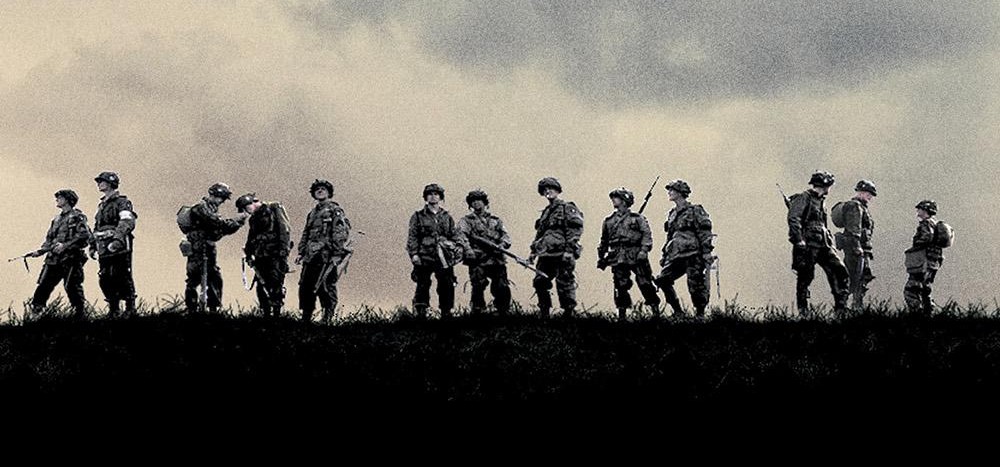
Featured Image: Band of Brothers, HBO (2001)
- Wife: It’s more like resignation, to be fair. Sometimes, I have a mental countdown clock to the comment, and a secondary one for when we have to turn the programme off. ↩︎
- A euphemism for the mental, emotional, and physical stresses which are part of basic training. ↩︎
- The shaved heads makes it even harder to pick out individuals when they’re moving as a formation. There would be no such difficulty for the Marine themselves. In training, you get to know your comrades by the back of their neck, their gait, their snores, and many more details besides. ↩︎
- “Men” is the generic term military term for “non-officers” (regardless of their sex). It’s less in vogue now, of course, but does have a lovely ring to it. You’ll see it on memorials, e.g. “This tablet is dedicated to the Officers, NCOs [non-commissioned officers] and Men of the 12th Battalion, Ulster Fusiliers.” It allows the words to be inclusive and still hierarchical, which is what the military is all about. ↩︎
- One big omission, for example, is the kind of vocational training in specific weapons or skillsets (e.g. reconnaissance) which is part of every military person’s career. Often, this training is common, because officers and their men need to know the same basic skills. ↩︎
- For the most part. There are some “operator” jobs which are officer-heavy, e.g. pilots. ↩︎


Leave a Reply