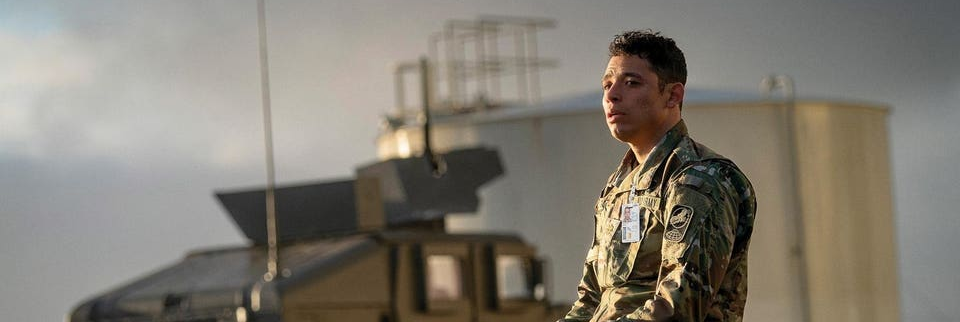
Part 1: Kathryn Bigelow’s latest film promises fission but ends with a fizzle.
Hi there. This week, as a natural follow-on to last week’s discussion on nuclear-powered cruise missiles, I want to give my perspective on Kathryn’s Bigelow’s recent Netflix hit, A House of Dynamite (HoD). This film has gained popular and critical acclaim since its release. It’s widely seen as a long-overdue addition to the nuclear doomsday popular culture canon. As Tom Nichols of The Atlantic says:
In recent decades, nuclear war has all but vanished from American movie screens, replaced since the end of the Cold War by special-effects blockbusters about zombie plagues, alien invasions, and errant asteroids… But the world’s nuclear weapons haven’t gone anywhere.
Bigelow and Noah Oppenheim, HoD’s writer, say that the ambition of the film is to spark discussion around nuclear weapons strategy. Regular readers of this blog will see similarities with Annie Jacobsen’s book Nuclear War: A Scenario, which I reviewed here two months ago1.
Today I’m going to talk about the events of the film itself, what I think about the film’s ending, and what the message and moral of the story is. I’ll wrap up with a reflection on the nature of democracy and nuclear strategy. I wanted to include a bit about how realistic (or otherwise) the film is, but that grew to be a full article in itself, which I’ll do next week.
If you want a TL;DR of Part 1, here it is:
- HoD follows the USA’s minute-by-minute response to a surprise missile attack, using three separate perspectives. It’s a detail-oriented drama that will have you on the edge of your seat until the very end…
- …which is a bit of a cop-out, leaving the watcher in suspense. The filmmakers, and many reviewers, defend the ending, but it’s been divisive.
- The message at the heart of HoD is that nuclear deterrence doesn’t work, but it could also be read as a salutary warning to America’s adversaries.
Warning: there are many spoilers ahead.
Before we start, let me encourage you to subscribe to the blog using the link below. As always, I’d love to see your comments below, or you can contact me via webform here or email here. Finally, if you’ve enjoyed this post, please share it with a friend.
If you enjoy this blog and want to support it, please consider a donation. Keeping this blog going doesn’t cost much, but it isn’t free either, so any help would be very much appreciated👍
The film leans into its titular metaphor
A ballistic missile is launched from somewhere in the Pacific: nothing new here. Operations officers in the White House Situation Room and an early warning station in Alaska track the little dot on their big screens, assuming it’s another harmless test. About a minute later, the missile has travelled far enough that their satellites and supercomputers can predict its trajectory. Its point of impact is somewhere in the continental United States. This is no longer a normal day in the office.
A breathless half hour later, the world is on the brink of nuclear Armageddon as the President is about to give the order for an all-out first strike on Russia, China, and North Korea. “This is crazy,” the film’s protagonists say. We, the audience, think the same. How has it gotten to this? Something else must have happened which we didn’t see.
Then the film rewinds and puts us in the shoes of the US Strategic Command and the Deputy National Security Advisor as they grapple with the same dilemmas over the same timeframe… then it does the same with the President himself. The weaving of the three perspectives is expertly done, with enough repeated dialogue to keep you located in the correct part of the sequence, but not so much as to make it dull or repetitive.
The three perspectives lure you into thinking there’s a deeper story that must explain the rapid escalation. There isn’t, but the film is so well shot that you feel for President Idris Elba while he grapples with his fateful decision. “What would I do?” the viewer asks themselves. We can understand why the President escalates (maybe/probably) to all-out war, even though it makes no actual sense, not even to the characters we empathised with sixty minutes before.
Imagine, a room, awash in gasoline. And there are two implacable enemies in that room. One of them has nine thousand matches. The other has seven thousand matches. Each of them is concerned about who’s ahead, who’s stronger.
This Carl Sagan quote is one potential source for the “house filled with dynamite” metaphor which President Elba uses to describe the situation he’s in. Bigelow skilfully plays with our empathy to make what is a terrible set of decisions seem not only plausible, but inevitable, because of this metaphorical dynamite all around us. Is it? We’ll get to that next week. But while we’re on the subject of dynamite, which I’ve written about before, allow me to put on my extreme pedant hat and dig out the deleted scene where Lt Cdr Reeves pulls up the President on his metaphor:

Okay, sorry about that. Joking aside, HoD convincingly brings us down the path of how things might play out while the most consequential decision in the history of the world is being taken. And what decision is ultimately made, you ask? Let’s talk about A House of Dynamite’s ending.
The ending is divisive and a cop-out
Each time we run through the timeline in HoD, we end with seconds to go until the (potentially nuclear) missile hits Chicago. The President has to make a choice. How will he respond? His options are:
- Do nothing, and earn the opprobrium of the stern General Brady, the clean-cut nuclear football-carrying Lt Cdr Revves, and, presumably later, of the American people,
- Carry out selected or limited nuclear attacks on adversaries unknown (there’s a lot of pages in the book, and we don’t see POTUS2 read very much of it),
- Launch a full nuclear attack on China, Russia, and North Korea, hoping to blunt their capability to respond. This is the “well done” option which Reeves advises.
It’s a ridiculous set of options (which we’ll return to next week), but the tension is real and we feel the weight of the moment. When the first timeline run-through gets to this point, it goes black… then back to the start. Clever! Keep the tension up and keep the audience guessing.
On the second run-through, we get to the same point, and… Bam! Back to the start. Nice. Still a cliffhanger as we go into the third run-through, where we’ll finally see what decision POTUS makes. Right? Wrong. Let’s take a look at the script:

The filmmakers leave us on a cliffhanger, which is very mean when they’ve teased us twice already with the countdown. Their reasoning?
We don’t want to give the audience a clean and neat resolution
I’m sorry Noah, but that’s your actual job as the writer. You don’t get to draw me in for nearly two hours and then leave the rest of it up to me to decide. I’m not the only person who thinks this!
Just because Inception got away with it, doesn’t mean you can. Besides, they ended Inception on the ambiguous spinning top scene. Frustrating, but artfully done. HoD ends with the President’s non-decision, but then shows us a parade of key officials filing into a nuclear bunker, and our missile defence Major Gonzales looking sad.

Is he sad because his interceptors failed? Or because the missile turned out to be a nuke and destroyed Chicago? Or because the President pressed the “end world now” button?
And the folks in the bunkers: would they still be going in there if the President had chosen the “don’t end world now” option instead? We don’t know, so we need to speculate.
My point is that the ending is unsatisfying not only because of the unresolved cliffhanger, but because we’re left with these tea leaves to try to sift through for clues. In my opinion, Oppenheim and Bigelow wanted to do the Inception trick, but also wanted us all to know what way they think it went. It’s like if we had another Di Caprio dream sequence after the spinning top. Just so we all had the right idea. They’re tipping their hand while claiming plausible deniability.
Unsatisfying ending aside, what do we take from HoD?
What message is HoD trying to send?
The primary reading of HoD is that we (the world) have built up systems of nuclear armament which are 1) utterly devastating and 2) extremely fragile. It’s difficult to dispute this. The first point is well-illustrated by Our World in Data with an infographic showing the total amount of “destroyable area” by nuclear weapons deliverable in a first strike, i.e. those weapons already loaded onto bombs or missiles:

Even today, after drastic reductions in the number and explosive power of nuclear arsenals, the world’s major powers still possess enough boom to devastate 7% of all built up area. You would have to assume that urban casualties would be more than 7% of the total, though, since large population centres would be disproportionately targeted.
As for point 2, the fragility of the system, we will discuss this a bit more critically next week, but it’s fair to say that any system that has a single point of authorisation (i.e. POTUS in the US) is fragile. That, in addition to the razor-thin time window for making a decision, makes it scarily fragile.
Toward the end of the film, President Elba recognises the fragility of the situation, how everything they do is about deterrence, but now deterrence has failed:
I always thought having [the military aide] follow me around with that book of plans for weapons like that… Just being ready is the point, right?
Keeps people in check. Keeps the world straight.
If they see how prepared we are, no one starts a nuclear war, right?
This is the core message of the film. Deterrence only works until it doesn’t. And then it really, really doesn’t.
For a while after watching this, I wondered whether it was an elaborate US psychological operation (psyop). A way of signalling to Russia and China (and maybe even North Korea) not to try any funny business, because the USA’s system is so fragile and its generals so gung-ho that they might just go ahead and end the world.
It reminds me of Blazing Saddles, albeit if the sheriff had a hand grenade instead of a pistol:
Whether it is a conspiracy or not (and I suspect not), this film will do wonders for American deterrence. Any adversary watching this will get the message: “If you’re going to hit us, you’d better finish the job, or we’ll finish it for you.”
A supporting message to the “fragility” one is the “anti-jingoism” one. There’s an interesting parallel between HoD and that other Cold War classic, Dr. Strangelove. Both feature a bellicose general who advises the President to attack with every available nuclear asset, thereby hobbling the enemy and limiting the casualties to the low eight figures:

The difference between both films is that President Merkin Muffley in 1964 never seriously considers this option, whereas his counterpart 61 years later is implied to have chosen it.
Conclusion: Nobody voted for this
STRATCOM rehearses it 400 times a year, the president of the United States, the person who in our system is the only one who has to make this decision in the end, he or she has probably never rehearsed it… The last president who participated in nuclear drills was like Nixon. I mean, they don’t do it. They get a briefing… when they come into office. About the military aid who follows them with the football and how that system works and what options they’re gonna see if that nuclear decision handbook is ever opened up and placed in front of them… But they don’t then, you, know, once a week go through a drill where somebody says to them, if this happens, here’s how it works. So we were left in a situation where the person was the most power has the least practice, the least expertise.
—Noah Oppenheim, in conversation with Jon Bateman from Carnegie Endowment for International Peace
Nobody voted for nuclear annihilation. When it’s suggested to President Elba that he not respond immediately to the nuclear attack on Chicago, he asks incredulously whether “the American people are gonna go for that?” He may well have wondered whether they would “go” for the destruction of dozens of their cities during the inevitable counterstrike from Russia, China, and North Korea.
This might not be the most realistic response from the President, but we’ll get to realism next week. Suffice to say that it’s plausible that a President, deep in shock at the rapidly-unfolding catastrophe, would make such a terrible decision. And it’s plausible because, as Oppenheim pointed out in the interview quoted above, presidents don’t practice this.
Responding to a nuclear attack is the single most important decision that a US president will have to make, and they get one briefing and may never think about it again.
This is the scariest part of A House of Dynamite, and it’s something that Bigelow and Oppenheim are to be commended for bringing to the fore. If you haven’t watched this film yet, make it your business to do so, if only to experience, thrice, the scarily short countdown from detection to destruction. The nuclear Sword of Damocles hangs over all of our heads, no matter who or where you are. You owe it to yourself to watch this film and remind yourself of the threat.
Thanks for reading and please remember, if you haven’t already, to subscribe using the link below. Please also share this article with a friend. See you next week.
Featured Image, along with all images and quotes, unless stated otherwise: A House of Dynamite, Netflix (2025)
- Did Bigelow and Oppenheim base their film on the book? It’s possible, and you can follow this debate on Reddit here. While there are some eerie similarities, I think Jacobsen’s book is a much wider study. Besides, the film was likely well into production when the book came out, so it’s hard to see how the latter would have influenced the former. ↩︎
- President Of The United States. ↩︎
- Full quote: “We chose the ending we did because Kathryn and I both believed that any other ending would let the audience off the hook… “We don’t want to give the audience a clean and neat resolution. Any ending where the world is saved or the world is destroyed allows people to kind of walk out of the experience and say, ‘Okay, well, that’s that…. It ended that way, and it’s over, and I can go back to my everyday life.’… I think we’re trying to invite the audience to lean into a conversation, not about the specific scenario in this movie, but about the world in which we live. That regardless of what those characters decide, we walk out of the theatre or turn off the television, and we’re still in a world where there are several 1000 nuclear weapons, many of which are on a hair trigger.” ↩︎

Leave a Reply