All you need to know about EOD on one page.
Explosive Ordnance Disposal, or EOD, is a specialised military (and sometimes civilian) capability which is all about making dangerous explosive threats safe. It also occasionally crops up in TV and films, usually as a way to add tension to a climactic scene, but occasionally as the story itself (e.g. The Hurt Locker, which I have devoted a whole section to below).
It’s one of those niche military skillsets that somehow our hero is always fluent in, regardless of whether he is an international secret agent or a municipal police detective. Regardless of who’s doing the bomb disposal, the actions themselves are portrayed as tense. The stakes are high because the consequences for failure are total:

This is the part where I’m supposed to say that EOD is actually pretty humdrum. In time-honoured fashion with this blog, I ought to rain on your childish belief in the inherent coolness of a job. I ought to tell you that the cool parts are grossly exaggerated and the lame admin bits take up most of one’s time.
I ought to, but I won’t, because it isn’t true. EOD actually is cool. It’s genuinely, unequivocally, unapologetically cool. I never felt as accomplished as I did in the EOD truck, with blue lights on and police escorts front and rear, speeding through the city to get to the scene of the task. EOD incidents draw crowds, and every eye is on you as the police bring you through the cordon. What’s more, everything you do is in the public eye, so it’s a high-stakes bit of improv theatre performed to an extremely fickle audience.
No matter how rigidly you’ve followed procedures and relied on your education and training, no matter how many precautions you’ve taken and safety measures you’ve put in place, there’s nothing like the adrenaline of pressing the button and waiting that fraction of a second (which feels like an age) to hear the bang—the right kind of bang, the bang that marks one infinitesimal but oh-so satisfying victory in the great war against explosive threats.
Awesome and all as EOD is, Hollywood still manages to take quite a few liberties. Sometimes this is forgivable for the sake of drama, sometimes it’s just incoherent or farcical. There are also aspects of EOD which (in my biased opinion) are just as gripping as the big explosions but are usually overlooked.
I put this page together to collect some of my weekly articles on EOD and weave it into an overall explainer for you. I’ve gone through a few Hollywood examples along the way so you can see what works and what doesn’t. I’ll start with a less Hollywood-y but very common EOD scenario: the buried bomb from WW2. Then I’ll talk about improvised explosive devices, focusing mainly on car bombs and bombs in cars (there’s a difference!) because that’s where a good chunk of Hollywood’s attention goes. Then I’ll talk about what it’s like to wear the bomb suit before covering manual neutralisation techniques, a.k.a. snipping red and/or blue wires (another Hollywood staple). I’ll finish on a case study of The Hurt Locker, since it’s arguably the archetypal EOD movie.
Click here to read the whole thing, and pop the page in your bookmarks for easy access the next time you need to “well, actually” somebody.
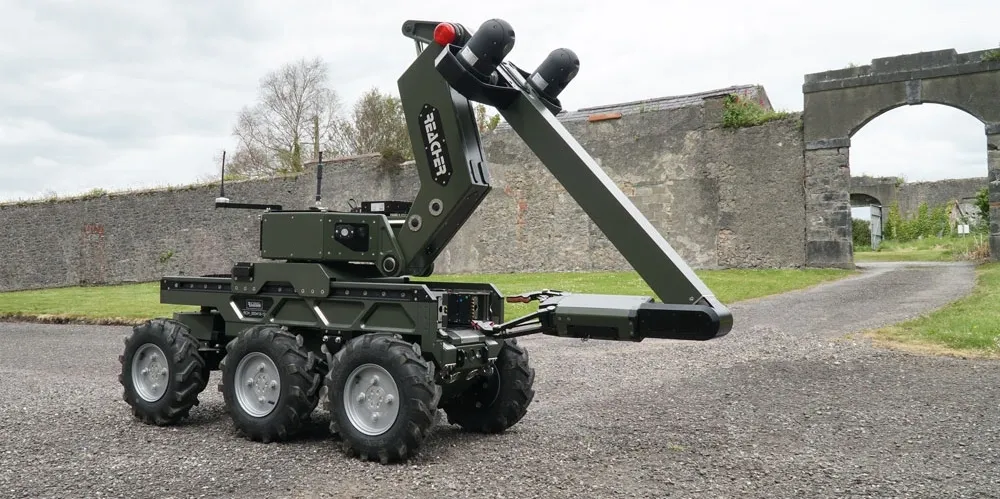
Cover picture: Reacher EOD robot (Reamda), via EOD Robots | Secure life group

Leave a Reply