The movie myth of complex planning
I recently re-watched Christopher Nolan’s Batman trilogy because it landed on Netflix and it had been a few years since I’d seen it. Quite a few years, in fact, when you look at Morgan Freeman’s indignation at a surveillance program on people’s phones in The Dark Knight:

As insidious as tech surveillance is, it’s not my reason for writing this week. I wanted to spend some time talking about plans in movies. Because, although the three films are great (in my opinion), they contain some wildly implausible plans which we’re supposed to swallow.
This is part of a wider movie tendency for having elaborate plans, and I’d like to contrast this with my own experience of planning small-scale military operations.
And yes, despite what Blackadder would have you believe, our battles do indeed have plans.

I’ve spoken before about special operations plans and the virtues of a simple plan, well-rehearsed. This was evident when the US Delta Force went into Caracas and kidnapped Nicolás Maduro, which I wrote about shortly afterward. Proper planning is not unique to special operations.
This time I’d like to focus on three characteristics of military plans which differentiate them from most plans we see on screen, even in military stories. Firstly, real plans are simple. They are not complex, because they need to have the highest chance of success. Secondly, they are rehearsed. No-one carries out a plan without practising the most critical parts, but this is something we rarely see on screen. Thirdly, they are well-understood. By this I mean that the people carrying them out know most, if not all of the details of the plan. This is in contrast to movies, where sometimes only one person knows the plan from start to finish.
Before we start, let me encourage you to subscribe to the blog using the link below. As always, I’d love to see your comments below, or you can contact me via webform here or email here. Finally, if you’ve enjoyed this post, please share it with a friend.
If you enjoy this blog and want to support it, please consider a contribution. Keeping this blog going doesn’t cost much, but it isn’t free either, so any help would be very much appreciated👍
1. Real plans are simple
Keep it Simple, Stupid
Is what every military instructor, ever, has said to their charges at some point. Simplicity is a virtue in the military. Higher still, in fact, it’s a Principle of War, at least for some. Simplicity is important not because military people themselves are simple (although physical degradation and lack of sleep can have that effect) but because what we do has such high stakes.
Complexity results in many failure points, so when your plan absolutely must succeed, it should have as few of these as possible. It should, in other words, be simple. As usual, the great Clausewitz has covered this:

How simple? At a section level (about nine soldiers), the algorithm for taking an enemy position goes something like this:

There are a grand total of two decisions that the commander (normally a Corporal) has to make:
- Can we do this ourselves?
- Which flank (side) do I attack from?
That’s not a complex plan. It’s very simple. But as anyone who’s done it will tell you, it’s one of the hardest things to do right. That’s because every single one of those boxes comprises a series of standard actions that you need to orchestrate while lying on your belt buckle in a freezing cold puddle of mud, laden with useless kit, trying to draw a sketch of the terrain with a grease pencil on a piece of disintegrating paper. While the machine gun is chattering away next to you. And also the shouting. Lots of shouting.
The plans get more complex as you go up the ranks, but only slightly. A platoon commander rotates their three sections through multiple iterations of the above plan to neutralise multiple enemy positions. A company commander has three times as many soldiers again but still follows the standard Assault—Suppress—Reserve formula I showed above. They might, however, have heavier weapons to play with such as machine guns or light mortars.
Even as more assets get drawn in, the plans remain simple. The mortars will fire at the enemy from a position of relative safety1. The machine guns will fire at the enemy from a position of overwatch. The anti-armour weapons will deploy against, you guessed it, the enemy’s armour.
What would a film character do in these situations? Definitely not keep it simple. They never do. In films, the more complex the plan is, the more we admire the character carrying it out. This is true of goodies and baddies, both of whom appear to take the famous Swiss Cheese Model of Risk Management and use it aspirationally:

This is the movie character playbook. Never plan anything the easy way, because you’ll always roll a natural twenty when it comes to carrying out the plan2.
No-one ever falls asleep, or trips, or loses the key, or forgets their respirator, or forgets which person they’re supposed to double-cross, or misses a wildly implausible shot.
Rick and Morty summed up the silliness of movie heist plans:
2. Real plans get rehearsed
A good set of rehearsals can save a poor set of orders
Talking through the plan is only half the battle. Any good commander will then spend as much time as possible rehearsing the most important or finicky parts of it.
This doesn’t need to be a full “dress” rehearsal. Obviously, if you’re about to deploy from a covert patrol harbour, then you’re not going to do full contact drills with live ammunition and shouted orders. But you can talk through the responses with your team, with everyone in close, just to practice muscle memory.
You might not realise how important rehearsals are until you’ve given a set of orders, left out the rehearsals, and then done the operation. It won’t go to hell straight away, but a time will come when you’ll reach an important step and realise you don’t know what you need to do. It’s only by doing the rehearsals that you realise the little details that need confirmation.
I recently wrote about how the US Delta Force built an entire fake replica Presidential compound before their operation to kidnap Nicolás Maduro. Special Operations Forces have the luxury of time and resources to practice extensively, but all soldiers will do at least some rehearsals before any operation.
The Dark Knight Rises opens with Bane and his team audaciously hijacking a CIA plane. This is a spectacularly complex plan (see previous section on simplicity3), but the part I want to focus on is here:
Bane tells his underling that he (the underling) must die in the crash for believability. This is supposed to show us how loyal Bane’s followers are. Instead, it tells me that Bane is awful at planning. How the hell was this crucial detail not rehearsed beforehand?
Bane: “Then we shoot everyone except the scientist. I’ll attach myself to him and say something sinister. Jenkins, you have the easy job. You stay in your seat and crash with the plane. Any questions?”
Jenkins: “No sir.”
Heat is another one where poor rehearsals spoil a good plan. The bank job itself shows a bit of prior coordination, but this all goes to shit during the subsequent shoot-out with the police.
A simple rehearsal question of “what if the police arrive when we’re leaving?” would have saved them having to improvise an escape (however tactically sound it might have been).
This aspect isn’t always overlooked in films. In Die Hard, Hans Gruber’s crew execute an almost flawless takeover of Nakatomi Plaza with clearly defined roles and strong evidence of prior rehearsals. Top marks so far.
Where Gruber falls down as a leader is in his inability to predict that someone might avoid capture, move between floors, and compromise their communications. Once again, this could have been mitigated with a set of rehearsals and suggested mitigation measures for his crew. Perhaps we don’t go off on solo runs to avenge our siblings against a lone and unknown hostile. And maybe we do a full headcount from the security log before calling in our demands.
At least Hans and his team know what the plan is, unlike in many movie operations. Let’s discuss that next.
3. Real plans are well-understood
The Dark Knight opens with a very entertaining bank robbery. It’s our introduction to The Joker, who leads a six-man team but has each member systematically kill each other out of greed until he’s the only one left:
It sets up his character as a chaotic baddie who doesn’t play by any of the “normal” rules. As he himself says later in the film: “Do I look like a guy with a plan?”
Despite his protestations, however, he very much does have a plan. It’s complex (see Section 1), there’s no way it’s rehearsed (see Section 2), and it involves nobody knowing anything apart from the Joker himself.
To put it plainly, this is not good planning practice. People need to know stuff. Otherwise, and this is important, they won’t know what to do. Ah, says the movie baddie, but I’m so smart that I can predict what people will do based on what they think they know. To which I say, good luck with that. Getting folks to do what’s necessary is hard enough when they do know what the plan is, let alone when you’re concocting and running several parallel fake plans, each known only to a subset of your team.
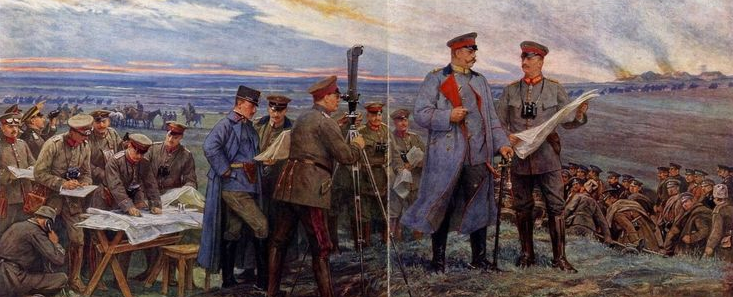
The best counterexample to this is a real-life military operation from 1914. In the first month of the First World War, the Russians advanced into East Prussia (modern day Poland and Kaliningrad) with two armies (1st and 2nd, about half a million men in all) against the German defenders’ single army (the 8th, about 250,000). Things weren’t going well for the Germans and their commander, General Maximilian von Prittwitz.
German High Command sent the respected General Paul Von Hindenburg to take command of the deteriorating situation. While he was en route, Prittwitz’s Deputy Chief of Staff, Colonel Max Hoffmann, devised an audacious plan to use Prussia’s extensive railway network to defeat the Russians. He proposed that the German 8th redeploy against the Russian 2nd Army in the south, leaving only a screening force against the Russian 1st. Once the 2nd Army were defeated, the Germans would get right back on the trains and trounce the Russian 1st Army.

This was a brilliant plan, and it resulted in a great victory at the Battle of Tannenberg against the Russian 2nd Army. General Von Ludendorff, Hindenburg’s deputy, gets a lot of the credit for this plan because he drafted it independently of Hoffmann while en route to the battle.
The simple fact is that both German officers came up with the same plan independently, because they were both products of the same military educational system and could both read a map.
When it comes to plans, they work best when everyone important knows what’s going on. Unfortunately for screenwriters, this makes for dull plots. Let’s wrap up on that point.
Conclusion: Real plans are kind of boring
You’ve heard me read movie planners to filth because their plans are overly complicated, never practiced beforehand, and known only to a select few. But wait, I hear you cry. That’s what makes these films so interesting.
You’re right, if course. The unifying theme when it comes to real plans is that they’re boring.
Take everyone’s favourite military operation, the Allied invasion of Normandy in 1944 (Operation Overlord, and not “D-Day”, as it’s often called). Everyone knew that the Allies were going to invade France in 1944. Even the dogs on the streets of Berlin knew it. They (the Wehrmacht, not necessarily the dogs) even had a fair idea of how many invaders there would be, how they would land, and what their strategic objectives would be (liberate Paris, continue into Germany).
The only thing the Germans didn’t know was exactly where and exactly when the invasion would happen.
Operation Overlord sure was clever. I mean, it worked. But if we wanted to re-imagine it to make it more suitable for a movie audience, there are a few details we could change:
- Move D-Day from 6th June to 5th June, when the weather was awful. Sure, they would lose a few planes and ships, but it’s the last thing the Germans would expect.
- Don’t land on Gold, Juno, Sword, or Utah beaches. Focus all Allied efforts into a single do-or-die on the beach with the most intact defences (Omaha Beach). Take enormous casualties in the invasion attempt, so much so that the commander considers abandoning it.
- Have the commander actually be a German double agent, attempting to compromise the whole operation. This traitor is unmasked by a heroic underling (if the film is for an American audience, make the traitor British and the underling American, vice-versa for a British audience).
- Once the traitor is apprehended, the hero must reveal the hitherto secret paratrooper divisions who landed the night before and now surprise the Germans defenders from the rear.
- Once the Germans are surrounded and about to surrender, reveal that their commander actually orchestrated his own troops’ defeat in an attempt to weaken Hitler, force a regime change, and win the war with competent leadership and the reserve Panzer divisions which are hiding just behind the sand dunes.
- But the dastardly Germans never get to use their secret divisions because General George S. Patton arrives leading the entire First United States Army Group on a heroic charge from the Pas-De-Calais. The fake army which everyone thought was a distraction was actually the real invasion, and no-one, not even the Allies, knew about it.
- The Germans surrender for real this time and the Allies liberate France.
That would have made for a much more entertaining and cinematic plan. The real one, by contrast, involved simple steps, lots of rehearsal, and a shared understanding among its participants.
That’s all for this week. Thanks for reading and please remember, if you haven’t already, to subscribe using the link below. Please also share this article with a friend and help me broaden my reach. Every little helps! See you next week.
Cover picture: Battle of Tannenberg by Hugo Vogel. (1917). Accessed via History Crunch
- This is the great thing about mortars: you don’t need to see your target. Mortars (small and large) are an example of “indirect fire,” i.e. up-and-over fire. This contrasts with “direct fire,” where you see what you’re shooting at, and which is what a rifle or a tank gun does. ↩︎
- Don’t pretend you don’t get the D&D reference. ↩︎
- For a start, the operation would have failed if, at any stage, the pilot of the CIA plane banked the plane by the smallest degree to the left or right to throw off the attackers. ↩︎


Leave a Reply