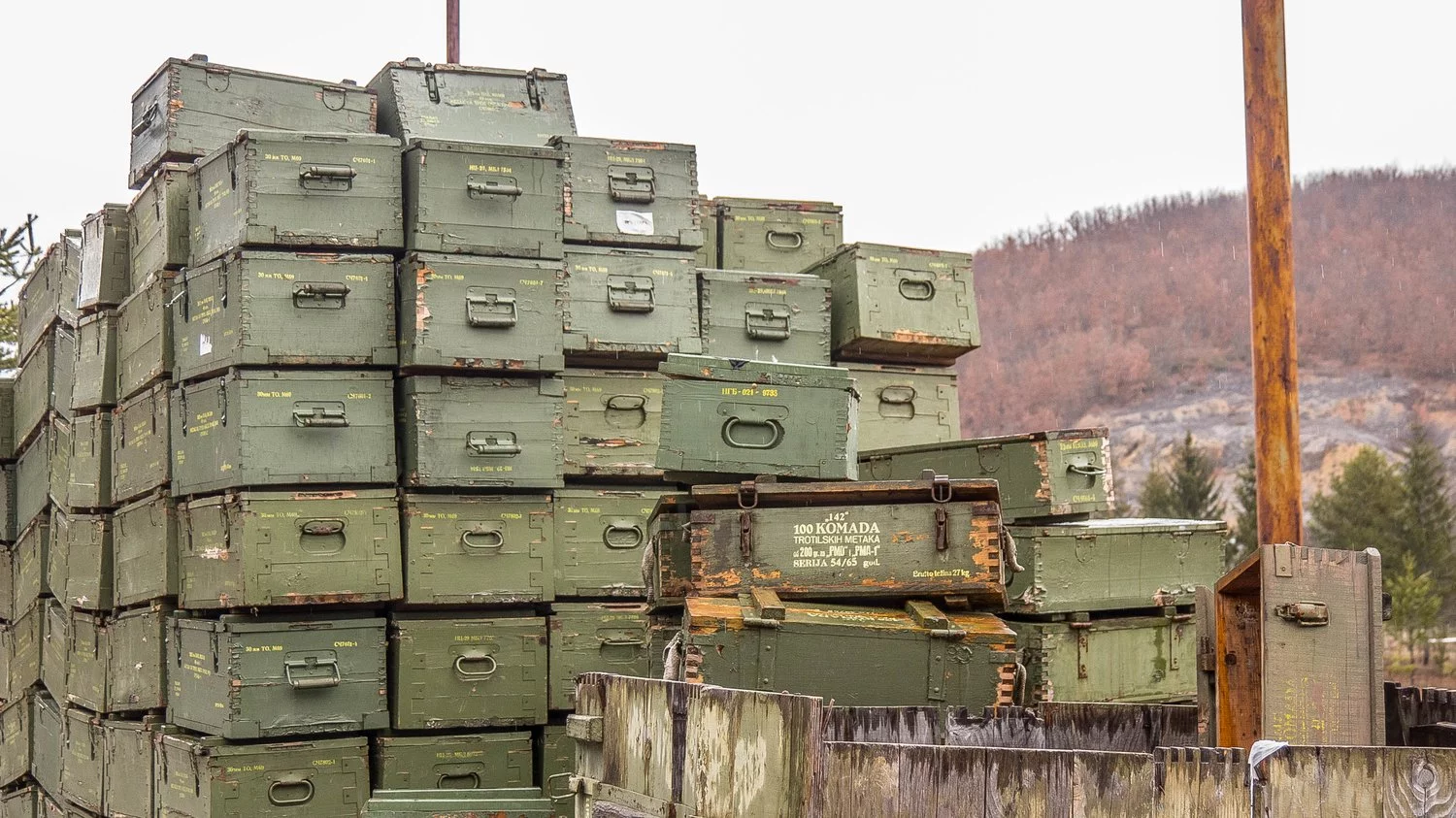
The paradox of ammunition stockpile management
Hello there. This week I want to talk about the logistics of ammunition. Exciting stuff, I know! But please bear with me, because this topic brings with it plenty of large explosions. I’ve written about failures of ammunition logistics before, from recent magazine explosions in Russia as part of the Russo-Ukrainian War to (only last week) the catastrophic gunpowder explosion in Dublin city centre in the sixteenth century.
Speaking of which, a reader who is an expert in early-modern warfare got in touch with me after my assertion that:
What effect did the explosion have, aside from the death and destruction? While it undoubtedly hampered the Crown’s war effort, it wasn’t decisive in the long run.
They pointed out that the gunpowder explosion, coming as it did in 1597, was almost certainly a huge contributor to the Crown’s failure to end the war quickly with concentrated repression. The late 1590s saw a series of Irish victories, including Yellow Ford in Armagh in 1598 where an English gunpowder wagon exploded due to a lucky Irish shot.
There is a broader error here, which I fell into, and that is to look for “decisive” moments in the story of a conflict. We fixate too much on the Waterloos or the Stalingrads and not enough on the Allied unity against Napoleon or the (other) Allied degradation of Nazi Germany’s industrial output. We like to think about the instant that changes everything, and we neglect the slow march of economic and logistical factors1.
Anyway, I digress. What I want to talk about today is ammunition, and why it’s a special type of military supply that is difficult to manage in peacetime and in wartime. I’ll start by talking about the challenges of ammunition as an item of inventory. Then I’ll talk about ammunition’s propensity to explode, and what that means for supply chain management. Finally, I’ll talk about the challenge of balancing peacetime and wartime requirements when it comes to ammunition stockpiles. I’ll wrap up by reflecting on why re-armament is difficult and involves trade-offs.
Before we start, let me encourage you to subscribe to the blog using the link below. As always, I’d love to see your comments below, or you can contact me via webform here or email here. Finally, if you’ve enjoyed this post, please share it with a friend.
If you enjoy this blog and want to support it, please consider a donation. Keeping this blog going doesn’t cost much, but it isn’t free either, so any help would be very much appreciated👍
1. Ammunition is treated like inventory…
Militaries are complex things. A modern soldier can’t just pick up his or her weapon, throw on a bag and be self-sufficient. There’s a whole supply chain that goes into ensuring that this soldier can impart lethal force using the most appropriate means (bullet, artillery shell, bunker-busting bomb) when they’re called upon to do so.
This supply chain includes many important categories such as:
- Clothing and protective equipment, e.g. helmets and body armour
- Food (an army marches on its stomach)
- Medical supplies
- Construction equipment
- Spare tyres and other parts for transport
- Fuel, mainly diesel
- Weapons
It also includes the crucial complement to that last category, ammunition. Without ammunition, a soldier is nothing more than an overly laden security guard with face paint.
Ammunition, like all of a military’s inventory, is stored in the rear echelons in large warehouses2 and brought to the front line in supply drops. Inventory has a cost: you need to buy it, you need to store it, and you need to write off inventory that never gets used.
This cost is something that planners and bean counters want to minimise, and for good reason: no-one likes waste.
At the outset of the 2022 full-scale Russian invasion of Ukraine, the former had 16 million artillery shells dating back to the Cold War, while Ukraine had closed its last artillery production plant in the years before the invasion. Until 2022, the Russian example would have been viewed as criminally irresponsible from a financial point of view and the Ukrainian one as demonstrating prudent inventory management and outsourcing low value-add manufacturing processes.
We now know, of course, that Russia’s stockpile gave it a significant advantage. It continues to do so, aided by a larger production capacity and imports from allies such as North Korea.
It’s easy to blame the bean counters in the West for their ignorance, but a bit unfair. They’re only abiding by the overwhelming trend in inventory management over the last few decades, ever since someone lifted the hood at Toyota and decided to spread their philosophy to the world. Manufacturing and supply chain experts ever since have relentlessly strived to keep inventories as low as possible using the “just in time” principle.
For ammunition, this means keeping purchases small (within reason, you have to balance this with procurement efficiency and workload) so that most of it gets used up naturally in training, which is predictable:

In a sense, ammunition is like vaccines. In the normal course of events, demand is predictable and pharmaceutical companies can match their output to meet this demand for the best price and with minimum wastage.
When a pandemic strikes, however, doctors and public health officials start crying out for more vaccines. Producers need to invest in new factory lines to produce vaccines at the enormous scale needed.
We have no intention of paying a pharma company to keep tonnes of vaccine cultures on ice or to maintain empty factories which are ready to ramp up when the call comes in. So, they don’t do this. Nor do ammunition manufactures. But there’s one additional problem with ammunition that most inventory types don’t have.
2. …but it’s an inventory that can explode
Ammunition has an unfortunate tendency to explode. In certain contexts, that’s exactly what you want. In others, it’s a bit of a problem:

This is the age-old problem that has faced ammunition designers since the invention of gunpowder:

I’ve written about fuzes previously, which ensure the first part, but today’s discussion focuses more on the right-hand side of the equation, i.e. ensuring that it doesn’t explode when you don’t want it to. There’s a predictive formula for this type of incident which I’ve written about before:

Proper ammunition storage might seem like common sense. And it is, to some extent:

Common sense is one thing: I’m sure that even the most uneducated rebel fighter could tell you that the above setup was unsafe. What’s usually lacking is not the knowledge but the will, investment, and governance needed to implement this common sense. Like I said last week, doing the right thing is hard.
The explodey nature of ammunition means that, as an inventory item, it requires quite a bit more time, attention, and expense throughout its lifecycle:
- When you buy it, you need to make sure it’s both functional (does what it says on the tin) and safe to store. It’s hard to verify all these things at the supplier’s factory, and it’s too late once it’s in your own troops’ hands.
- When you ship it from the factory (which may be abroad), you’re carefully shipping Class 1 Dangerous Goods via land, sea, or air. You need special types of containers, transport, trained personnel, licences, and maybe even security escorts.
- When you receive it, you need to store it in the right place. Storing incompatible explosives in the same building is a big no-no.
- As it’s sitting in storage and gathering dust, you need to run periodic tests to make sure it’s still safe and functional. Depending on the type of ammo, these can be as simple as a visual inspection but can range up to mechanical breakdown of samples from each batch3 to test their propellant in a special lab.
- When it’s issued, the receiving unit needs to do the same Dangerous Goods rigmarole as above to bring it to the firing range (or front line).
- If it fails to fire, then a team from explosive ordnance disposal will need to arrive and
blow it upmake it safe. - If it does fire, then the inert remnants (ranging from bullet casings to spent launch tubes to complex electronics) need to be collected and recycled.
- If it’s never used, then some day, upon reaching its shelf life, it needs to be taken out, buried in a deep hole along with lots of other expired ammunition, and
blown to bitsmade permanently safe.
Each step above takes time and money. The process presents quite a large logistical burden even when the amounts of ammunition in question are small. Warfighting, as we discussed above, necessitates quite a lot of ammo. This is where the burden becomes unsustainable and some militaries will simply cheat.
After all, what are the odds of something going wrong? And how bad could it be? After all, the Small Arms Survey tallied the Top 25 ammunition depot explosions from 1979 to 2013 and counted a piddling 530,000 tonnes of munitions lost. And they listed 24 defence ministers or other senior officials who were fired, killed in the blast, or jailed. If my statistics are right, 24 outcomes from 25 incidents means you have a 4% chance of not getting blown up or jailed. I like those odds.

3. Warfighting and peacetime approaches are incompatible
Recent years have seen a greater awareness of how important stockpiles of ammunition are to military effectiveness. First came the Russian full-scale invasion of Ukraine in 2022, which I mentioned above:

The Western allies scrambled to transfer their stockpiles of ammo to Ukraine so that it could hold off the Russian advance and, later, mount counteroffensive operations. Meanwhile, Russia relied on its vast and ageing stocks of Cold War-era ammunition. This worked out just fine until Ukraine started targeting Russia’s depots, lax practices, and degraded ammunition stocks.
As ammunition depots in Germany, France, the UK, and elsewhere became empty, military buyers began buying up as much future supplies of ammunition as they could. Lead times for certain types of ammo were years. Defence companies dragged their heels on investing to expand production capacity, and can you blame them? A sudden outbreak of peace would leave them with stranded assets and warehouses full of unsellable
The outbreak of the Third Gulf War / Iran-US-Israel War of 2026 has given us all another lesson in ammunition shortages, this time for complex surface-to-air interceptors for ballistic missiles. These can cost hundreds of thousands to millions of dollars per unit, so you can see why it’s hard to stockpile them to a great extent.
The mismatched economics of different weapons systems is something which the West needs to learn with the Iran War as well as the Ukraine War. It should have been learned a long time ago. When US and allied forces were fighting in Afghanistan, it was not unheard of for them to engage enemy infantrymen with $70,000 Javelin missiles. Is it any wonder that they lost the war?
The plain fact is that peacetime and wartime demand entirely different ways of managing ammunition stockpiles. We saw the peacetime or “just-in-time” example in Section 1. It was all about minimising wastage by adapting procurement and production to predictable training cycles.
The warfighting or “just-in-case” example involves a massive expense when the ammunition reaches the end of its shelf life. Not only do you need to write off a large amount of inventory from your balance sheet (ammo is expensive), but you need to spend money doing it safely.

Admittedly, the examples above are hugely simplified to illustrate the point. You might argue—and I’ve heard this from senior military sources before—that it’s possible to balance training and shelf-life requirements so that you can minimise the write-offs.
I’m sceptical. Ammunition requirements for war are so much more than what’s needed for training. Ukraine was firing 2,000 to 9,000 shells a day at the height of the conflict with Russia, and that was less than half of their 20,000 round-per-day estimated requirement. A NATO planning figure assumed 25-40 rounds per gun barrel per day for high intensity combat, a figure that neither Russia nor Ukraine came close to meeting.
By contrast, an artillery crew might fire that many rounds in a year’s worth of training. You might increase that a bit, but you can only do so much before you’re unduly wearing down your gun barrels, clogging up scarce range resources, and keeping the gun crews away from their other important tasks.
In summary, you cannot maintain a war-fighting inventory with peacetime constraints around husbanding resources and achieving value for money. And this is why re-armament is hard, as Europe is starting to realise.
Conclusion: Re-armament is hard and involves trade-offs
During the chaotic Premiership of Boris Johnson (UK Prime Minister 2019-22) one of the distractions that he employed to shift the media narrative away from the difficulties of achieving Brexit was the “Boris Bridge”. This mega-project would link Scotland and (Northern) Ireland via either a bridge or rail tunnel.
Although an incredibly cool idea, one which the engineer in me loves, the idea has a serious flaw: any route between the two land masses must pass over, through, or under Beaufort’s Dyke, a deep-sea trench containing an estimated million tonnes of conventional and chemical munitions dumped there after both World Wars:

Sea dumping of munitions, although hugely convenient, was banned by international treaty. But it goes to show what a military must do to get rid of the awful liability that is time-expired munitions.
Remember, blowing them up is difficult, potentially dangerous, and expensive4. You could put them through a careful process of dismantling and recycling, but that’s more expensive again. And the last thing you want to do is leave them there and pretend they don’t exist. Although, to be fair, that’s an approach that some people have taken when it comes to explosives:

If you want to be ready for war, you need to invest in many different things, most of which are expensive. But your ammunition investment is a special kind of cost, because it has so many additional expenses throughout its lifecycle. As soon as you own it, it becomes a liability as well as an asset, and you need to keep a much closer eye on it than most other types of inventory.
Assuming all goes well and you never end of fighting a war, then congratulations! You get to figure out how to dispose of millions of tonnes of high explosives in a safe, cheap, and environmentally friendly way. Please don’t dump them off the coast of Ireland though.
That’s all for this week. Thanks for reading and please remember, if you haven’t already, to subscribe using the link below. Please also share this article with a friend and help me broaden my reach. Every little helps! See you next week.
Cover picture: Ammunition, GICHD
- In the case of the Dublin Gunpowder Explosion, it’s a difficult one to analyse because it doesn’t fit a high-level narrative of the war: “The English won in the end.” We need to make our narrative a bit more detailed to see where the explosion fits in: “The Irish had many years of success against the odds, winning on the battlefield against the English, who suffered logistical mishaps which also hampered their war effort. Eventually, however, the centralised power of the larger unitary English monarchy prevailed.” ↩︎
- Ammunition and explosives need special types of warehouse, as I’ve discussed previously. This is to protect their contents from explosions outside and the protect the outside from exploding contents. ↩︎
- Yes, ammunition is made in batches, just like foodstuffs. It also has a shelf life, although this is usually quite a bit longer for ammunition. ↩︎
- But deeply therapeutic. I have the privilege of speaking from personal experience here. ↩︎


Leave a Reply