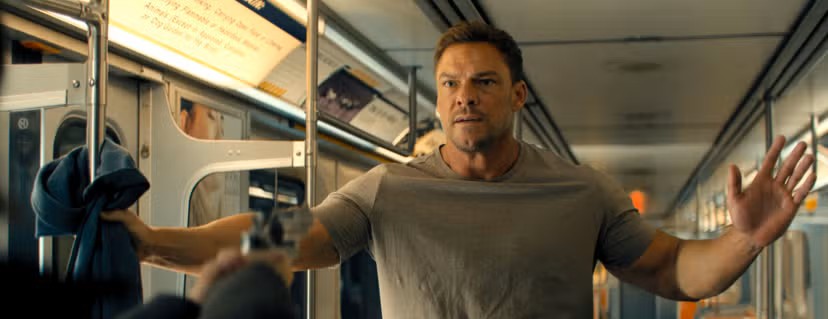
Analysing Jack Reacher’s list of indicators.
Hello there and Happy Thursday. I’ve made the mistake of starting Reacher Season 4 on Amazon. I know, I know. I have only myself to blame at this stage. After my complaints about how Season 2 lobotomised and depraved Jack Reacher, and Season 3 transformed Lee Child’s mystery novels into an action beat-em-up through cargo cult storytelling (not to mention Looney Tunes rules for the big boss fight scene), you might reasonably ask why I’m still watching it. Especially since I called my last review “Reacher’s last chance.”
You would be right to ask. I have no defence. The show was on Amazon and I was stuck for something to watch. Sometimes I just want to shout at the screen and not be judged for my choices. And yet still exercise the freedom to judge.

Anyway, this article won’t be a full review of the season, for the very legitimate reason that I’m only four episodes in and Amazon is doing that very 20th century thing of releasing the episodes one week at a time. How quaint!
Suffice to say that Season 4, at least so far, delivers on all the Reacher mutations we’ve come to expect from the TV adaptation. Psychopathy? Check. Careless use of firearms? Check. Physical invulnerability? Check. They’ve even added some more, such as the magical ability to pass through solid walls in subway tunnels.
But we’ll get back to that when the season is finished and we can do a proper retrospective. Today’s post is about the opening scene/chapters of the episode and its source material, the book Gone Tomorrow by Lee Child, written in 2009.
Spoilers below, but only for that scene in question.
Reacher is riding a subway train in Philadelphia (New York in the book) when he sees a woman who looks suspicious. He thinks she’s wearing a suicide bomb… but it turns out she’s got a gun, which she turns on herself.

I’m going to pick apart the book and the TV programme’s rationale for why Reacher thinks what he thinks and does what he does. I’m going to talk about the signs of a suicide bomber, as described by Lee Child in Gone Tomorrow and as glossed over by the Reacher Season 4 showrunners. There are technical details which both sources fall down on.
Then I’ll talk a bit more about the threat assessment of an improvised explosive device attack, and why both book and show fail to take proper account of this. I’ll sum up with an assessment of how the show stacks up the book, at least in its opening scenes and pages.
Before we start, let me encourage you to subscribe to the blog using the link below. As always, I’d love to see your comments below, or you can contact me via webform here or email here. Finally, if you’ve enjoyed this post, please share it with a friend.
If you enjoy this blog and want to support it, please consider a contribution. Keeping this blog going doesn’t cost much, but it isn’t free either, so any help would be very much appreciated👍
1. Technical details matter…
In the opening scene of Season 4, Reacher sees a woman acting strangely on the subway. He approaches her, but she doesn’t want to engage with him. After he tells her that he’s a cop (which is a porkie1), she shoots herself in the head. In the subsequent questioning at the police station, Reacher defends his actions to the detectives:
The only reason I approached her is because she had several of the behavioural indicators of a suicide bomber… nervous woman sweating, fidgeting, mumbling, possibly praying, looking straight ahead, wearing a heavy coat for the time of year to hide explosives, and a large bag… she was checking all the boxes.
Wow, Reacher. All the boxes? He’s obviously never seen a crazy person on public transit, bless his innocent heart.
The book is more tantalising. Lee Child takes his time with this scene, because it’s so important to the rest of the story, and because it’s the best possible page turner. Look at this for an opening line:
Suicide bombers are easy to spot. They give out all kinds of tell-tale signs.
Mostly because they’re nervous. By definition they’re all first-timers.
He goes on for three chapters talking about the signs, but you wouldn’t know it by how quickly the pages turn2. He describes twelve, of which eleven apply for a female suspect3. He also goes into a lot of detail on how to make a suicide bomb. Some of it is very technical (not all of it is right, and this might be deliberate). Some of it is very gory and potentially gratuitous. Here are the signs:
The first was the obvious no-brainer: inappropriate clothing. By now
explosive belts are as evolved as baseball gloves… [alarmingly detailed description of how to build a suicide vest follows]… Altogether effective, but altogether bulky. The only practical concealment, an oversized garment like a padded winter parka.The second point is: a robotic walk. Significant at a checkpoint or in a crowded marketplace or outside a church or a mosque, but not relevant with a seated suspect on public transportation. Bombers walk robotically not because they’re overcome with ecstasy at the thought of imminent martyrdom, but because they’re carrying forty extra pounds of unaccustomed weight, which is biting into their shoulders through crude suspender straps, and because they’re drugged.
Points three through six are variations on a subjective theme: irritability,
sweating, tics, and nervous behaviour. Although in my opinion sweating is as
likely to be caused by physical overheating as by nerves. The inappropriate
clothing, and the dynamite4.Therefore point seven: breathing. She was panting, low and controlled. In, out, in, out. Like a technique to conquer the pain of childbirth, or like the result of a ghastly shock, or like a last desperate barrier against screaming with dread and fear and terror.
Point eight: suicide bombers about to go into action stare rigidly ahead. No
one knows why, but video evidence and surviving eyewitnesses have been
entirely consistent in their reports.Point nine: mumbled prayers.
Point ten: a large bag.
Point eleven: hands in the bag.
In the book, the suspect has a heavy bag over her shoulder and a heavy jacket zipped up. Reacher thinks through the steps in a logical way, dismisses the thought several times, but keeps coming back to it. Then he intervenes, because he’s learned to trust his instincts and his training.
In the TV show he’s eyeing each passenger and he spots this lady in the back looking nervous and mumbling. And she has a bag. A small little blue bag which is very different to what’s described in the book. And it’s possible that he goes through the same thought process he did in the book, but that’s not what we see as viewers. He spots the woman and he moves straight away. And that’s a problem, because both Reachers (Book and TV type) are wrong about what this lady is really doing. And it should be obvious to them. Let’s discuss that next.
2. …but Threat Assessment is even more important
Threat assessment is one of the most important parts of any tactical estimate of a situation. And the threat assessment in this case should be screaming at Reacher that he’s wrong to approach the woman. Signs be damned, there’s no way that she’s a suicide bomber.
Both the TV show and the book make reference to this point, but the book makes a better fist of it. In each case, Reacher says it to the bomber, which is… certainly a bold and unique move:
TV Reacher:
There are only a few people on the train. If you waited till rush hour, your plan would be more effective.
Book Reacher:
‘It’s late,’ I said. ‘You should wait for rush hour.’
She didn’t reply.
‘Six more hours,’ I said. ‘It will work much better then.’
Her hands moved, inside her bag.
I said, ‘Not now.’
TV Reacher is telling her she’s an idiot and bad suicide bomber, Book Reacher is playing for time in a situation where he doesn’t know how to respond.
The underlying truth, of course, is that he’s absolutely right. Anyone with enough know-how to make and wear a suicide bomb, or (as is more likely) to convince someone else to wear a suicide bomb they’ve made, will also know when to deploy it.
The “when” and “where” to detonate the bomb isn’t some abstract detail, it’s fundamental to the whole operation. And no operation will involve detonating the bomb in a near-empty train carriage in the wee hours of the morning. It just doesn’t make sense.
In EOD, we were taught to get into the head of the attacker. Is their aim to kill many people indiscriminately, or one particular person? Is that one particular person me, by any chance? Are they motivated by trying to save their own skin and get away, or are they willing to die in their attack? What do they know about the target? What information is readily available, or what might they have gleaned from watching the target?
All of these questions help you to determine what kind of device you’re dealing with, and therefore how you can disarm it safely. But the threat assessment is fundamental. If there’s no target, then you start asking yourself: am I the target?
That’s what Reacher should be asking himself. Although he may not have been the intended target of this woman, he becomes an inadvertent target by being a witness and then someone who is assumed to have obtained information from the woman who killed herself. It’s his own fault: if there’s no target, then maybe you’re the target. You got played, Reacher.
Although the book does a better job of owning up to this contradiction, it’s not enough to absolve Reacher of his actions. He still acts like an idiot, and that sours the story somewhat. By contrast, TV Reacher acts entirely within his (poor) character. Let’s wrap up on that point.
Conclusion: The TV show does it better
This is one the rare occasions when the TV programme does this better than the source material. I know I’m on record as not being overly thrilled with the TV adaptation, and my criticism still stands. I do prefer the books. But the suicide bomber mis-en-scène works for the TV show in a way it never did for Gone Tomorrow. Let me explain.
TV Reacher, as we’ve established before, differs in a few significant ways from Book Reacher:

Most importantly for this story, Book Reacher is smart, whereas TV Reacher is just a lump of muscle with occasional insights borne of his antipathy toward people. Book Reacher knows all about threat assessment and situation and timing and probabilities5. Book Reacher should have realised the obvious: that just because someone ticks off a few items on a list designed for a busy Jerusalem street, doesn’t mean the same conclusion applies on a Manhattan subway train at two in the morning.
It’s as if you saw someone bent double, breathing hard, with a pronounced bump in their abdomen and a puddle of water at their feet and deduced that they were going into labour… but neglected the fact that they were a seventy-year-old man.
But book Reacher doesn’t realise this, which is out of character. Maybe he’s tired, a bit drunk. He was coming from a blues club downtown. It’s not a mortal sin in storytelling, but it’s never sat right with me that the entire premise of this book flowed from a singular Jack Reacher cock-up.
TV Reacher, on the other hand, is not smart. He doesn’t have to be smart, to be fair to him. He isn’t solving mysteries like Book Reacher is. He’s an action hero whose job is to punch a series of progressively tougher bad guys until they tell him where the chief bad guy is.
This isn’t a critique of the show (well actually, it is, but I’m trying to be even-handed). We can tell how clever Book Reacher is because we, the readers, get to see his thoughts on the page. We have no such luxury with TV Reacher. The only insight we get into TV Reacher’s thoughts are via:
- His features, which are frozen in a state called “sexy-angry.”
- His actions, which are the typical apex predator’s trio: feeding, fighting, and… making love.
- His words, which are few, by character design.
So, it’s much more plausible for TV Reacher to do what he does in the season intro. He’s constantly on the lookout for trouble and this poor lady who looks a bit unusual is a perfect target. “Oh,” he says to himself. “I remember that list of suicide bomber traits I heard from that dude in Jerusalem. She’s doing some of those things. Let’s go investigate.”
That’s all for this week. What do you think? Please let me know in the comments below. As always, remember to subscribe if you haven’t already. Thanks again for reading.
Cover picture: ‘Reacher’ Season 4 Release Date, Trailer Cast and Book Changes Confirmed: Everything We Know, Men’s Journal, Aug 7th 2026
- Porkie = pork pie = lie, for my readers who don’t speak (or at least understand) the King’s English. ↩︎
- And, to be fair, they are very short chapters. ↩︎
- There’s the tactical implausibility of this being a bombing, which we will talk about in the next section, but you also should play the odds. Although it’s not impossible for a white (book) or East Asian (TV show) woman to be a suicide bomber, you ought to look at the odds and take a beat to reassess. The twelfth sign, incidentally, is a fresh shave which may expose lighter skin underneath which hasn’t been getting the sun. ↩︎
- Yes, I know. Sigh. Suicide bombers use military grade explosives, if they can get their hands on them. TNT or RDX taken from munitions, or, better still, plasticised mixtures of same. If they can’t get their hands on them, they might use homemade explosives such as TATP. Dangerously unstable, but then your aim is to kill yourself and many others. I wouldn’t expect to see dynamite, unless they worked in an old-timey quarry and had easy access to the stuff. Remember, and repeat after me: TNT is not dynamite. ↩︎
- So many sequences of “Reacher logic” in the books revolve around probabilities and statistics. He could be an excellent card counter in a casino. Maybe that’s how he manages to stay solvent and fund his peripatetic lifestyle. It sure as hell isn’t his army pension (it could probably also be his tendency to rob drug dealers. In fact, it’s probably that). ↩︎


Leave a Reply