Introduction
Ballistics: what’s it all about?
We’ve all heard about ballistic missiles, particularly in the context of the Iran / Third Gulf War (at the time of writing, July 2026) but also from the ever-present threat of nuclear Armageddon.
Or perhaps your exposure to the term comes from crime dramas, where “ballistics” are the nerds who can recreate crime scenes and get the most extraordinary information from a bullet fragment or even a bullet hole. Sometimes these nerds are also billionaires:
Or maybe you think of “ballistics gel,” that stuff which makes for excellent slow-motion videos and gifs (don’t worry, there are plenty more of these below):

Ballistics, at least in the military sense, is the collection of separate but interrelated disciplines which underpin our understanding of the “hot” end of firearms and ammunition. I say “hot” end to distinguish ballistics from the study of weapons themselves, which is armoury, and which we talked about in a separate Realism Report: How Guns Work.
There are three big areas of ballistics: internal, external, and terminal. Then there are two minor ones: intermediate and wound ballistics. You can navigate to each section using the links on the image below.

The interesting thing about ballistics is that the sub-disciplines are quite different. As you can see below, each domain has its own set of scientific and engineering tools which we use to design and evaluate. This makes ballistics a real treat for someone who likes putting classroom theory into practice with concrete examples. Or, indeed, with concrete-shattering examples. Because, as we all know, mechanical engineers build weapons, and civil engineers build targets.
As well as the five ballistics domains listed here, I’ve included two interludes which relate but provide a break from the heavier theory. The first is on silencers, and the second is on hitscan mechanics in video games, a.k.a. magical instant bullets.
Without further ado, let’s get into internal ballistics. Just a reminder, if you haven’t already, to please subscribe to the weekly blog using the button below. Thanks, and enjoy.


Internal ballistics: Barrel envy
Internal ballistics is the bit that happens inside the gun barrel.

More specifically, it’s everything that happens between the moment the propellant is initiated and the moment the projectile leaves the barrel.
I’m going to start by looking at energy conversion, which will tell us why gun barrels look the way they do. Then we’ll talk about some of the big challenges for gun designers in terms of making the propellant and making the barrels. We’ll pull in some examples from film and TV to see where they get it wrong (or, indeed, right).
Efficient energy conversion is the aim, and long, thin barrels are the game
What is a gun? From a thermodynamic point of view, it’s an internal combustion engine with an open cylinder and a single-stroke operation. It’s very similar to a car’s internal combustion engine. Both convert chemical energy (propellant/petrol) to kinetic energy (bullet travel, crankshaft movement).

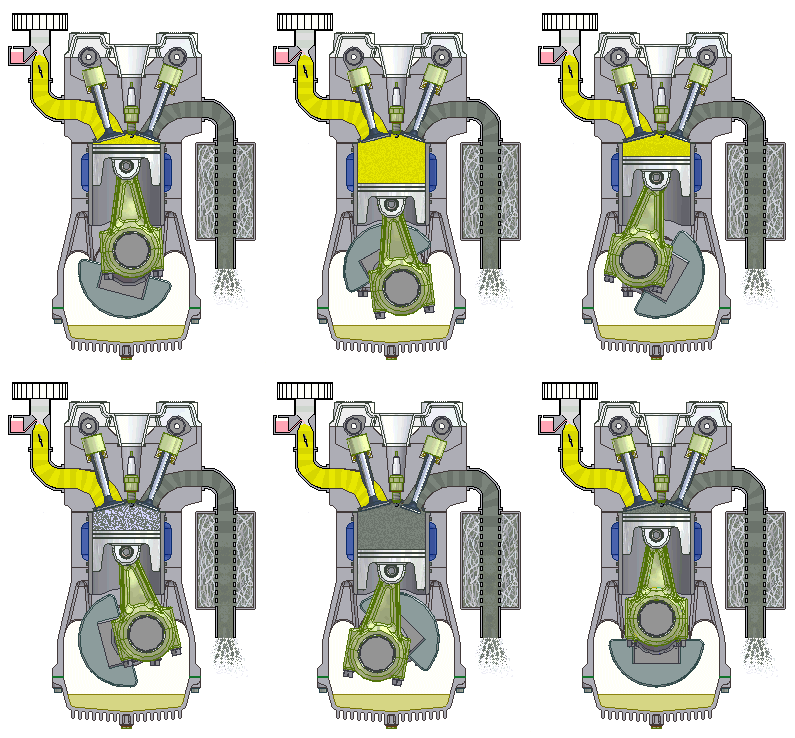
Just like a car designer, the gun designer wants to build this engine to maximise the amount of the chemical energy that gets converted into kinetic energy. If you do the math(s) on this1, you’ll find out that the maximum kinetic energy is determined by the mass of the barrel (heavier is better), the material strength (stronger is better), and the material density (denser is worse). In other words, the gun barrel has one job to do, and that job does not depend on its length:

In practice, although there are some wicked cool examples of short, fat gun barrels, such as the mortar below from the US Civil War, designers have tended toward the long and thin type of barrel.

_(14576269528).jpg)
Why is this? Longer barrels make for a slow3, smooth increase in projectile speed, as opposed to the short, sharp acceleration in a shorter barrel.
The ideal gun, in theory, would have an infinitely long barrel, or at least one that went all the way from the firer to the target. Obviously practical issues aside (“Sorry pal, can you just hold the end steady while I shoot you? Thanks!”), there’s also the effect of friction.
The longer a bullet or shell stays in the barrel, the more of its kinetic energy is transferred to heat via friction. The designer picks a trade-off between kinetic energy added from propellant gases and lost to friction:

Despite this, there have been some attempts made at ridiculously long barrels. One neat trick is to add more propellant in little sub-chambers along the path of the shell which initiates as it passes. Hitler tried this towards the end of WW2. You probably know about his V-1 (world’s first cruise missile) and V-2 (trailblazing ballistic missile, first object to reach space) revenge weapons. What you might not know about is his V-3, which was a very long gun:


It must be a dictator thing. Saddam Hussein tried to build a gun so big it could launch a projectile into orbit. Project Babylon was never completed, thanks to some timely assassination work by Mossad, but sections of the gun remain as museum pieces. It’s big:

Even the Joker has read the memo about long barrels (but don’t read the description, there are so many things wrong with it that I don’t know where to start):
There are significant engineering challenges to overcome
Propellant shape
You might easily mistake some types of gun propellant for pasta (at least until you try to heat it on the stove):


Just like pasta, the shape of the propellant “grain” matters enormously. Long, spaghetti-like grains burn from one end to another and release their pressure (relatively) slowly4, whereas chopped-up cylinders or flakes (think macaroni) burn quicker.
As well as the speed of burning, gun designers also care about how the speed changes during the burn itself:

In atmospheric conditions, propellant appears to burn violently, as the video below (one of a plethora on YouTube) shows. Please don’t try this at home:
The burn above, while violent by the standards of normal fuel, is glacial compared to the speed of reaction in the gun. This is because it’s happening in ambient atmospheric pressure. Propellant burns faster when it’s under pressure. But burning it releases gas, which raises the pressure quickly. If you confine this reaction (by putting it inside a sealed gun barrel, for example) the positive feedback loop turns a burn into a bang.
All the energy you saw in the ten second burn above is released in about ten milliseconds (a thousand times faster). We discussed this same effect before when we talked about dust explosions:

In short, the shape, the quantity, and the ignition of gun propellants are of paramount importance to the gun designer. Of course, The Simpsons told us this many years ago:
Barrel strength
Once we get the propellant burn right, then we need to design the gun that can handle the immense pressure inside. This involves using quite a lot of steel to contain the high-pressure burn:

It’s not just about the amount of material you put around the ammunition. What you do to it is just as important. Gun barrels have evolved from the early gunpowder designs which involved metal hoops to strengthen it and looked, funnily enough, just like a barrel.
Since the industrial revolution, barrels have been strengthened by permanently deforming the inside face of the material. This might surprise you if you’re not familiar with the miracle of work hardening5. Subjecting the barrel to immense pressures before you ever fire a round out of it makes it better able to withstand said pressures when it’s being used.
At first, barrels were simply made on the understanding that the first round through it made it a bit wider and strengthened the material for every subsequent round. Oil under hydraulic pressure was a more controlled way to achieve this so-called autofrettage. Later still, manufacturers held the barrel in place and ran an oversized tool through the bore to create these stresses.
Nowadays manufacturers use giant all-round hammers to deform their gun barrels into the right shape. The advantage of this is that they can hammer the barrel around a tool which has the grooves for rifling (see below). See below extract for a view of how they do this with giant artillery gun barrels:
If we get this wrong, it’s very bad for the firer. Barrels (like any internally pressurised tube) fail along the axis of the gun, so the resulting damage is like a banana peeling open: a banana whose peel is steel and whose innards are hot propellant gases. This, by the way, is one of the many problems I had with the Reacher vs. Paulie fight scene in Season 3 of Reacher, and which I’ve bored you with enough at this stage.

We’ve already mentioned rifling. Most gun barrels have grooves cut inside them to impart spin to the bullet (we’ll talk about why next week). This is where a “rifle” gets its name, but rifling is in most gun barrels6, from artillery howitzers to small pistols. You’ve seen this before, of course, in the iconic James Bond gun barrel opening sequences:


Barrel wear and temperature
Even if you get the propellant sorted and manufacture your gun barrel to be (well) bulletproof, you have one more hurdle to overcome: temperature. As well as lots of pressure, the expansion of propellant gases also generates lots of heat. For one or two rounds, this isn’t a problem. The barrel is heavy, and the amount of gas involved is small, so the heat dissipates quickly.
If you fire lots of rounds all at once, then heat does become a problem. Just like a drip isn’t a problem but a torrent is, the cumulative heat added by all those bullets can quickly heat a gun barrel to literally red-hot temperatures:
The barrel above is obviously beyond repair (you can actually see the droop), but you don’t need to even go that far to cause irreparable damage. All barrels wear down with use, but extended firing at high temperatures dramatically accelerates this process. The hotter steel is weaker, for one, and the high-temperature propellant gases have a corrosive effect on the inside of the barrel.
Barrel temperature is a serious limitation in real life. Machine guns come with multiple barrels: at least two for the 7.62 mm FN MAG, and three for a .50 cal (12.7 mm) M2 Browning. That’s a lot of extra kit to carry, and the gunners are expected to change the barrels every 100 to 200 rounds. You should be changing the barrel almost as often as you change the ammunition box, but neither of these annoying realities weigh on our Hollywood action heroes:
I wanted to include the .50 cal scene from the fourth Rambo (2008), but it’s age-restricted, so you’ll have to follow this link to see it. It’s not pretty (both in terms of the gore and what he’s doing to that poor weapon). If you want to go on an extended shooting spree, you’d better use a rotary/Gatling gun with multiple barrels:

Even the best-kept barrels can have surprisingly short lifespans. As gun calibres, rates of fire, and muzzle velocities go up, the lifespan of the barrel drops. Whereas a pistol barrel might last a million rounds, rifle’s barrel is good for about 10,000, and a heavy machine gun’s lasts 1,000, depending on the rate of fire (i.e. not like the photo above). Artillery and tank gun barrels have lifespans in the hundreds of rounds7, as Russia is finding out the hard way.
Conclusion: A gun is a reasonably efficient heat engine
Earlier on, we noted the similarities between a gun and a car engine. Like any engine, we care about how efficient it is. Guns, it turns out (and this is a big generalisation) are about 30% efficient:

This doesn’t sound great. In other words, 70% of the energy in the gunpowder is wasted. But it’s roughly the same as a regular petrol engine, which gets useful motion out of 20-40% of the energy in the fuel. Diesel engines are about 45% efficient, and the gas turbines uses to generate electricity give us about 60%. Could we make guns more efficient?8
In short, we probably could. We could use longer barrels, but then we look like the Joker in the clip above. We could load our ammunition with more propellant to generate higher pressures, but then we’d need to make a stronger barrel to contain this pressure, and this adds weight to the weapon. We could use a cleverer type of propellant grain shape, such as a progressive burn design which spreads the peak pressure along the barrel a bit more. But this is more complex to make, and you can be sure it will add cost.
The reality is that you hit a law of diminishing returns. Getting about 30% of your propellant energy back as useful killing energy is a decent return, and gun designers have worked very hard to get even that much. If you use guns every day for work or recreation, then be glad that they’ve done their math properly and kept your gun barrel from banana-peeling in your face.
Intermediate ballistics: Bullets flying backwards
Intermediate ballistics is the strange and often overlooked regime between the giants of internal and external ballistics:

Formally, intermediate ballistics (or transitional ballistics) is the study of projectiles from when they exit the muzzle (the front) of the gun until they overtake the muzzle shock waves and enter the normal atmosphere. It is not an exact science9, and it’s over quickly. It is still important: getting this bit wrong can mess up the bullet, the gun, and the firer.
I’ll start off this section by explaining what intermediate/transitional ballistics is. Then I’ll go into the problems it brings the gun designer, namely aerodynamics, recoil, and noise. Along the way I’ll show you how Hollywood gets it wrong, usually quite understandably.
Intermediate ballistics is the messy transition between two stable regimes
As the diagram and the name imply, intermediate ballistics is a transitional phase between internal and external ballistics. Whereas internal and external ballistics and well-understood and predictable, intermediate ballistics is chaotic:

Intermediate ballistics is imprecise because it involves turbulent flow, which is inherently chaotic. It doesn’t last very long—a few hundred microseconds11 at most—but its effects can be significant for the projectile, the weapon, and the firer.
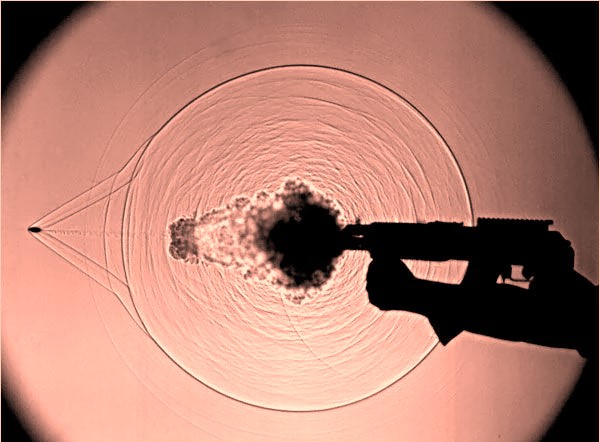
Schlieren photography12 gives us a way to observe the fast-moving gases and shock waves which define the intermediate ballistics region:


This is a Schlieren photo montage of a pistol bullet just after it exits the gun barrel. What, exactly, are we seeing in these pictures?
- Time dilation. The video is slowed down, obviously. It’s hard to say for sure, but I estimate this clip covers about 0.6 milliseconds and 250 mm of travel, or a slow-down factor of over 6,00013.
- Shock fronts. The sharp lines in the picture in front of and behind the bullet are the “fronts” of shock waves, i.e. the actual boundary where the air pressure changes suddenly. This sudden change in pressure is what defines a shock wave.
- Turbulent gas flow. Harder to see in the first image above, but clearer in the one below, is the swirling mass of gas which indicates turbulent fluid flow. Just like turbulence on a flight, turbulent flow is unpredictable by its nature.
Intermediate ballistics generates three problems for the gun designer
Problem 1: I need to design my bullets to fly backwards as well as forwards
When the bullet reaches the muzzle of the gun, the pent-up gases behind it still have a lot of energy. They jostle around it and rush past. You can see this most clearly in the AK-47 GIF above, within the first foot / 30 cm (and probably about 400 microseconds, or 0.4 milliseconds). The propellant gases move past the bullet (in fact, they completely obscure it) since they are travelling faster. This means that for a brief fraction of a millisecond, the bullet is flying backwards.
Let’s think about a bullet in normal flight, or an aeroplane, car, or anything aerodynamic. As it travels forward the (mostly) stationary air seems to move from front to back at the same speed as the object travels forward. If the object was stationary and the air moved at the same speed instead, this would have the same aerodynamic effect. This is the principle behind wind tunnels.

If, by the same logic, the air/gas is flowing past the bullet from back to front, then the bullet is flying backwards:

This is more than just of academic interest. The shape of the back of the bullet is slightly important when the bullet is flying forward, but extremely important when it’s flying backward. This can be a problem because of how bullets are made. Military bullets have a copper jacket covering the lead core, and the traditional way of putting on the jacket leaves a messy opening at the base:

The open-tip match (OTM) round improves “fly backward-ability” by putting on the jacket the other way around, with a more controlled manufacturing process:

Although this process greatly improves accuracy, militaries have been slow to adopt OTM rounds because of a belief (probably false, and certainly conservative) that their small hollow tip puts them in violation of the Hague Convention14, a point we’ll come back to below when we talk about wound ballistics.
What does this have to do with the movies? Admittedly not much—bullet-jacketing techniques rarely feature strongly in any work of art—but it does bring in mind the brilliant opening sequence from Lord of War:
Problem 2: I have to figure out what to do about the recoil
If the plume of propellant gases looks a bit like a rocket to you, you’re on the right track. Just like a rocket, the gas coming out of a gun barrel will cause an equal and opposite reaction on the gun itself. We call this reaction “recoil,” and it can be quite dramatic, if you’re not prepared for it:
Recoil (and the need for accuracy) is why seeing action heroes “dual-wielding” weapons makes me roll my eyes. Even firing two pistols at once is stupid, let alone anything bigger and heavier:

What can a gun designer do about recoil? For starters, they can actually utilise it to make the gun work. I’m going to do a full explainer on how guns work some other day, but suffice to say now that most automatic weapons have a way of diverting some of the propellant gas energy back into the weapon to eject the fired cartridge case and load a new round into the barrel.

For the unused portion of the recoil energy, or for non-automatic guns, designers can reduce recoil in long-barrelled weapons with a special attachment on the end called a “muzzle brake”. This redirects the gases to the side or even backward. Obviously the shorter the barrel, the less ability there is to direct them backward without burning the firer:


.jpg)
Although these muzzle gases are mostly invisible, a realistic depiction in movies would have characters flinching away when their heads are close to another gun which is firing (or covering their ears, like we see in the photo above). The sound would also contribute to the flinch, and that’s what we’ll talk about next.
Problem 3: I can’t hear myself think over the noise!
The shock fronts on the Schlierin photographs above might look pretty, but they sound nasty. A shock wave results in a loud “bang,” since sound waves are pressure waves in air and a shock wave is a sharp increase in pressure15. That guns are loud is probably not news to you. But unless you’ve experienced it first-hand, you might not appreciate just how loud they are. In addition, bigger guns are louder still, to the extent that training becomes a serious health and safety challenge. Exposure to loud bangs brings three problems:
- Acoustic trauma. Sudden once-off damage to the eardrum, which may be temporary or permanent.
- Noise-induced hearing loss. Permanent progressive deafness from repeated exposure to loud noises.
- Mild traumatic brain injury. A more recent discovery, this is a scary loss of cognitive ability due to repeated blast waves hitting the soft and delicate tissues of the brain. It’s explained in more detail here.
Militaries, by and large, don’t want to cause unnecessary pain and suffering to their soldiers16, so will go to certain lengths to reduce the “loud noises” risk. Earplugs and earmuffs (what we used to call “double hearing protection”) or earmuffs alone (“single hearing protection”) bring noise levels below the danger line, depending on the weapon in question. The big problem, of course, is that it’s much harder to hear fire control orders and other instructions from your teammates. Imagine trying to do even the kind of simple section-level tactics I discussed a few weeks ago with your hearing ability significantly reduced. Or imagine that you’re patrolling and expecting “contact”17. Then you’d better have your hearing protection already in place, because you won’t get a chance once the bullets start flying. Good luck with any attempts at stealth when the whole team is operating with up to 30 dB18 hearing impairment.
One solution to this is active earmuffs, i.e. rugged noise-cancelling headphones which boost quiet sounds and muffle loud ones:

These can be very effective, but are just as awkward and uncomfortable as normal earmuffs. Every piece of equipment and armour which you make a soldier wear or carry involves a tradeoff between protection and mobility, and hearing protection is no different. Active earmuffs are yet another thing for a soldier to carry, keep spare batteries for, clean, maintain, break, or lose.
Silencers are another option. These can greatly reduce the bang caused by muzzle gases, which is good for the firer and their comrades close by. By passing muzzle gases through a series of baffles prior to entering the atmosphere, while leaving the bullet unhindered, they can also reduce recoil and turbulence, the two problems discussed above.


Contrary to their film depictions, however, silencers do nothing for the sonic boom of the bullet itself, or the mechanical noise of the gun, both of which can be significant. The “pfft” Hollywood noise à la John Wick below is pure fiction:
Still, silencers mitigate the problems of intermediate ballistics. Why aren’t they universal? We might discuss this in more detail in a future post dedicated to silencers, but suffice to say that they add complexity, weight, and a lot of additional maintenance to any gun. As we discussed above, any additional weight needs to be carefully “weighed” against the benefit it brings. This is, I think, the short answer to the reason why you don’t see them on general issue in the military.
While silencers are common in Hollywood (and usually portrayed unrealistically), you never see soldiers or action heroes wearing any sort of hearing protection in the movies. I’m willing to give a certain amount of leeway here: action heroes take risks no soldier ever would, and a bit of hearing loss down the line is hardly top of the list. Although when you think about franchise action heroes like James Bond’s exposure to millions of gunshots over the years, then some of his witty one-liners take on a new dimension:

There are plenty of loud weapons out there, but the loudest I ever fired were the 84mm recoilless rifles: the single-use AT-4 and the reusable Carl Gustaf Recoilless Rifle. Any time I fired or supervised the firing20 of these, I fastidiously wore double hearing protection, as per the regulations. And I still felt every decibel. This is why I absolutely cannot take the clips below seriously: these guys’ unprotected ears would be bleeding.

Conclusion: We design to minimise the energy lost
The design challenge of ammunition is getting the maximum amount of energy from the chemical propellant to the target. This is true for every stage of ballistics:

Intermediate ballistics is a very short phase when compared with any of the others, especially external ballistics. It’s important, though, not just because of the relatively modest amounts of energy lost through turbulent flow, recoil, and sound. Each of these gives rise to a second-order reduction in the overall effectiveness of the bullet on the target:
- Turbulence upsets the trajectory of the bullet right at the outset of its travel, with small errors cascading into a large gap once the bullet reaches (or misses) the target.
- Recoil obviously changes the point of aim by applying a force through the gun. This has little or no effect on the bullet which has just left the barrel, but will have a significant effect on all subsequent rounds.
- Noise affects the shooter and their comrades and makes it harder to keep a steady point of aim.
Not an exact science, little understood, and often ignored. Welcome to intermediate or transitional ballistics. It’s messy because it’s the interface where two predictable but very different environments meet: the intricate and tight internal combustion engine of the gun barrel and the vast open-ness of the atmosphere. Gun designers will never fully understand the chaotic interplay of fluid and shock physics that happens here, but they still need to study it and attempt to make things a little bit better for the person firing the gun.
Interlude 1: Silencers (they aren’t really silent)
Let’s take a break from the heavy stuff and talk about something fun: silencers/suppressors21.

As this chapter’s title suggests, we’ll debunk the myth created by Hollywood that a firearm can be completely silenced, reduced only to a “pew”. I’ll pull together some examples of silenced firearms and show what silencers/suppressors can and can’t do, and compare the noises you’d get to some other types of sound. Then I’ll go into the components which make up firearm noise: mechanical, sonic boom, and muzzle blast. Then I’ll discuss the advantages that silencers bring, even though they’re not as impressive as they seem in the movies. Finally, I’ll sum up by discussing the limitations of silencers and why they are not universal.
Let’s use the John Wick: Chapter 2 clip above as an anchor for today’s discussion while we also pull in some other Hollywood examples. Thankfully for us, there’s no shortage of unrealistic silencers on screen. The John Wick clip warrants another entry in the Realism vs. Drama Hall of Fame:

Even a quieter gunshot is still very loud
Gunshots are very loud things, so even when you eliminate most of their noise, they’re still loud. In the last section I mentioned decibels, which are the unit of measurement of sound intensity level (i.e. loudness). Here’s a chart (you can find any number like this on Google) which compares the decibel level of some common things:

Decibels are a funny unit, designed to measure the wide range of sound pressure levels that correspond to loudness. For example, 180 dB is a billion billion times louder than 0 dB22. I don’t know about you, but I can’t picture a billion billion anything. To make matters more complicated, our ears don’t respond in a linear way to sound pressure. It’s like they have their own algorithm in there to make sense of the world (your brain, I suppose). All you need to know is that:
- An increase of 10 dB is ten times louder, but sounds twice as loud
- A decrease of 10 dB is ten times quieter, but sounds half as loud
- An increase of 3 dB is a doubling in loudness, but is the smallest increase in volume we can perceive
- A decrease of 3 dB is a halving in loudness, but is the smallest decrease in volume we can perceive
We see that “explosion” tops out the scale in the chart above, at 150 dB. How does this compare with gunshots? The loudness of a weapon (or anything) depends on the strength of the pressure wave and how close the listener is to the source. The problem with the above chart is that there are no distances, but we do have some firearms data which is calibrated to an observer 1 m away from the gun:
| Firing a… | …registers… |
|---|---|
| AT4 recoilless anti-tank weapon | 187 dB (according to this source). Might be measured closer than 1 m. |
| Smith & Wesson 586 .357 Magnum pistol | 169 dB |
| Remington 742 rifle (.30-06 calibre, standard 22″ barrel) | 161.6 dB |
| Remington SP-10 10-gauge shotgun | 161.4 dB |
| Glock 22 .40 pistol | 159 dB |
| AR-15 5.56mm rifle | 158.9 dB |
| .22 rifle | 140 dB (no distance specified, this source). |
For some context to these numbers, 187 dB feels 20 to 130 times louder than the pain threshold of hearing (115-140 dB). 160 dB feels more than twice as loud (and is actually more like 10x as loud) as the top of most decibel charts. 140 dB is the level above which hearing protection is mandatory in the workplace, no matter how short the exposure it.
So much for unsilenced firearms. What difference does a silencer make? Dakota Silencer (now known as Silencer Central) produced a handy graphic comparing the difference between unsuppressed and suppressed versions of common firearms23:

You might not be too impressed with this, but it’s quite a big difference hidden by the logarithmic nature of decibels. Let’s show it a different way:


The above diagrams might be based on over-optimistic marketing material, but scientists have found that silencers reduce noise by 17 to 24 dB (98% to 99.6%). This is a huge difference, but still results in quite a lot of sound energy out there, hence the gulf between reality and what Hollywood shows us. This video from Debunked explains it well:
With all that in mind, how does the infamous John Wick subway shooting scene look? Luckily for us, Moose with a Scarf has done the hard work of fixing the scene with more realistic-sounding pistols :
Why are guns so loud, and so hard to silence?
Gunshot noise has three different components
There are three distinct noises which make up the familiar (from Hollywood, if nothing else) gunshot sound:

There’s another noise associated with gunshots, and that’s the sound of the bullet striking the target. It’s not usually considered as part of the trifecta above because it happens somewhere else, but it’s worth bearing in mind when we think about the infamous subway scene: even if they magically managed to fully silence their pistols, how is no-one reacting to the sounds of lead hitting concrete and tile at 300 m/s?
Mechanical noise: metal-on-metal clanging
Guns are full of metal parts under spring tension which move back and forth multiple times per second. There’s no easy way to make this quiet. The bigger the gun, the most noise its parts make. If you’ve ever spent time in a draughty section room doing “dry drills”24 on a GPMG then you’ll appreciate the clanging noise that a machine gun makes. When you’re firing live ammunition, your cheek pressed to the weapon and your hearing protection in place, the “ping” of return springs and “crunch” of moving parts is what you notice most, since the frequencies of the muzzle blast have been attenuated by the earmuffs.
Hollywood has a double standard here. On the one hand, gun cocking is always loud and dramatic, with a “CHK-CHK” to announce the fact that the wielder means business (even if they absolutely should and would have cocked their weapon earlier). On the other hand, silenced weapons leave out or minimise the noise of the very same cocking actions while the gun is firing, like this example from The American:
To eliminate this noise you need a special type of gun design that has internal parts which avoid harsh impacts. Alternatively, avoid automatic fire and rely on bolt action, like the Welrod pistol we’ll discuss below.
Sonic boom: the trade-off that comes with speed
Anything that travels faster than the speed of sound creates a sonic boom. You might be most familiar with this from Concorde25 and other supersonic aircraft. The crack of a whip is another example. Sonic booms happen because the bullet pushes air out of the way as it moves forward. The air moves at the speed of sound (it can’t go any faster). Because the bullet is moving faster than the speed of sound, the pressure waves pile up behind it. When these stacked-up waves hit you, the observer, you hear it as a sudden loud noise. Compare how sound waves behave with subsonic, (trans)sonic, and supersonic objects:


The excellent illustrations above come from Wikimedia Commons (CC BY-SA 3.0). Do you see how a supersonic object leaves a line (or a cone in three dimensions) of high-pressure sound waves. This is the boom, and it travels along with the object for anyone in its path to hear.

There’s not much you can do about the sonic boom, apart from using subsonic (slower than the speed of sound) ammunition. If you’re doing something sneaky in close quarters, this is probably fine. If you’re looking to engage a target accurately at range, now you’re in trouble, because less speed means your bullet won’t go as far and won’t do as much damage to the target if it gets there.
Muzzle blast: the bit we can do the most about
The last component of firearm noise is muzzle blast, which we discussed above as part of intermediate ballistics. This is the shockwave caused by the high-pressure gases from inside the barrel suddenly coming into contact with the outside world once the bullet leaves the barrel. These gases have been cooped up for so long and under so much pressure that they just want to go everywhere at once: the resulting shockwave is the characteristic bang we hear from a gunshot.
Silencers/suppressors address this shockwave with their interlinked chambers. These let the gases expand slowly before exiting to the outside atmosphere, as seen in the GIF below:
Think of the unsilenced firearm like a stadium suddenly opening its gates and trying to expel a crowd of 50,000 away fans who’ve just seen their team beaten badly. When these hungry, angry, and drunk fans finally make it through the gates, they will wreak havoc on the surrounding neighbourhoods, in the manner of a shock wave. The silencer is like a buffer zone of food stands, bars, toilets, and lines of riot police outside the stadium. Some fans won’t hang around, but some will get another drink, some will get some food, etc. The density and anger of the crowd is reduced, and the neighbouring streets feel much less of an impact.
All silencers reduce muzzle blast, but some firearms designers take it further, addressing all three elements of noise to get “whisper” quiet weapons.
Maximum suppression means addressing all three elements of noise
The Welrod pistol, developed for Britain’s Special Operations Executive (SOE) during WW2, was specially designed to be as quiet as possible for clandestine operations, by addressing the three aspects we discussed above:
- It minimises mechanical noise by not being automatic. Each round must be manually cycled, and the bolt is designed for smooth and silent operation. Rapid fire is not an option with this weapon, so you’d better make your shots count.
- It eliminates the sonic boom by using subsonic ammunition (.32 ACP, a standard police round of the time). This round is already just about subsonic, clocking in at ~300 m/s muzzle velocity, but the internal barrel of the Welrod is drilled with holes to allow gases to expand slowly and to reduce the bullet’s velocity even more.
- It reduces muzzle blast using the familiar series of baffles, but also includes three rubber “wipes” or discs through which the bullet must pass. This further slows the release of gases during firing.
The cutaway below from Reddit clearly shows the barrel holes, the baffles, and the wipes (three dark-grey discs equally spaced along the front half of the barrel, with baffles in between).
The wipes in the Welrod are a consumable resource: their effect degrades with each round, and after a few rounds they no longer provide any sound suppressing effect. The firer needs to unscrew the front of the barrel and insert fresh wipes. Take a look at this Forgotten Weapons clip on the Welrod to see what a challenge this (and everything about the pistol) would be:
The Small Arms Review wrote about a noise test they did with a Welrod pistol in 2002. They fired the same type of round from an unsuppressed Walther PP (as a benchmark), then used a Welrod with well-worn wipes, then one with brand new wipes inserted. The measurements were done at 1 m, just like the results above. Here’s what they found:

The authors are at pains to note that the 122.8 dB sound measurement don’t tell the whole story, however:
Although the sound meter as an objective measurement is an important benchmark, it does not tell the entire story. There are a number of air (pellet) pistols with similar sound levels and some integrally suppressed .22 rimfire pistols with a slightly lower sound level. The subjective evaluation of the Welrod is that it makes less noise than these other weapons. Part of the reason is the locked breech. Although left-of-muzzle measurements of the .22-rimfire weapons may meter a lower sound level, subjectively they are louder due to right-hand ejection port noise. Further, the Welrod, with its wipes, significantly changes the sound characteristic with elimination of virtually all the higher frequency sounds. The sound of the Welrod being fired in a quiet location is almost imperceptible at 15 feet. In a noisy environment and with the muzzle in actual contact with the intended target, it would be inaudible even to the operator.
I’ll let you judge for yourself. Here’s a video of the Norwegian Arms & Armour Society testing a Welrod26. It’s certainly quiet, but it’s definitely not “Hollywood quiet.” Then again, this might be due to worn wipes. Still, it’s a whisper when compared to the other weapons they fire:
Conclusion: silencers serve a purpose, but come with trade-offs
A cynical armourer, like me in a past life, might roll his eyes and say that silencers are just another expensive way for more “elite” soldiers to differentiate themselves from the rest. A bit like Homer Simpson when he gets a gun:

The cynic in me would be wrong. Silencers do serve some very real purposes, even if they rarely make a shooter 100% stealthy:
- Location: Silencers make it harder for the enemy to judge where the sound is coming from. A muzzle blast occurs at a point and therefore can be traced back to its source. A sonic boom occurs along the line of travel of the bullet and reaches the observer after the bullet has already passed, making it harder to trace back to a source.
- Recoil and accuracy: By adding weight to the end of a barrel, and reducing the kick from expanding gases, silencers mean that barrels rise less due to recoil, improving accuracy.
- Hearing conservation: Bringing the firearm noise down by 17-24 dB, as we saw above, means a reduction of 98% to 99.6% in the total amount of sound energy hitting the ears of friendly forces. Or, if we want to talk about how this feels to our logarithmic ears, it’s a reduction of 70% to 81% in perceived sound. That’s quite significant, especially if you and your squad are laying down a base of suppressing fire. Apart from the health and safety aspect there’s also a tactical benefit, since acoustic trauma could impact a soldier’s ability to hear orders and think clearly on the battlefield.
They do have downsides, however, which is why you don’t see them on general issue:
- Cost. A silencer is a complex piece of engineering with many high tolerance parts. Its price is probably a significant fraction of that of the rifle it screws onto. This might be a worthwhile investment for a handful of special operators, but it’s a cost that most militaries will be unwilling to extend to general issue.
- Complexity. Silencers require more care, cleaning, and maintenance than a rifle. Their effectiveness depends on how well they are maintained, and that puts a giant regulatory burden on militaries if they are relying on silencers as part of noise control measures. How can you stand over the safety of a training exercise without inspecting every single silencer?
- Carriage. Silencers add weight to the weapon, as well as length, which can be awkward when operating in confined spaces. They also get hot and take a long time to cool down, posing a burn hazard.
For all of the downsides, there are legitimate responses. The cost of everything has been going up in recent decades27, so adding silencers is incremental rather than extortionate. Armourers already inspect weapon function prior to training shoots and NCOs and officers do cleaning checks in the field; adding silencers is not unthinkable. And the fully-laden weight of a soldier, like the cost of equipping them, has been rising in recent decades. What’s another couple of hundred grams?
The conventional wisdom is shifting. The new US Army M7 rifle, which is just coming into service, has an integrated silencer. The US Marine Corps were issuing silencers to their units a few years ago. Where the US moves in weapons technology, expect the rest of the world to follow. But I think it’s fair to assume that they won’t sound like this:
Refreshed? Let’s get back to the ballistics.
External ballistics: You spin me right round baby
External ballistics is/are everything that happens to the bullet or shell between leaving the influence of the gun and hitting the target. It’s everything that happens “outside,” as its name suggests.

As with the rest of the ballistics journey, the gun designer is always trying to maximise how much of the chemical energy in the propellant ends up causing damage to the target. We saw above that keeping 30% of the energy by the time the bullet leaves the gun is a good return. How do we keep as much of that 30% as possible all the way to the target? And better still, how do we maximise our chances of hitting the target? That’s our focus today.
We’ll start by talking about spin-stabilisation, which is one of the oldest tricks in the book. Then we’ll look at some alternatives, such as using fins to keep the projectile on track. Finally, we’ll touch on some tricks for squeezing out a bit more range.
Spinning the bullet improves accuracy
Why is this?
A bullet28 which spins quickly as it travels through the air is more likely to stay on its intended course and not veer off wildly in some other direction. This is clearly a good thing, and a step up from the early days of firearms.
A spinning bullet works better for the same reason that a spinning top doesn’t fall over: the gyroscopic effect. Any little disturbance in the air, which would cause a non-spinning bullet to tumble wildly, turns a spinning bullet around a second axis instead, in a motion called precession:

Spinning bullets are so much like spinning tops that there’s a YouTube trend of wonderful idiots firing pistols into ice to see the bullets bounce out and behave like little spinning tops. I say “idiots” because this is not safe, and “wonderful” because it gives us this amazing phenomenon:
Bullets need to spin fast enough to keep them from “falling over” into the airflow (i.e. tumbling). You can see at the end of the clip above when it finally runs out of energy and topples. There’s no point in spinning them any faster than this, however, since it brings no extra benefit29. It takes energy to spin up the bullet (more on this below), so the spin rate is carefully selected to be just right.
How fast is this? It depends on the round and the design of the gun barrel, but spin rates of hundreds of thousands of RPM are common. This sounds fast (and it is), but a bullet itself is very fast, so the spin is pretty staid by comparison. This is yet another example of how everything to do with firearms stretches the bounds of human perception. See the video below, where the spin rate is just about visible before the bullet hits the wall:
The other notable thing about the video above is how the bullet is very clearly engraved with the marks caused by the rifling process. Let’s talk about this next.
How do we achieve spin?
Gun designers make bullets spin by engraving the inside of the barrel with grooves:


The bullet or shell is ever so slightly wider than the distance between the tops of the grooves, so they grip onto the projectile and make it spin as it accelerates down the barrel. This leaves discernible imprints on the soft copper jackets of a rifle round:


The imprint on the bullet will include any micro-imperfections in the gun barrel’s rifling. This means that bullets can be forensically matched to the gun barrel which fired them, or at least to the tool which made a series of barrels. This is just a consequence of rifling and spin-stabilisation, and is not a design feature of rifles.
Larger calibre projectiles get the spin treatment too, usually via a “driving band” made from copper or another soft material which engages in the gun’s rifling.

The band on bigger “bullets” illustrates the main problem with rifling: it puts high stresses on the projectile and causes extra friction which wastes that precious energy we’re trying to conserve. A single copper band instead of an entire copper jacket means less friction on the shell.
One solution to this problem is progressive twist rifling, i.e. a groove that starts with a very gradual twist and increases the twist angle until the end of the barrel.
The GAU-8 Avenger cannon used on the A-10 (a.k.a. the “BRRRT plane”) uses a progressive twist30. It’s complicated to manufacture barrels with a progressive twist, however, so it’s not a widely used technique.
If you want to be really radical, however, you can ditch rifling altogether. We’ll discuss that further down, but first, let’s look at some movie examples.
What do the movies say?
We’ve seen that spin is good, and rifling causes spin. As well as spin, bullets precess, i.e. their nose rotates around a fixed point in front. This precession also has a second-order wobble on top of itself called nutation. If we slowed down time and put a light trail on the tip of the bullet, it would draw a path something like this:

This is something which, as you might expect, Hollywood doesn’t always get. Sometimes we don’t see any spin at all31…

…and other times, we see far too much32:

Other times, we see some faint traces in the animation which sort of count:33
And sometimes we get to see the spin, along with some wonderfully unrealistic bullet curving:
What we don’t see, because admittedly it would be more difficult to animate, is the wobbling of the bullet as it travels and spins. It would make for a cool shot though. Then, if the filmmakers wanted to get graphic, they could show a bullet starting to tumble just before it hit someone, for maximum damage.
Fins are better for dart-like projectiles
We mentioned above that you can ditch rifling altogether. This is an option when you’re firing long, thin projectiles. Luckily for designers, this is the preferred modern tank vs. tank ammunition type. It’s known by the not-at-all suspect term “long-rod penetrator34” and works by shedding an outer layer (a “sabot”) as soon as it leaves the tank’s gun barrel:


The combination of fins, sabots, and a long, dense core make this a very effective anti-armour weapon. I’ll come back to this when we talk about terminal ballistics. For now, suffice to say that:
- The sabot means you can use a big barrel to give all the propellant energy to a thin projectile, so it goes very fast (nearly twice as fast as a shell fired from the equivalent gun).
- The thin cross-section means air resistance is minimised.
- The fins provide much-needed stability due to the missing spin, meaning the projectile doesn’t tumble.
Getting rid of spin-stabilisation has one big advantage, which is that you no longer need to rifle your gun barrels. Compare the German 120 mm tank gun barrel below to the sectioned British 105 mm gun above35.


Focusing on the back end can eke out more distance
The last thing to talk about is how designers make their projectiles (and usually we are talking about artillery shells here) go that little bit further by optimising their aerodynamic shape to minimise drag. This is done at the front end, obviously, but the tail end of a projectile is also important for its aerodynamic shape. Improving aerodynamic performance often comes at the expense of payload, i.e. the effect you want to have on the target:

The aerodynamic back end shape, as seen in numbers 3 and 4 above, is called a “boat tail.” An even more extreme step you can take is to fill the boat tail section with propellant (instead of explosive) and burn this propellant as the shell flies through the air, sending the exhaust gases out little holes in the base of the shell:


This so-called base bleed (or base burn) system fills up the vacuum behind the shell, which reduces drag. It’s not a rocket motor, although it’s on a continuum of “things that burn and extend range while taking up internal space.”
If you like, you can go ahead and put in a rocket system altogether. As you might imagine, this involves devoting even more internal space to propellant at the expense of explosive:


Base bleed can add 5 to 10 km to a 155 mm howitzer’s already impressive 25 km range. Rocket assist can bring the range up to 40 km.
Conclusion: Counter-intuitive design choices
A lecturer in college said something which has always stuck with me. The great thing about engineering, according to him, is that it can lead you down the most counter-intuitive design choices which still make sense.
For example, anyone with common sense can see that a bigger engine, or one that burns more fuel, will generate more power. Spraying water into the engine, on the other hand, would seem silly. But that’s exactly what an engineer will tell you to do, via an intercooler, to further compress the intake air before combustion and generate extra power.
The same holds for gun design. You wouldn’t intuitively think that putting complicated grooves in a barrel and making the bullet slightly too big to fit through them would result in a better shot—but it does.
Common sense might not lead you to design big blocks around a projectile which get discarded as soon as they leave the barrel—but these result in a much faster kinetic energy tank round.
A very weak rocket motor which barely sputters out some limp gas might seem like a waste of space, but it eliminates a negative pressure area, reduces drag, and greatly improves overall range.
Thanks to some clever engineering, gun designers can minimise the energy lost in the external air while the bullet or shell is travelling toward its target.
What happens when the projectile reaches its target? This will be the topic of our next ballistics section, but let’s first take an interlude to look at how computer games take account of all this complexity (spoiler: they usually don’t).
Interlude 2: “Hitscan,” a.k.a. magical instant bullets
Have you ever played Unreal Tournament? I’ve spoken in these pages before about the Rocket Launcher and Flak Cannon, but the topic of ballistics insists that we look at the Sniper Rifle with our usual pedantic criticism.
Although the Sniper Rifle is one of the least sci-fi of the UT weapons, its effects are less plausible than the Rocket Launcher and the Flak Cannon. We’ll go through what these implausibilities are, as well as the reasons for them. This ties into how video games are designed and built: dissecting weapons like the UT Sniper Rifle allows us to take a look under the hood of the game and get an insight into the choices and limitations facing designers, especially with older games like UT.
“Facing Worlds” is a video game classic…
It’s impossible to talk about Unreal Tournament’s Sniper Rifle without talking about one of its most iconic maps: Facing Worlds. Widely acknowledged as one of the genre’s best, it is a small, open, capture the flag36 map:
The map consists of two towers connected by a walkway and suspended in orbit above an Earth-like planet. It’s an exquisite setting, albeit with a quarter of a century less computer graphics development. The beauty of the setting is accentuated by the haunting soundtrack.
All of this beauty is, of course, merely a backdrop for the epic Sniper Rifle duels which the map is well-known for. Each tower provides about a dozen spots where you have an unobstructed view of the enemy tower and the route the enemy need to traverse to get to your tower. This makes sniping a guaranteed high-impact strategy: there’s no alternative but to walk onto the “sniper highway” that is the bridge connecting the towers. Of course the challenge is that while the towers give great vantage points, they don’t offer much cover or concealment37. So while you’re busy plugging enemies on the far side, they’re busy finding and shooting you, which gives the map its cruel charm.
Today’s post isn’t about the ins and outs of sniper tactics and techniques, mainly because I’m unqualified in this area and can only give second-hand experiences. Suffice to say that camouflage and concealment are just as important as marksmanship for a sniper team.
But I want to focus more on the weapon itself: the UT Sniper Rifle:

There are plenty of these beauties and their associated ammunition stashed throughout each tower, feeding the fuel of the famous sniper duels. Compared to the rest of the exotic UT arsenal, these seem unremarkable, boring even. They don’t fire bright bolts of plasma or glowing, exploding goo. They don’t cause big explosions. Even the shot’s report is dull and drab in comparison to the noises you get from more fanciful weapons like the Rocket Launcher or the Ripper.
Don’t be fooled: this weapon is perhaps the most unrealistic of the lot. We’ll discuss why in the next section.
…but only by ignoring the laws of physics
Using the Sniper Rifle in Facing Worlds, or any UT map, is very simple: right click to look down the telescopic sight, left click to fire:
This is a gameplay model of sniper rifles (or anything with a scope or sight) which is used in many other shooters. Aim, shoot, and hit (or miss). The game uses a simple model logic called “Hitscan” to determine whether each shot is a hit or not:

This is why bullets seem to cross the map instantly: the game models them that way. This, to state the obvious, is not how real-life bullets work. A real life-logic tree of whether a shot is a hit or a miss would look something like this:

This model was not something that the computer games of the 1990s were able to replicate, especially for rapid fire weapons. Add to this the complexity of multiplayer games, where PCs had to simulate gameplay and communicate and synchronise it across multiple machines over comparatively slow internet connections, and you can see why a simple model of bullet accuracy was preferable.
This began to change not long after the release of UT. Of course, modelling projectiles in video games was nothing new:

By the early 2000s, shooters were coming onto the market which modelled time of flight and bullet drop in a parabolic arc. Operation Flashpoint was a Cold War era West vs. East38 “realistic” shooter which featured large, open maps, actual squad tactics, driveable armoured vehicles, and simulated projectile parabolic arcs from the shooter to the target. Battlefield 1942 was a primarily multiplayer game pitting giant teams of soldiers against each other in large maps where the object was to gain and hold ground. It also featured a wide variety of driveable vehicles39 and the aforementioned parabolic modelling of bullet physics. Most of these game engines didn’t actually create a bullet as a physical object and model its travel through the air, rather, the engine did some clever math(s)40 to determine if the shot was a hit or miss and then modelled the damage appropriately.
Max Payne (2001) and its 2003 sequel41 took firepower physics to a new level, modelling each bullet as an in-game physical object which interacted with other in-game objects (e.g., you, in-game baddies).

Tristan Jung gives an excellent summary of bullets in video games on Medium. As he explains, it’s not a simple case of increased computing power always leading to more complexity. Some of the most popular newer shooters such as the Call of Duty franchise still use Hitscan logic in their game engines:

We’ll discuss the reasons for this in the next section.
Video games take shortcuts, but so does everyone
If we want to understand why game designers moved toward more complex models, one reason (at least with Max Payne and slow-motion bullet time) is for coolness. Slowing down time and making bullets more realistic can make gunfights far more satisfying and believable.
A bigger part of the answer, however, is the aforementioned bigger, more open maps. Take a look at this screenshot from Battlefield 1942:

With bigger maps, the flight time of a projectile becomes a lot more important42. Conversely, it really doesn’t matter so much on smaller maps and over shorter distances, because the time lag and parabola effects of bullets at short ranges are negligible. There’s absolutely no point in modelling an effect which the player won’t notice.
No matter how many resources you throw at a simulation, it will only ever be an approximation to reality. Ammunition engineers will employ teams of designers and supercomputers to create a simulation of the real-life fluid dynamics43 affecting a bullet in flight, and still fall short of reality:


No computer game will ever have the level of sophistication to model shockwaves, fluid dynamic effects, spin44, the Coriolis effect, and the Magnus effect. Don’t know what these are? Don’t worry, you’re not alone. Snipers and artillery gunners have heard of these things, but don’t need to worry about them every time they take a shot. This is because they have tables of data which approximate the real world sufficiently to the task in hand. Need to know what ammunition to use? There’s a table for that. What charge should the projectile be, and what bearing and elevation45 should we set the gun to? There’s another table for that. What if it’s really warm or cold: does the change in air density make a difference? Sure does, and there’s another table for that. There are lots of tables (it’s all the one page in the links above), and they account for most reasonable scenarios within a reasonable degree of precision, but they do not represent the “true” physics governing the motion and explosion of the artillery round.
A similar (but much simpler) table is below for a normal assault rifle round (.223″ Remington46, courtesy of and transcribed from Ammo.com). This shows roughly how fast the bullet is travelling at various distances, how long it takes to get there47, and how far the bullet drops in that time:
| Range (yards) | Muzzle Velocity (fps)48 | Time (s) | Elevation (inches) |
|---|---|---|---|
| 100 | 2,901 | 0.1 | 1.3 |
| 200 | 2,556 | 0.2 | 0 |
| 300 | 2,236 | 0.4 | -6.7 |
| 400 | 1,939 | 0.6 | -20.3 |
| 500 | 1,669 | 0.8 | -43.4 |
A few things you might notice from the above:
- The bullet falls a lot once it starts slowing down
- It also seems to rise before it falls—wait, what’s that about?
- It takes nearly a full second to travel half a kilometre
Here’s a though experiment: imagine you fire a bullet on a horizontal axis and, at the same instant, drop an identical bullet from the same height. Which one hits the ground first?

The semi-surprising answer is that both hit the ground at exactly the same time. The fact that the fired bullet is travelling at nearly a kilometre per second horizontally doesn’t have a bearing on how gravity accelerates it in the vertical direction49. But when we’re teaching soldiers to shoot in the real world, we use a very simplified model. Rather than learn about the parabolic trajectory of the round, they learn to assume a flat trajectory and no bullet drop at the “zeroed” range, which in our case was 300 m50. For any distance closer than this, the bullet was said to “rise”, so the estimated point of impact at 100 m was 10 cm above the point of aim. That’s exactly what you see in the table above too, although they have assumed zeroing at 200 yards (metres).
We also teach soldiers to fire at the centre of mass of the target, i.e. the enemy soldier’s midsection. This means that a bullet “rise” of 10 cm would hit the upper chest or neck, still a probable lethal shot (ignore the focus on “headshots” you see in videogames and films: real soldiers go for the centre of mass). This simplified version of reality allows us to account for the real-world effects of gravity with the minimum impact on a soldier’s perception of how his/her rifle works:

Games which use hitscan mechanics might be taking a shortcut, but it’s one we can forgive. The effects aren’t likely to affect realism too much, and we take these shortcuts in real life as well.
Conclusion: All models are wrong; some models are useful
All models are wrong, but some models are useful
—George Box (statistician, 1976)
The above quote is one of my favourite from my engineering university days. It applies to every branch of the sciences, and failure to appreciate its truth is one of the leading causes of ignorance. It means that no matter how hard we try to simulate the infinite complexity of the real world, we will fall short. If we accept this limitation, however, and are aware of the limitations of our model, then we might get to do something useful with it.
Hitscan mechanics in shooter games is a perfect example of this: it’s a model which works just fine in most cases and allows us to program games with very simple mathematical rules under the hood. Unreal Tournament is no exception: it’s hard to notice the limitations of its hitscan mechanics in what is for the most part a corridor shooter, with fast-paced, high-octane, close-range engagements. Enemies are rarely far enough away for bullet projectile physics to become important. Facing Worlds is an exception: the instantaneous flight time from rifle muzzle to enemy head is quite noticeable. This works, however, because it’s such a balanced map where the enemy has the very same advantages as you do.
The Sniper Rifle in UT is one of the most unrealistic weapons in the entire game, but its unrealism is subtle. Like everything UT-related, we will happily park our beloved but often pesky physics to one side for a few minutes while we grab a [magic] Sniper Rifle and revel in the low-gravity, high mortality asteroid that is Facing Worlds.
Speaking of mortality, let’s dive back into ballistics by looking at what happens when copper and lead from a bullet meets the glorified jelly that make up the bodies we humans inhabit.
Wound ballistics: Jelly vs. lead
I thought it might be useful in this section to go into the gory (literally) details of what bullets do to human bodies. I’ll contrast the reality of gunshot wounds with the sanitised versions we see in video games and on TV.
Content warning: This post will talk about the effects of bullets on human bodies. I’ll try not to be graphic for the sake of it, but this is an unavoidably dark subject. If you’re not feeling in the headspace to deal with it, then take a knee and come back to it when you are (or skip it; I won’t be offended).

I’m going to start this section by talking about the physical effects of bullets travelling through flesh. Then I’ll contrast some of these effects with what we see in films and video games. Finally, I’ll turn to first aid and advanced treatment of bullet wounds, again contrasting what we see on-screen with the reality.
Getting shot anywhere is bad news…
In the litany of obvious things I’ve said on this website, the above must rank fairly high. And yet the movie and video game industries would have you believe otherwise: that gunshot wounds can be no more than a minor nuisance (if you’re lucky and smart enough). The limbs and shoulders seem to be particularly resilient. If you get shot there, it’s a minor annoyance to be dealt with later:
Let’s take a look at the actual effects of a bullet on the human body, or at least on ballistics gel, which is the standard substitute used in tests. First, here’s a GIF of 5.56 mm (NATO standard rifle ammo):

Next, here’s a bunch of handgun hollow-point rounds, which are designed to cause maximum internal damage:
In the videos of bullet impact above, each second of video time is about six milliseconds of real time51. So, we can chart the journey of the bullet through the body in terms of seconds, and also use a bit of imagination to translate what’s happening in the gel into what’s happening in a human body:

- 0-1 milliseconds (ms): Bullet breaks the skin and enters the body. Suddenly the bullet is travelling through water (more or less) instead of air. Its spin still keeps it steady, but it can’t go very far in this environment. The heavy drag of the water acts on the tip of the bullet, pushing back against it. If the bullet has a hollow tip/point52, this will start to bulge open.
- 1-2 ms: The bullet feels the effect of the 1000x denser external medium. Its spin is no longer enough to keep it from tumbling, so it starts to rotate. At the same time, the drag forces of the water cause the hollow point to bulge into a mushroom shape. This increases drag even more, leading to more deformation and tumbling.
- 2-3 ms: The tumbling, possibly splayed-out bullet causes a bubble-like “temporary cavity” which pushes all other organs, blood vessels etc. away. Fragments of the bullet might break off and cause additional, smaller permanent cavities.
- 3-5 ms: As the bullet slows, it has less energy to keep pushing open the temporary cavity, which gets smaller as the bullet comes to its final resting position in the body.
- 5-15 ms: The temporary cavity collapses back and the displaced organs and blood vessels partially return. There is a permanent cavity which is smaller than the temporary one.
Fluid dynamics acts on different types of bullets in different ways, with corresponding effects on the wounds they inflict:

As you can see from the diagram above, bigger and faster bullets have a bigger and bloodier effect on human tissue. However, the biggest rounds can actually go through the target without leaving all of their energy inside, provided it is thin enough. The longer the round stays in the body, the more likely it is to yaw and thereby create an enlarged permanent and temporary cavity. E.g. for the 7.62 x 39 mm round, hitting a target less than ~25 cm from front to back would result in the round going through the target without leaving all its energy inside.
Every different type of bullet has a certain “effectiveness” against a corresponding target. The actual damage, or “effect” that a bullet will have against a particular target depends on a multitude of factors, including the target’s own physiological and psychological state. It’s difficult or even impossible to predict what the effect of a certain bullet will be, but we can talk about the effectiveness of particular bullets against particular targets. In other words, every gunshot wound will be unique, but with common characteristics. It’s much simpler in the world of video games and Hollywood, as we’ll see next.
…but films, TV, and games are a lot more forgiving
In contrast to real life, where the effect of a bullet depends on many factors, there’s a much simpler determinant at play in movies and TV, which I call the “Prominence/Morality Matrix”:

If you’re the main character and a goodie, then you’re virtually impervious to bullet wounds, or at most they are a minor inconvenience. If you’re a generic baddy henchman, then even the puniest bullet will tear through your body and create momentum out of thin air to hurl you backward to tumble over the nearest railing or balcony.
In video games, the effect is a lot more deterministic. Characters have a set number of “hit points”. Reach zero and you’re dead. Bullets take hit points off the character in a fully predictable way, and you can usually see this on-screen with the health bar:


There’s still some of the Hollywood bias in video games too, because main characters usually have way more hit points than mere henchmen. Baddies, however, sometimes have far more. The hit point allocation also depends on the difficulty setting. In video games, the headshot usually inflicts the maximum number of damage points, and other parts of the body attract fewer.
Hollywood also has a fixation with “headshots,” which are the mark of a very accomplished sniper, special agent, or assassin:
Obviously, the head is the worst place to be shot, but soldiers aren’t trained to aim at the target’s head. Why? Because it’s small and can move around unpredictably. It’s more reliable to aim at the target’s centre of mass (i.e. their chest), and marksmanship training targets follow this principle:


As we’ve seen above, the bullet’s effect on the body means that hits to the limbs or shoulders are still almost certainly going to leave big ol’ cavities in the body which are likely to cause incapacitation. A bullet to the thorax or abdomen (the most likely place to hit) is going to do even more damage.
Just because the cavity is “temporary,” by the way, does not mean it lacks wounding potential. The rapid displacement and return of organs and blood vessels can have catastrophic consequences for the target. There is a difference, however, between incapacitation now and incapacitation later. In the heat of battle, a target can suffer several gunshot wounds and keep going, so ammunition designers focus on achieving rapid incapacitation with one round, in a matter of seconds. Just because they can stay in the fight does not mean that they are unharmed.
First aid involves much more than health packs or makeshift bandages
If a gunshot wound doesn’t put you out of the fight immediately, it will do so after the fact, once the adrenaline has washed away but the pain has not. Fictional representations of gunshot wounds do not take account of this:

I don’t think anyone out there seriously thinks that walking over a first aid kit will instantly heal you, so pointing out the lack of realism in video games feels a bit “well, duh”. I doubt we actually want a realistic shooter. Moving on to movies, then, there’s a few common tropes around the treatment of gunshot wounds:
Taking out the bullet. This is not something you should do yourself, as it may do more harm than good. In fact, you shouldn’t ever remove something which has caused a penetrating injury. Leave this to the medical professionals, even if you’re James Bond.
Maintaining full range of motion. Even if you’re so high on adrenaline that you don’t notice the pain, you’re still going to run into mechanical problems. Cavitation caused by the bullet might have severed nerve connections, tendons, or fractured bones, all of which making it difficult or impossible to move (and shoot, and fight) as normal. Sorry Bruce.
A woman’s love. The hero is usually patched up by the love interest (regardless of her level of medical training). This gives him a chance to demonstrate his tolerance to pain, and her a chance to admire him for this. It’s the perfect meet-cute. Right? Somehow, I don’t think I would be at my most alluring after I’d been shot.
As the crowning example of what not to do, let’s look at Sylvester Stallone’s actions below in Rambo 3:
Oh dear. Don’t take out the fragment. Don’t try to cauterise the wound yourself without antiseptic. Definitely don’t use gunpowder to do this. In short: Don’t do what Donny Don’t Does.
Conclusion: Why wound?
Now that we’ve gotten a taster of the nasty ways that bullets affect human tissue, you might be wondering whether and why designers go to this effort to cause such pain and trauma with bullets. I won’t get into the moral question of whether or not guns, ammunition, or military operations are inherently bad. What I will say is that a designer of guns and ammunition, whether good, bad, or indifferent, has a desired outcome and engineers the tool to achieve that outcome.
What is that outcome? Weapon and ammunition design is all about delivering the maximum amount of energy to the target through each stage of ballistics, including wound ballistics:

Bullets need to carry their kinetic energy as far as possible, get through any protective armour, and then dump as much of that energy as possible into the target to cause incapacitation. Because that is the ultimate goal of any firefight: to incapacitate the target so that they no longer pose a threat. Ideally, we want this incapacitation to happen as quickly as possible. Depending on the circumstances, however, we will use different types of ammunition to achieve this:
| Scenario | Target considerations | Energy transfer considerations | Suitable ammunition types |
|---|---|---|---|
| Police engaging an armed criminal | Probably unarmoured, at close range, with high likelihood of innocent parties nearby | Prevent over-penetration (could cause collateral damage) | Hollow-point for rapid incapacitation at close range |
| Sniper engaging enemy soldiers | Long range, target protected by armour | High velocity to get bullet to target and to penetrate the armour | High-calibre, high-velocity, potentially armour-piercing |
| Hunter taking down large game | Unprotected, long range, single shot kill needed | High velocity to get bullet to target | High-velocity, potentially hollow-point to maximise wounding effect |
| Soldier engaging insurgents in a city | Probably unarmoured, at medium range | Hit target accurately, cause rapid incapacitation | Ball (i.e. “normal”) rifle ammunition53 |
What about suppression? I’ve written frequently in this blog about the importance of suppressing fire as part of standard infantry tactics. Modern manoeuvre warfare is all about using fire to keep the enemy’s head down so that your own forces can move under cover to a better position. The vast majority of rounds fired in anger never strike a human target—they pass overhead. The ability to suppress the enemy, however, is dependent on the threat they perceive from your firepower. So, your ammunition needs to be able to do its gruesome business at the target end for the enemy to take it seriously.
There you have it: when we strip back all the military doctrine and theory and drills and training, it’s all about wounding the enemy enough so that they’re no longer a threat. Firearms are one (but not the only) way of doing this, and they do it with a ruthless efficiency that we don’t really see in our movies, TV shows, or video games.
Let’s move on to our last port of call for this realism report: terminal ballistics.
Terminal ballistics: The end of the line
Terminal ballistics is about the interaction between projectile and target:

Strictly speaking, this definition covers wound ballistics, which we discussed above. The human body is a unique target, so it’s often treated as a separate, albeit adjacent topic.
In this section I’ll start off talking about the same energy problem that’s present at every stage of the ballistic cycle. Then we’ll skim over some materials science, since that’s a critical part of terminal ballistics. Don’t worry, we’ll only “touch the wavetops”. I’ll move on to discuss the role of high explosives in terminal ballistics, especially in HEAT, HESH, and fragmentation warheads. Then I’ll discuss alternatives to high explosives, namely kinetic energy penetrators. We’ll sum up by looking at the “arms race” in its totality.
We want to leave all the energy in the target
Until this point, the goal of the weapon designer has been to minimise energy lost in various stages of the cycle. Internal ballistics was about minimising energy lost as heat in the gun barrel. External ballistics was concerned with minimising aerodynamic losses on the way to the target, and so on.
Now that we’ve reached the target, the opposite is true. We want the projectile, bullet, shell, whatever it is, to deposit all of its energy into the target(s). Any energy which stays in the projectile after the target will be wasted, like a high-velocity bullet which goes straight through the target’s body and keeps going. Sure, it’s going to hurt (and maybe kill), but it’s a lot less devastating than when the bullet enters and then slows down, tumbling and yawing and breaking apart inside.
The physical make-up of the target is the most important factor in weapon design. Let’s compare a few:
| Type of target | Difficulty in targeting | Difficulty in hitting | Difficulty in penetrating | Difficulty in defeating |
|---|---|---|---|---|
| Human | High: Use unguided missiles (bullets) and weight of numbers to increase chances | Medium: Small cross section, slow to get away | Low: Skin is not an effective ballistic protection | Low: Gunshot wounds cause shock and trauma |
| Vehicle (soft skin) | Low: Lots of heat and noise | Low: Large cross-section, slow to get away | Low: Vehicles are not built for ballistic protection | Medium: Vital areas may be small in proportion to total cross-section |
| Vehicle (armoured) | Low: Lots of heat and noise, and cross-section | Medium: Smaller cross section (comparatively). Not very manoeuvrable, but may have active defence measures | High: Heavy armour protects most vital areas | Low: Vital areas (crew, ammunition, engine) are more concentrated |
| Aircraft | Medium: Lots of heat, but doesn’t hang around | High: Can manoeuvre quickly, far away | Low: Most aircraft are unarmoured | Low: Many areas crucial to being able to keep flying |
On the other side of the coin, designers of armour need to be aware of the threat. For vehicles, this is often expressed as the so-called survivability onion:

Clever design can subvert this “onion” somewhat, e.g. a high-explosive fragmenting warhead, coupled with the right fuze, means you can miss the target and still damage or even destroy it. For the most part, however, the aim is to hit the target, and this is usually how maximum target effect occurs. This is especially true at the smaller end of the scale. We’ll start here, with small arms ammunition, where material design is the most important factor for terminal ballistics.
Materials make a difference
It’s tempting to think of materials (when we think of materials at all) as being on a singular spectrum of weak to strong, soft to hard, etc. The reality is more complicated, and impossible to render graphically, but I’ll give it a go anyway:

If the target is soft (think about an unarmoured person or even a soft-skinned55 vehicle), then the penetrating material of the bullet can be fairly soft. This explains the original and enduring popularity of lead in bullet materials. Lead (or more commonly, lead antimony) is:
- Dense, meaning it packs a greater punch per unit of cross-sectional area
- Ductile, meaning it can squeeze through a rifled barrel, take a spin from the grooves, and also pancake flat on impact with a human target

If the enemy responds to the threat of lead bullets with armour, then the softness of lead becomes a bug rather than a feature. Designers respond to this with bullet tips or cores made from a much harder and stronger material (which is ideally still dense). The dense part of the bullet will push through the useless soft parts and will deliver a decent chunk of the bullet’s kinetic energy into a small area, ideal for punching a hole through something.

.svg)
Just as important as the bullet material is the target material. There and many different types of bullet-plate interaction, depending on both materials and the velocity of impact. For example, a hard penetrator56 hitting a soft/ductile target might result in ductile hole growth failure mode. In this mode, the armour material effectively absorbs projectile energy as it deforms. The hole is the same size as the bullet. On the other hand, a hard penetrator striking a brittle target might cause sufficient stress waves within the projectile to induce fragmentation. These fragments can themselves cause additional injury to whomever is behind the armour.

All of the above failure mechanisms, to one degree or another, absorb some energy from the projectile before it perforates57 the target (the exception is the “spall failure” diagram at the bottom, where perforation does not happen, but we’ll come back to that). Since energy is absorbed, this means that if a target is strong enough, or thick enough, or a penetrator is too soft, or too brittle, or has lost too much energy in flight, then perforation doesn’t happen.
Thankfully (for the weapon designer), this is where high explosives can come to our rescue.
High explosives can help with this…
HEAT is the OG tank-killer
High explosive anti-tank (HEAT) warheads deserve an entire article of their own. Luckily for you, I’ve already written it. To give you a very quick summary, HEAT has nothing to do with heat, and it doesn’t “melt” armour. It involves a shaped charge of explosive accelerating a metal lance to speeds of over 8 kilometres (5 miles) per second:

This lance or jet of ridiculously fast material cuts through the armour, not because it’s hot, but because it’s travelling so fast that the target material doesn’t have time to cop on and behave like a normal material, i.e. stay in one piece.
HEAT warheads are extremely effective. They can penetrate armour up to eight times thicker than the starting diameter of the warhead. They need to be manufactured very precisely, and have some other important requirements:
- Shaped charge material: A dense, ductile metal. It needs to be ductile and dense. Copper is good. Gold is better, but obviously expensive.
- Length: The longer, the deeper the penetration. The length of the jet is a function of the starting diameter of the shaped charge.
- Shaped charge explosive: The higher the velocity of detonation, the deeper the penetration.
- Stand-off: This is crucial. If the warhead detonates too close to the target, it will be less effective. Too far, and it will be much less effective.
That’s enough on HEAT warheads for now. If you want to know more, then read my “Heat doesn’t melt” article from January 2025.
Fragmentation can give you an area effect
If you’re trying to achieve an area effect, e.g. killing several troops in the open, or causing maximum damage to a softer target such as a house or truck, then a normal high explosive fragmentation warhead is your best bet.
Wouldn’t you know it, I also wrote an article about this. Here’s a graphical abstract:

The many fragments caused when an artillery or tank round detonates radially outward58 and cause injury to personnel and damage to equipment nearby. Fragments can be deadlier than bullets because of their jagged and uneven size and can account for the lion’s share of casualties in some battlefield situations.
Let’s move on the something new: HESH.
HESH: you don’t need to pierce me to kill me
High explosive squash head, to give HESH its full name, is a type of warhead which makes use of the spalling/scabbing failure mechanisms we saw in the diagram above. We don’t even need to perforate the armour of a target to get an effect with a HESH round, although it’s better more destructive if we do.
A HESH round consists of a big ol’ wad of plastic explosive in a shell, with the fuze59 in the back. When the round hits an (armoured) target, the plastic explosive inside pancakes60 on the outer face of the target. Once it has been sufficiency pancaked, the fuze at the back causes the whole lot to detonate. The detonating explosive causes shock waves in the plate of armour. As these waves bounce off the front and back of the armour, they can interact in a way that causes bits of the material to break away. These just-liberated bits of metal decide to fly off in whatever direction they want, which is not good for the occupants of, say, the interior of a cramped tank.

HESH rounds are falling out of fashion. The stress waves that cause the material to break apart can be disrupted by layering different types of armour material or including voids in the material (spaced armour). The devastating effect of spalled material inside an armoured vehicle’s compartment can be mitigated with a Kevlar spall liner attached to the inside of the armour plate. This slows or stops the lethal fragments. As a neat bonus, it also makes it marginally less excruciating when you bang your head off the inside of the vehicle, which you inevitably will do, because you’re an idiot you decided to take your helmet off for a split second.
For the moment, however, HESH rounds are still used as an alternate secondary ammunition for British tanks (as pointed out by a commentator on the original article). This is why the UK’s tank guns are still rifled, whereas most nowadays are smoothbore. However, this is due to change with the Challenger 3 upgrade: Britain will join most of its allies in using a 120 mm smoothbore gun and firing kinetic energy ammunition (see below).
HESH ammunition still enjoys a useful niche against bunkers, fortifications, and buildings in general, since it has the same devastating effect on concrete. Let’s talk next about another chemical explosive warhead which has a great niche use: EFPs.
EFPs are a less discriminating version of HEAT
Explosively formed penetrators/projectiles (EFPs) are a type of shaped charge with a metal liner. Confusingly, however, the term “shaped charge” usually refers only to the conical type we discussed above and elsewhere. The difference between EFPs and “normal” shaped charges is the shape of the indentation on the charge, which has a huge effect on how it behaves:


Below is a time-lapse diagram showing how the EFP evolves from a shallow dish to a supersonic metal slug in less than half a millisecond:


Because EFPs are effective at much longer ranges than shaped charges, they are extremely useful in warheads that need to penetrate a certain amount of armour but cannot get right up close and personal in the way a shaped charge warhead can. Two examples of this are:
- Sensor Fuzed Munitions (SFMs), which are delivered by an artillery shell or air dropped bomb, parachute down, and scan for an armoured vehicle. When they see one, they fire their EFP from about thirty metres altitude onto the relatively weak roof armour of the vehicle. Here’s a good description and diagram of how these smart munitions operate.
- Improvised Explosive Devices (IEDs) or Roadside Bombs (RSBs) used against the coalition in the Iraq War of 2003-2011. Insurgents learned to make these EFP weapons using ordinary metal pipe and copper discs. Because the EFP can penetrate armour from dozens of metres, there were plenty of places to hide the IED.
In my own training experience, was that it was alarmingly easy to make improvised EFPs from household items. Although we often achieved a shotgun-blast spatter effect (multiple holes from smaller slugs), there was usually a “main” slug which had devastating penetration on whatever target we used.
High explosives, fun though they are to practice and train with, are not the only way to get through armour plate.
…but they’re not the only the only solution
Kinetic energy or “long rod” penetrators (KEPs) are an emerging solution to the problem of tank-on-tank action. Instead of using a warhead, the idea here is to fire a projectile really, really fast. Not quite as fast as an EFP, not nearly as fast as a shaped charge jet, but much faster than a bullet.
I spoke about KEPs in my HEAT article (and used the image below), and touched on them in the external ballistics section above too. To compare HEAT and KEP rounds:


The critical point about KEPs is that they use the same mechanism of attack as shaped charges: they travel so fast that material strength doesn’t matter so much. The longer and denser the projectile is, the more it will penetrate the target. This is known as “hydrodynamic penetration.” Which still has nothing to do with melting temperatures!
Material choice is just as important for KEPs as it is for bullets. The penetrator needs to be made of a material that’s dense (to maximise penetration), tough (to resist shattering), hard (to maximise penetration in non-hydrodynamic conditions), and strong (to resist fracture). Tungsten alloys and depleted uranium are two ideal candidate materials. Although the latter gets more negative press (aArGhH! rAdIaTiOn!), both are nasty materials which have potential health effects from over-exposure. By far the nastiest health effect, however, is if they penetrate an armoured vehicle in which you happen to be sitting.
Kinetic energy penetrators represent the pinnacle of gun design. They have been used successfully by both sides in Ukraine, although anti-tank missiles and drones seem to get more media attention over here.
The disadvantage of KEPs is that they are ruinous on gun barrels, as I mentioned above. A tank might only get a few hundred of these KEP rounds off before needing a new barrel. This is because they are fired at nearly twice the velocity of a full-bore explosive warhead round, which means the barrel has to endure higher pressures and temperatures and therefore wears quicker.
Conclusion: it’s literally an arms race
Before we wrap up, let’s take a moment to compare the velocities of the various projectiles we’ve spoken about here:

The variation in speeds illustrates the diversity of threats facing the armour designer. They have responded to these threats with bigger and thicker armour plates. They have also relied on novel techniques such as explosive reactive armour (ERA), which I’ve discussed elsewhere. It’s quite literally an arms race between the weapon and the armour designer at the top end (e.g. tanks).
There’s a way to protect against every type of ballistic threat, which is a comforting thought. On the other hand, there’s a way to defeat every type of protection as well. It might be less comforting to know that whatever level of protection you seek, someone has designed the most cost- and energy-effective way to defeat it.
On that grim note, that’s all for this section, and for this ballistics article. I hope you feel somewhat enlightened and maybe even inspired to learn a bit more about ammunition systems engineering. Please remember to subscribe, if you haven’t already, to the weekly blog using the link below.
Featured Image: Schlieren image of an AK47 shot with some lovely shocks on the leading and trailing edges of the bullet, from u/alex9831 via Reddit
- This is your fault for clicking. The energy at the muzzle is the force multiplied by the length (of the barrel). The pressure is the force times the cross-sectional area. The max pressure is (from thin-walled pressure vessel theory) equal to twice the thickness, times the material yield strength, divided by the barrel diameter. The mass of the barrel is given by pi times diameter times thickness times length times material density. Sub all of these together and everything cancels except for mass, material strength, and material density. ↩︎
- The caption is worth including, also from Wikipedia: “THE RAILROAD GUN S EXECUTIVE COMMITTEE, COPYRIGHT, 1911, PATRIOT PUB. CO. These nine men are the executive committee that controlled the actions of the great mortar, and a glance at them shows that they were picked men for the job — men in the prime of life, brawny and strong — they were the slaves of their pet monster. Some shots from this gun went much farther than they were ever intended, carrying their fiery trails over the Confederate entrenchments and exploding within the limits of the town itself, over two and a quarter miles. The roar of the explosion carried consternation to all within hearing. In the lower picture is the great mortar resting in the position it occupied longest, near Battery No. 4.” ↩︎
- Comparatively slow. A rifle bullet accelerates at nearly a million metres per second per second. An artillery piece, about 70,000. These are average figures, so the peak acceleration closer to the start of the barrel will be higher. ↩︎
- This is a bit of a simplification; it depends on where the ignition source comes from and whether it burns in a line, like a cigar, or on all surfaces at once. Sometimes grains are coated on the curved surface with a flame retardant to avoid the latter scenario and burn in a neutral rather than degressive way. Thanks Basil for pointing this out. ↩︎
- The TL;DR version goes something like: most engineering materials are elastic. You load them, they change shape (like bending a metal bar), you unload them, they go back to normal. Every elastic material has a point (called its yield strength or elastic limit) beyond which it permanently deforms (you bend the bar too much and when you let go, it still has a residual bend in it). Work hardening is deliberately pushing a material beyond its elastic limit so that the deformation is already “baked in,” and it can endure the same, higher limit in its service life. ↩︎
- The big exceptions are smoothbore (i.e. not rifled) tank cannons, shotguns, and mortar tubes. We’ll discuss all of these below. ↩︎
- Potentially a bit more for artillery, where you can dial up or down the amount of propellant used depending on how far you need to fire. A barrel rated for several hundred rounds of “full charge equivalent” (i.e. maximum pressure) might last a thousand rounds or more with lots of sub-maximum charges. ↩︎
- I realise this is a question not many people are asking. ↩︎
- These aren’t my words, but those of Carlucci and Jacobson (titans of the ballistics world). ↩︎
- Well, according to the prompt I fed it: “Can you make me a picture please? I want it to be two staid, respectable, distinguished professor-types in a library, both frowning at an upstart mad-scientist type with zany hair and a labcoat. The mad scientist is in between the two of them. They all should have visible nametags. The first old professor is “Internal Ballistics”. The second is “External Ballistics,” and the scientist is “Intermediate Ballistics). Context: this is a metaphor.” ↩︎
- Millionths of a second. ↩︎
- We’ve seen Schlieren imagery on the blog before. It uses the principle that a moving fluid changes its optical properties, and these changes can be visualised using special equipment to make visible the invisible. ↩︎
- I’m assuming that the round is 9 mm in diameter and has a muzzle velocity of roughly 400 m/s. The duration of the animation is 4 seconds. ↩︎
- In short, the reason it’s probably not a violation is that the Hague Convention specifically bans ammunition which has a hollow point which is designed for and results in an increased wounding effect. OTM’s hollow point is a consequence of the manufacturing process, which in turn is optimised for greater accuracy, not increased wounding effect. In addition, the small open tip of OTM is quite different to purpose-designed hollow point ammunition, and studies suggest that its increased wounding effect is not significant, especially when compared to “traditional” FMJ rounds which tend to fragment inside the target. ↩︎
- Aside from gunshots, the very same phenomenon could be seen (heard) with Concorde, or indeed any supersonic aircraft. This is/was one of the problems with supersonic passenger flight: you can’t fly over built-up areas, because the shock wave is so loud. ↩︎
- “Are you high?” —every soldier ever. ↩︎
- This is a lovely military euphemism for “getting shot at by the enemy.” ↩︎
- dB = decibel (one tenth of a “bel”, but you never hear people talk about “bels”). Decibels are a funny unit. The bel is logarithmic, which means that each bel (or ten decibels) is an order of magnitude difference. 60 dB is ten times louder than 50 dB, which in turn is ten times louder than 40 dB, and so on. So the 30 dB sound intensity reduction from earmuffs is actually 10 x 10 x 10 or 1,000 times quieter. Wow! But our ears and brains have evolved to hear a wide range of sound intensities, so we don’t actually perceive 30 dB as being 1,000 times quieter. ↩︎
- I’m not singling out the USA for sneering (although you guys make it so easy sometimes). Silly and all as tactical flashes are, at least they make some kind of sense for a flag like Old Glory here which is recognisable in black and white. Likewise the Union Jack, Canadian flag, Chinese, Spanish, etc. What is utterly ridiculous is when soldiers from a country with a tricolour flag buy these velcro patches. I’m looking at you, France, Italy, and even (sigh) my own dear Ireland. ↩︎
- Firing these weapons was loud. Supervising was louder, but being the No. 2 for the Carl Gustaf was the worst of all. The No. 2’s job is the load the ammo and then look behind (with your head basically resting on the barrel) to ensure the back-blast area is clear. This means that the No. 2 doesn’t know exactly when the No. 1 is going to pull the trigger, so the chest-thumping bang will take them by surprise. ↩︎
- Before we get started, a quick note on terminology. I usually call these things “silencers,” but I won’t get hung up on names, and “suppressor” is a common term for the same thing. There’s a school of thought that says we should call them suppressors because the word “silencer” implies that they completely remove the noise of the gun, and therefore contribute to the Hollywood myth. I don’t buy this. The silencer on a motorbike doesn’t kill the noise of the engine completely, and we don’t insist on calling it a suppressor. The original firearm suppressor was the “Maxim Silencer“: this term is not a Hollywood invention, even if they have fallen victim to the marketing hype. ↩︎
- And here’s another funny thing about decibels. The way we use them to measure loudness, they are defined in relation to a reference pressure which is set at the threshold of human hearing. In most units, it would be meaningless to say that something is a multiple of zero (normally one is the reference), but 0 dB has a finite and measurable value. ↩︎
- Yes, I know some values, e.g. the AR-15, differ by as much as 6 dB between the table above and the chart below. I think the table is useful because it defines what distance the measurement is from, and it’s in a .doc format as opposed to a picture—these things matter! A 6 dB difference is a difference of four times the sound intensity, which could be explained by halving the distance to the source, i.e. 0.5 m instead of 1 m. ↩︎
- i.e. practicing loading, firing, and unloading the weapon but without ammunition, or with inert drill ammunition. ↩︎
- For my younger readers, Concorde was a supersonic passenger aircraft which flew from New York to London and Paris. Yes, there was a time when you could get across the Atlantic ocean in under four hours without being a fighter pilot. ↩︎
- As well as the noise, take a look at how awkward it is to re-cock (the shooter messes it up on his first try) and how easy it is to fire accidentally. ↩︎
- Including the cost of litigation for hearing loss damage from veterans. In this context, silencers could entail a massive saving. ↩︎
- I’m throwing the word “bullet” out here a lot, but will also be talking about tank and artillery shells. When they are spin-stabilised, the same principles apply. ↩︎
- It may actually damage the bullet through centrifugal forces if the spin is too extreme. ↩︎
- This allows it to have a lighter barrel because the chamber pressure is lower, because, in turn, the initial resistance on the bullet is lower. For airborne weapons, weight is everything. ↩︎
- Admittedly, the camera and probably the viewer is looking at Gal Gadot much more than the bullet. No complaints there. This second clip, with the bank robbers, suffers from the “single-speed slow motion” effect I’ve noted previously. If Wonder Woman really did move that poor schmuck’s head out of the way of a bullet, the sudden impact of her hand on his head would be as bad, or worse, than the bullet. ↩︎
- Compare the spin “trails” (also not a thing) with the slower rate of spin we saw in the high-speed video above. I feel bad nitpicking this scene though, because it’s so freaking iconic, and they made a decent attempt. ↩︎
- This is yet another example of single-speed slow motion. Everything takes the same length of time, be it a shirt opening, a bullet moving, or food falling to the floor. ↩︎
- Yes, seriously. Also known as a “kinetic energy penetrator” or, if you want to go deep into the jargon, “APFSDS-T,” which stands for “Armour-Piercing Fin Stabilised Discarding Sabot (Tracer).” ↩︎
- The eagle-eyed among you might have noticed that, in the external ballistics section, I showed a picture of a cutaway gun barrel with a long-rod penetrator round in the chamber. The barrel was rifled. What gives? British tanks, including the modern Challenger 2, have always had rifled tank guns. This is because their favoured tank ammunition is high explosive squash head (HESH), which fires a shell, which needs to be spin-stabilised, which requires a rifled barrel. But they also fire long-rod penetrator ammo, in which case they have a special “slipping driving band” which engages in the rifling but doesn’t transfer all of the spin to the projectile. Makes sense…. right? ↩︎
- “Capture the flag” (CTF) is a type of game where the goal is to fight your way to the heart of the opposing team’s base, steal their flag, and carry it back to your own flag to score a point. ↩︎
- The distinction is that “cover” is something that will stop a bullet, whereas “concealment” will not. Think “cover from fire” and “concealment from view.” Facing Worlds offers neither. ↩︎
- The distance in time between when this game was released (2001) and when it was set (1985) is much less than the period between when it was released and today (writing in 2026). Remember when Cold War-era conventional warfare against the Russians seemed like a relic of the past? ↩︎
- Up to and including bomber aircraft and ships, leading to some very entertaining arcade-style gameplay. It’s funny how even “realistic” shooters like Flashpoint assume that tanks, trucks, and planes are just sitting there, waiting for a friend or foe to claim them and use them. It definitely makes these games more fun, but I shudder to think of the poor transport sergeant and quartermaster staring at a burning tank hulk after the battle and trying to reconcile the books. ↩︎
- The “s” in brackets is for if you hate 🇺🇸Freedom!!🇺🇸. ↩︎
- Admittedly not first-person shooters, but third-person shooters. In an FPS, the player sees through the eyes of their in-game character and controls what they do. In a TPS, you control the character but also see what they do, from a viewpoint just above and behind them. TPS controls tend to be used for more character- or story-driven games (e.g. Max Payne), while in an FPS the main character tends to be more of a blank canvas for the player to mould/inhabit as they see fit (e.g. Deus Ex). ↩︎
- Think about the <sigh> sniper scene from The Hurt Locker. As I’ve given them due credit for, the physics in this scene are on point. ↩︎
- Sorry if this is obvious, but air is a fluid. ↩︎
- Not to mention precession and nutation. ↩︎
- I won’t get into too much detail on this today, but charge, elevation, and bearing are the three things you need to know to get an artillery round to hit the target. Charge: how fast to send it down the barrel. Elevation: how high up to aim the barrel. Bearing: what direction to point it in. ↩︎
- Which is almost, but not quite exactly the same, as 5.56 x 45 mm NATO. ↩︎
- This bit was an estimate on my part, based on the distance to be travelled and the average of the speed at that distance and the speed at the previous distance mark. ↩︎
- This is short for “feet per second.” If you’re a European reader, you might be hyperventilating at this point. Pull yourself together and suppress the panic. It’s just an Imperial unit: you can still do maths with it, and it’s probably more afraid of you than you are of it. ↩︎
- You don’t need a rifle and a perfectly flat desert to test this theory (and even if you do, please don’t). Get two identical balls and do the same: throw one horizontally and drop the other one, and you’ll see the same effect. ↩︎
- I assume different militaries zero their weapons to different ranges. You can zero a rifle to any range. For us, 300 m was the effective range of the rifle for an individual firer, so it made sense to zero our weapons to this range. ↩︎
- This estimate comes from the video. In the full episode (here), the camera guy says he’s shooting at 5000 frames per second (FPS). Assuming the playback is at 30 FPS for us, this means each second of real time translates to about 167 seconds of slow-mo time. Or, to put it another way, each second of slow-mo time is about six milliseconds of real time. Or, each 1/6 seconds of slow-mo time is one millisecond of real time. I don’t know what the high-speed frame rate of the first 5.56 mm GIF was, but it looks about the same, so I won’t go down a rabbit hole of trying to figure it out. ↩︎
- Hollow point ammunition is forbidden for use by militaries, at least when the purpose of the hollow/flattened tip is to cause enhanced wounding. It’s a grey area that’s potentially exploited by some ammunition types, e.g. open-tip match (OTM), as we discussed in the Intermediate Ballistics section. ↩︎
- Without going down the rabbit hole of the Hague Convention and the Law of Armed Conflict (see above), yes you could in theory use hollow-point ammunition for many military engagements where you need rapid incapacitation and are worried about collateral damage. However, you’re not allowed. ↩︎
- Forgive the jargon. “Signatures” refers to things like heat signature, radar signature, acoustic signature, even visual signature. Anything that allows the enemy to detect, recognise, and identify you (link here if you want to learn more about this topic, at least in the optical sense). ↩︎
- This is military jargon for unarmoured. ↩︎
- Stop sniggering in the back, please. ↩︎
- Most projectiles penetrate a target to some degree, if they pass through to the other side they’re said to have perforated it. All perforations are penetrations, not all penetrations are perforations. ↩︎
- Depending on the geometry of the warhead and its angle of attack, fragments can be directional rather than going everywhere. I’m being simplistic above. ↩︎
- Reminder that the fuze (or fuse) is the part of the warhead that 1) stops it from detonating prematurely, 2) senses when the correct moment to detonate is, and 3) kick-starts the explosive train when that moment arrives. ↩︎
- That’s the technical term. ↩︎