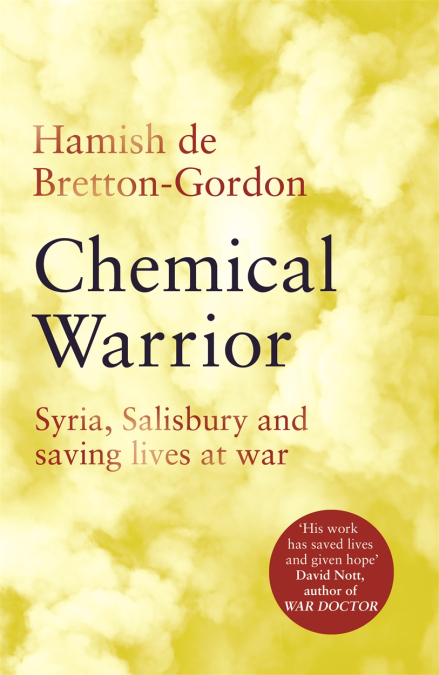
A review of “Chemical Warrior: Syria, Salisbury and Saving Lives at War”, by Hamish de Bretton-Gordon.
Happy New Year readers! Whether you’re new to the blog or a returning regular, I hope that the Christmas holidays were good to you and yours and you’re all set for 2025 (or, even better, you’re still luxuriating in the last of the time off). I had a wonderful break, spending time with family and friends and, as I mentioned last week, furthering my ambition to turn into a human sphere.
With a break from work I was able to catch up on plenty of reading, including a book I got as a present which I’d been meaning to read for some time: “Chemical Warrior”, by Hamish de Bretton-Gordon1. “DBG”, as the author styles himself, is a former British Army officer, a prominent spokesman on chemical weapons (CW), and a regular contributor to The Daily Telegraph.

DBG’s autobiography was published in 2020, and references to the then-inescapable COVID-19 pandemic abound (I’ll come back to this point later). The book starts with his early career experiences as a tank commander in Iraq during the First Gulf War, and charts his military career until 2011. DBG found his calling as a strong opponent of CW, especially in Syria, and the latter half of the book deals with his civilian work as a provider of CBRN2 defence solutions and training, as well as pursuing the anti-CW cause as a commentator.
This is a short and very accessible book, and its rapid pace makes it hard to put down. At times, the style can be a bit too “Bravo Two Zero” for my liking, but overall it’s a good read, alternating between entertaining and harrowing. In this review I want to focus more on the content than the style, however. Firstly I’ll give a brief synopsis of the book, which describes the author’s reluctant conversion into a CBRN warrior and commentator, or so-called “expert”. Then we’ll dive into this “expert” moniker a bit more, to see whether it’s fully deserved (spoiler: it’s not), but equally, to show how important DBG’s organisational (i.e. “soft”) skills were in mobilising support for his causes. Finally, we’ll examine how “Chemical Warrior” really hits the nail on the head when it comes to telling a story about military life.
As ever, if you like what you’re reading, I’d greatly appreciate a “Like”, a share on your socials, and (if you haven’t done so already), a sign-up via the link below so that you never miss a post.
If you enjoy this blog and want to support it, please consider a donation. Keeping this blog going doesn’t cost much, but it isn’t free either, so any help would be very much appreciated👍
Synopsis: DBG is a reluctant opponent of chemical weapons
All he wanted to be was a “tankie”…
The author grew up in a military family and joined the British Army’s prestigious Royal Tank Regiment straight out of university, but he skips all this in the book and plonks us down right in the middle of the action with a gripping account of coming under a suspected gas attack in Iraq. It’s 1991 and he’s on his first overseas tour of duty during Operation Granby, the British Army’s contribution to the Gulf War / Operation Desert Storm. This incident presages his later career path in CBRN, but was not the instigating factor, since:
I had shown no inclination whatsoever to be involved with chemical weapons. I was more than happy in my tank, thank you very much.
—Hamish de Bretton-Gordon (author of all quotes unless noted otherwise)
After coming back from Iraq, he became, in the words of his fiancée “a bit of an arse” due to the abrupt transition from a high-tempo warzone to civilian life in the days before post-deployment decompressions were routine. Thankfully for all concerned, he gets his act together and wins her back. We then jump ahead by more than a decade to the unwelcome news that he is slated to be the next commanding officer of the CBRN Regiment. After a decade of training exercises and peacekeeping tours, the post-9/11 wars have kicked off, and DBG is expecting to lead a regiment of tanks in the Middle East. He doesn’t mince his words:
I was distraught. Commanding a tank regiment was… where heroes were forged and legends were made… to reach the highest ranks in the armed forces you had to have commanded a guards, cavalry or rifles regiment. The CBRN Regiment was none of these.
This is not surprising: cavalry regiments are among the most prestigious of the British Army, and a tank commander most definitely has The Right Stuff (or at least its closest land-based proxy):

After a few brief pages of feeling sorry for himself, DBG (at his wife’s urging) gets over himself and embraces this new opportunity.
…but he embraced the “dirty detail” of commanding the CBRN Regiment…
After the initial disappointment, DBG realises that CBRN might be much more relevant to modern warfare than tanks, especially with the threat of chemical and biological weapons in Iraq. He was right, of course, and probably a bit prescient, but these things are cyclical and tanks look far more important again today in 2025 than they did twenty years ago.
He readily acknowledges that he “knew next to nothing” about CBRN, and was duly sent to the Royal Military College of Science to get a diploma in “chem bio science.” As a graduate of this same institution (albeit a slightly different field of study), I can attest to their winning formula, which is to get academics who are both brilliantly brainy and mission-focused, balancing theory with practical applications to impart the necessary knowledge to a very diverse audience of soldiers, civil servants, and international students.
If you’re surprised that the army would place a know-nothing3 Lieutenant Colonel in charge of a unit with a very technical mission, then you don’t know the British Army, which believes that the inherent leadership qualities of its officers, combined with focused technical learning, can make up for a lack of foundational scientific or technical education:

The top left of the above formula (in pink) is the traditional “gentlemen amateur” or “gentleman officer” ideal4 which goes back centuries. As a system, I’m sure it has its flaws, but it enabled DBG to transition onto a new career track which brought him to some extraordinary places. He ultimately ended up showing a commendable and canny enthusiasm for his new role, which is evident as he describes the history of chemical and biological weapons to the reader. Enthusiasm is one of the most important traits of any leader, and DBG shows his enthusiasm for CBRN on the page, as he surely did to the troops in his new command.
…and was intoxicated by the world of chemical weapons
DBG quickly brings us to Iraq, where, despite the now-infamous lack of chemical and biological weapons, his team had some moments of excitement (more on this below). He then transitions to an intelligence role in Afghanistan, and a recurring theme throughout these tours is the lack of on-site quick detection methods for biological samples. He helps to bring into service a quick on-site DNA testing machine using the now-famous PCR technology. Seeing the commercial potential for such a device, and becoming disillusioned with the army, he decides to retire and strike out in the business world.
DBG starts with a contract to identify victims of Saddam’s CW attacks against the Kurds, and then, as a rising star in the CBRN world, becomes drawn into the quest to prove the Assad regime’s use of CW during the Syrian Civil War. The latter half of the book deals with his work in Syria, which ranged from smuggling out samples of contaminated CW residue, to sneaking in to educate doctors on CBRN decontamination procedures. The reader really gets the sense at this stage that DBG is a man on a mission, crusading against chemical weapons, the Assad regime, and its Russian backers.
The memoir ends with the crusade coming to DBG’s own home town of Salisbury in 2018, with the Russian assassination of the British spy Sergei Skripal using Novichok, a deadly chemical weapon.
Critical analysis: DBG is more of an advocate than an expert
You need to know the facts to be an expert…
There’s no gentle way to say this, but the “expert” description on the dust jacket of the book is generous. DBG is not an expert in chemical weapons, although he is undoubtedly a powerful champion of the cause, as we’ll see below, and has a lot of real-world experience of their effects. An expert needs to be fluent in the facts, but technical mistakes crop up with surprising frequency in the book. The most common type is a misunderstanding of the lethality of CW. For example, he tells the story of an instructor on his chem bio course:
‘In your hands you are holding the nerve agent VX… if you were to correctly distribute what you are holding… you could kill one million people.’
Sorry, but there’s no way he was mixing 5 kg of VX agent under a fume hood. That’s before we even get into the “correctly distribute” part, which is one of the big design challenges of CW. It gets worse. Later on, when discussing the Salisbury attack, he says (of the Novichok family of nerve agents5):
It was virtually undetectable and very persistent, lasting for years once it had been spread on a surface. Most chillingly of all, just one molecule could kill millions of people.
One molecule of Novichok cannot kill one million people. To put it another way, one millionth of a molecule6 cannot kill someone. And while it might hang around in the environment for weeks or months, a persistence of “years”, as DBG says, seems unlikely, albeit a much less glaring error7.
I don’t think these errors are especially shocking or damning, given his broad rather than deep expertise. I am surprised that he didn’t get an expert from Porton Down to do a fact check before publishing. This might indicate some hubris on the author’s part, i.e. assuming that he doesn’t need fact checkers. A more generous interpretation is that publication was rushed8 and some howlers were missed. This would explain some other non-CBRN errors, such as referring to Aleppo as the capital of Syria, or lumping ISIS and the Al-Nusra Front into the same category9.
The stand-out example of non-expertise is a supposed incident where the author moved 54 tonnes of volatile chemicals from a police basement in Afghanistan, then mixed the acids and alkalines together to prevent them reacting like a “bomb”. All while the Taliban were closing in on his location. It’s hard to figure out exactly what happened here. The best I can do is assume that his team disposed of a bunch of old chemicals (not by mixing them together) with some experts from Porton Down giving advice on how to mitigate risks. Somehow this got mistranslated into the scene which DBG recounts in a way which would make Michael Bay blush.
…and even “experts” can get tunnel vision
There’s a tendency, when you know a lot10 about a certain topic to see every problem in this context. It’s the old cliché: when all you have is a hammer, everything looks like a nail. Similarity, when all you have is a gas mask, everything smells like gas.
This is a tendency I saw in myself, especially overseas. At every opportunity, I tried to bring in my ammunition and EOD skillset to the problem at hand. At times this was suitable, but at other times it definitely was not. Luckily I had different types of experts11 on the team, as well as commanders who saw the bigger picture.
DBG falls into the same trap at times in his memoir. The CW attacks by the Assad regime were the mark of a brutal and increasingly desperate regime, but were not the only, or indeed the worst thing that the regime did to its people. To date over 600,000 people, mostly civilians, have been killed in the Civil War. The brutality of Bashar al-Assad is that, like his father, he was willing to murder enormous numbers of his own people to stay in power. Chemical weapons are part of this, but not the only part.
The added significance of CWs in the Syrian Civil War was that Western leaders drew a “red line” and then failed to act when Assad crossed it. DBG sees this decision by the West as empowering despots all over the world to use CW. In particular, he posits that the 2018 Salisbury Novichok attacks would not have happened if the West had taken a stronger stance against CW back in 2013. I’m not at all convinced by this point. Is this evidence of a greater “acceptance” of CW, or is it simply Russia trying a new and sick way to kill her enemies? They killed Alexander Litvinenko with a radiological weapon in 2006 and assisted in the killing of Georgi Markov with a biological weapon (albeit a toxin) in 1978: their modus operandi is to tailor the assassination method to the target, while experimenting with new technique over time. Novichok was definitely new; it’s in the name.
Another example of this is a story DBG tells about responding to a biological weapons alert in the middle of a high-tempo operation in Iraq. The team investigated a suspected anthrax attack by Saddam’s forces. Spoiler: The alert was caused by naturally-occurring anthrax, in this case from a dead camel. As an armchair critic, I’m wary of second-guessing someone’s decision in the moment. However, DBG relates with what seems like pride how he scared the General in command of UK forces into ordering a full base lockdown until DBG and his team could investigate the threat. In retrospect, a bit more humility might have been in order. One wonders how robust the threat assessment was: had there been any indication, up until then, that Saddam’s forces were about to use biological weapons? As we know now (admittedly, with hindsight), there were no CW, let alone BW, in Iraq in 2003. Just because you have a shiny CBRN team on standby does not mean you should use it at the slightest opportunity, especially when it involves significant disruption for friendly forces. DBG ought to be a bit more reflective of this fact.
Soft skills can clearly make all the difference
Lest you think I’m being entirely critical of this memoir, I’d like to pivot now to an important aspect of DBG’s experience. It also complements the lack of technical expertise I mentioned above. This is his undoubted ability to mobilise a network of supporters around a cause, in his case, chemical weapons.
The most impressive example of this is the story he relates of leading an effort to rescue several hundred badly wounded children from a hospital in a rebel-held part of Syria which was about to be bombed by Assad’s forces, with the assistance of the Russians. He mobilises an on-the-ground team of medics to safety evacuate the kids while using intermediaries to beg the Russians to hold off on their assault. It works, and they get out of the danger zone.
DBG even manages to secure clearance for the children to fly to the UK for treatment, although the doctors later decide they are better off being treated in Turkey. Feats like this can only be pulled off by someone with strong soft skills such as empathy, charisma, and persuasiveness. The factual howlers I pointed out above don’t really matter if you can bring together a group of effective experts, some of whom will fill in your gaps in specific technical knowledge. Of course, the fact that the UK evacuation never happened despite the Trojan preparatory work was a disappointment, but this is an aspect of military life one needs to be familiar with: high effort for uncertain benefit, and sometimes doing nothing is the best solution. DBG shows us some other truths of military life in his memoir, and we’ll wrap up this review with a discussion of them.
Evaluation: “Chemical Warrior” reveals some real truths of military life
Experiences can be intense, even if they’re not big-picture significant
In the first chapter DBG describes what he thought at the time was a chemical attack on his unit. The experience must have been terrifying, and the author does a great job conveying the sheer panic as he tried and failed to breathe through his respiratory. But while that incident was one of the formative experiences of DBG’s life, it warrants no mention in grand narratives of the war. Spoiler: It was a false alarm.
This is an important, and oft-overlooked, part of military life: sometimes the most action-packed moments of danger happen in a context that bears little significance to the overall narrative of the great campaign. This reminds me of George MacDonald Fraser’s12 Quartered Safe Out Here, his memoir of service in the Burma campaign of WW2. He talks about a firefight which took some of his comrades and nearly killed him. It was by far the most intense fighting he took part in, and it happened at the end of the war, when the Japanese were about to surrender. It had no military significance. By contrast, his part in much more significant operations such as the Battle of Meiktila and Mandalay and the Irrawaddy River campaign was much less action-filled. This was because he was in a unit which was in reserve13 for much of the crucial periods of fighting.
The same applies, unfortunately, to some of the harrowing scenes and situations which DBG relates in his memoir. The individual stories of suffering, inconsequential though they may be in the grand narrative, are what affects him. One which haunted me, and which will stay with me forever, is when the author was in a queue of cars waiting to cross the Syrian border into Turkey. Ahead of him is an ambulance which is trying to cross with a little girl who has her four limbs missing. She’s being taken to a better hospital in Turkey in an effort to save her life, but the guards won’t let her through due to missing paperwork. As the author tries in vain to persuade the guards to let the ambulance through, the girl dies, alone, nameless, and afraid. It’s a difficult scene to recall, let alone to read, let alone to have experienced it as DBG did. Even though this poor girl’s death was one of over 600,000 in the Civil War, it had an understandably traumatic effect on the author. Ask any military person (anyone at all, for that matter) who has seen suffering in warzones, and it’s individual stories that stay with them.
Actions have consequences, and Syria won’t forget
I deliberately steer clear of politics in my writing, but I’ll make a brief exception today. The fact that the West14 turned a blind eye to the actions of the Assad regime in 2013 will not be forgotten by the Syrian people or its new rulers. That’s not to automatically say the West should have tried to topple the regime: we all know what happened in Iraq. DBG acknowledges the Iraq failure (briefly and, in my view, a bit belatedly) and makes a strong case for why the West should have intervened. I don’t fully agree with him15, but I find it hard to disagree. With all that’s happened recently in Syria, I think it’s important to reflect on what “our” indifference to Syrian suffering in the past might portend for this great country. This is part of a bigger move in recent years away from intervention based on an international rules (however imperfectly and inconsistently enforced) toward a “might is right” order which is exemplified in the war in Ukraine.
DBG thinks the West should have intervened after Assad was shown definitively to have used CW. There would have been consequences to intervening, potentially some very bad consequences (look at what happened in Iraq). But non-intervention is also a decision, and inaction has consequences too.
Military life is a sacrifice
The last big takeaway, at least for me, was the level of sacrifice which DBG underwent as part of his military and subsequent post-military but military-adjacent career. Every military memoir has at least a token bit about missing wife and kids etc. while the author was off doing all their cool stuff. You get the impression here that DBG really feels the sacrifice keenly:
In Jemima’s first year, I was home for only nineteen days, which was agonizing
In later years, as he’s negotiating civilian evacuations from Syria, he works through the Christmas holidays. There are many examples in the text of short notice separations from family. Aside from this, DBG is also very frank about his ill-health caused by the stresses of military life. It doesn’t stop him from carrying out some of the most hair-raising adventures, but it definitely has an effect on his family life, putting more worry on his wife and children.
Military life can be unique, adventurous, exciting, rewarding, and extremely fulfilling. The highs are higher than you get anywhere else, which can more than make up for the many lows. Unfortunately, the equation is much harder to balance for spouses and families. They don’t get the highs, but they get the lows of missing a loved one for significant period of time, while also getting to worry about what might happen to them. One of the main reasons I left the military was because of this asymmetry. I loved my job (at times, and that’s enough), but it didn’t love my family the way I did. I have the utmost respect for families that can make this balance work. The only reason I can take the easy option is because other people are willing to make the sacrifice. Thank you.
And thanks for reading! As always, I love to hear your thoughts, reflections, reactions, and comments, especially if you think I’m wrong about something. I appreciate you sticking through a longer post than usual, although I guess it’s making up for not posting last week. Please subscribe using the link below if you haven’t already, and please like and share this post with your friends to spread the reach of the blog. If you want to get my hot takes on chemical and/or biological weapons in the media, then check out my recent articles: Chemical Weapons: Fact Vs. Fiction and Biological Weapons: Fact Vs. Fiction, all part of the Weapons of Mass Distraction series.
- Colonel Hamish Stephen de Bretton-Gordon OBE, to give him his glorious full name and titles. I won’t lie: his extravagant name was the first thing which drew my attention to this fellow, many years ago. ↩︎
- Chemical, Biological, Radiological, and Nuclear; on the off-chance you’ve missed my four-part series on same (how dare you!). ↩︎
- Using DBG’s own words! ↩︎
- If you’re looking for an explanation of why this is, as well as a fascinating account of what led up to the infamous Charge of the Light Brigade during the Crimean War, then you must read the highly entertaining The Reason Why: The Story of the Fatal Charge of the Light Brigade by Cecil Woodham-Smith. The TL;DR version is that Britain historically ensured social stability by making its powerful landowning class the same as its professional military commander class. Wealth, rather than ability, was the determinant of success in the military. Sounds crazy? Yes, and you get a few military disasters as a result, but you also get a military that will never turn on the government, since both parties are always interested in keeping the status quo. Crazy, but it worked (more or less): Britain has a military that (with one exception in 1914) has stayed out of politics. None of this is to imply that DBG is some sort of present-day Lucan or Cardigan, or that the same conditions prevail in the British Army today. It’s just a piece of useful historical context whose echoes can be seen to this day. ↩︎
- As a reminder, in case you weren’t paying attention during my chemical weapons lessons, nerve agents are a category of lethal/casualty chemical weapon, along with blood agents (e.g. hydrogen cyanide), choking agents (e.g. chlorine), and vesicants (e.g. mustard gas). ↩︎
- Of Novichok, or, indeed, of anything. Okay, let’s get really pedantic for a minute here. Skip over this if you have a life, but I clearly don’t and need to go down the rabbit hole. The largest molecule ever made is called PG5. It has around 20 million atoms and weighs 3.3 x 10⁻¹⁶ grams. The most energy you can possibly get from this molecule is given by Einstein’s famous E=mc2. Let’s say we got a molecule of PG5 and a managed to make an antimatter counterpart. When we bring the two molecules together they would annihilate each other and release… drum roll please… 0.06 Joules. This is, to put it bluntly, not enough to kill somebody, let alone a million bodies. Feel free to check and correct my maths, but my point is that molecules are really small. Saying that one molecule can kill “millions” of people betrays a fundamental misunderstanding of chemistry. ↩︎
- And, to be fair, one of the inventors of Novichok claims that it can stay in the environment for up to 50 years, but only (and importantly), by falling into a crevasse or crack. ↩︎
- Perhaps to capture the zeitgeist of COVID-19, when decontamination procedures were in the public sphere. Depressingly, they could have taken their sweet time and still made the wave: little did we know in mid-2020 that we had at least another year of the pandemic. ↩︎
- Of course everyone knows about Al-Nusra now, and their successor organisation HTS, which led the recent overthrow of the Assad regime. But even back then, anyone halfway familiar with the Syrian Civil War knew that ISIS and Al-Nusra, while both having radical Sunni ideologies, were bitter enemies. ↩︎
- Or even a little. ↩︎
- Screwdrivers and spanners to my hammer, if you well. The takeaway is that we were all a bunch of tools. ↩︎
- Yes, the Flashman author, who I’ve recommended to you before. ↩︎
- Not in the sense of being a “reserve” unit, or even a rear-echelon support unit, but rather a front-line fighting unit which happened to be in the reserve “position” at the critical moment. Units are (or should be) rotated in and out of the front line during military operations. This happens at every level of organisation. At the simplest level, a “platoon in attack” (~30 soldiers, three “sections”) will have one section assaulting, one section suppressing (i.e. shooting at) the enemy, and one section in reserve. When the assaulting section reaches its objective it stays put and regroups. If there’s another further position to be taken, then the reserve section becomes the new assaulting section, the suppressing section gets a breather and becomes the reserve section, and the assaulting section suppresses the new objective from the recently-captured previous objective. This idea works for higher formations too: one fixes the enemy in place while another moves into an advantageous position, while the third is held in reserve. ↩︎
- By whom I mean primarily the USA and the UK, but also the EU. ↩︎
- In particular, I think he castigates the political opposition, particularly the UK Labour party, for voting against military intervention, although (as he acknowledges himself), public opinion was strongly against it. He also denounces “useful idiots”, i.e. stooges of the Russian regime who cast doubt on many of the claims of CW coming out of Syria. He’s right to counter these peoples’ claims with hard evidence, but wrong to dismiss them all out of hand, since that way lies political intolerance. ↩︎


Leave a Reply