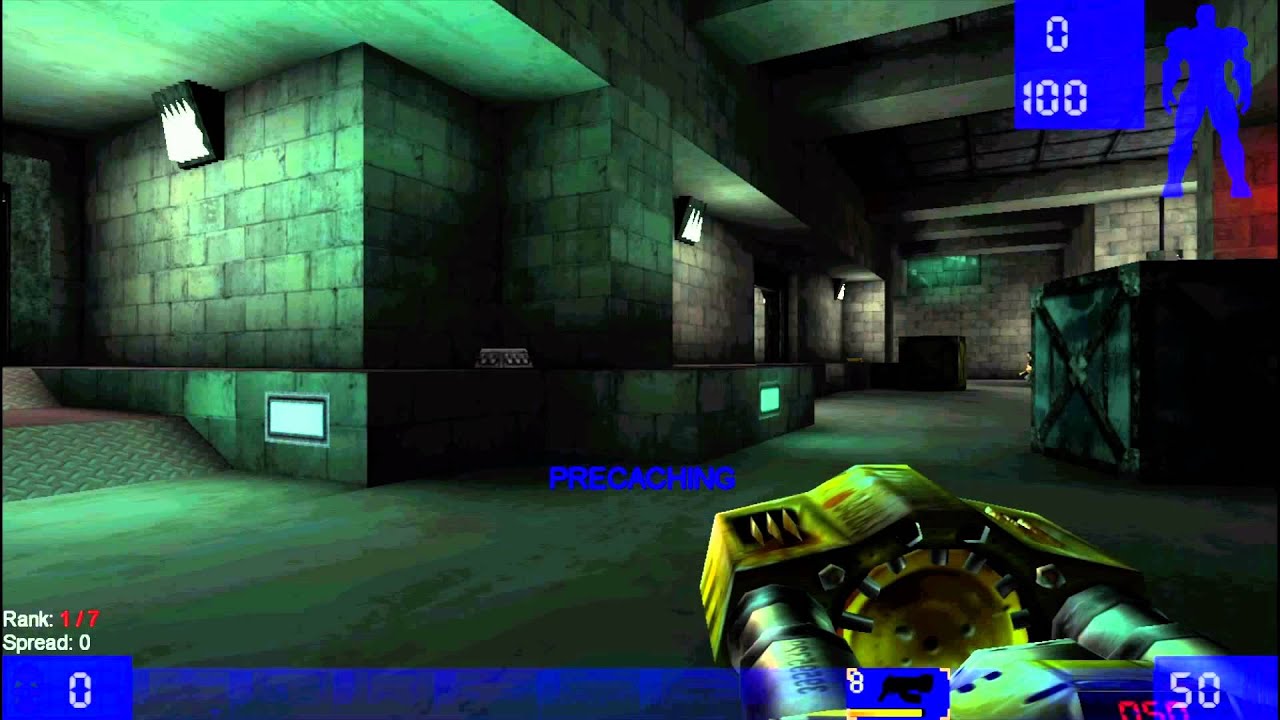
Unreal Tournament weapons: Part 2
🎧 Available in audio
Hello again. This week I’m bringing another instalment in our Unreal Tournament weapon critiques. I’ll turn my beady eyes on the Flak Cannon. This weapon was a particular favourite of mine, probably due to my lack of aiming skills. I’ll discuss how it works in the game, and why it wouldn’t work in real life (of course I’m going to ruin it. I’m a thing-ruiner). I’ll then move on to talk about shotguns and shotgun-adjacent weapons in games more generally, and compare their popularity in games to their real-life role.
If you don’t know what Unreal Tournament (UT) is, then you can read my first UT weapons article here, where I rate the iconic rocket launcher but also give a bit more context to this series1.
As always, I greatly appreciate your support. If you like these articles please share them and, if you haven’t already, please subscribe using the link below. Thanks, and enjoy!
If you enjoy this blog and want to support it, please consider a donation. Keeping this blog going doesn’t cost much, but it isn’t free either, so any help would be very much appreciated👍
The flak cannon is my all-time favourite UT weapon…
Unreal Tournament‘s most underrated weapon, in my opinion, is the humble Flak Cannon. It’s underrated because it sits below the rocket launcher in order of “switch” priority: if you’re carrying a flak cannon and pick up2 a rocket launcher, the game will automatically switch over. This might suit some rocket-preferring weirdo UT players, but it usually results in me panicking, spinning the mouse wheel the wrong way to end up with the utterly useless impact hammer3 before getting “gibbed” by my ruthless opponent whom I would have easily dispatched with the flak cannon.
And why would I have easily dispatched them? For starters, the flak cannon is coded “shotgun” and, as everyone who plays first-person shooters knows, shotguns are among the most forgiving weapons if your reflexes and hand-eye coordination are lacking. If you fall into this category, then you have two options when it comes to shooters:

The Flak Cannon is UT’s version of a shotgun, but it has some crucial differences:

Primary fire from this weapon gives the expected shotgun buckshot effect: a spray of fragmentation which spreads out in a cone, giving a lethal effect at close range without the need for pinpoint accuracy. Just like buckshot, however, the fragments slow down and disperse quickly, so the effective range is limited.
Secondary fire lofts an intact shell slowly toward the target, which explodes in a burst of shrapnel4. This gives the flak cannon a much-needed ranged capability (medium range, at least. This is never good for long ranges), redressing what is usually the downside of video game shotguns. This makes the flak cannon unusually powerful, like being able to choose “rock” and “paper” at the same time. Here it is in action, courtesy of PC Gamer, who share my enthusiasm for “the greatest gun in PC gaming”:
Even though it’s my favourite weapon, I must admit that the flak cannon leaves a lot to be desired in the realism department. That’s right, stand by: I’m going to tell you how Unreal Tournament, yet again, does not give an accurate depiction of how actual weapons work.
…but it doesn’t make much sense
The flak cannon’s primary and secondary modes of fire would each be semi-plausible in isolation. Together, they don’t make sense. Let’s break down how it might work.
The primary mode of fire is like a shotgun. This means you need a thin cartridge filled with fragmentation, and a low explosive propellant charge to accelerate these fragments down the barrel of the gun:

The secondary mode of fire is like a grenade launcher: the shell is sent at fairly low speed toward the target, where it then explodes and showers the area with fragments. This means you need a small low explosive propellant charge, a thick shell casing, a high explosive bursting charge, and a fuze of some kind. This is a very different type of ammunition:

The second type of ammo requires less “oomph” at the start (the propellant charges are smaller and the weapon itself can be lighter because there’s less recoil), but has a lot more internal complexity and engineering to deliver death when it reaches the target.
These are definitely not interchangeable. If you tried launching the first type of ammo toward the target without breaking it up first, then you’d get an unimpressive “thud”, since there’s no high explosive charge to break apart the casing and spread the fragments. Maybe the force of impact would split the casing open, but then all you’d get is a few fragments bouncing around. It might make the enemy trip, if they didn’t watch their footing.
On the other hand, if you tried to be clever and program the fuze on the second type of ammo to detonate early and give you a shotgun effect, then this would go very badly for you as the firer. Firstly, you’re getting a high explosive detonation mere inches from your face, which is never a good idea. Then you’d get the inevitable bits of shell casing and pre-formed fragments coming back toward you5, blinding or otherwise maiming you. Not a great idea.
What if we used different ammunition types? What if the Flak Cannon’s magazine is cleverly subdivided into two, with a ready supply of each type of ammo? There are two problems with this. The first (the smaller problem) is that the game’s animations make it very clear that a new shell is loaded into the breech immediately after the last one is fired (in other words, it’s an automatic weapon). This means that you can’t choose which type of ammunition you’re going to fire, because the weapon already has the round loaded and ready to go:

The bigger problem has to do with the weapon’s design. As we saw above with our shotgun vs. grenade cross-sections, the shotgun needs a big heavy breech to keep the shotgun shell and all the hot gases facing forward, i.e. the correct direction. A grenade launcher, because it shoots a much slower projectile, needs much less propellant and consequently a lighter breech block and therefore a lighter weapon. So, you wouldn’t use the same weapon to fire both ammunition types, because this makes no sense from a design point of view. You’re either carrying something that’s far too lightweight and flimsy to fire a shotgun shell, or a majorly over-engineered behemoth for lobbing a few grenades.
There’s a much bigger problem here, however, and it’s an issue regardless which type of fire we’re talking about. As you can see in the animation above, the round is loaded into the barrel, and then we can see the back of it until it fires. The only thing holding the round in place is what looks like a series of circumferential pins. There’s no way that a few flimsy pins and the brass of the back of the shell casing would be strong enough to keep the propellant gases from bursting through and ruining the firer’s day. This takes the concept of “firing from an open breech” to a whole new and absurd level. It makes for a cool firing/loading animation, but it would never work in reality.
Speaking of reality, let’s look at the popularity of shotguns in other shooters and how this compares to the real world, or at least the military.
Shotguns are popular in video games, and sometimes in real combat
Shotguns are a popular weapon in first-person shooters. This is mainly because of their very forgiving nature for novice players, as mentioned above. A second reason comes with newer games (newer than Unreal Tournament, at least, which isn’t hard) and ragdoll physics engines. Shotguns were given improbably high stopping power and so would physically blow the enemy away6 in a very satisfying manner, as seen in some of these examples:
Combat shotguns do have a place in the modern-day military, but it’s a limited role. They’re used to break open door locks during urban warfare7 and occasionally as an offensive weapon in similar operations where ranges are limited and the enemy might appear right in front of you at any moment. Trench warfare, particularly during WW1, was another use case for shotguns.
By and large, though, shotguns are a niche rather than an everyday weapon for militaries. They have limited utility at range and shotgun ammunition is much heavier than rifle ammunition: a 12-gauge8 round is nearly four times heavier than a 5.56 x 45 mm standard rifle round. And ammunition weight is important, because soldiers use quite a lot of it. This, in turn, is because they spend a lot of time hunkered down behind cover firing at the enemy. We mentioned this a few weeks ago in talking about fire and manoeuvre. Modern tactics mean you need to be able to pin the enemy down with long-range accurate fire so that your buddies can move into a position to assault. And while the shotgun may be pretty good at the “assault” bit, it’s pretty useless at the “suppression” bit, unless you’re firing and manoeuvring at point blank range (and even then, it will be pretty bad because of the limitations in how much ammunition you can carry).
In the real world of combat, the advantages of the shotgun are usually outweighed by its disadvantages.
Conclusion: Real weapons have tradeoffs
I mentioned above that Unreal Tournament‘s Flak Cannon was like being able to play two “rock, paper, scissors” options against your opponent’s one. It won’t guarantee you a win every time, but it stacks the deck seriously in your favour. The only place the Flak Cannon falls down is in long-range fire. In a game like UT, however, where most maps feature tight corridors and lots of right angles, this weapon is almost always perfect:

It’s also a perfect accessory for the manic speed which characterises a typical UT deathmatch. You can rack up your double, triple, mega, and even M-M-M-MONSTER kill streaks with a dozen or so shells, a sneak approach, and the right angles.
This weapon is glorious because it deliberately casts aside the trade-offs that are normally strictly enforced in shooters. Ranged weapons are slower to reload, rapid-fire weapons cause less damage, more powerful weapons have smaller ammunition loads, etc. The Flak Cannon laughs at your conventions as it spits high explosive grenades and shotgun shells from the same orifice, in contravention of all known norms of gun design and quite possibly some laws of physics. What’s not to love?
That’s all for this week, folks, and I hope you’re enjoyed my trip down memory lane. I hope it brings back some memories of UT or other shooters for you too and, if not, it’s never too late to try out this masterpiece. As always, please let me know what you think in the comments below, and please “like” and share on your favourite socials. Finally, if you haven’t already, please subscribe using the link below to never miss an article. Thanks for reading, and I’ll see you next week.
Featured Image: Why the Flak Cannon is the greatest gun in PC gaming, PC Gamer, via YouTube
- Although not a huge amount, it must be said. If you’re wondering I spend so much of my time thinking and writing about esoteric weapons from long-ago games, then you must be new here. Welcome! Don’t go away. ↩︎
- By which I mean “walk on top of”. When you’ve carried rifles, machine guns, or even rocket launchers up and down mountains, you’ll always raise an eyebrow at how quickly your video game character can switch between different weapons, and how many of these things they can carry. ↩︎
- The default UT weapon. I’ve never once managed to use it effectively. Bots are quite good at it though, which probably tells you all you need to know about my skill level. ↩︎
- As I’ve mentioned before, there’s a difference between “shrapnel” and “fragmentation”, but we won’t fall out over it. ↩︎
- In theory, you could engineer it so that the explosive was behind the fragments and accelerated them forward, but you would always get some fragments travelling back the way. Besides, this setup would reduce the grenade’s effectiveness when lobbed. ↩︎
- Fun and all as ragdoll physics is, this is one of those areas where I need to be a thing-ruiner again. While it’s true that shotguns pack a punch, they won’t send the target cartwheeling backwards upon being hit. Our old friend Isaac Newton has come again to ruin our fun, this time with the laws of conservation of momentum. In short, if the projectile hitting the target causes it to fly backward, then the projectile leaving the barrel ought to send a similarly sized firer sprawling in the other direction. ↩︎
- Also known as “FIBUA”, or “Fighting In Built-Up Areas”, showing that the military has an acronym for truly everything. We also have “FIWAF” (Fighting In Woods And Forests,” and, when we’re on leave in the local town, “FIPAC”, or “Fighting In Pubs And Chippers.” ↩︎
- Brief aside on how we measure shotgun calibres. “12-gauge” means that the barrel is the same diameter as a lead ball weighing 1/12 of a pound. That’s why 20-gauge is a narrower barrel (because the equivalent notional lead ball is only 1/20 lb) and an 8-gauge is wider. ↩︎


Leave a Reply to padraiglenihanCancel reply