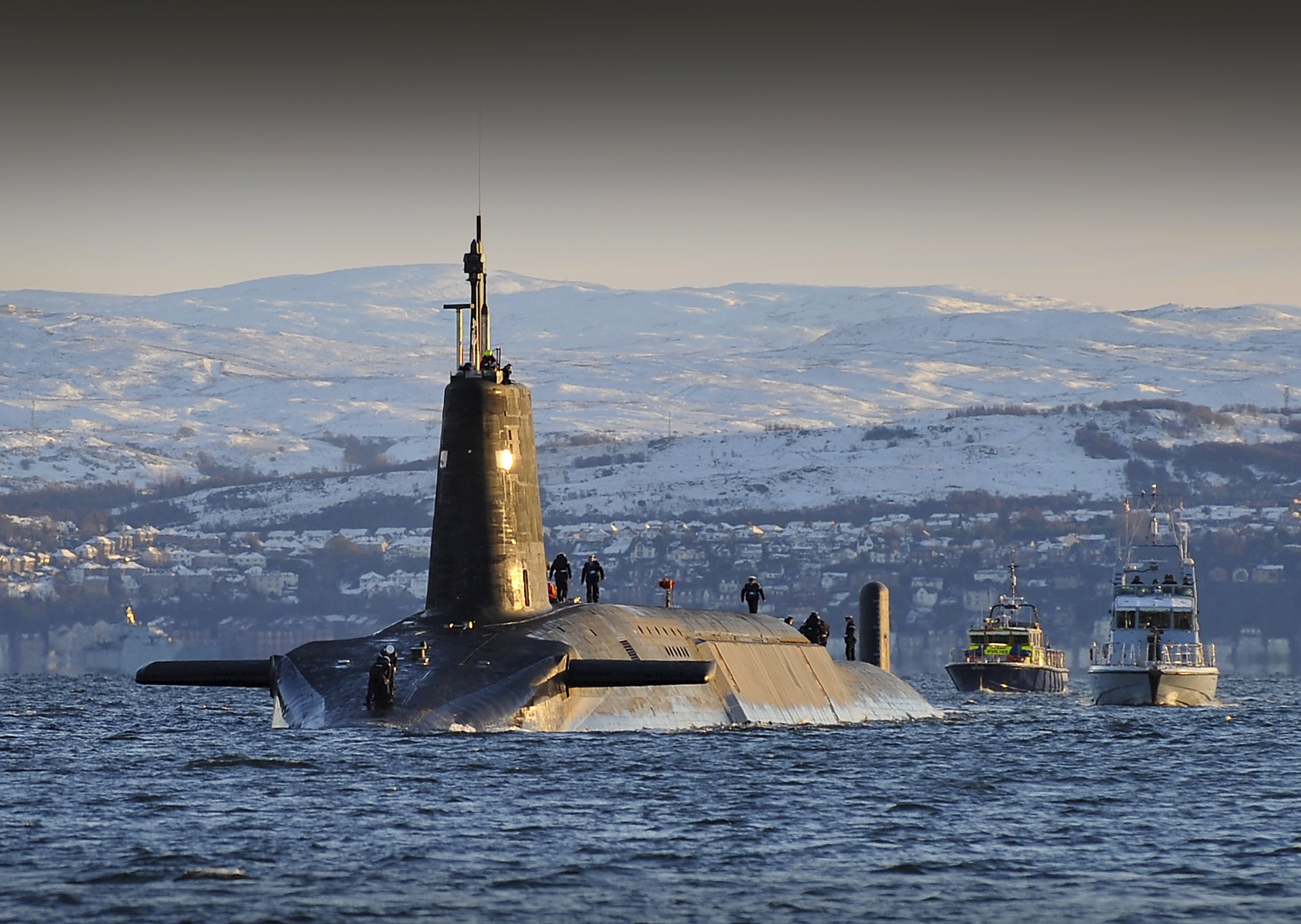
What, exactly, is a “nuclear” submarine?
Hello all. I was working on an article all about internal ballistics this week, but got sidetracked by President Trump’s recent announcement about positioning “Nuclear Submarines” in the “appropriate regions.” You might have heard about this too:

What, I wondered, is he talking about? Lots of news media reacted breathlessly to this social media post, as if it contained new and alarming information. Others pointed out the glaring ambiguity, which is that:
Nuclear-powered and nuclear-armed submarines are not the same thing
I’m sorry if this is blindingly obvious to you, but lots of reactions I saw have convinced me that it’s not obvious to everyone. Hence I decided to dedicate this week’s post to explaining the differences and similarities, and why it matters. More detail in the post below, but the TL;DR version is:

Nuclear-powered submarines use a neat technology to get around, while nuclear-armed submarines use a very scary technology to threaten to burn many cities in minutes. Let’s look at each in more detail.
I’ll start by talking about nuclear-powered submarines, then move onto nuclear-armed subs (generally speaking, ballistic missile submarines). I’ll wrap up by bringing it back to Trump’s post above, and what (if anything) it means. As usual, I’ll bring in some film and TV examples. Luckily, Hollywood is pretty rich in nuclear submarine lore.
Before that, however, I’ll encourage you to subscribe to the blog using the link below. As always, I’d love to see your comments below, or you can contact me via webform here or email here. Finally, if you enjoy this read, please share it with a friend.
If you enjoy this blog and want to support it, please consider a donation. Keeping this blog going doesn’t cost much, but it isn’t free either, so any help would be very much appreciated👍
What is a nuclear (powered) submarine?
The “powered” bit in the section title above is redundant, since the term “nuclear submarine” specifically means a sub which is powered by a nuclear reactor. The nuclear energy stored in the bonds within uranium atoms is released when the atoms split. This energy is used to heat water and turn important bits of machinery, such as the sub’s propeller:

Nuclear technology is expensive, highly specialised, and has a history of going wrong. Soviet nuclear submarines, in particular, have had a patchy history, claiming the lives of at least 28 and up to 60 sailors, including the 1961 accident that was dramatised in K-19: The Widowmaker.
Safety aside, nuclear propulsion is not the quietest way to power a submarine. Nuclear reactors can’t be turned off, so even on the stealthiest stealth mode, the cooling water needs to be constantly pumped around the core. The waste heat from the reactor can also leave a thermal signature on the surface above the submarine, given sufficiently sensitive detection equipment.
With all these problems, why opt for nuclear propulsion? There are two giant, stonking advantages which nuclear brings. The first is energy density. Apologies for re-using this wonderful xkcd image, but there’s no better way to illustrate the difference between nuclear and fossil fuels:

A nuclear submarine can go decades between refuelling “stops,” and will use just a few kilograms of enriched uranium in that time. This gives nuclear submarines a global reach. The only limiting factor is the amount of food that can be carried on board.
As well as having a practically unlimited operational range, nuclear submarines can also stay underwater for months on end (the limiting factor being the food again, or perhaps the crew’s psychological endurance). This is due to the second big advantage: a nuclear reactor doesn’t need to breathe. Diesel engines, or any form of combustion engine, needs oxygen to work. Unless you carry all that oxygen on board1, you will need to make frequent trips to the surface to replenish your air with a snorkel. Range and the ability to remain submerged make nuclear submarines hard to track and detect, which is exactly what you need.
And as for the safety issue, operating in submarines is inherently dangerous, and military submarines even more so. The additional risk posed by nuclear propulsion is dwarfed by the risk of being in a submarine in the first place:

As you might expect, nuclear submarine technology is limited to a handful of the largest world powers:

Although the USA clearly has an overwhelming numerical advantage in nuclear submarines, it doesn’t have any non-nuclear (i.e. diesel-electric) subs (neither do the UK or France). Russia and China both deploy substantial numbers of these to bring their submarine fleet sizes to 51 and 53, respectively.
There are three broad categories of nuclear submarine, one of which we’ll deal with in the next section:

What is a ballistic missile submarine?
A ballistic missile submarine, or boomer, or SSBN2 is a submarine which carries nuclear missiles on board. Its primary mission is to survive a sneak first nuclear strike and retaliate against the aggressor, thereby ensuring mutually assured destruction and deterring the original sneak attack.
Specifics vary from navy to navy, but SSBNs generally carry over a dozen nuclear missiles, with multiple warheads on each missile. This means that, in theory, a single SSBN could destroy dozens of enemy cities. The USA has fourteen of these monsters, Russia twelve, China seven, the UK and France four apiece, and India and North Korea two each. That’s a lot of nuclear firepower lurking underneath the waves3.
Ballistic missile submarines form part of the so-called nuclear-triad (at least in the USA’s doctrine):

Ballistics missile submarines are deployed for months at a time. Their locations are, of course, closely-guarded secrets. They can launch their megadeath missiles without even surfacing, and they can receive a limited amount of radio communications while hiding at depth. They are exceedingly difficult to find, fix, and destroy, and therefore are a useful way that a nuclear power can guarantee the destruction of their enemy in an all-out war.
Nuclear propulsion technology, of course, is a significant enabler for an SSBN’s mission. Unlimited range and no need to surface makes them difficult to find. Their missiles can be launched from anywhere on Earth at most other locations on the planet (depending on the range of the missile).
Not all nuclear-armed submarines have nuclear propulsion, although most do. The significant exception is the North Korean Hero Kim Kun Ok submarine which is based on the Soviet Romeo-class diesel-electric submarines, but modified to carry cruise and ballistic missiles.
There’s a whole genre of “submarine films” (Wikipedia counts 150 shot between 1910 and 2010) which use the isolation and threats facing the small, confined crew as the backdrop for high drama. Since the development of ballistics missile submarines during the Cold War, these classes of sub have been over-represented in film and TV. It’s easy to understand why. As the late, great Gene Hackman says in Crimson Tide, they are “the most lethal killing machine ever devised.”
An honourable mention must go also to The Hunt for Red October, based on the Tom Clancy novel. There are plenty of submarine movies about attack subs, but they tend to focus more on the pre-Cold War and ballistic missile era. Examples are Das Boot, The Enemy Below, and U-571.
An extremely dishonourable mention must go to the 1999 Bond movie The World is Not Enough, the nineteenth in the franchise. The plot revolves around a stolen atomic bomb which half-explodes. The baddies plan to use the other half to melt down the reactor of a nuclear submarine (which is lying in the Bosphorus) and cause a super-nuclear explosion which will destroy Istanbul.
Sigh. The nuclear weapon in question uses plutonium, whereas a nuclear reactor uses 20% enriched uranium4. These are different elements. A plutonium bomb won’t cause uranium to undergo fission, especially not at 20% enrichment and in an improvised setup. It’s still lethal as a projectile, though, as Bond finds out:
The nonsense in the film above is symptomatic of the general ignorance around nuclear technology. Nuclear power is similar to nuclear propulsion, but very different from nuclear weapons. This general ignorance, in turn, might be what prompted the confusing announcement from the US President—or perhaps not. Let’s discuss this next, as we wrap up.
Conclusion: What does all this mean?
What does President Trump mean, therefore, when he says that “two Nuclear Submarines [will be] positioned in the appropriate regions”?
Option 1: He’s talking nonsense. Trump has form here, having been stumped in past debates with questions about the USA’s nuclear triad5. In this scenario, he’s unaware that he’s made a meaningless statement, because all US submarines are nuclear powered, and ballistic missile submarines don’t need to be “positioned” anywhere: they can hit a target anywhere in Russia from anywhere in the Atlantic (including their home bases on the East coast of the USA).
Option 2: He’s tipping his hand, and it’s alarming. Perhaps something really is happening here. When he says “nuclear” submarines he’s referring to “nuclear weapon” submarines, most likely ballistic missile submarines. I know I’ve just said that a sub can hit anywhere in Russia from anywhere in the Atlantic, and that’s true… but if it were closer to its target, the time of flight would be much shorter. This would give the attacker an opportunity to carry out a decapitation attack in a surprise first strike, destroying command and control infrastructure and neutralising6 political and military leadership. The hope would be that such a decapitation would limit the enemy’s ability to launch a counterstrike.
Do I really think that President Trump would breach many layers of security and brag about ballistic missile positioning on Truth Social? Hmm… maybe. Having said that, let me put my cards on the table and state that I don’t think this is the case. I really, really hope that this is not the case. Russia has more than enough nukes (including on ballistic missile submarines of its own) to maintain a second strike capability. This option would be extremely bad on many, many levels. Let’s move swiftly on.
Option 3: He’s being strategically ambiguous. By deliberately using vague terminology to win a flame war without changing the status quo, he is acting out a form of low-level strategic ambiguity. He knows (or sort of knows) that the “nuclear submarine” category in itself conveys no special threat. The Russians (at least those who matter) also know this, and therefore will limit their escalation to mere rhetoric. But most of his people, whether they are loyal followers or angry critics, don’t appreciate this point. So when he threatens Russia with “nuclear submarines,” two things happen:
- His followers are happy, because he’s demonstrating “America First” toughness,
- His critics are mad, because he’s being “reckless” and upending “norms”. When his critics get mad, his base gets defensive and doubles down7. This ratchets up his supporters even more. Ultimately, someone on the MAGA side will silence the critics with the real facts, and he wins the media battle.
I’m inclined to believe Option 3, and give the US President the benefit of the doubt (although you may think I’m being generous). So, after all that, what’s the net effect of this nuclear subs announcement?

A big, fat duck egg. Nothing at all. The media cycle moves on (it has already, to be honest. I’m a few days late to this). But, even if you’re behind the curve now, at least you know a bit more about nuclear submarines and ballistic missile submarines.
That’s all for this week. Thanks for reading and please remember, if you haven’t already, to subscribe using the link below. Please also share this article with a friend. Thanks, and see you next week, when we’ll finally get back to talking about ballistics.
Featured Image: Nuclear submarine HMS Vanguard arrives back at HM Naval Base Clyde, Faslane, Scotland following a patrol. From UK MOD Defence Imagery, via Wikimedia Commons.
- Not a preposterous idea, it’s what rockets do, but it would not be practical for a submarine. ↩︎
- This stands for “Ship, Submersible, Ballistic, Nuclear” (link is a .pdf), which combines jargon with the often ridiculous military logistical backward-speak. ↩︎
- Although they are not all deployed at once, at least in normal times. ↩︎
- As a reminder, the percentage here refers to the proportion of the fissile isotope uranium-235. The remainder is the non-fissile (but radioactive) uranium-238. “Fissile” means it can undergo nuclear fission, i.e. can split apart. This 20% enriched uranium found in subs is more enriched than the 3-5% generally found in nuclear reactors on land, for various reasons to do with the more compact design of a mobile reactor. It’s still a long way off the 85%+ which is typically used in nuclear weapon cores, when they do use uranium. ↩︎
- Like lots of Trump’s foibles, this put some of the more “liberal” news and comedy folks in a bind. They obviously wanted to make hay out of his ignorance, but couldn’t do so without seeming like massive nuclear weapon MAD-hawks. How can you talk about nukes and still seem “woke?” ↩︎
- This is a very euphemistic way of saying “burning to a crisp in a fraction of a second, along with millions of other people.” ↩︎
- E.g. “What you libs don’t understand is President Trump is ready to rain down hellfire and damnation AT ANY MOMENT!!” ↩︎


Leave a Reply to Assorted Links for Saturday, November 08, 2025 – Mostly Dross – Ramblings From BensonCancel reply