Why it’s hard to destroy airborne drones
Hi there. This week I’m talking about a topic which has been trending in Ireland over the past week, and that’s the visit of the Ukrainian President Volodymyr Zelenskiy to Dublin. More specifically, the incursion of suspected Russian drones near the flight path of Mr. Zelenskiy’s plane, these drones subsequently buzzing an Naval Service vessel in the Irish Sea, and questions about why the Naval vessel didn’t take stronger measures against the drones. An unnamed source in The Irish Times said “it would have been nice to shoot down at least one for evidential value.” The article goes on to say (with my emphasis in bold):
The [ship], which arrived back in port in Haulbowline, Co Cork, on Monday, was “entirely capable” of shooting down the drones, said one naval source, and had carried out air defence exercises a few nights before Mr Zelenskiy’s visit.
It has also practised shooting down target drones in the past, sources said. However, it lacks an air search radar and electronic jamming equipment, meaning it is almost entirely reliant on the marksmanship of the crew.
Given the questions being asked, I thought I’d address some of the realities of hitting flying objects. I saw one commentator give a very clear explanation on X, and I thought I’d try to get into more detail.
I’ll start by describing why it’s hard to hit flying things. Then I’ll discuss some of the ways that ammunition designers have addressed these challenges. After that I’ll talk about the unintended consequences of firing into the air, before wrapping up by talking about the actions of the Navy in this new context.
I should add a massive caveat at the outset. I don’t know anything about the Irish naval operation and the drone incursion besides what’s been posted on print and social media. I don’t know who the crew were (the Irish Defence Forces are small, but not that small), and I haven’t the faintest idea what their orders and constraints were. All I can do is use open-source information and what I know about weapons to address some of the less informed commentary in the media.
Of course, as always, please chime in in the comments below if you think I’ve left anything out. You can also contact me via webform here or email here. Also, please subscribe to the blog using the link below. Finally, if you’ve enjoyed this post, please share it with a friend.
If you enjoy this blog and want to support it, please consider a donation. Keeping this blog going doesn’t cost much, but it isn’t free either, so any help would be very much appreciated👍
It’s hard to hit flying things…
This is hardly a novel idea, but it’s worth emphasising. The sky is big[citation needed] and bullets are small. It’s hard for soldiers to hit things, especially moving things, and that’s on a flat(ish) plane with a sturdy resting point for your weapon:

There’s a bunch of (mostly unsubstantiated) figures out there that it takes somewhere between 5,000 and 250,000 rounds fired per enemy killed1, based on data from WW2 to the recent Iraq and Afghanistan Wars. The number isn’t important, but it highlights something that every soldier knows: most of your rounds fired are in suppressing fire, and creating a “beaten zone” where rounds land across an area is actually a desirable thing.
The point is that if we don’t even expect soldiers to be pinpoint accurate against targets on the same horizontal plane as them, how can we expect sailors to hit something flying around them in three dimensions? Not to mention the complicating factors of ballistic arcs, air resistance, gravity, and the time of flight to the target (remember, bullets aren’t magical and instant like in some computer games).
Many aeons ago, when I was a young cadet, we practised firing against towed airborne targets with the GPMG on its anti-aircraft mount:

We were atrocious and didn’t hit a thing. Small arms fire against airborne threats is a last resort. Militaries realised long ago2 that it’s hard to get a single round in the same volume of air as the aircraft (let along a vulnerable part of it), even assuming you trained for this, so we came up with some neat tricks to increase our odds. Let’s talk about these in the next section.
…so, we found a way to increase our odds
Fire lots
The simplest way to overcome the low probability of a hit is to increase the amount of lead in the air. The gold standard for this is the American Phalanx Close-In-Weapon System (CIWS), which has been described by naval sources as “like R2-D2 with a hard-on.”
Note from the video above that most of the rounds missed the target (as you’d expect), now imagine how much more difficult it is to hit something in the air. And this thing has a built-in radar and an automatic fire control system. It really is like a droid. Slightly alarmingly, there seems to be a trend for putting these weapons systems in ridiculous outfits:

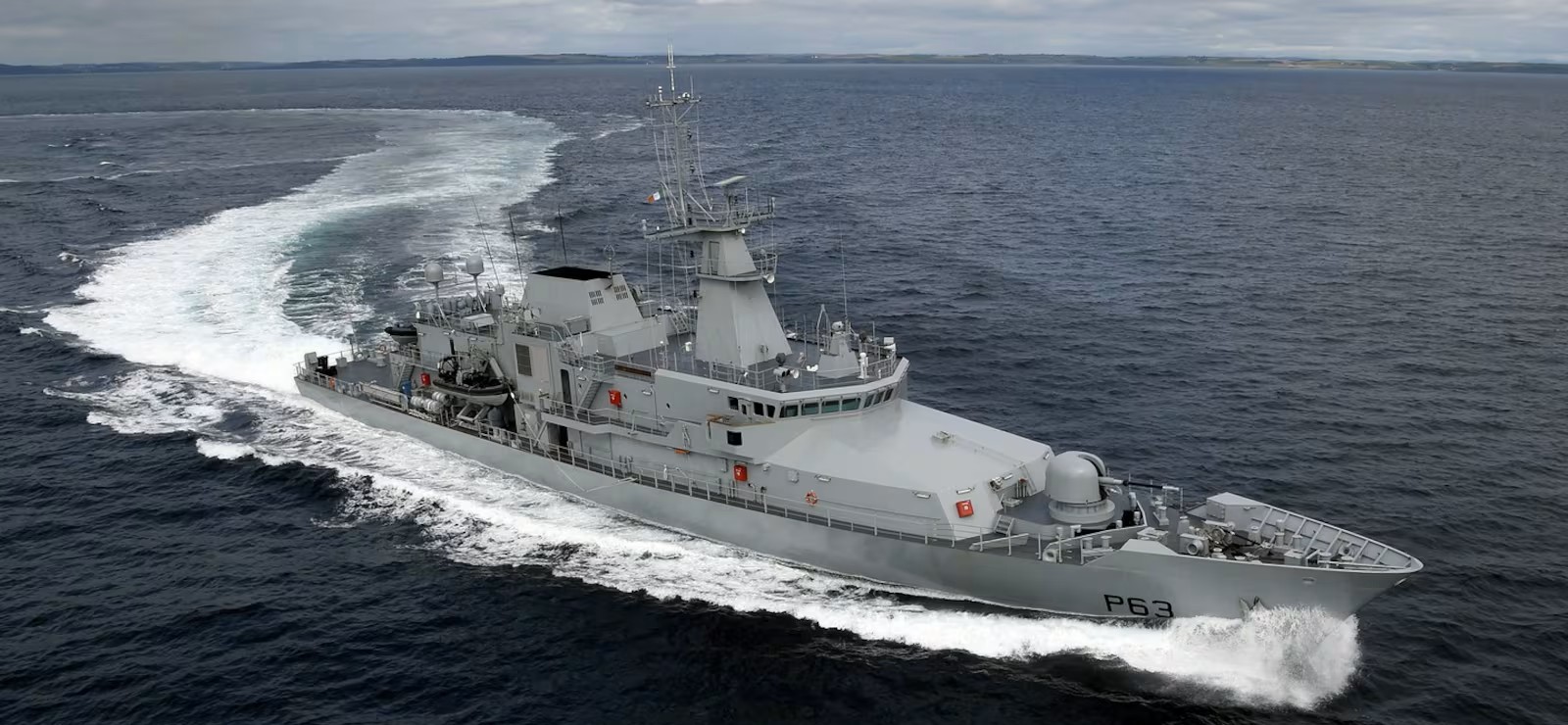
The ship involved, the LÉ3 William Butler Yeats, does not have a system like this4. Its secondary armament is the Rheinmetall Rh 202 20 mm autocannon which fires an impressive 800-1000 rounds per minute, compared with the 4,500 rpm for the Phalanx CIWS.
Guide the projectile
If you can guide the “bullet” onto the target, then you might get a hit from only one attempt. This is the principle behind guided missiles, which come in many forms such as air-to-ground, air-to-air, or, what interests us now, surface-to-air.
To hit a moving aerial target, missiles need to be one of two types:

Here’s a video of the US’s short range anti-air and anti-missile… missile. It’s called the RIM-7P Sea Sparrow.
The LÉ William Butler Yeats does not have any guided weapons as part of its normal armament. Even if it did, to be fair, the unit cost of €100,000+ for a guided missile makes it uneconomical to use against cheap drones, as NATO countries are finding out.
Create a wall
If you know where the airborne threat is going, then you can put as many projectiles as possible into the space where they are going to be. This is the principle behind large concentrations of anti-aircraft fire (“flak”), which was a feature of WW2 strategic bombing.

The US Army Air Force made an excellent training video about anti-aircraft fire in 1944. This whole video is gold, but watch this part specifically where they talk about creating a flak-filled volume of air where they expect the planes to have to go:
Creating a wall of flak against drones or any other target requires time, altitude, or proximity fuzing, which we’ll discuss in the next section.
Use clever fuzing
The simple way to get an airburst effect, like the walls of flak discussed above, is with a timed fuze. As the name suggests, this is a component on the shell which is set before firing, then fired, and when the set time has elapsed it will cause the explosive payload to detonate.
This is great for anti-air because you can use maths to crunch target data such as altitude, direction, and speed, and therefore determine the ideal time for the round to detonate and spray its fragments all around, hopefully hitting the aircraft (or drone) in the process.
These timed fuzes are much more effective if you can figure out the ideal detonation time and “set” the fuze quickly. As far back as 1944 (see video above) they had “directors” computing the time required, and fuze setting machines which also did this in moments.
Modern ammunition has gone a step further with “programmable” fuzes, which have a radio-controlled fuze which receives a setting signal from the weapon as it’s being fired. The process goes something like this:
- Firer finds a target and shoots a laser at it
- Laser bounces back and gives the range
- Weapon sets the sights and firer shoots the ammunition
- As the ammo leaves the barrel, transducers in the muzzle measure its velocity
- Based on the round’s velocity and the distance to the target, they send a signal to the round telling it when to detonate
Rheinmetall have programmable rounds for larger calibre guns (this is a pdf link), while Nammo have one for automatic grenade launchers (40 x 53 mm). Here’s a video of the Nammo grenade in action against a drone:
If you want to go one better than a timed fuze, then you need a proximity fuze. This contains a miniature radio transmitter and receiver. It has a pre-set or programmed proximity trigger. As the shell flies through the air, it continually sends out radio waves and listens for echoes. The echoes tell it how far it is from a hard surface. When the echoes get close together and the hard surface (such as the side of an aircraft) gets close enough, it sends a signal to detonate the round, hopefully showering the target in deadly fragments.
The proximity fuze has been described as the “Secret Invention That Changed WW2”, and with potentially good reason. It allowed the Allies to carry out much more effective anti-aircraft fire (not to mention its benefits for other types of artillery), which proved decisive against Japanese air threats in the Pacific and German V1 cruise missiles in England. I’ll leave the rest to Real Engineering and Curious Droid, two excellent videos:
Proximity fuzes are far more effective than pointing up and spraying and praying. Which is good, because shooting bullets up in the air has one big downside, which we’ll discuss next. Unfortunately, none of the weapons on the LÉ William Butler Yeats has ammunition with either a timed or proximity fuze: the 20mm autocannon we discussed above has rounds which are just a little too cramped inside for that kind of fancy electronics.
I’ve just discussed many ways that navies can improve their odds against drones or other airborne targets, and we’ve seen that the vessel in question didn’t have these. But surely they can and should have just given it a go with the tools at their disposal? Channel me, c. 2008, spraying a praying a GPMG into the sky? There’s no harm in trying, right?
Bullets end up somewhere
Bullets which are fired up into the air eventually end up on the ground again, due to Newton and his pesky gravity. This is why the phenomenon of injuries and deaths from “happy shooting” is a real thing in places where such customs are common. This on one reason why a commander might hesitate before opening fire with small arms at some nearby drones.
These guys were miles out to sea, however. What’s there on the surface to hit? For starters, there could be civilian vessels within the eventual ballistic arcs (which are kilometres long) of any anti-drone bullets. Granted, it’s a long shot, quite literally.
What was a more pressing constraint was the presence of civilian aircraft nearby in a holding pattern for Dublin Airport. You do not want to be the ship’s captain who shoots down a Ryanair plane full of holidaymakers from Lanzarote (or, indeed, the Swissair from Geneva with skiers).
These risks are probably still minor, but they need to be weighed against the likelihood of actually getting a drone (low, arguably, given the reasons I’ve outlined above), and the lack of a direct threat posed by the drone at that moment.
Conclusion: When you don’t have the tools, you can’t do the job
Let’s return to the quote I put up at the outset of this piece:
The [ship], which arrived back in port in Haulbowline, Co Cork, on Monday, was “entirely capable” of shooting down the drones, said one naval source, and had carried out air defence exercises a few nights before Mr Zelenskiy’s visit.
It has also practised shooting down target drones in the past, sources said. However, it lacks an air search radar and electronic jamming equipment, meaning it is almost entirely reliant on the marksmanship of the crew.
This is from The Irish Times, Tues 9th Dec 2025. The emphasis is mine.
I don’t know what I would have done as the commander of that vessel in that situation. Thankfully, the decision wasn’t mine to make. But I think it’s unfair to criticise someone for not taking a potentially reckless action for probably limited gain, unless they were given clear order to do so. Which, judging by the available information, they were not.
If you don’t have the right tools, then sometimes it’s better not to attempt the job, as anyone who’s ever done a DIY project can attest. I can’t square the contradiction between, on the one hand, saying that the ship was “entirely capable” of shooting down the drone, while on the other hand, saying that it’s reliant on the crew’s own eyeballs and marksmanship. The latter fact means that you don’t have the right tools, and therefore you are not entirely capable.
I’ll end on a mini rant, so please excuse me. Throughout my entire career in uniform, I was dismayed to see the doublespeak on display:
- Internally, over a coffee: Everything is going to shit and there’s nothing we can do about it
- Externally, to politicians and the media: Everything is fine, we have some minor challenges but it’s all under control
Irish defence has been shown up, for all to see, as a shambles. Rather than argue over what the crew should or shouldn’t have done, which is a non-story, we should demand better capabilities to protect our country against drones and other threats.
This is not the worst thing that Russia, or anyone, could do to us. Let’s hope someone changes things before we get to that point.
Thanks for reading and please remember, if you haven’t already, to subscribe using the link below. Please also share this article with a friend. See you next week.
LÉ William Butler Yeats, from Irish Times
- Additional sources here and here. ↩︎
- To give one example, tail gunners in WW2-era bombers had very inconsistent success rates against enemy fighters, and were mostly there as a deterrence. ↩︎
- “LÉ” stands from Long Éireannach, which is Irish for “Irish Ship.” ↩︎
- The Phalanx is not the only one, e.g. the Dutch have the “Goalkeeper” CIWS which fires 4,200 rounds per minute. It doesn’t have a ridiculous radome on top of it, however, so it’s harder to dress up and therefore objectively less interesting. ↩︎


Leave a Reply to The DirectorCancel reply